Hypervigilance After a Toxic Relationship: How to Trust Again
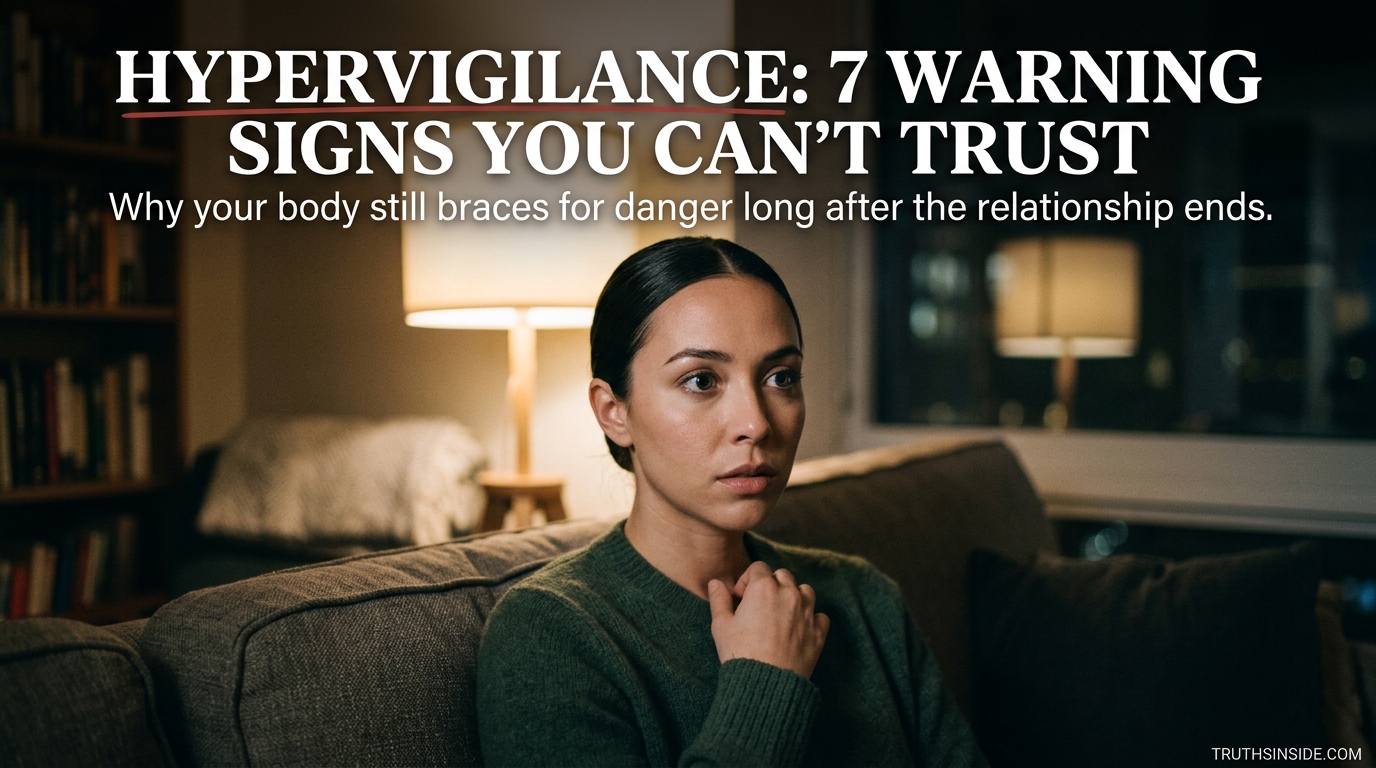
You check your phone the second it buzzes, heart already racing before you’ve read the message. You replay a partner’s tone of voice for hours, searching for signs of anger you might have missed. This isn’t paranoia. It’s a trauma response called hypervigilance, and research on complex trauma shows the nervous system can remain in a heightened threat-detection state for months or even years after leaving an unsafe relationship. If you feel like you can never fully relax around people you care about, you’re not broken. Your brain is doing exactly what it learned to do to survive.
This heightened alertness after a toxic relationship often gets mistaken for anxiety, overthinking, or being “too sensitive.” In reality, it’s a survival adaptation. When you spent months or years in a relationship where calm moments could shift into conflict without warning, your nervous system adapted by staying alert at all times, scanning for danger even in safe situations. That adaptation kept you prepared during the relationship. The problem is that it doesn’t automatically switch off once the relationship ends.
This article breaks down what hypervigilance actually is, why it lingers long after a toxic relationship, and what psychologists say actually helps calm an overactive nervous system. If you’ve been wondering why trusting a new partner, or even trusting yourself, feels impossible right now, this response is very likely part of the answer. Understanding it is the first step toward loosening its grip.
What Hypervigilance Really Is
Hypervigilance is a heightened state of sensory sensitivity designed to detect potential threats. In a toxic relationship, threats weren’t always obvious. They could be a shift in tone, a long pause before a reply, a change in body language. Because danger was unpredictable, your brain learned to monitor everything, all the time. Psychologists describe this as the nervous system’s attempt to prevent being caught off guard again. It’s exhausting, but it made sense inside the relationship where it developed.
The difficulty is that this heightened state doesn’t recognize when the danger has actually passed. Long after you’ve left a toxic relationship, your body may still respond to safe situations, like a partner going quiet during dinner, as if they were dangerous. This is why hypervigilance so often gets mistaken for trust issues or overreacting. It isn’t a character flaw. It’s a nervous system still running old survival software in a new, safer environment that it hasn’t yet learned to recognize as safe.
📃 Related article: Splitting in Relationships: 5 Alarming Warning Signs
Why the Nervous System Stays on Alert
Trauma researchers point to the body’s stress response system as the mechanism behind this ongoing alertness. Repeated exposure to unpredictable emotional threat trains the brain’s alarm center to activate faster and stay activated longer. Even after the relationship ends, this system can remain sensitized, meaning it takes very little to trigger a full threat response: a raised voice nearby, a delayed text, silence during an argument. None of these are inherently dangerous, but to an alarmed nervous system, they can feel identical to real danger.
This is also why hypervigilance often intensifies rather than fades immediately after leaving a toxic relationship. With the constant threat removed, the nervous system sometimes becomes even more sensitive as it processes everything it suppressed to survive day to day. Many people describe feeling worse in the months right after leaving, not because the relationship is still happening, but because their body finally has space to fully register what it endured. Understanding this timeline can make the intensity of the response feel less alarming and more like a predictable part of healing.

Signs You’re Experiencing Hypervigilance
Hypervigilance shows up differently for everyone, but certain patterns are especially common after a toxic relationship. Many people notice they scan a new partner’s face or tone constantly, searching for early warning signs of anger or withdrawal. Others describe an inability to relax even during genuinely peaceful moments, as if calm itself feels suspicious. Sleep disturbances, a racing heart triggered by minor conflict, and an exaggerated startle response to loud noises or sudden movements are also common signs of this trauma response rooted in relational harm.
Another lesser-known sign is emotional preemption, apologizing before you’ve done anything wrong, or trying to manage a partner’s mood before they’ve even expressed one. This developed as a survival skill, a way to prevent conflict before it started. In a safe relationship, this pattern often creates confusion, since there’s no real threat to preempt. Recognizing hypervigilance as the root cause, rather than assuming something is wrong with you or your new relationship, is often the turning point in beginning to heal.
“I kept apologizing for things that hadn’t happened yet. I was bracing for a fight that wasn’t coming, because for years, it always did.”
The Difference Between Hypervigilance and Healthy Caution
It’s important to distinguish this response from reasonable caution after a painful relationship. Healthy caution means taking time to build trust, noticing genuine red flags, and pacing intimacy based on someone’s actual behavior. This reaction, by contrast, treats neutral or even positive behavior as though it were threatening, regardless of the actual evidence in front of you. A partner being quiet after a long day isn’t automatically a red flag. An alarmed nervous system may interpret it as one anyway.
The key difference lies in proportionality. Healthy caution adjusts as trust is built over time. Hypervigilance often stays at the same intensity regardless of how safe a new relationship actually is, because it’s responding to the past rather than the present. Learning to notice this gap, between what’s actually happening and what your body is reacting to as if it’s happening, is one of the most effective tools for managing this pattern without dismissing genuinely valid instincts.

How Hypervigilance Affects New Relationships
This heightened alertness can quietly sabotage relationships that are actually safe. Constant scanning for threat creates chronic tension, both for the person experiencing it and for the new partner, who may sense the anxiety without understanding its source. Some people withdraw preemptively to avoid getting hurt again, while others become overly accommodating, trying to control every variable to prevent conflict before it can start. Both patterns are understandable trauma responses, but both also make it harder to experience the safety that’s actually available.
New partners sometimes misread hypervigilance as mistrust of them personally, which can create friction in an otherwise healthy relationship. This is why naming it out loud, explaining that your nervous system is still adjusting rather than reacting to something they’ve done, can be an important act of communication. It doesn’t put the responsibility of healing on a new partner, but it does help both people understand what’s actually happening beneath the surface of an argument or a moment of withdrawal.
📃 Related article: Jealous Woman: 6 Hidden Signs She Won’t Admit It
Steps to Calm Hypervigilance and Rebuild Trust
Healing this response isn’t about forcing yourself to feel safe through willpower. It’s about slowly teaching your nervous system, through repeated evidence, that the danger has actually passed. Somatic practices like grounding techniques, deep breathing, and body-based therapy such as EMDR or somatic experiencing are frequently recommended by trauma specialists because hypervigilance lives in the body, not just the mind. Talking through the trauma matters, but so does retraining the physical alarm system underneath it.
Consistency from safe people also plays a major role in reducing this heightened state over time. Every time a new partner does what they say they’ll do, stays calm during a disagreement, or responds gently instead of defensively, it becomes a small piece of counter-evidence for a nervous system that expects the opposite. This process is slow and rarely linear. Progress often means fewer and shorter episodes of this response, not the complete disappearance of it. Working with a trauma-informed therapist can significantly accelerate this process, especially when it’s rooted in prolonged emotional or psychological abuse.
“Healing wasn’t about never feeling scared again. It was about noticing the fear, and then noticing that nothing bad actually happened.”
Self-compassion is often the missing piece in recovering from hypervigilance. Many people judge themselves harshly for reacting strongly to situations that objectively aren’t dangerous, which only adds shame on top of an already exhausted nervous system. Treating this response as a logical adaptation to what you survived, rather than a flaw to eliminate through frustration, tends to produce faster, gentler progress. Your nervous system adapted to protect you. It deserves patience, not punishment, while it learns that it’s finally safe to stand down.

Frequently Asked Questions
Is hypervigilance the same as anxiety?
They overlap but aren’t identical. Anxiety is a broader response to perceived future threat, while this pattern specifically involves constant environmental and emotional scanning learned from repeated real danger, often within a relationship.
How long does hypervigilance last after a toxic relationship?
There’s no fixed timeline. For some, it eases within months with consistent safety and support. For others, especially after prolonged abuse, this response can persist for years without targeted trauma treatment.
Can hypervigilance go away completely?
Many people experience significant reduction with therapy, safe relationships, and nervous system-focused practices, though occasional flare-ups during stress are common even after substantial healing.
Is it normal to feel hypervigilant in a healthy relationship?
Yes, especially early in recovery. A safe relationship doesn’t erase this response instantly. It provides the repeated safe experiences needed to gradually retrain a nervous system shaped by past danger.
What’s the fastest way to calm hypervigilance in the moment?
Grounding techniques, like naming five things you can see or focusing on slow, deliberate breathing, can help interrupt an active response by signaling safety to the nervous system in real time.
Final Thoughts
Hypervigilance after a toxic relationship isn’t a sign that something is wrong with you. It’s evidence of what you survived, and it can soften with time, safety, and support. If this article helped you understand what you’ve been experiencing, save it for later, share it with someone healing from the same thing, and follow Truthsinside.com for more research-backed psychology content.
🎵 Music
Maren Lull is a singer-songwriter who writes from the places most people don’t talk about out loud.
Not the dramatic grief. Not the obvious heartbreak. The quiet kind — the ordinary Tuesday emptiness, the habit of reaching for someone who isn’t there anymore, the particular exhaustion of being strong for so long that the strength itself wears thin.
Her music lives at the intersection of emotional honesty and soft beauty — breathy vocals over gentle piano, slow tempos, lyrics that feel less like songs and more like something you wrote in a private notebook at two in the morning and never showed anyone.
Maren Lull writes for the people who feel everything deeply and say very little about it. For the ones who listen to sad music not because they want to feel worse — but because being understood, even by a song, makes the feeling easier to carry.
📱 Follow Maren Lull:
→ Spotify
→ Apple Music
→ Youtube
→ Audiomack