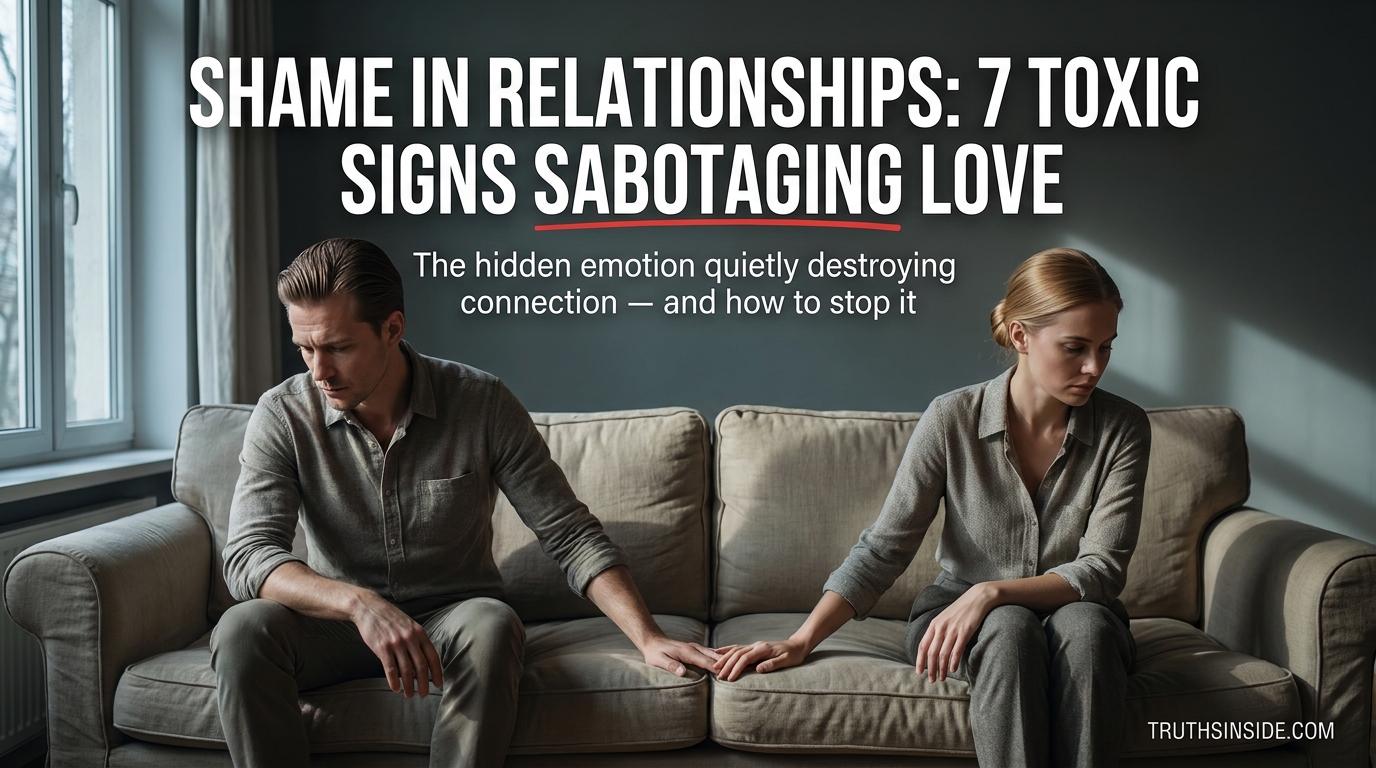
Maria used to apologize for things that weren’t wrong. A wrong tone of voice, a delayed text reply, an opinion that didn’t match her partner’s — each one triggered a wave of self-blame she couldn’t explain. What she was experiencing had a name, and it wasn’t guilt. It was shame in relationships, a pattern researchers say quietly erodes more partnerships than infidelity or financial stress combined.
According to shame researcher Dr. Brené Brown, shame convinces a person that they are fundamentally flawed and therefore unworthy of love and belonging — a belief that, left unaddressed, becomes one of the most corrosive forces in intimate partnerships. Unlike guilt, which says “I did something bad,” shame says “I am something bad.” That single distinction is often the difference between a couple that repairs after conflict and one that slowly disconnects.
This article breaks down exactly how shame in relationships develops, the signs it’s already present in your own connection, and the psychological tools that help couples move from hiding to healing.
WHAT IS SHAME IN RELATIONSHIPS?
Shame in relationships is the internalized belief that you are unlovable, inadequate, or fundamentally flawed — and that if your partner truly saw you, they would leave. It differs from embarrassment, which fades quickly, and from guilt, which is tied to a specific behavior. Shame attaches itself to identity. It doesn’t say “I made a mistake.” It says “I am a mistake.”
In a relationship, this belief doesn’t stay contained inside one person. It leaks outward. A partner carrying unprocessed shame often preemptively defends, withdraws, or attacks before vulnerability can even happen — because vulnerability feels like exposure, and exposure feels dangerous. Over time, shame in relationships becomes a silent third presence in the room, shaping how both people communicate, argue, and connect.
Psychologists studying attachment note that shame typically originates early, often in childhood environments where love felt conditional on performance, obedience, or emotional restraint. Those early blueprints don’t disappear in adulthood — they resurface in romantic partnerships, often triggered by moments that mimic old wounds: criticism, rejection, or perceived disappointment from a partner.
📃 Related article: Causes of Divorce: 7 Silent Reasons Marriages Fail
THE PSYCHOLOGY BEHIND SHAME IN RELATIONSHIPS
How Shame Hijacks the Nervous System
Shame is not just an emotional experience — it’s a physiological one. According to polyvagal theory, developed by neuroscientist Dr. Stephen Porges, the nervous system constantly scans for cues of safety or threat, a process called neuroception. When shame activates, the body often responds as though it’s in physical danger, triggering fight, flight, freeze, or fawn responses even during ordinary relationship disagreements.
This explains why a seemingly small comment — “You forgot again?” — can trigger a disproportionately large reaction. The nervous system isn’t just responding to the sentence. It’s responding to an old, familiar feeling: not being enough. This is the mechanism that makes shame in relationships so difficult to talk through logically. The body has already reacted before the mind catches up.
Attachment Wounds and Shame in Relationships
Attachment theory offers another lens. People with anxious attachment styles often experience shame as a fear of abandonment — believing that if they aren’t perfect, their partner will leave. People with avoidant attachment styles often experience shame as a fear of exposure — believing that closeness will reveal flaws they’ve spent a lifetime hiding. Both patterns feed shame in relationships, just from opposite directions.
“Shame doesn’t just make people hide from their partner. It makes people hide from themselves — and that’s the harder wound to heal.”
Understanding which attachment pattern is active in a relationship helps explain why the same argument seems to repeat endlessly. It isn’t about the dishes or the missed phone call. It’s about an old fear being reactivated in a new context.

SIGNS OF SHAME IN RELATIONSHIPS
Shame rarely announces itself directly. It shows up disguised as other behaviors, which is why so many couples miss it entirely. Below are the most common signs of shame in relationships.
1. Chronic Defensiveness
When feedback — even gentle feedback — is consistently met with justification, counter-blame, or irritation, shame is often the underlying driver. Defensiveness protects against the unbearable feeling of being “found out” as inadequate.
2. Emotional Withdrawal After Conflict
Rather than repairing after an argument, a partner disappears emotionally — going quiet, avoiding eye contact, or physically leaving the room. This isn’t always anger. It’s frequently shame in relationships manifesting as self-protective retreat.
3. Difficulty Accepting Compliments or Affection
When kindness feels unbearable to receive, and a partner deflects praise or affection with jokes, dismissal, or discomfort, it often signals a belief that they don’t deserve it.
4. Over-Apologizing
Constant, reflexive apologizing — even for things outside one’s control — is a hallmark of internalized shame. It’s less about accountability and more about trying to preempt rejection.
5. Secrecy Around Mistakes
Hiding small errors, minor spending, or minor missteps out of fear of a partner’s reaction (rather than the mistake itself) points to shame in relationships operating beneath the surface.
HOW SHAME IN RELATIONSHIPS FUELS DYSFUNCTION
Relationship researcher Dr. John Gottman identified defensiveness, criticism, contempt, and stonewalling as the strongest predictors of relationship breakdown — what he termed the “Four Horsemen.” Shame is frequently the emotional fuel behind all four. A person who feels fundamentally flawed is far more likely to respond to conflict with defensiveness or withdrawal, because the stakes don’t feel like “we disagree.” They feel like “I might be unlovable.”
This is where shame in relationships becomes cyclical. One partner’s shame triggers withdrawal. The other partner, feeling shut out, escalates to get a reaction — which triggers more shame, and more withdrawal. Neither person is trying to destroy the relationship. Both are trying to protect themselves from an old, painful belief. But without awareness, the cycle repeats indefinitely, and intimacy erodes a little more with each round.
Over time, unresolved shame in relationships can also manifest as controlling behavior, jealousy, or emotional volatility — not because the ashamed partner wants control, but because vulnerability feels too dangerous to risk. Control becomes a substitute for safety. This is one reason shame is so often mistaken for other issues, like trust problems or communication breakdowns, when the deeper driver remains hidden.

BREAKING THE CYCLE OF SHAME IN RELATIONSHIPS
Healing shame in relationships doesn’t happen through logic alone — it requires rebuilding a felt sense of safety. Below are approaches supported by relationship and trauma-informed research.
Name the shame out loud. Simply saying “I think I’m reacting from shame right now” interrupts the automatic defensive response and invites a different kind of conversation.
Practice self-compassion, not self-criticism. Research from psychologist Dr. Kristin Neff shows that self-compassion — treating oneself with the same kindness offered to a friend — reduces shame far more effectively than self-punishment.
Slow down before reacting. Because shame activates the nervous system’s threat response, taking a pause — even 20 minutes — allows the body to return to a calmer state before continuing a difficult conversation.
Seek therapy, individually or as a couple. Approaches like Emotionally Focused Therapy (EFT) and Cognitive Behavioral Therapy (CBT) are specifically effective at helping partners recognize and rewire shame-driven patterns.
Build a repair ritual. Couples who explicitly practice repairing after conflict — through a short check-in, a physical gesture, or a verbal acknowledgment — report significantly stronger relationship satisfaction over time, according to Gottman Institute research.
“You cannot love your way out of shame. You have to feel safe enough to be seen first — and love grows from there.”
Recognizing shame in relationships isn’t about assigning blame to one partner. It’s about understanding that both people are often operating from old wounds, reacting to present-day moments as if they were past ones. The goal isn’t to eliminate shame overnight — it’s to build enough safety that shame no longer runs the relationship from the shadows.

FREQUENTLY ASKED QUESTIONS
Is shame the same as guilt in a relationship?
No. Guilt says “I did something wrong,” while shame says “I am something wrong.” Shame in relationships is tied to identity, not behavior, which makes it far harder to resolve through apology alone.
Can shame in relationships be unlearned?
Yes. With consistent self-awareness, therapy, and relational safety, people can rewire shame-driven patterns over time. It requires patience, but the nervous system can learn new responses.
Why does my partner shut down instead of talking when we argue?
Withdrawal is often a protective response to shame, not a sign of not caring. The nervous system perceives conflict as a threat and defaults to self-protection rather than connection.
How do I bring up shame without sounding accusatory?
Use “I” language and curiosity rather than diagnosis — for example, “I notice I shut down when I feel criticized, and I want to understand that better,” rather than labeling a partner’s behavior for them.
Does therapy actually help with shame in relationships?
Yes. Modalities like EFT and CBT are specifically designed to identify shame triggers and build healthier communication and emotional regulation patterns between partners.
If this helped you understand your own relationship patterns a little better, save this article to revisit it later, share it with someone who needs to hear it, and follow Truthsinside.com for more research-backed relationship and psychology content.
🎵 Music
Maren Lull is a singer-songwriter who writes from the places most people don’t talk about out loud.
Not the dramatic grief. Not the obvious heartbreak. The quiet kind — the ordinary Tuesday emptiness, the habit of reaching for someone who isn’t there anymore, the particular exhaustion of being strong for so long that the strength itself wears thin.
Her music lives at the intersection of emotional honesty and soft beauty — breathy vocals over gentle piano, slow tempos, lyrics that feel less like songs and more like something you wrote in a private notebook at two in the morning and never showed anyone.
Maren Lull writes for the people who feel everything deeply and say very little about it. For the ones who listen to sad music not because they want to feel worse — but because being understood, even by a song, makes the feeling easier to carry.
📱 Follow Maren Lull:
→ Spotify
→ Apple Music
→ Youtube
→ Audiomack