When Love Becomes an Obsession: The Line Between Passion and Fixation
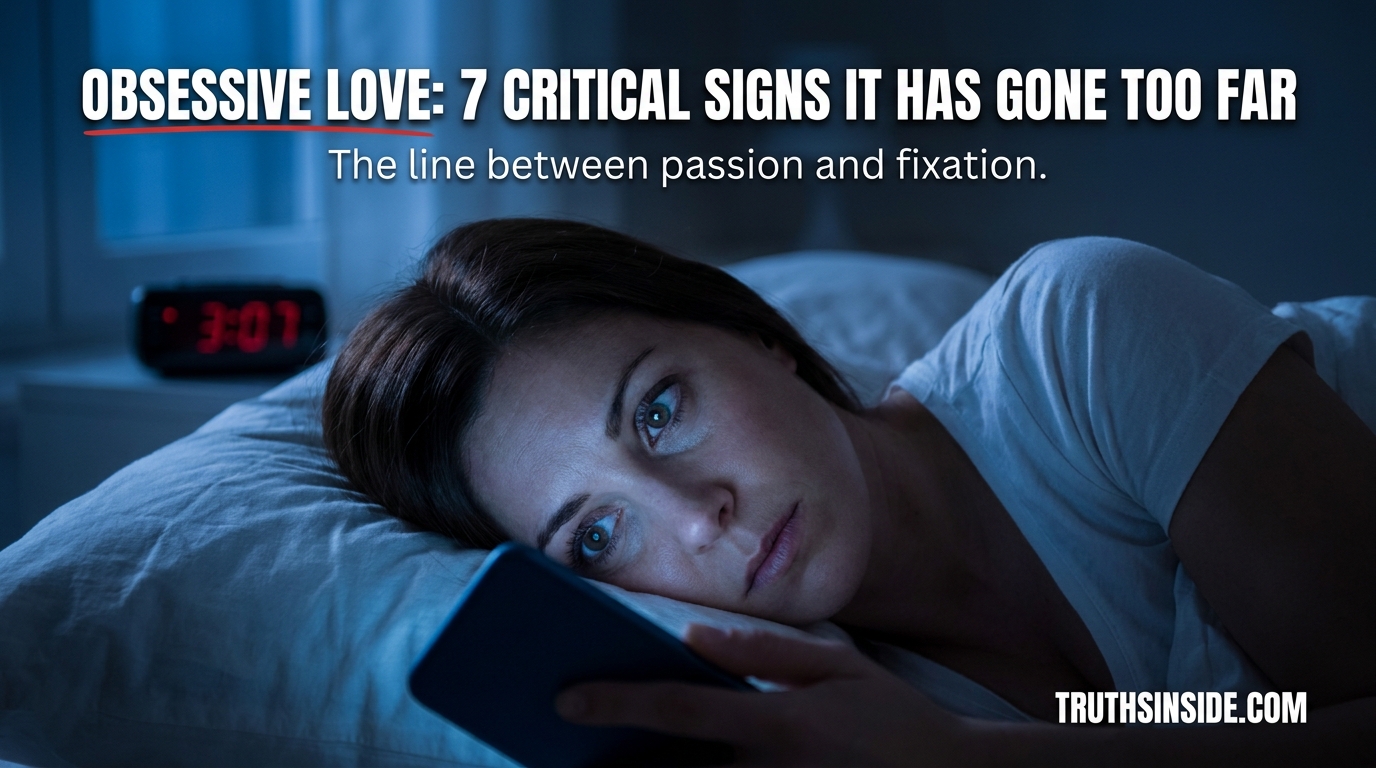
Obsessive love often starts as the most beautiful thing you have ever felt. Your heart races at their name, you replay every conversation, and the world seems brighter whenever they are near. Then, slowly, brightness turns into hunger. You cannot concentrate, cannot sleep, and cannot stop checking whether they have texted. You wonder whether this is deep passion or something that has quietly taken over your life.
The science explains why the line is blurry. In a 1999 study, psychiatrist Donatella Marazziti found that people who were newly in love showed serotonin-transporter levels similar to those seen in people with obsessive-compulsive disorder. In other words, the early stage of romance can look a lot like obsession in the brain. The difference is what happens next: whether the intensity settles into connection or hardens into fixation.
This guide explains obsessive love, how it differs from healthy passion, and the seven critical warning signs that love has gone too far. You will learn what drives it, how it relates to limerence and attachment, how to break free, and when to seek help. Whether you are the one feeling consumed or you are on the receiving end, you will find practical, compassionate guidance.

Passion vs. Obsession: Where Is the Line?
Passion is not the problem. Intense feelings, longing, and desire are part of healthy love. Psychologist Robert Sternberg’s triangular theory of love lists passion as a core ingredient alongside intimacy and commitment. The question is not how strongly you feel. It is whether your feelings add to your life or take it over.
Researcher Robert Vallerand distinguishes between harmonious passion and obsessive passion in his work on motivation. Harmonious passion fits comfortably within your life, while obsessive passion feels uncontrollable and pushes out other priorities. Although he studied activities rather than relationships, the idea maps well onto love: healthy passion enriches you, and obsession consumes you.
| Healthy Passion | Obsessive Love |
|---|---|
| You feel excited and secure | You feel anxious and desperate |
| Your life stays full and balanced | Your life shrinks around one person |
| You trust and respect their freedom | You monitor, test, or try to control |
| You can handle time apart | Distance feels unbearable |
| Rejection hurts, but you recover | Rejection feels like the end of the world |
| You see the real person | You idealize and ignore red flags |
Nearly everyone touches the right-hand column sometimes, especially at the start of a relationship or after a breakup. The concern is intensity, duration, and loss of control.
What Is Obsessive Love?
Obsessive love is an intense, consuming preoccupation with another person, often involving constant thoughts, a strong need for reassurance or reciprocation, and difficulty accepting distance or rejection. It is not an official medical diagnosis, but psychologists recognize the pattern and often describe it through related ideas such as anxious attachment, limerence, and obsessive relational intrusion.
Obsessive love can happen inside a relationship, after a breakup, or toward someone who barely knows you. It can feel like deep love from the inside, but it is often driven by fear: fear of abandonment, fear of being alone, or fear that your worth depends on being chosen.
Understanding this does not mean your feelings are fake. It means that intensity and love are not the same thing, and that you can feel deeply without letting those feelings run your life.
Why Love Feels Like an Obsession: The Psychology
Several forces combine to make fixation feel like destiny.
Brain Chemistry in the Early Stages
Brain-imaging research by Helen Fisher and colleagues found that intense early love activates reward regions rich in dopamine, the same systems involved in motivation and craving. Combined with the serotonin changes described by Marazziti, this can create a state of focus, longing, and intrusive thought that feels irresistible.
Limerence
Psychologist Dorothy Tennov coined the term limerence in 1979 to describe an involuntary state of intense romantic desire marked by intrusive thoughts, idealization, and a powerful need for the other person’s response. Limerence can fade, or it can persist, especially when the feelings are not returned or are only partly returned.
Attachment Anxiety
People with an anxious attachment style tend to fear abandonment and seek closeness and reassurance intensely. When a partner seems distant, their attachment system fires an alarm, driving behaviors like checking, calling, and ruminating. Research links attachment anxiety with greater jealousy and preoccupation, although not everyone with this style becomes obsessive.
Low Self-Worth and Unmet Needs
When someone feels empty, lonely, or unworthy, another person can seem like the solution to everything. The relationship becomes a source of identity and safety, so any threat to it feels catastrophic.
Uncertainty and Intermittent Reward
Unpredictable affection, hot-and-cold behavior, and unclear commitment can intensify fixation. When you never know whether you will receive love, your mind keeps searching for answers.
📃 Related article: Possessive Partner: 7 Shocking Red Flags to Spot
7 Critical Warning Signs That Obsessive Love Has Taken Over
Everyone has moments of overwhelming feeling. These signs matter when they are persistent, distressing, and hard to control.
1. You Cannot Stop Thinking About Them
Thoughts of the person dominate your day, intrude at work, and keep you up at night. You replay conversations, imagine scenarios, and search for hidden meaning in small gestures. You may feel that you cannot control where your attention goes.
Missing someone is normal. The warning sign is when the thoughts feel compulsive and distressing, and when you spend hours each day caught in them.
2. Your Self-Worth Depends on Their Attention
A kind message lifts you. A delayed reply crushes you. You feel valuable when they approve and worthless when they do not. Obsessive love ties your sense of self to another person’s reactions, which makes you vulnerable to every shift in their mood.
This is exhausting, because no one can be responsible for another person’s self-esteem. Healthy love adds to your sense of worth. It should not be the only thing holding it up.
3. Intense Jealousy and the Urge to Monitor
You check their social media, track when they were last online, or question who they talk to. The urge feels urgent and irrational at the same time. Jealousy is common, but obsessive love turns it into surveillance, which damages trust and increases anxiety for both people.
If checking brings only brief relief, followed by more doubt, you may be caught in a loop where the behavior feeds the fear.
4. You Neglect Your Own Life
Friends, hobbies, work, and basic self-care slip away. You cancel plans in case they call. Your schedule revolves around their availability. Over time, your world shrinks until the relationship, or the hope of one, is almost everything.
A healthy relationship should leave room for the rest of your life. When it replaces your life, it becomes fragile, because everything you have rests on one person.

5. You Cannot Tolerate Distance or Rejection
A short separation triggers panic. A boundary feels like a threat. You may react to distance with anger, pleading, or dramatic gestures. If the person ends the relationship, you may feel unable to accept it and keep trying to reconnect.
Pain after rejection is normal. Obsessive love turns it into a crisis that demands immediate resolution. The inability to accept “no” is one of the most important warning signs.
6. You Idealize Them and Ignore Reality
You see the person as perfect, destined, or uniquely able to save you. You dismiss red flags and make excuses for hurtful behavior. You may be in love with an image, built from a few moments and a lot of imagination.
Idealization protects the fantasy, but it blocks real intimacy. Real love needs the real person, including their flaws, limits, and independent choices.
7. You Cross Boundaries
You keep calling, messaging, or showing up after being asked to stop. You contact their friends, track their location, or use new accounts to reach them. At this point, the behavior is no longer just painful for you. It is harmful and frightening for them.
Repeatedly contacting or following someone who does not want it can be stalking, which is a crime in many places. If you recognize this in yourself, stop, step back, and seek professional help. No feeling justifies disregarding another person’s boundaries.
Love can be intense without being consuming. Passion adds to your life. Obsession takes it over.
Obsessive Love vs. Limerence vs. Relationship OCD
These terms overlap, but they are not identical.
Limerence
Limerence centers on longing for reciprocation, often with idealization and intrusive thoughts. It can occur with very little actual relationship, such as toward a coworker or an ex.
Relationship OCD
Relationship OCD involves intrusive doubts about a partner or relationship, such as “Do I love them enough?” and compulsive checking or reassurance seeking. Researchers like Guy Doron have studied it. It is driven by anxiety rather than longing, and a therapist who treats OCD can help.
Obsessive Love
Obsessive love is a broader description that can include any of these elements, plus controlling or intrusive behavior. Only a qualified professional can diagnose what is going on, but knowing the differences can help you describe your experience and find the right support.
What Obsessive Love Does to You
Living inside obsessive love is exhausting. Sleep suffers, anxiety rises, concentration drops, and mood swings become common. You may withdraw from friends, struggle at work, and feel ashamed of your own behavior. The emotional highs are short, and the lows are long.
It can also affect your sense of identity. The more you focus on one person, the less you recognize yourself. Many people describe feeling like a stranger, acting in ways that do not match their values. This is a sign that you need support, not a sign that you are a bad person.
How to Break Free From Obsessive Love: 7 Steps
Change is possible, even when your feelings seem unstoppable. These steps are small, but they add up.
1. Name It Without Shame
Say to yourself, “I am caught in obsessive love, and I can work on this.” Shame feeds the pattern, while curiosity helps. Write down what you feel and what you fear. Seeing it on paper can reduce its power.
2. Reduce Your Triggers
Mute or unfollow, delete message threads, and stop checking. It is hard, but each time you resist the urge, it weakens. If contact is not wanted, stop completely. If you share obligations, keep communication brief and practical.
3. Interrupt the Rumination
When thoughts loop, label them: “This is rumination.” Redirect to something absorbing, such as a walk, a call with a friend, or a task that needs focus. Try scheduling a short “worry window,” perhaps fifteen minutes a day, then move on when it ends.
4. Rebuild Your Life
Reconnect with friends, restart hobbies, and set small goals. A full life reduces the power of one person’s attention. Create simple routines for mornings and evenings, so that your day has structure that does not depend on anyone else.
5. Care for Your Body
Prioritize sleep, regular meals, movement, and limited alcohol. Slow breathing can calm the nervous system. A steadier body helps create a steadier mind, and it makes strong emotions easier to handle.
6. Practice Riding Out Urges
Urges to text, check, or seek reassurance rise and fall like waves. Notice the urge, breathe, and wait ten to twenty minutes before deciding what to do. Over time, your tolerance for uncertainty grows, and the urges lose some of their grip.
7. Get Professional Support
Therapy can help. Cognitive behavioral therapy, acceptance and commitment therapy, and attachment-based approaches are commonly used, and exposure and response prevention is a standard treatment for OCD-related patterns. A therapist can help you understand what drives your feelings and build healthier ways of relating.
How to Love Passionately Without Losing Yourself
The goal is not to love less. It is to love in a way that fits inside a full life. Keep your friendships, your work, and your interests. Share feelings openly rather than testing or demanding reassurance. Treat your partner as a whole person with their own freedom, and treat yourself the same way.
Build security from the inside. Practice self-compassion, tolerate small uncertainties, and let affection grow at a pace that feels steady. Passion rooted in trust can be deeply romantic and lasting, because it does not depend on fear.
If You Are on the Receiving End of Obsessive Love
Being the focus of someone’s obsession can feel flattering at first, then frightening. You are allowed to set clear boundaries. State your limits simply and calmly: “I do not want contact. Please do not message or call me.” Avoid mixed messages, replies that give hope, or continued engagement, because they can prolong the behavior.
Keep records of messages, calls, and incidents. Block contact where possible, tell trusted people, and consider speaking with an advocate or the police if the person continues, threatens you, or follows you. If you feel unsafe, trust that feeling. In the United States, the National Domestic Violence Hotline at 1-800-799-7233 can offer guidance, and in an emergency you should call 911.
Mistakes to Avoid When Love Becomes an Obsession
Trying to win them back with grand gestures. Dramatic efforts often increase pressure and can feel threatening to the other person.
Checking “just once.” One look rarely satisfies. It usually restarts the cycle.
Using other people to stay close. Asking friends for updates or contacting their circle keeps you stuck and can cross boundaries.
Numbing with alcohol or other substances. It may dull the pain briefly, but it worsens mood, sleep, and impulse control.
Rebounding to fill the void. A new person cannot heal what needs your own attention.
Staying in contact “as friends.” If the closeness keeps the obsession alive, space is a kindness to yourself.
Believing intensity proves true love. Calm, steady love is not less real. It is often more real.
📃 Related article: Emotionally Dependent? 7 Shocking Signs to Spot
When to Seek Professional Help
Reach out to a mental health professional if obsessive thoughts take hours of your day, you cannot stop contacting someone, your work or relationships are suffering, or you feel hopeless. Therapy is a strength, not a failure, and many people find real relief with the right support.
Helpful resources include:
- 988 Suicide & Crisis Lifeline (U.S.): call or text 988 if you feel hopeless or in crisis.
- SAMHSA National Helpline (U.S.): 1-800-662-4357 for free treatment referrals.
- International OCD Foundation: iocdf.org for information and provider directories.
- Outside the United States: findahelpline.com lists services by country.

Frequently Asked Questions About Obsessive Love
What is obsessive love?
Obsessive love is an intense, consuming preoccupation with another person, marked by constant thoughts, strong need for reassurance, jealousy, and difficulty accepting distance or rejection. It is not an official diagnosis, but it is a recognized pattern that can cause real distress.
Is obsessive love the same as real love?
No. Real love can be passionate, but it leaves room for freedom, trust, and a full life. Obsessive love is driven largely by fear and need, and it tends to bring anxiety, control, and loss of self rather than security.
Can obsessive love turn into stalking or abuse?
It can. When feelings lead to repeated unwanted contact, monitoring, or ignoring boundaries, the behavior can become harassment or stalking, and it can be frightening for the other person. If you notice this in yourself, stop contact and seek professional help.
How do I stop obsessing over someone?
Reduce triggers, interrupt rumination, rebuild your daily life, take care of your body, and practice waiting out urges. Support from a therapist can make a major difference, especially if the thoughts feel uncontrollable.
Can obsessive love be healed?
Yes. Many people recover with time, self-awareness, healthy routines, and professional support. Therapy can address underlying fears, attachment patterns, and anxiety, and help you build relationships that feel secure rather than consuming.
Final Thoughts
Obsessive love can feel like the deepest love you have ever known, but depth and desperation are not the same thing. Real passion fits inside a life you also care for. If you see yourself in these signs, be gentle with yourself. Notice the pattern, rebuild your world, and reach for support. You can love fully and still remain whole.
💾 Save this guide so you can return to it on a hard day.
📤 Share it with someone who may be struggling with an all-consuming love.
➕ Follow Truthsinside.com for more honest relationship and psychology insights every week.
🎵 Music
Maren Lull is a singer-songwriter who writes from the places most people don’t talk about out loud.
Not the dramatic grief. Not the obvious heartbreak. The quiet kind — the ordinary Tuesday emptiness, the habit of reaching for someone who isn’t there anymore, the particular exhaustion of being strong for so long that the strength itself wears thin.
Her music lives at the intersection of emotional honesty and soft beauty — breathy vocals over gentle piano, slow tempos, lyrics that feel less like songs and more like something you wrote in a private notebook at two in the morning and never showed anyone.
Maren Lull writes for the people who feel everything deeply and say very little about it. For the ones who listen to sad music not because they want to feel worse — but because being understood, even by a song, makes the feeling easier to carry.
📱 Follow Maren Lull:
→ Spotify
→ Apple Music
→ Youtube
→ Audiomack