
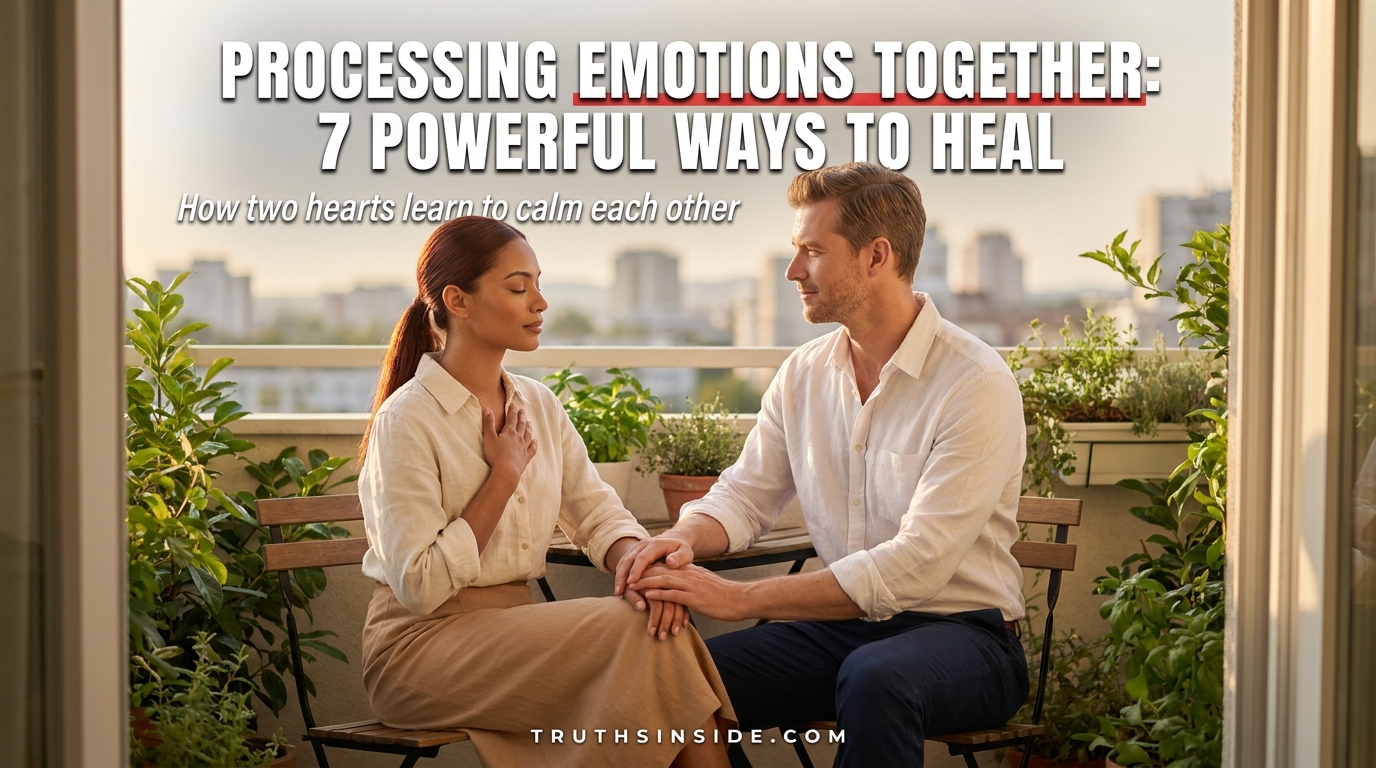
Processing Emotions Together: How Couples Can Regulate Each Other
Processing emotions together is one of the most underrated skills in love, yet most of us were taught to handle big feelings alone. If you have ever swallowed tears in the bathroom, gone silent in the middle of an argument or felt your partner’s anxiety wash over the entire room, you already know how deeply two hearts affect each other.
Science backs that feeling up. In a well-known brain imaging study, women anticipating a mild electric shock showed calmer threat responses when holding their husband’s hand, especially in happier marriages. Comfort from someone you trust can change how your brain handles stress.
This guide explains how couples can help each other regulate, why it often feels hard, and seven practical ways to begin processing emotions together tonight, without fixing, fighting or fading away.
What Does Processing Emotions Together Really Mean?
Psychologists describe two ways we calm down. Self-regulation is what you do alone: breathing, walking, journaling or telling yourself to settle. Co-regulation is what happens between people, when one nervous system helps another return to balance through presence, tone, touch and words. Processing emotions together uses both.
It does not mean one partner manages the other’s feelings. You cannot, and should not, be responsible for your partner’s every mood. Healthy co-regulation is more like leaning on a sturdy railing than carrying someone up the stairs. You each stay on your own feet, and you each let the other steady you.
It also differs from emotional dumping, where one person unloads without caring how it lands, and from emotional merging, where partners absorb each other’s panic until nobody is calm. When you practice processing emotions together well, there is room for both people’s feelings, and a shared goal of returning to safety and closeness.

The Science Behind Processing Emotions Together
The hand-holding study points to a broader idea called social baseline theory. It suggests the human brain expects to have trusted people nearby, and treats them as a resource for coping. When a safe person is close, the brain seems to spend less effort on threat, so hard moments feel more manageable. Processing emotions together taps into that built-in design.
Another useful finding comes from brain imaging research at UCLA, which showed that putting feelings into words tends to calm the brain’s alarm center. Saying “I feel scared and ashamed” does more than describe the moment. It changes the moment. When a caring partner helps you find those words, the effect can be even gentler.
Relationship researcher John Gottman also described how stress can flood the body. When the heart rate climbs high during conflict, thinking narrows, empathy drops and people say things they regret. Therapists in Emotionally Focused Therapy, developed by Sue Johnson, teach couples to notice this cycle and to turn toward each other instead of attacking or retreating. Together, these ideas explain why processing emotions together is not soft or optional. It is practical biology.
📃 Related article: CBT for Relationships: 7 Proven Ways to Heal
Why Processing Emotions Together Feels So Hard
Many of us learned early that feelings were too big, too messy or too inconvenient. If a parent changed the subject when you cried, or punished anger and ignored fear, you may have concluded that emotions are best handled alone. As adults, that lesson shows up as a partner who “has no feelings” or one who feels everything and fears being too much.
Differences in style add friction. One partner may want to talk right away, while the other needs quiet to settle. The pursuer feels abandoned, the withdrawer feels pressured, and both end up more dysregulated. Without a shared plan, processing emotions together turns into a tug-of-war instead of a team effort.
There is also the fear of burdening each other. Many people hide pain to “protect” their partner, and then feel lonely inside the relationship. Others rush to fix problems because watching someone suffer feels unbearable. Recognizing these patterns without blame is the first step. Neither style is wrong, but both can learn new moves.
Love is not the absence of hard feelings. It is having someone to feel them with.
7 Powerful Ways to Practice Processing Emotions Together
These seven habits work best as a set, but even one can shift an evening. Try them when emotions are moderate, so the skills feel familiar when emotions run high.
1. Check Your Own State First
You cannot calm another person while your own system is racing. Before responding, scan your body: Is your jaw tight? Is your breathing shallow? Take one slow breath and tell yourself, “I can stay present.” This tiny pause is the foundation of processing emotions together, because a steadier you becomes a steadier room.
2. Slow Your Breathing Together
Breath is the quickest bridge between two nervous systems. Sit close, rest a hand on each other’s shoulder or back, and breathe so that your exhale is a little longer than your inhale. A longer exhale tends to activate the body’s relaxation response. Many couples find their breathing naturally begins to match, which can feel surprisingly intimate and calming.
3. Use Safe, Welcome Touch
Touch can be a powerful regulator, but only when it is wanted. Ask first: “Would a hug help, or would you rather have space?” Holding hands, a hand on the back or a long, quiet hug can lower tension for many people. Respecting a “not right now” is just as loving, and it builds the safety that makes processing emotions together possible.
4. Name the Feeling
Help each other find specific words. Instead of “I’m upset,” try “I feel overlooked and a little embarrassed.” Partners can offer gentle guesses: “Does it feel like disappointment?” Naming does not make the feeling disappear, but it gives it edges. Feelings that have names tend to be easier to carry and easier to share.
5. Validate Before You Problem-Solve
Most people want to be understood before they want advice. Try: “That makes sense, given how hard your week has been.” Validation does not mean you agree with every conclusion. It means you recognize the feeling as real. Once someone feels heard, their system settles, and problem-solving becomes much more productive.
6. Pause With a Promise to Return
If emotions are too intense, a break helps. Gottman’s research suggests that at least twenty minutes is usually needed for the body to calm. Say, “I am getting overwhelmed and I want to do this well. Can we pause for thirty minutes and come back?” The return promise turns a pause into care instead of abandonment.
7. Repair and Reconnect
After the storm, close the loop. Apologize for specific moments, ask “What do you need from me right now?” and share one appreciation. Repair is the hinge of processing emotions together, because it shows that conflict does not break the bond. Couples who repair quickly build a deep sense that their relationship is a safe harbor.

A 10-Minute Ritual for Processing Emotions Together
Rituals make skills automatic. This simple check-in takes about ten minutes and works well in the evening, away from screens. Sit close, silence your phones and agree that the goal is understanding, not winning.
Start with two minutes of arrival: breathe together and notice the day’s tension leaving your shoulders. Then one partner speaks for about three minutes about a feeling, using “I” language such as “I felt anxious when the schedule changed.” The listener only reflects, saying things like “It sounds like you felt unsupported.” No advice, no defending.
Switch roles for another three minutes. Close with two minutes of appreciation, naming one thing your partner did that helped. This structure protects both people from interruptions and keeps processing emotions together predictable and safe. Many couples find that the ritual shrinks their big arguments, because feelings no longer pile up unspoken.

Processing Emotions Together in Real Life: Nora and Ben
Nora comes home tense after a stressful meeting. Ben, who loves solving problems, immediately offers five solutions. Nora snaps, “I do not need a plan.” Ben feels criticized and goes quiet. Within minutes, both are dysregulated, and the evening is headed for a familiar cold war.
This time, Ben catches himself. He takes a slow breath, softens his voice and asks, “Do you want comfort or ideas right now?” Nora exhales and says, “Comfort.” He sits beside her, rests a hand on her back and says, “That sounds exhausting.” Nora’s shoulders drop, and her eyes fill with tears she did not realize she was holding.
Ten minutes later, she is ready for ideas, and Ben’s suggestions land as help instead of criticism. Nothing about her day changed. What changed was that she did not face it alone. That is the quiet magic of processing emotions together: the same problem feels lighter when it is shared.
Small Daily Habits for Processing Emotions Together
You do not need a crisis to practice. The strongest regulation skills grow in ordinary moments, when stakes are low and your bodies are calm enough to learn. Think of these habits as brushing your teeth: small, regular and quietly protective.
Start with a warm reunion. When you reconnect after work, spend the first minute greeting each other fully, with a real hug and a real look, before logistics begin. This brief ritual tells both nervous systems that the person at the door is safe. Add a midday message that has no task in it, only care, such as “Thinking of you, hope the meeting goes well.”
End the day with a short reflection. Ask, “What was the hardest part of today, and what was the best part?” Listening without fixing is a simple way of processing emotions together before small stresses harden into resentment. Five minutes of this each night can prevent hours of tension later.
Mistakes That Block Processing Emotions Together
Even loving couples fall into patterns that make things worse. Knowing them helps you catch them early.
Fixing Too Fast
Jumping straight to solutions can feel like dismissal. People often need to feel heard first. Ask what kind of support is wanted before offering advice.
Minimizing or Rushing
“It’s not a big deal” or “Calm down” tells your partner their feeling is wrong. Telling anyone to calm down rarely calms them. Try “I am here, and I want to understand.”
Mirroring the Panic
Emotions are contagious. If your partner is anxious and you become anxious too, nobody is steady. Your job is not to match the storm, but to be a calmer presence nearby.
Using Feelings as Ammunition
Bringing up vulnerable confessions later in a fight destroys trust. Processing emotions together requires that what is shared in softness is never turned into a weapon in anger.
Different Emotional Styles, One Team
Couples often differ in how they handle emotion. Some people think out loud, others need silence. Some turn toward closeness when stressed, others move away. Neither style is a character flaw. Talk about these differences when you are calm, and build a plan that respects both.
For example, you might agree that the quieter partner signals, “I need twenty minutes, then I want to talk,” while the more expressive partner agrees to give the space without chasing. In return, the withdrawing partner promises to return. Agreements like these make processing emotions together feel safe for both nervous systems.
Be patient with your own history, too. If you grew up around chaos or neglect, closeness may trigger alarm even when your partner is kind. That response is understandable, not shameful. Small steps, honest words and consistent safety help the body learn something new.
Calm is contagious, but so is care. Be the person your partner’s nervous system recognizes as home.
Processing Emotions Together During Big Life Stress
Major stress tests every couple. A job loss, a new baby, an illness, a move or the death of someone close can flood both partners at once, leaving nobody with spare calm to share. In these seasons, expect your usual skills to feel harder, and lower your expectations of yourselves.
Grief deserves special patience. Partners often grieve differently: one cries openly, the other keeps busy, and each may secretly worry the other does not care. Say it out loud: “We are both hurting, and we show it differently.” Naming the difference prevents misunderstandings and keeps processing emotions together from turning into a competition over who is coping correctly.
During heavy seasons, shrink the goal. A single hug, a shared walk or one honest sentence counts. Ask for help from friends, family or a counselor so that you are not each other’s only lifeline. Support from the wider community gives the relationship room to breathe, and makes it easier to be gentle with each other.
When Processing Emotions Together Needs Extra Support
Self-help has limits. If you experience persistent depression, anxiety, trauma reactions, panic or substance use, a licensed therapist can help far more than a book can. Couples therapy, especially approaches like Emotionally Focused Therapy, is designed to help partners work through patterns step by step with a guide.
If a relationship involves fear, threats, controlling behavior or violence, processing emotions together is not the right focus. Your safety comes first. In the United States, the National Domestic Violence Hotline is available at 1-800-799-7233. If you or someone you love is thinking about suicide, you can call or text 988 to reach the Suicide and Crisis Lifeline at any time.
Asking for help is not a sign that love is failing. It is a sign that you take it seriously. Many couples discover that a few sessions of professional support give them language and confidence that years of trial and error never did.
📃 Related article: Partner Losing Interest: 7 Hidden Long-Distance Signs
FAQ: Processing Emotions Together
What is co-regulation in a relationship?
Co-regulation is the way partners help each other calm down and feel safe through presence, tone, touch and supportive words. It is a key part of processing emotions together and works alongside each person’s own self-regulation skills.
Is it unhealthy to depend on my partner for emotional support?
No. Leaning on a trusted partner is natural and healthy. It becomes a problem only when one person is expected to manage all of the other’s emotions or when support flows in only one direction. Balance and mutual care matter.
What if my partner shuts down when I try processing emotions together?
Shutting down is often a sign of overwhelm, not indifference. Offer a gentle pause with a clear time to return, lower your intensity and try shorter conversations. If the pattern persists, couples therapy can help.
How long does it take to get better at processing emotions together?
Many couples notice small changes within a few weeks of regular practice, but deeper trust grows over months. Progress is rarely a straight line, so treat setbacks as information instead of failure.
Can I practice this if only one of us is willing?
Yes. You can work on your own regulation, use calmer language and set clear requests. These changes often shift the whole dynamic, though lasting change in processing emotions together works best when both partners participate.
Final Thoughts
Strong relationships are not built on never feeling overwhelmed. They are built on what happens next. When one person falters, the other steadies, and then they trade places. That quiet rhythm of care is what makes a home feel safe.
Start small tonight. Take one slow breath together, name one feeling and ask one kind question. Processing emotions together is a skill, and every gentle attempt makes it stronger.
Found this helpful? Please do three things:
- Save this article so you can return to the seven practices on hard nights.
- Share it with a partner or friend who could use a softer way to connect.
- Follow Truthsinside.com for more love, emotions and relationship psychology insights.
🎵 Music
Maren Lull is a singer-songwriter who writes from the places most people don’t talk about out loud.
Not the dramatic grief. Not the obvious heartbreak. The quiet kind — the ordinary Tuesday emptiness, the habit of reaching for someone who isn’t there anymore, the particular exhaustion of being strong for so long that the strength itself wears thin.
Her music lives at the intersection of emotional honesty and soft beauty — breathy vocals over gentle piano, slow tempos, lyrics that feel less like songs and more like something you wrote in a private notebook at two in the morning and never showed anyone.
Maren Lull writes for the people who feel everything deeply and say very little about it. For the ones who listen to sad music not because they want to feel worse — but because being understood, even by a song, makes the feeling easier to carry.
📱 Follow Maren Lull:
→ Spotify
→ Apple Music
→ Youtube
→ Audiomack