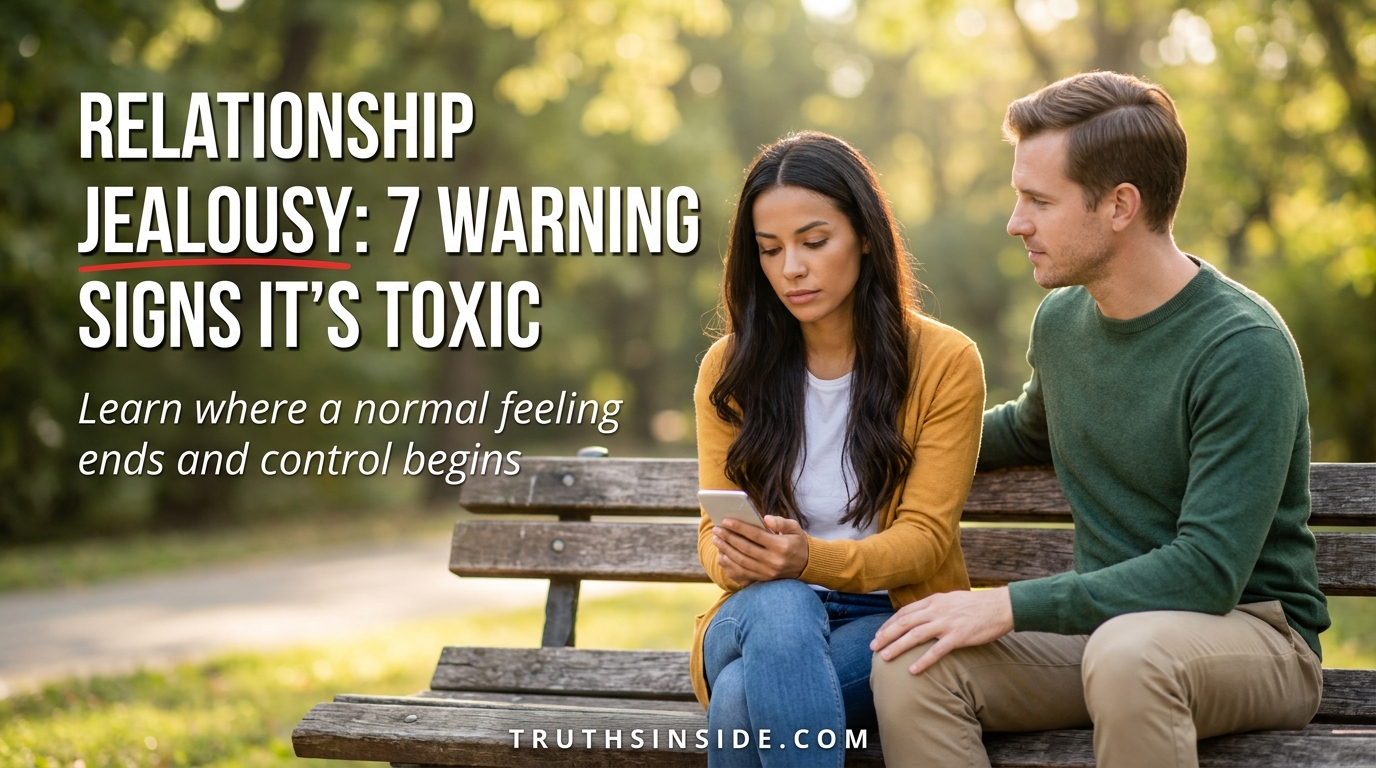
Jealousy in Relationships: When It’s Normal and When It’s a Problem
Relationship jealousy is one of the most uncomfortable feelings in love, and one of the most misunderstood. That hot flash in your chest when your partner laughs a little too easily with a coworker, the tight stomach when a name keeps coming up, the urge to check one more time: if you have felt any of it, you are not a bad partner. You are a human being who cares.
Researchers consider jealousy a near-universal emotion. Evolutionary psychologist David Buss has argued that it exists across cultures because it works as an alarm that guards valued bonds. The alarm itself is normal. What matters is what you do when it rings.
This guide explains when relationship jealousy is a healthy signal and when it becomes a problem, seven warning signs that it has turned toxic, and practical steps for handling it, whether you are the jealous partner or the one on the receiving end.
What Is Relationship Jealousy, Really?
Relationship jealousy is the mix of fear, insecurity and anger that appears when you sense a threat to an important bond, whether the threat is real or imagined. It usually involves three people in your mind: you, your partner and a third person or activity that seems to be taking your place. That third presence can be an ex, a coworker, a friend, a hobby or even a phone.
Psychologists often separate jealousy from envy. Envy is wanting what someone else has. Jealousy is fearing the loss of what you already have. In practice they overlap, since you may envy a rival’s confidence while fearing she will win your partner’s attention. Untangling the two helps you name the real feeling underneath.
Jealousy is also layered. Research by Paul Pfeiffer and Paul Wong, who developed a well-known jealousy scale, describes three parts: the thoughts you have, the emotions you feel and the actions you take. This distinction matters, because the first two are human and unavoidable, while the third is where relationship jealousy either stays healthy or becomes harmful.

Is Relationship Jealousy Ever Normal?
Yes, and often it is more useful than we admit. A brief pang of jealousy can tell you that this person matters, that you want closeness or that something in the relationship needs attention. Many couples say a small spark of jealousy reminded them how much they valued each other.
The difference between healthy and unhealthy jealousy comes down to how you respond. Healthy relationship jealousy is brief, proportionate and communicated honestly. You notice the feeling, name it and perhaps say, “I felt a little insecure when you mentioned her, and I wanted to tell you instead of hiding it.” Then the feeling passes, or you work through it together.
Unhealthy relationship jealousy is persistent, disproportionate and expressed through control. Instead of sharing a feeling, the person tries to manage the partner: monitoring, accusing, restricting or punishing. The emotion has stopped being information and has become a weapon, even if the person feels more frightened than powerful.
A pang of jealousy is a feeling. Checking, accusing and controlling are choices, and the choices are what shape a relationship.
Normal vs. Problem: Relationship Jealousy Side by Side
A quick comparison can make the line clearer. Use it as a guide, not a diagnosis, and remember that frequency and intensity matter more than any single incident.
| Healthy relationship jealousy | Problem relationship jealousy | |
|---|---|---|
| Duration | Brief, passes with reassurance | Lingers for days or returns constantly |
| Trigger | Real, specific situation | Vague, imagined or everything |
| Expression | “I felt insecure, can we talk?” | Accusations, interrogations, silent treatment |
| Behavior | Self-soothing, honest sharing | Checking, tracking, restricting contact |
| Effect on partner | Feels trusted and close | Feels watched, guilty and anxious |
| Response to reassurance | Calms down | Needs more and more proof |
If most of your experience sits in the right-hand column, the pattern needs attention and new skills.
Why Relationship Jealousy Shows Up
Jealousy rarely appears out of nowhere. It usually grows from a mix of personal history, current stress and the specific dynamics of the couple. Understanding the roots makes the feeling less shameful and easier to change.
One major root is attachment style. Research on attachment theory links an anxious style, marked by a fear of abandonment and a strong need for reassurance, with higher levels of jealousy. People who learned early that love could be unreliable may scan constantly for signs of loss. Their relationship jealousy is less about the partner’s behavior and more about an old, alert nervous system.
Past betrayal is another powerful trigger. If a former partner cheated or lied, your mind may treat the new partner’s ordinary behavior as evidence of danger. Low self-esteem also feeds jealousy, because if you privately doubt your worth, it is easier to believe someone better could replace you. Finally, real changes, such as secrecy, emotional distance or a partner’s flirtation, can create warranted jealousy that deserves an honest conversation rather than dismissal.
Relationship Jealousy in the Age of Social Media
Social platforms have given jealousy new fuel. A single “like,” a follow from an ex or a photo with an unknown face can set off a spiral in seconds. Research by Amy Muise and colleagues found that greater Facebook use was linked with more jealousy-related feelings and monitoring in romantic relationships, creating a loop in which people check, feel worse and check again.
The problem is that social media shows a partial, unexplained snapshot. You see the like but not the context, the smile but not the conversation. Your imagination fills the gaps, usually with the worst version. This is why relationship jealousy online can feel so intense and so hard to prove or disprove.
Healthy couples set simple, shared norms about what feels respectful online, and they do not treat each other’s feeds like crime scenes.
📃 Related article: Taking the Relationship for Granted: 7 Shocking Signs
7 Warning Signs Relationship Jealousy Has Become Toxic
Every couple has a rough moment. These signs matter when they form a pattern, last over months and leave one or both people feeling smaller, afraid or constantly on guard.
Sign 1: Constant Checking and Monitoring
Going through a phone, tracking a location, reading messages or scrolling a partner’s followers for clues is more than curiosity when it becomes routine. This kind of monitoring turns the relationship into surveillance. Even if nothing is found, the relief rarely lasts, and relationship jealousy simply asks for another check.
Sign 2: Accusations Without Evidence
“Who were you really with?” “Why did you smile at him?” When questions feel like cross-examinations and the answers are never enough, the focus has shifted from understanding to proving guilt. A partner may begin to rehearse every sentence to avoid the next argument, which is exhausting and corrosive.
Sign 3: Controlling Who You See and What You Do
A partner who dislikes your friends, discourages your hobbies, objects to your clothes or asks you to cut off contact “if you really loved me” is using relationship jealousy to shrink your world. Healthy love expands your life. Control narrows it, one small concession at a time.
Sign 4: Punishing You With Silence, Anger or Guilt
Sulking for hours, giving the cold shoulder, slamming doors or reminding you of what you “made them feel” are ways of making you pay for their pain. The message becomes: managing my feelings is your job. Over time, you may feel responsible for emotions you cannot control.
Sign 5: Jealousy of Everyone and Everything
Some partners are jealous not only of exes and coworkers but also of friends, family, work and time alone. When relationship jealousy attaches to nearly anything that takes your attention, the issue is probably less about what you are doing and more about the fear underneath.
Sign 6: Needing Reassurance That Never Lasts
Reassurance is a normal and loving act. The warning sign is when it works for ten minutes and then must be repeated, with higher stakes each time. If you find yourself giving more proof, more access and more explanation without ever reaching peace, the problem lies in the pattern, not your behavior.
Sign 7: Threats, Intimidation or Fear
Any threat, whether of leaving, of harm, of exposing secrets or of self-harm to keep you from going out, crosses into emotional abuse. If you feel afraid of how your partner will react, you are in a safety issue, not a normal jealousy problem. Physical aggression of any kind is never acceptable.

How Relationship Jealousy Damages Both Partners
The harm of toxic jealousy is not limited to the person being watched. The jealous partner often lives in a state of constant alarm, replaying scenes, imagining betrayals and feeling too ashamed to admit it. They may sleep poorly, feel physically tense and wonder why they cannot simply stop.
The other partner often changes quietly. They start explaining everything before being asked, avoid mentioning certain people and give up small freedoms to keep the peace. Over time, they may feel anxious, resentful or lonely. Trust, the very thing the jealous partner longs for, wears away because it is being demanded instead of built.
This is the cruel irony of relationship jealousy. The behaviors meant to protect the bond, such as checking, controlling and accusing, tend to push the partner away. A person who feels constantly watched eventually starts to feel less safe, less honest and less close.
How to Handle Your Own Relationship Jealousy
If you recognized yourself in the signs, take a breath. Awareness is the hardest step, and it means you can change. These practical steps help you turn relationship jealousy from a driver into a signal.
Step 1: Pause and Name the Feeling
When jealousy spikes, resist the immediate urge to act. Take a slow breath and name what you feel: “I feel scared and left out.” Putting feelings into words tends to reduce their intensity, and it separates the emotion from the story your mind is building around it.
Step 2: Ask What Is Underneath
Jealousy is often a mask for another need: reassurance, attention, safety or self-worth. Ask, “What am I really afraid of right now?” The answer might be “I am afraid I am not enough” or “I am afraid of being left.” Naming the fear lets you respond to the real need instead of the surface trigger.
Step 3: Check the Evidence
Borrow a skill from cognitive behavioral therapy. Write down the thought, such as “She prefers him to me,” then list the facts for and against it. Be fair, like a judge instead of a prosecutor. Often you will find that the story rests on a feeling, not a fact.
Step 4: Share the Feeling Without Blame
Replace accusations with vulnerable statements. Instead of “Why were you texting her?”, try “I felt a little insecure tonight, and I could use some reassurance.” This invites support instead of defense. Good relationship jealousy management is about asking for connection, not demanding proof.
Step 5: Build Your Own Security
The more your self-worth depends on one person, the more frightening any threat feels. Invest in friendships, goals and routines that are yours. Strengthening your inner stability does not reduce your love, and it makes relationship jealousy much easier to carry.
Step 6: Stop the Checking Habit
Checking brings brief relief and long-term anxiety. Delay each check by ten minutes, then twenty. Each time you ride out the urge, your brain learns the feeling can pass on its own.
Step 7: Get Support
A therapist can help you trace the roots of intense jealousy, whether they lie in attachment, past betrayal or anxiety. Seeking help is not failure. It protects both you and the relationship you value.
How to Respond When Your Partner Shows Relationship Jealousy
Being on the receiving end is difficult. You may feel defensive, guilty or trapped. Start by separating compassion from compliance: you can care about your partner’s feelings without agreeing to control, monitoring or isolation.
Respond to the feeling, not the accusation. Try, “I can see that you are feeling insecure, and I want you to feel safe with me.” Offer honest reassurance about things that are true, and be open about reasonable matters. Transparency is a gift. But if your partner needs endless proof, remind yourself that more evidence will not fix a fear that lives inside them.
Set clear, kind boundaries. “I am happy to talk about how you are feeling. I am not willing to hand over my passwords or stop seeing my friends.” Boundaries are not punishments. They protect the relationship from sliding into control. If your partner respects them and works on the issue, that is a hopeful sign. If they keep escalating, take it seriously.
Reassurance can calm a feeling, but it can never replace the work of feeling secure on your own.

A Real-Life Example of Relationship Jealousy Done Right
Elena notices that her boyfriend Sam has been texting a new coworker named Priya almost every evening. Her stomach tightens, and a story begins: “He is losing interest in me.” The old Elena would have scrolled through his phone or snapped, “Who is she?”
This time, she pauses and asks herself what she is really afraid of. The answer is simple: she has been feeling disconnected from Sam because both of them have been working late. The next day, she says, “I noticed I felt a bit jealous about the texts with Priya, and I think it is because I miss you. Could we have dinner this week, just us?”
Sam is surprised, then relieved. He tells her the texts are about a work project, and he offers to introduce her to Priya. They plan a weekly dinner. The jealousy did not disappear overnight, but it did what a healthy signal should: it pointed to a need, and the couple responded to it together.
When Relationship Jealousy Crosses Into Control or Abuse
There is a line where jealousy stops being a relationship challenge and becomes a safety concern. Warning signs include threats, intimidation, damaging belongings, forbidding you from seeing family or friends, controlling your money, constant tracking, or any physical aggression. Intense jealousy is also widely recognized as a feature of coercive and controlling relationships.
If you feel afraid of your partner, if you are changing your behavior to avoid their anger or if you feel isolated from people who care about you, please take it seriously. You do not have to prove the abuse is severe enough to deserve help. In the United States, the National Domestic Violence Hotline is available at 1-800-799-7233, and you can also text START to 88788.
Relationship jealousy that comes with fear is not a communication problem to solve alone. Your safety comes before saving the relationship.
Can Couples Heal From Relationship Jealousy?
Many can, especially when the jealousy is rooted in insecurity instead of control, and when both partners are willing to work on it. Healing usually involves three changes: the jealous partner learns to soothe themselves and communicate feelings without blame, the other partner stays honest and open without being controlled, and both rebuild trust through consistent small actions.
Regular check-ins and shared rituals help the jealous partner feel secure without constant proof.
Couples therapy can speed this up, especially approaches such as Emotionally Focused Therapy, which helps partners see the fear and longing beneath the conflict. If one partner refuses to change controlling behavior, however, individual support and clear boundaries become even more important. Healing relationship jealousy takes two willing people, and sometimes only one is ready.
📃 Related article: Processing Emotions Together: 7 Powerful Ways to Heal
FAQ: Relationship Jealousy
Is jealousy in a relationship normal?
Yes. Occasional, mild jealousy is a common human response to feeling a threat to a valued bond. Relationship jealousy becomes a problem when it is constant, intense or expressed through control, monitoring or punishment.
Is jealousy a sign of love?
Jealousy can show that you care, but it is not proof of love. Love respects freedom and builds trust, while controlling jealousy limits both. A partner who loves you will manage their feelings instead of making you responsible for them.
How do I stop being jealous in my relationship?
Pause when the feeling spikes, name what you are afraid of, check the facts and share your feelings without blame. Build your own security through friendships and goals, reduce checking and consider therapy. Change takes practice, so be patient with yourself.
What if my partner’s relationship jealousy is controlling?
Set clear, kind boundaries and avoid giving up friends, privacy or independence to keep the peace. Encourage professional help, and seek support from trusted people. If you ever feel afraid, contact a domestic violence hotline or a licensed professional.
Can a relationship survive extreme jealousy?
Sometimes, if the jealous partner takes responsibility, stops controlling behavior and works on the root causes, ideally with a therapist. If the behavior continues or escalates, the relationship may not be healthy enough to keep.
Final Thoughts
Relationship jealousy is not the enemy. It is a signal, one that says something you value feels uncertain. The real question is what you do next: listen, share and rebuild, or watch, accuse and control.
Whether you are the one feeling it or the one receiving it, you deserve a relationship where trust is built, not demanded. Start with one honest sentence this week, and let that small step be the beginning of a calmer, safer kind of love.
Found this helpful? Please do three things:
- Save this article so you can come back to the seven warning signs whenever doubt appears.
- Share it with someone who is struggling with jealousy or living with it.
- Follow Truthsinside.com for more honest relationship advice and psychology insights.
🎵 Music
Maren Lull is a singer-songwriter who writes from the places most people don’t talk about out loud.
Not the dramatic grief. Not the obvious heartbreak. The quiet kind — the ordinary Tuesday emptiness, the habit of reaching for someone who isn’t there anymore, the particular exhaustion of being strong for so long that the strength itself wears thin.
Her music lives at the intersection of emotional honesty and soft beauty — breathy vocals over gentle piano, slow tempos, lyrics that feel less like songs and more like something you wrote in a private notebook at two in the morning and never showed anyone.
Maren Lull writes for the people who feel everything deeply and say very little about it. For the ones who listen to sad music not because they want to feel worse — but because being understood, even by a song, makes the feeling easier to carry.
📱 Follow Maren Lull:
→ Spotify
→ Apple Music
→ Youtube
→ Audiomack