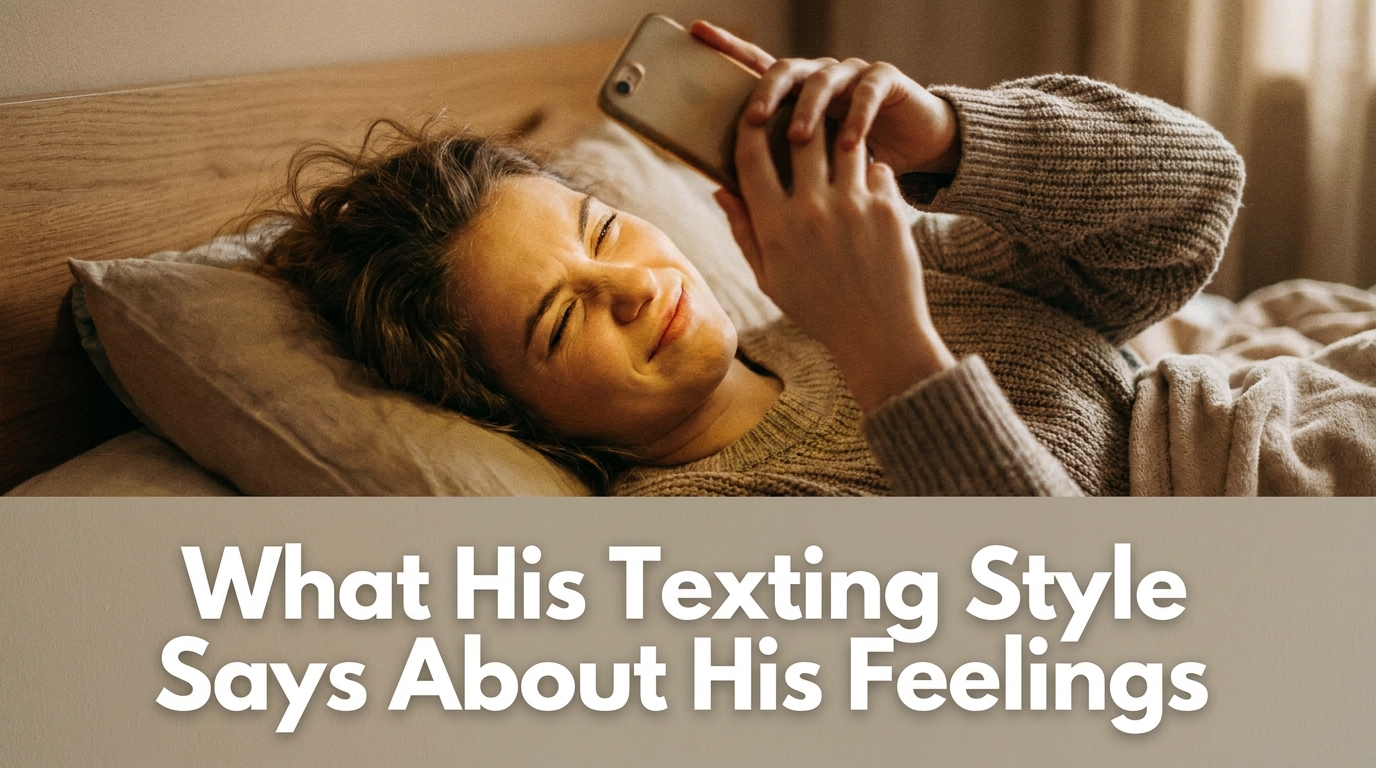
You read it three times. You screenshot it and sent it to your best friend. You typed four different replies before deleting them all. Because somewhere between “hey” and “goodnight” there’s a message inside the message — and you’re trying to figure out what it actually means.
Texting has become one of the primary languages of modern romantic communication, yet most of us were never taught how to read it. A 2020 study from the University of California found that digital communication patterns — including response time, message length, and initiation frequency — are statistically significant predictors of romantic interest and emotional investment. In other words, what his texting style says about his feelings is not just something you’re imagining. It is something you can actually learn to decode. This article breaks down every major texting pattern, what it signals, and how to read the full picture clearly — without overanalyzing every word.

Why Texting Reveals More Than People Realize
Before diving into specific patterns, it’s worth understanding why texting is such a revealing window into someone’s feelings — particularly for men, who are often socialized to be less verbally expressive about emotions in face-to-face interactions.
Texting removes the social pressure of immediate response. It gives people time to compose, edit, and choose — which means every choice made in a text exchange is more deliberate than it might appear. How quickly someone responds. How much they write. Whether they ask questions. Whether they initiate. Whether they use your name. All of these are conscious or semi-conscious choices that reflect the level of investment the sender has in the conversation — and in you.
Psychologist Albert Mehrabian’s research established that communication is only 7% words — the rest is tone, body language, and nonverbal cues. Texting strips all of that away, leaving only the words and the patterns around them. Which means the patterns carry enormous weight. Learning to read them accurately — without projection or wishful thinking — is one of the most practically useful skills in modern dating.
Texting Pattern 1: Response Time
Response time is the single most discussed — and most misread — signal in text communication. Here is what it actually means.
He responds quickly and consistently: Consistent fast responses are a strong signal of interest and investment. Not because fast responses are inherently romantic, but because they indicate that your messages are a priority — that when your name appears on his screen, he wants to engage with it promptly. The key word is consistent. One quick response means nothing. A sustained pattern of quick responses means a great deal.
He takes hours — but always eventually responds: This pattern requires context. Men with genuinely demanding jobs, active social lives, or communication styles that are naturally less phone-focused may respond slowly without it reflecting reduced interest. What matters is the quality and effort of the response when it arrives. A thoughtful, engaged reply after four hours signals more than a one-word answer sent immediately.
Response time is wildly inconsistent: Sometimes within minutes, sometimes days — with no clear external explanation. This inconsistency is one of the clearest texting signals of emotional ambivalence or deliberate hot-and-cold behavior. It creates anxiety by design — consciously or not — and is worth paying attention to as a pattern.
He leaves conversations on read — regularly: Occasional read receipts without reply happen to everyone. A consistent pattern of reading and not responding signals that engaging with you is not a priority — regardless of what is said when conversation does resume.

Texting Pattern 2: Message Length and Effort
How much someone writes — and how much thought they put into it — is a direct reflection of how much they want to engage with you.
Long, detailed messages: When a man consistently sends messages that are substantive — that add to the conversation, share something personal, or develop a topic in depth — he is investing real effort in connecting with you. Long messages are time-consuming. Nobody writes them for someone they’re indifferent to.
Short replies that match your energy: Not all short replies signal disinterest. If your message was casual and brief, a short reply is simply conversational matching. The question is whether his message length scales with the depth of the conversation — whether he rises to meet substance with substance.
One-word or emoji-only replies to substantive messages: When you write something meaningful and receive “haha” or “yeah” in return — consistently — that mismatch in effort is information. It signals either emotional unavailability, reduced interest, or a communication style that requires a direct conversation to understand.
He uses proper grammar and punctuation: This sounds minor but isn’t. A man who takes the time to write clearly — who doesn’t just dash off autocorrected fragments — is communicating that the impression he makes on you matters to him. Small signals of care in writing often reflect larger patterns of care in the relationship.
Texting Pattern 3: Who Initiates
Initiation is one of the clearest signals of genuine interest — because it requires wanting to connect rather than simply being willing to respond.
He initiates regularly: A man who texts you first — not every single time, but consistently enough that you’re not always the one starting the conversation — is actively choosing to bring you into his day. That choice, repeated over time, is a meaningful signal of interest.
He only responds, never initiates: This pattern is one of the most common sources of confusion in early dating. He’s warm and engaged when you text — but never starts the conversation himself. This can reflect a passive communication style rather than disinterest, but it is worth addressing directly rather than endlessly analyzing. Over time, a relationship where one person does all the initiating creates an imbalance that mirrors the dynamics of a one-sided relationship.
He initiates at specific times only: Late night only. Only when bored. Only when plans fall through. Initiation that follows a narrow pattern — particularly one that seems convenience-driven rather than genuinely motivated — is a signal worth examining honestly.
He initiates after periods of silence: A man who reaches out after a gap — without you prompting — is demonstrating that you crossed his mind and he chose to act on it. The consistency of this pattern across time tells you far more than any single message.

Texting Pattern 4: Questions and Curiosity
How much someone asks about you in text is one of the most reliable indicators of genuine interest — because questions require curiosity, and curiosity cannot be faked for long.
He asks follow-up questions: He remembered that you had a difficult meeting today and he’s asking how it went. He picked up a detail from three conversations ago and circled back to it. Follow-up questions signal active listening and sustained interest in your life — not just the surface of the conversation.
He asks personal questions: Not invasive or inappropriately early, but genuinely curious — about your family, your past, your opinions, your dreams. A man who wants to know you — not just spend time with you — will use text to build a fuller picture of who you are.
He asks questions that invite longer answers: “What did you think of it?” instead of “Did you like it?” Open questions signal that he wants a conversation, not just an exchange. He’s creating space for you to share more — because he wants you to.
Conversations are all statements, no questions: A pattern of responses that don’t include questions — where he answers what you ask but never turns the conversation back to you — is a signal worth noting. It can reflect self-absorption, communication style, or simply reduced investment in deepening the connection.
Texting Pattern 5: Content and Vulnerability
What someone chooses to share in text — particularly the personal, unguarded moments — is one of the most meaningful signals of emotional investment.
He shares things unprompted: He texts you about something funny that happened at work. He sends you a song that made him think of you. He mentions something personal without being asked. Unprompted sharing is a sign of genuine desire for connection — he’s thinking about you in the spaces of his day and choosing to bring you into them.
He uses your name: People use names in text when they want to create intimacy and personal connection. If he uses your name naturally in messages — not formally, but warmly — it signals a level of personal investment that goes beyond casual conversation.
He texts you about the small things: Not just big plans or meaningful conversations — but the mundane, the random, the everyday. “You’d find this ridiculous” or “this reminded me of you” texts are some of the most revealing signals of genuine affection. They mean you live in his mind during ordinary moments, not just when he’s planning something.
He shares something vulnerable: A worry, a frustration, something he’s not sure about. Men who are emotionally guarded rarely share vulnerability in text unless they feel a genuine level of trust and connection. When he does — pay attention. It means the wall is coming down, even incrementally.

Texting Pattern 6: Consistency Over Time
Individual texts tell you moments. Patterns over time tell you the truth.
His texting is consistent across weeks and months: He texts with roughly the same frequency, effort, and warmth whether you’re in the exciting early stages or settling into something more established. Consistency is one of the most underrated signals of genuine interest — and one of the most reliable predictors of how someone shows up in a relationship.
His texting dramatically improves after in-person time — then fades: This pattern often reflects someone who is genuinely engaged in the moment but not sustaining investment between interactions. It’s not necessarily dishonest — but it does reveal something about the depth of daily investment.
He texts less when things are going well: Some people pull back precisely when feelings deepen — a classic sign of fear of commitment dressed in texting behavior. If his warmth over text seems to cool after particularly good in-person moments, refer back to the signs of someone scared to commit.
The quality of his texting has been declining over time: This is perhaps the most important pattern to recognize honestly. A gradual reduction in effort, initiation, and warmth over time — not explained by obvious external stressors — is one of the earliest signals that emotional investment is shifting. It deserves a direct conversation rather than endless analysis.
What Texting Cannot Tell You
As revealing as texting patterns are, there are things they genuinely cannot tell you — and mistaking analysis for certainty is one of the most common traps of modern dating.
Texting cannot tell you why someone behaves the way they do. A man who responds slowly might be deeply interested and genuinely bad at his phone. A man who texts eloquently and warmly might not be ready for anything real. Patterns point to possibilities — they are not confessions.
Texting also cannot replace a direct conversation. If you have been analyzing his texting style for weeks without clarity, that energy is better directed toward a calm, honest conversation about where things stand. His behavior in response to that conversation will tell you far more than any number of decoded messages ever could.
And finally — texting cannot tell you whether someone is right for you. It can tell you whether someone is interested. Those are very different questions, and only time, consistency, and real-world presence answer the second one.

The Bottom Line
What his texting style says about his feelings is real, it is readable, and it is worth paying attention to. Response time, initiation, message length, questions, vulnerability, and consistency over time all paint a picture that is more honest than most people realize.
But the most important thing to remember is this: patterns are data, not conclusions. Use them to inform your understanding — not to replace the honest, direct communication that no amount of text analysis can substitute for.
The best thing his texts can tell you is whether to pay attention. The best thing you can do with that information is trust what you see — and ask clearly about what you don’t.
📌 Save, Share & Follow
💾 SAVE this article — come back to it the next time you’re trying to decode a conversation that’s driving you crazy. 📤 SHARE this with a friend who is currently screenshot-analyzing someone’s texts at midnight. 👉 FOLLOW TruthsInside.com for more honest, psychology-backed relationship content that gives you real clarity.
❓ Frequently Asked Questions
Q1: Is it bad if he takes a long time to reply? Not necessarily. Response time should always be read in context — his lifestyle, his job, his natural communication style. What matters most is the quality of engagement when he does respond, the consistency of the pattern, and whether his behavior in person matches the warmth or distance his texts suggest.
Q2: What does it mean if he texts a lot but never makes plans? It often signals someone who enjoys the connection and validation of texting without the investment of real-world commitment. This pattern — high text engagement, low follow-through on actual plans — is worth addressing directly. Sustained texting without tangible progression is a signal that something is blocking real-world investment, whether that’s fear, unavailability, or lack of genuine intent.
Q3: He used to text a lot but suddenly slowed down. What does that mean? A sudden shift in texting behavior — without an obvious external reason — is worth paying attention to. It can reflect a change in emotional investment, something happening in his personal life, or the natural reduction in intensity that sometimes follows early-stage excitement. The most honest approach is to acknowledge the shift in a low-pressure way and observe his response.
Q4: Is double texting a bad idea? Not inherently. One follow-up message after no response — particularly if the original message warranted one — is completely normal and not something to stress about. A pattern of multiple unanswered messages is worth stepping back from — not because of rules, but because it provides clear information about where the investment level actually is.
Q5: What if his texting is bad but he’s great in person? Some people are genuinely poor communicators over text but deeply present and invested in person. If his in-person behavior is consistently warm, engaged, and effort-filled, his texting style may simply reflect his relationship with his phone rather than his feelings for you. The key is that in-person behavior should be the primary reference — texting is a supplement, not the main event.
🎵 Music
Maren Lull is a singer-songwriter who writes from the places most people don’t talk about out loud.
Not the dramatic grief. Not the obvious heartbreak. The quiet kind — the ordinary Tuesday emptiness, the habit of reaching for someone who isn’t there anymore, the particular exhaustion of being strong for so long that the strength itself wears thin.
Her music lives at the intersection of emotional honesty and soft beauty — breathy vocals over gentle piano, slow tempos, lyrics that feel less like songs and more like something you wrote in a private notebook at two in the morning and never showed anyone.
Maren Lull writes for the people who feel everything deeply and say very little about it. For the ones who listen to sad music not because they want to feel worse — but because being understood, even by a song, makes the feeling easier to carry.
📱 Follow Maren Lull:
→ Spotify
→ Apple Music
→ Youtube
→ Audiomack