
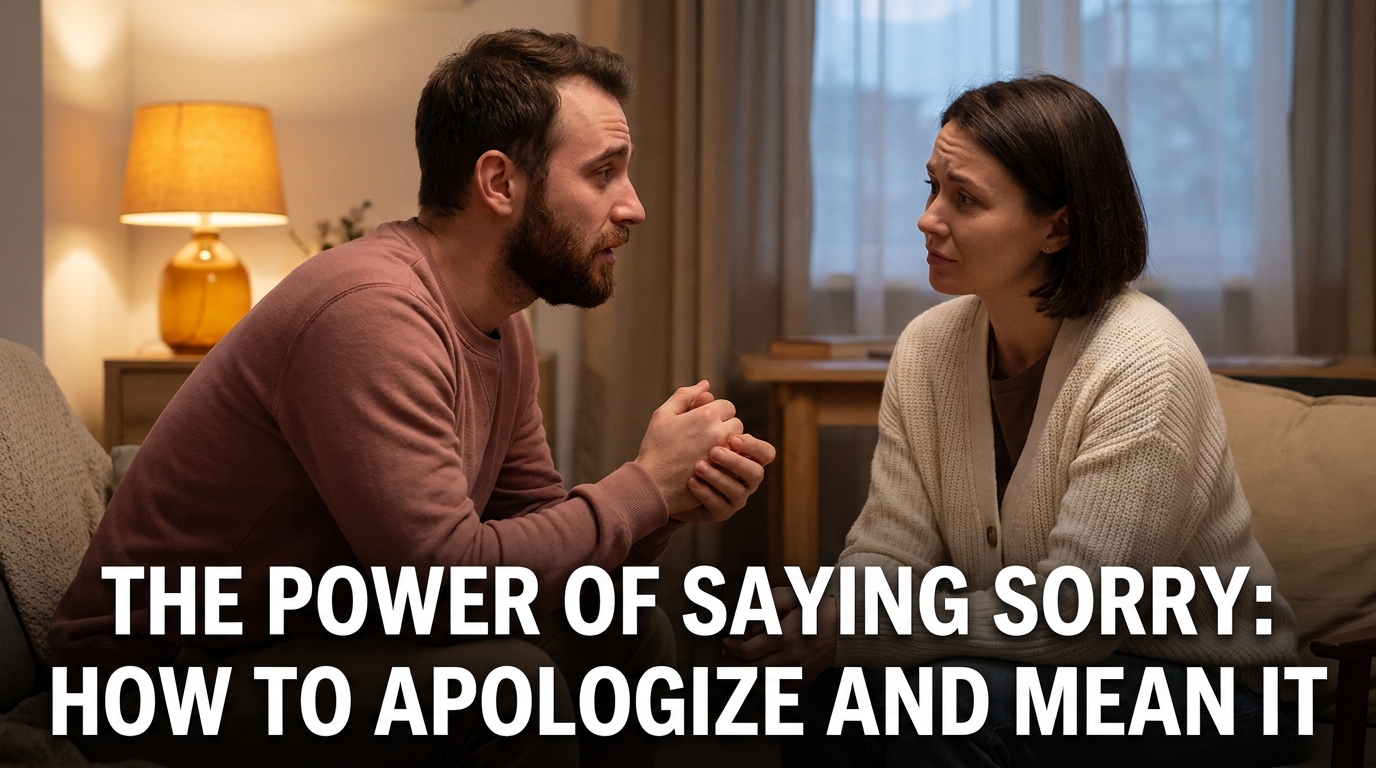
Most people have said sorry without meaning it.
The reflexive apology offered to end an argument. The “I’m sorry you feel that way” that apologizes for nothing. The elaborate gesture that substitutes performance for accountability. The apology delivered so quickly that it skips the step of actually understanding what went wrong.
And most people have received those apologies — and felt the hollow space inside them. The gap between the words and the truth. The sense that something was offered that looked like repair but wasn’t.
A genuine apology is one of the most powerful acts available in a relationship. Research from the University of Ohio found that apologies that included acknowledgment of responsibility, expression of remorse, and an offer to repair were significantly more effective at restoring trust than apologies that included only one or two of these elements.
But a genuine apology is also one of the rarest. Because it requires something that most people find genuinely difficult — the willingness to be fully accountable, without defense, without deflection, and without making the apology secretly about yourself.
This article is about how to do that.

Why Most Apologies Don’t Work
Before exploring what a genuine apology looks like, it is worth understanding why so many apologies fail — even when they are sincerely intended.
They apologize for the feeling, not the action. “I’m sorry you feel that way” has become one of the most recognized pseudo-apologies in relationships — and for good reason. It acknowledges that someone is upset while implicitly declining to take responsibility for having caused the upset. It positions the feeling as the problem rather than the behavior that produced it. It is an apology for the inconvenience of someone else’s pain rather than for the thing that caused the pain.
They apologize too quickly. Speed is often mistaken for sincerity. But an apology that arrives before genuine reflection has occurred is an apology designed to end discomfort — the apologizer’s discomfort with the situation — rather than an apology designed to acknowledge and repair harm. The person receiving it can usually feel the difference. It lands as dismissal wearing the costume of accountability.
They include a “but.” “I’m sorry I said that, but you pushed me to it.” “I’m sorry you were hurt, but you have to understand that I was upset.” The “but” negates everything that came before it. It is an apology that exists only to set up the explanation for why the apology isn’t entirely deserved. This is not accountability. It is blame-sharing disguised as remorse.
They are about the apologizer, not the person harmed. “I feel terrible about this.” “I have been beating myself up all day.” “You know I am not like this.” These are statements about the apologizer’s internal experience — which may be entirely genuine — but which center the apologizer’s discomfort rather than the other person’s hurt. A genuine apology turns outward, toward the person who was harmed. Not inward, toward the one who caused the harm.
They skip the understanding. The most common failure in apologies is apologizing for the wrong thing — or apologizing in general without demonstrating specific understanding of what was hurtful and why. “I’m sorry for everything” covers nothing. “I’m sorry I dismissed what you said in front of our friends — I can see how humiliating that must have felt” covers exactly what needs to be covered.
“An apology without change is just manipulation.” — Unknown And an apology without understanding is just noise.

What a Genuine Apology Actually Contains
Psychologist Gary Chapman — author of The Five Love Languages — and Jennifer Thomas identified what they call the five languages of apology, noting that different people need different elements to feel that an apology is genuine. But across research and clinical practice, several components consistently appear in apologies that actually work.
1. Acknowledgment of What Happened — Specifically
A genuine apology begins with naming, specifically, what you did — not a vague gesture toward the general situation, but a clear, honest acknowledgment of the specific action or behavior that caused harm.
Not: “I’m sorry things got heated.” But: “I’m sorry I said what I said about your family. That was cruel and it was unfair.”
Not: “I’m sorry if I upset you.” But: “I’m sorry I made that decision without consulting you. I know how much it matters to you to be included in things that affect both of us.”
Specificity is not just a technicality. It communicates something essential: I know what I did. I am not apologizing in the abstract because you seem upset. I am apologizing for this specific thing, because I understand that this specific thing caused harm.
2. Acknowledgment of Impact — What It Cost the Other Person
This is the element most consistently missing from apologies — and one of the most important.
It is not enough to acknowledge what you did. A genuine apology also demonstrates understanding of how what you did affected the other person. This requires genuine empathy — the willingness to put yourself in their experience and understand what the harm actually felt like from the inside.
“I understand that when I said that in front of your colleagues, it wasn’t just embarrassing — it undermined your credibility in a space that matters enormously to you. That was real harm, and I’m deeply sorry for it.”
This kind of acknowledgment — specific about impact, not just action — communicates that the apology is not just about clearing your own conscience. It is about genuinely understanding and caring about what the other person went through.
3. Taking Full Responsibility — Without Qualifications
This is the hardest part for most people. Not because they lack remorse, but because taking full responsibility requires resisting every defensive instinct that says: but the context was difficult. But I was provoked. But I am not usually like this. But they also did something that contributed.
All of those things may be true. And none of them belong in the apology itself.
The apology is not the moment for explaining the circumstances that led to the behavior. It is the moment for taking unqualified responsibility for the behavior itself. Context can be discussed separately, at the right time, after the person who was harmed has felt genuinely heard and genuinely apologized to.
Unqualified responsibility sounds like: “This was on me. There is no version of this where how I handled it was okay. I am not going to make excuses for it.”
It does not sound like: “I’m sorry, but you have to understand I was under a lot of pressure.”

4. Expression of Genuine Remorse
Remorse is not the same as guilt. Guilt is about how you feel about yourself. Remorse is about genuinely caring that you caused pain to someone else — and being affected by that knowledge.
Genuine remorse is communicated not just through words but through presence — through the willingness to sit with the discomfort of what you did without rushing past it, without managing it away with excessive self-flagellation that redirects focus back to you, and without moving too quickly to the resolution.
Remorse sounds like: “I am genuinely sorry. Not because I am uncomfortable with this situation, but because I hurt you — and you matter to me, and knowing I caused you pain matters to me.”
It does not sound like: “I feel absolutely terrible. I have been miserable all day thinking about this.” — because that, however sincere, is primarily about your own suffering.
5. An Understanding of Why It Happened
A genuine apology often includes — carefully and briefly — some honest reflection on why the behavior occurred. Not as an excuse. As understanding.
There is an important distinction between: “I was stressed and I took it out on you, which is why you shouldn’t hold me fully accountable” — which is justification — and “I’ve been reflecting on why I reacted the way I did, and I think some of my own insecurity got triggered in a way I didn’t handle well — and that’s something I need to address” — which is self-awareness in service of genuine change.
The second version demonstrates that you have done the internal work to understand the root of the behavior — which makes it more credible that you will be able to prevent it in the future.
6. A Commitment to Change — With Evidence
An apology without the intention to change is not an apology. It is a temporary pause before the same behavior recurs.
A genuine apology includes some acknowledgment of what you intend to do differently — not as a promise that guarantees perfection, but as evidence that the understanding generated by the apology will translate into actual behavioral change.
“I am going to work on not dismissing you when I feel defensive. I know that is a pattern and I know it is not fair to you. I’m going to talk to my therapist about it.”
A commitment is made more credible — and more meaningful — when it is specific, when it is actionable, and when it is followed, over time, by visible effort. Visible effort is the evidence that converts an apology from words into something the other person can actually trust.
7. An Offer to Make It Right — If Possible
Some harm can be repaired materially. Some cannot. But offering — genuinely, not formulaically — to do whatever is within your power to address the harm is an important element of a complete apology.
“Is there anything I can do to make this right?” — asked after the apology has been made and received, not as a shortcut through the harder work of genuine acknowledgment — is an invitation for the person harmed to name what, if anything, they need from you now.
This offer communicates something important: the apology is not the end of my responsibility. I remain invested in your wellbeing and in the repair of what I damaged.

The Apology Languages — Why One Size Does Not Fit All
Gary Chapman and Jennifer Thomas’s research on apology languages offers a valuable framework for understanding why some apologies land and others don’t — even when both are sincere.
Different people need different things from an apology in order to feel that it is genuine. Understanding your partner’s apology language — and your own — can transform how effectively your apologies are received.
Expressing Regret — “I am so sorry. I know I hurt you and I hate that I did.” For people who need this language, emotional acknowledgment of the pain caused is the most important element of a genuine apology. Without it, the apology feels cold and procedural.
Accepting Responsibility — “I was wrong. This was on me. I am not going to make excuses.” For people who need this language, clear, unqualified accountability is what makes an apology real. Anything that softens or distributes the responsibility feels like avoidance.
Making Restitution — “What can I do to make this right? What do you need from me?” For people who need this language, an apology without some offer of repair feels incomplete — words without action.
Genuinely Repenting — “I am going to work on this. Here is specifically what I am going to do differently.” For people who need this language, the commitment to change is the most important signal of sincerity. Without it, an apology is just words.
Requesting Forgiveness — “I know I don’t deserve it, but I am asking for your forgiveness. I need to know we are going to be okay.” For people who need this language, the explicit request for forgiveness — which gives them agency in the repair process — is the element that makes the apology complete.
Knowing which of these your partner needs most — and leading with that element — dramatically increases the likelihood that your apology will be received as genuine.
How to Receive an Apology
Receiving an apology well is as important as giving one — and it is a skill that receives far less attention.
Give the apology room to land. Resist the urge to immediately list everything else that also needs to be apologized for. Let the apology that has been offered be acknowledged before moving to the next thing.
You do not have to forgive immediately. A genuine apology deserves a genuine response — and sometimes a genuine response is: “I hear you. I am not ready to fully move past this yet, but I appreciate you saying this.” Forgiveness that is offered before it is felt is not forgiveness. It is compliance.
Forgiveness is not the same as trust. You can forgive someone — release the emotional weight of what they did — while still needing to see changed behavior before trust is fully restored. These are separate processes and it is entirely legitimate to be clear about that.
Acknowledge the courage it took. A genuine apology — one that includes real accountability and no defensiveness — is genuinely difficult to offer. Acknowledging that — “I know that wasn’t easy to say and I appreciate that you said it” — is both kind and often very healing for both people.
When Sorry Is Not Enough
There are situations in which an apology — however genuine — is not sufficient on its own to repair what happened. When trust has been significantly broken, when a pattern of behavior has repeated despite previous apologies, or when the harm caused was severe, words are the beginning of repair — not the end of it.
In these situations, the apology must be accompanied by visible, sustained behavioral change over a significant period of time. The apology opens the door. What happens next determines whether repair is actually possible.
A partner who apologizes sincerely and repeatedly for the same behavior — without the behavioral change that would make the apology meaningful — is demonstrating something important: that the remorse, however genuine in the moment, is not translating into the internal work required to actually do things differently.
An apology that is not followed by change is, eventually, just a pattern. And a pattern that involves repeated apology for repeated harm, with no genuine shift, is something worth naming clearly — both to your partner and to yourself.

The Relationship Between Apology and Trust
Trust is not rebuilt through a single apology — however perfect. It is rebuilt through the accumulation of consistent, congruent behavior over time. The apology initiates the possibility of repair. What follows it determines whether that possibility becomes reality.
Research by Dr. John Gottman found that couples who repair effectively after conflict — and who demonstrate through consistent behavior that the repair was genuine — develop a specific quality of relationship trust that he calls earned trust. This trust, built through the experience of conflict navigated honestly and repaired meaningfully, is actually more robust than trust that has never been tested.
The couples who go through something genuinely difficult — who hurt each other, apologize genuinely, and change meaningfully — often emerge with a relationship more solid than couples who have never faced comparable difficulty. Because they know, now, through direct experience, that this relationship can hold something hard.
That knowledge is not available in easy times. It is only built in the moments like this one — where someone gathered the courage to say, honestly and fully: I was wrong. I understand what I did. I am genuinely sorry. And I am going to do better.
Saying sorry and meaning it isn’t weakness. It is one of the most courageous things one person can offer another — the willingness to stand fully in what they did, without defense, and ask to be trusted with another chance.
CALL TO ACTION
💾 Save this — it may be exactly what you need before a conversation you have been putting off. 📤 Share it with someone who deserves a real apology — or someone who needs to give one. 👣 Follow Truthsinside.com for honest, psychology-backed relationship content every week.
Frequently Asked Questions
Q1: What makes an apology genuine versus performative? The clearest indicator is what the apology is designed to accomplish. A performative apology is designed to end the discomfort of the situation — to stop the conflict, to restore the relationship to its surface equilibrium, to make the apologizer feel better about themselves. A genuine apology is designed to acknowledge harm, demonstrate understanding, and initiate real repair. Practically, genuine apologies tend to be specific rather than general, focus on the other person’s experience rather than the apologizer’s feelings, include no qualifications or “buts,” and are followed by visible behavioral change. Performative apologies tend to be quick, general, self-focused, and not followed by meaningful change.
Q2: Do I have to apologize if I don’t think I was wrong? No — and a false apology, offered purely to end conflict, is rarely effective and often harmful. If you genuinely do not believe you were wrong, the more honest and ultimately more productive path is to say so — clearly, respectfully, and with genuine curiosity about why the other person is hurt.
“I don’t feel I was wrong, but I can see you are genuinely hurt and I want to understand why” is more honest and more useful than a hollow apology. That said, it is worth examining whether the conviction that you were not wrong is accurate — or whether it is defensiveness preventing you from accessing a more honest assessment of your own behavior.
Q3: How do you apologize to someone who is not ready to receive it? Offer it anyway — simply and without pressure. “I want to apologize when you’re ready to hear it. I’m not going to push you. I just want you to know that I know I was wrong and I am truly sorry.” Then give them time. An apology pressed on someone who is not yet ready to receive it often lands as another act of the apologizer prioritizing their own need for resolution over the other person’s need for time. The willingness to wait — to hold the apology until the person is ready — is itself a form of respect and care.
Q4: Is it possible to apologize too much? Yes — and over-apologizing can be as problematic as under-apologizing, though in different ways. Chronic over-apologizing — apologizing reflexively for things that don’t warrant an apology, or apologizing repeatedly for the same thing without behavioral change — can undermine the meaning of the apology itself, make the apologizer seem less credible, and in some cases become a form of emotional management rather than genuine accountability. The goal is not quantity but quality — fewer, more specific, more genuine apologies followed by actual change carry significantly more relational weight than a steady stream of reflexive sorrys.
Q5: How long should you wait before apologizing after an argument? Long enough to have done the genuine internal work required for a real apology — to understand specifically what you did, how it affected the other person, and what you intend to do differently. Short enough that the hurt is not left to fester unnecessarily.
In practice, this often means a matter of hours rather than days — though for more complex situations, taking a day to genuinely reflect before apologizing is entirely appropriate. What is rarely useful is the immediate apology offered in the heat of the moment before either person has had time to process what happened — because that apology is almost always about ending discomfort rather than genuine accountability.
🎵 Music
Maren Lull is a singer-songwriter who writes from the places most people don’t talk about out loud.
Not the dramatic grief. Not the obvious heartbreak. The quiet kind — the ordinary Tuesday emptiness, the habit of reaching for someone who isn’t there anymore, the particular exhaustion of being strong for so long that the strength itself wears thin.
Her music lives at the intersection of emotional honesty and soft beauty — breathy vocals over gentle piano, slow tempos, lyrics that feel less like songs and more like something you wrote in a private notebook at two in the morning and never showed anyone.
Maren Lull writes for the people who feel everything deeply and say very little about it. For the ones who listen to sad music not because they want to feel worse — but because being understood, even by a song, makes the feeling easier to carry.
📱 Follow Maren Lull:
→ Spotify
→ Apple Music
→ Youtube
→ Audiomack