
Before you ever fell in love, you already had a template.
It was built in the first years of your life — before you had language for it, before you could reflect on it, before you were old enough to choose it. It was assembled from thousands of small moments: whether comfort came when you reached for it, whether your feelings were acknowledged or dismissed, whether the people you needed most were present or absent, consistent or unpredictable, safe or frightening.
That template — your attachment style — became the invisible architecture of every significant relationship you would ever have.
Research from the University of California found that attachment style formed in the first two years of life predicts relationship satisfaction, conflict resolution ability, and emotional intimacy levels in adult romantic partnerships with remarkable consistency.
You did not choose the template. But understanding it — clearly, honestly, and with genuine curiosity rather than blame — is the first step toward something different.

The Blueprint Built Before You Could Choose
Attachment theory, first developed by British psychiatrist John Bowlby in the 1950s, proposed something radical for its time: that the quality of a child’s early bond with their primary caregiver is not merely emotionally significant — it is biologically critical. The attachment system, Bowlby argued, is as fundamental to human survival as the drive for food and shelter.
The infant who is held, soothed, and responded to consistently learns — at a neurological level before a cognitive one — that the world is safe, that other people can be trusted, and that they themselves are worthy of care. This learning does not live in conscious memory. It lives in the body, in the nervous system, in the automatic emotional responses that arise in intimate relationships decades later.
Bowlby called this the internal working model — a set of deeply held beliefs and expectations about self and others that forms in early childhood and operates largely outside conscious awareness in adulthood.
Your internal working model answers questions you may never have consciously asked:
Am I worthy of love? Can I trust the people I depend on? Is closeness safe — or does it lead to pain? Will I be abandoned if I show my real self? Is love something that must be earned — or something I deserve to receive?
The answers your nervous system formed before you could speak have been shaping every significant relationship in your life ever since.
“The propensity to make intimate emotional bonds is a basic component of human nature, present in germinal form in the neonate.” — John Bowlby, Attachment Theory
Mary Ainsworth and the Strange Situation
In the 1970s, developmental psychologist Mary Ainsworth conducted a landmark series of experiments known as the Strange Situation — a structured observation in which young children were briefly separated from their primary caregiver and then reunited.
What Ainsworth observed in those reunion moments revealed, with striking clarity, three distinct patterns of attachment.
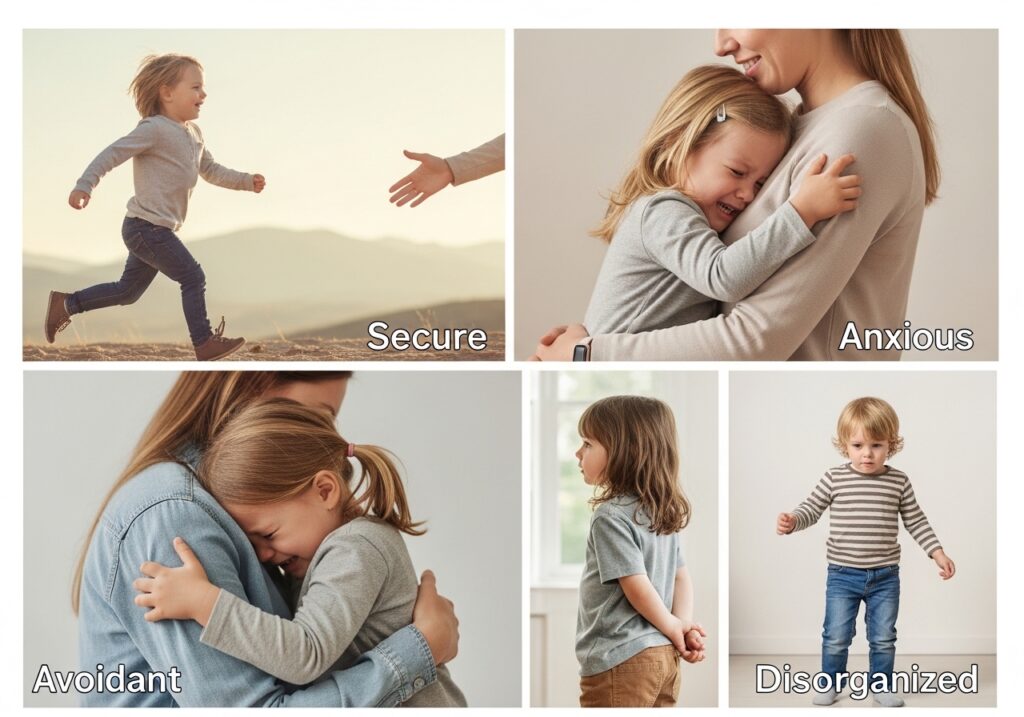
Securely attached children showed distress during separation — because the attachment bond was real and the loss of it mattered. But upon reunion, they were comforted quickly and returned to exploratory play. The caregiving system worked as designed: the need arose, was met, and resolved. These children had learned that comfort is available when needed.
Anxiously attached children showed intense distress during separation and, upon reunion, were difficult to soothe — simultaneously seeking comfort and pushing it away. Their caregiving environment had been inconsistent enough that they could not trust the reunion to last, and so the distress could not fully resolve even when the caregiver returned. These children had learned that love is uncertain and must be pursued intensely.
Avoidantly attached children showed minimal visible distress during separation and appeared indifferent upon reunion — though physiological measurements revealed elevated stress hormones, meaning the distress was real but had been suppressed. Their caregiving environment had been emotionally unavailable enough that displaying attachment needs had proven futile. These children had learned that needing people is pointless and potentially punishing.
A fourth pattern — disorganized attachment — was later identified by researchers Mary Main and Judith Solomon, observed in children whose caregiver was simultaneously a source of comfort and a source of fear. These children showed no organized strategy at all — approaching and retreating simultaneously, freezing, or displaying confused and contradictory behaviors.
Each of these childhood patterns maps with remarkable consistency onto adult attachment styles — and therefore onto adult relationships.
How Each Childhood Attachment Style Becomes an Adult Pattern
Secure Childhood Attachment — The Adult Who Loves Without Fear
What happened in childhood: The primary caregiver was consistently warm, responsive, and emotionally available. Not perfect — research shows that even good caregivers attune accurately only about 30 percent of the time. But consistent enough in the pattern of rupture and repair that the child developed a confident expectation of care.
What it became in adulthood: The securely attached adult carries an internal working model that says: I am worthy of love. Other people are generally trustworthy. Intimacy is safe. Needing someone is not dangerous.
In romantic relationships, this shows up as the capacity to be genuinely close without losing the sense of self, to tolerate conflict without catastrophizing, to ask for what they need directly, and to trust a partner without requiring constant reassurance.
Secure attachment does not mean the absence of difficult emotions or challenging relationships. It means having an internal foundation stable enough to navigate difficulty without being destabilized by it.
Anxious Childhood Attachment — The Adult Who Loves Too Hard
What happened in childhood: The primary caregiver was inconsistently responsive — sometimes warm and attuned, sometimes distracted, unavailable, or emotionally unpredictable. The child could never fully predict when comfort would be available, and so learned to escalate attachment bids — to cry harder, cling tighter, remain hypervigilant — in an attempt to secure the inconsistent care.
What it became in adulthood: The anxiously attached adult carries an internal working model that says: I am not quite enough. Love must be earned and constantly maintained. If I am not vigilant, the people I love will leave.
In romantic relationships, this shows up as a heightened sensitivity to signs of potential rejection, a deep need for reassurance that is never quite satisfied, a tendency to pursue intensely when a partner seems distant, and a fear of abandonment so profound it sometimes drives the very outcome it fears.
The anxious adult is not loving too much. They are operating from a nervous system that learned love is uncertain and must be fought for — constantly, urgently, without rest.
Avoidant Childhood Attachment — The Adult Who Loves From a Distance
What happened in childhood: The primary caregiver was consistently emotionally unavailable — perhaps physically present but emotionally absent, perhaps dismissive of emotional expression, perhaps unable to tolerate the child’s distress without becoming uncomfortable or withdrawing. The child learned that reaching for emotional comfort produced nothing — or produced the withdrawal of the caregiver’s warmth. And so reaching stopped.
What it became in adulthood: The avoidantly attached adult carries an internal working model that says: I do not need people. Closeness leads to suffocation or disappointment. Self-sufficiency is the only reliable strategy.
In romantic relationships, this shows up as a strong preference for emotional distance, discomfort with a partner’s emotional needs, a tendency to withdraw when intimacy deepens, and a persistent feeling of being suffocated when relationships become genuinely close.
Beneath the self-sufficiency is almost always a profound loneliness — and, often, a deep longing for the closeness that every part of their exterior has been built to keep at a distance.
Disorganized Childhood Attachment — The Adult Who Both Wants and Fears Love
What happened in childhood: The primary caregiver was simultaneously the source of comfort and the source of fear or harm. Whether through abuse, severe emotional instability, or their own unresolved trauma, the caregiver created an impossible bind: the child needed to approach for safety and needed to retreat for safety — simultaneously, with no resolution possible.
What it became in adulthood: The disorganized adult carries an internal working model that says two contradictory things at once: I desperately want closeness, and closeness is dangerous. Both are equally true. Both operate simultaneously.
In romantic relationships, this shows up as the push-pull dynamic — intense pursuit followed by sudden withdrawal, sabotage of good relationships at the moment of deepest intimacy, profound difficulty trusting even consistently safe partners, and oscillation between emotional extremes that exhausts both the person living it and the people who love them.
The Invisible Influence — How the Template Operates
Understanding that childhood attachment shapes adult relationships is one thing. Understanding how it does so — the specific mechanisms through which early experience becomes adult behavior — is another.
The Nervous System Remembers What the Mind Forgets
Early attachment experiences are stored not in explicit memory — the kind you can consciously recall — but in implicit memory, which is encoded in the body and nervous system. This is why attachment patterns feel not like choices but like instincts — because they are.
When an avoidantly attached person feels the pull to withdraw as intimacy deepens, they are not making a decision. Their nervous system is enacting a deeply wired protective response — one that was genuinely protective in the environment in which it was learned.
When an anxiously attached person feels the flood of panic as a partner goes quiet, they are not being irrational. Their nervous system is responding to a pattern it learned, in early life, to treat as a genuine threat.
These are not character flaws. They are the body’s faithfulness to what it learned.

The Self-Fulfilling Prophecy of the Internal Working Model
Perhaps the most profound — and most painful — way childhood attachment shapes adult relationships is through its tendency to generate the experiences that confirm it.
The anxiously attached person, convinced that love is uncertain and abandonment is imminent, pursues with an intensity that produces the withdrawal they feared — which confirms: love is uncertain. People leave.
The avoidantly attached person, convinced that closeness leads to suffocation, withdraws from partners who get too close — which produces the loneliness they were protecting against — which confirms: people cannot truly be counted on. Independence is the only safe position.
The disorganized attachment person, convinced that love and danger live together, creates chaos at moments of genuine connection — which produces the painful relational experiences they feared — which confirms: love always hurts. Getting close always ends badly.
The internal working model is not simply a passive prediction. It is an active generator of the relational experiences it predicts. Which is why attachment patterns are so persistent — and why changing them requires so much more than simply deciding to behave differently.
The Attraction to the Familiar
One of the most counterintuitive and most important ways childhood attachment shapes adult relationships is through attraction itself — specifically, the pull toward partners and dynamics that feel familiar.
Familiar does not mean comfortable. It does not mean healthy. It means neurologically recognizable — activating the same attachment circuits that were activated by early caregiving experiences.
This is why the anxiously attached person is so frequently and so powerfully attracted to avoidant partners — not because they consciously want distance and uncertainty, but because distance and uncertainty is what love felt like when love was first learned.
This is why people who grew up in chaotic or unpredictable caregiving environments so often find stable, consistent partners initially boring or uninteresting — because stability does not activate the familiar attachment circuitry, and unfamiliar does not feel like love.
The pull toward the familiar is not a design flaw. It is the nervous system doing exactly what it was designed to do — finding what it recognizes. Redirecting that pull requires understanding it first.
How Childhood Attachment Changes — And How to Help It
The most important thing to understand about childhood attachment patterns is that they are not fixed. The brain’s capacity for change — neuroplasticity — means that the internal working model formed in early childhood can be updated. Not easily, not quickly, and not without genuine effort. But genuinely and meaningfully.
Researchers call this process earned security — the development of a secure attachment style in adulthood despite an insecure early history. And the evidence for its possibility is robust and consistent across decades of attachment research.
Therapy as a Corrective Experience
Of all the pathways to earned security, therapy is the most consistently well-documented. A skilled attachment-informed therapist provides something profoundly healing: a consistent, boundaried, reliably warm relationship in which the client’s attachment needs are taken seriously, emotional experience is met with genuine curiosity rather than judgment, and ruptures — inevitable in any relationship — are consistently and carefully repaired.
This relationship is not just a context for talking about attachment. It is itself an attachment experience — one that teaches the nervous system, through direct experience, that safe connection is possible. That vulnerability does not lead to punishment. That being fully known does not lead to abandonment.
Approaches that are particularly effective for attachment healing include Emotionally Focused Therapy, Internal Family Systems, EMDR for trauma-related attachment wounds, and somatic therapies that work directly with the nervous system’s stored experience.
A Secure Relationship as Healing Ground
Research consistently shows that a sustained relationship with a securely attached partner is one of the most powerful vehicles for attachment healing available. The consistently available, non-reactive, emotionally warm presence of a secure partner provides — over time and through accumulation — the corrective emotional experience that the nervous system never received in early life.
This does not happen quickly. And it does not happen passively — the insecurely attached person must bring awareness and intentionality to the process, recognizing when old patterns are being activated and choosing, increasingly, to respond differently. But the evidence that it happens — that love, experienced consistently enough and safely enough, gradually rewires the nervous system’s expectations — is both scientifically robust and deeply hopeful.
Self-Awareness as the Beginning
Before therapy, before a secure relationship, before any of the other pathways to earned security — there is awareness. The simple act of understanding your own attachment pattern — seeing it clearly, naming it honestly, tracing it back to its origins with curiosity rather than shame — creates a meaningful shift.
Because when you can see the pattern, you can begin to distinguish between the past and the present. Between what your nervous system is telling you and what is actually happening in front of you. Between the child who learned love was unsafe and the adult who has the capacity to choose differently.
That distinction — small at first, larger over time — is where everything begins.

A Letter to the Child You Were
If you have read this article and recognized yourself — in the anxious pursuit, the avoidant withdrawal, the disorganized push-pull — there is something worth saying directly.
The pattern you developed was not a mistake. It was intelligence. Your nervous system looked at the environment it was given and built the most effective strategy available for navigating it. The hypervigilance of the anxiously attached child kept them attuned to a caregiver whose moods were unpredictable and therefore needed to be monitored constantly. The self-sufficiency of the avoidantly attached child protected them from the repeated pain of reaching for comfort and finding none. The confusion of the disorganized child was the only honest response to a situation that was genuinely irresolvable.
You were not broken. You were adaptive. You were trying, with everything available to you, to survive in the relational world you were given.
The work now is not to criticize the child who built those patterns. It is to thank them for what they managed — and to gently, with compassion and patience, show them that the world has changed. That the people available now are different. That reaching for comfort might, this time, produce something worth reaching for.
That love — the real kind, the safe kind, the kind that does not require constant vigilance or self-abandonment — is available.
Even now. Even for you.
The attachment wounds of childhood are not your destiny. They are your starting point. And every person who has ever developed earned security proves that the distance between the two is crossable — one honest, courageous, supported step at a time.
CALL TO ACTION
💾 Save this — share it with someone trying to understand why they keep ending up in the same relationship patterns. 📤 Tag a friend who has been doing the inner work of understanding themselves. 👣 Follow Truthsinside.com for honest, deeply researched content on psychology, attachment, and what healthy love actually looks like.
Frequently Asked Questions
Q1: Can childhood attachment really affect who I am attracted to as an adult? Yes — and this is one of the most consistently supported findings in attachment research. Attraction is not random. It is shaped significantly by the internal working model formed in early childhood — the set of expectations about self, others, and relationships that operates largely outside conscious awareness. We tend to be drawn to partners and dynamics that feel familiar — that activate the same attachment circuitry as early caregiving experiences. This is why anxiously attached people so frequently find avoidant partners compelling, and why people from chaotic early environments sometimes find stable partners initially less interesting. Understanding this dynamic is the first step toward redirecting it.
Q2: Is it my parents’ fault that I have attachment issues? This is the wrong frame — and it tends to produce more pain than insight. Most parents who created insecure attachment in their children were not cruel or deliberately harmful. They were people with their own attachment wounds, their own unresolved histories, their own limitations — doing the best they could with what they had.
Understanding the origin of your attachment pattern does not require assigning blame. It requires understanding. You can acknowledge that something was missing in your early relational experience — and that this missing thing has had real consequences — without making the story about fault. The point is not to establish who was wrong. It is to understand what happened so that it can be changed.
Q3: At what age does childhood attachment become fixed? It does not. This is one of the most important — and most frequently misunderstood — aspects of attachment theory. Attachment patterns are established in early childhood and become increasingly stable over time — but they are never fixed. The brain’s neuroplasticity means that internal working models can be updated throughout life, through new relational experiences, through therapy, and through sustained self-awareness. The process of updating them becomes more demanding as the patterns become more entrenched — but it remains genuinely possible at any age.
Q4: How do I know which childhood attachment style I have? Several validated assessment tools exist — including the Adult Attachment Interview, the Experiences in Close Relationships scale, and various online assessments based on attachment research. But perhaps the most revealing method is honest reflection on your own relationship patterns. Do you tend to pursue when partners seem distant, or withdraw when they get close? Do you feel fundamentally safe in relationships, or is there a persistent background anxiety or detachment? Do you oscillate between desperate closeness and urgent distance? Working with an attachment-informed therapist to explore these patterns in depth is the most accurate and most useful route to genuinely understanding your attachment style.
Q5: Can two people with different childhood attachment styles have a healthy relationship? Yes — and in fact, most relationships involve partners with different attachment styles. The critical factor is not sameness of style but self-awareness in both partners and genuine willingness to understand each other’s patterns rather than simply being triggered by them.
A relationship between an anxiously attached person and an avoidant person can become a vehicle for profound mutual healing when both partners understand the dynamic, work individually on their own patterns, and approach each other’s behavior with curiosity rather than judgment. Couples therapy with an attachment-informed therapist is particularly valuable for these pairings — providing both the framework and the safe container needed to interrupt habitual patterns and build something genuinely different.
🎵 Music
Maren Lull is a singer-songwriter who writes from the places most people don’t talk about out loud.
Not the dramatic grief. Not the obvious heartbreak. The quiet kind — the ordinary Tuesday emptiness, the habit of reaching for someone who isn’t there anymore, the particular exhaustion of being strong for so long that the strength itself wears thin.
Her music lives at the intersection of emotional honesty and soft beauty — breathy vocals over gentle piano, slow tempos, lyrics that feel less like songs and more like something you wrote in a private notebook at two in the morning and never showed anyone.
Maren Lull writes for the people who feel everything deeply and say very little about it. For the ones who listen to sad music not because they want to feel worse — but because being understood, even by a song, makes the feeling easier to carry.
📱 Follow Maren Lull:
→ Spotify
→ Apple Music
→ Youtube
→ Audiomack