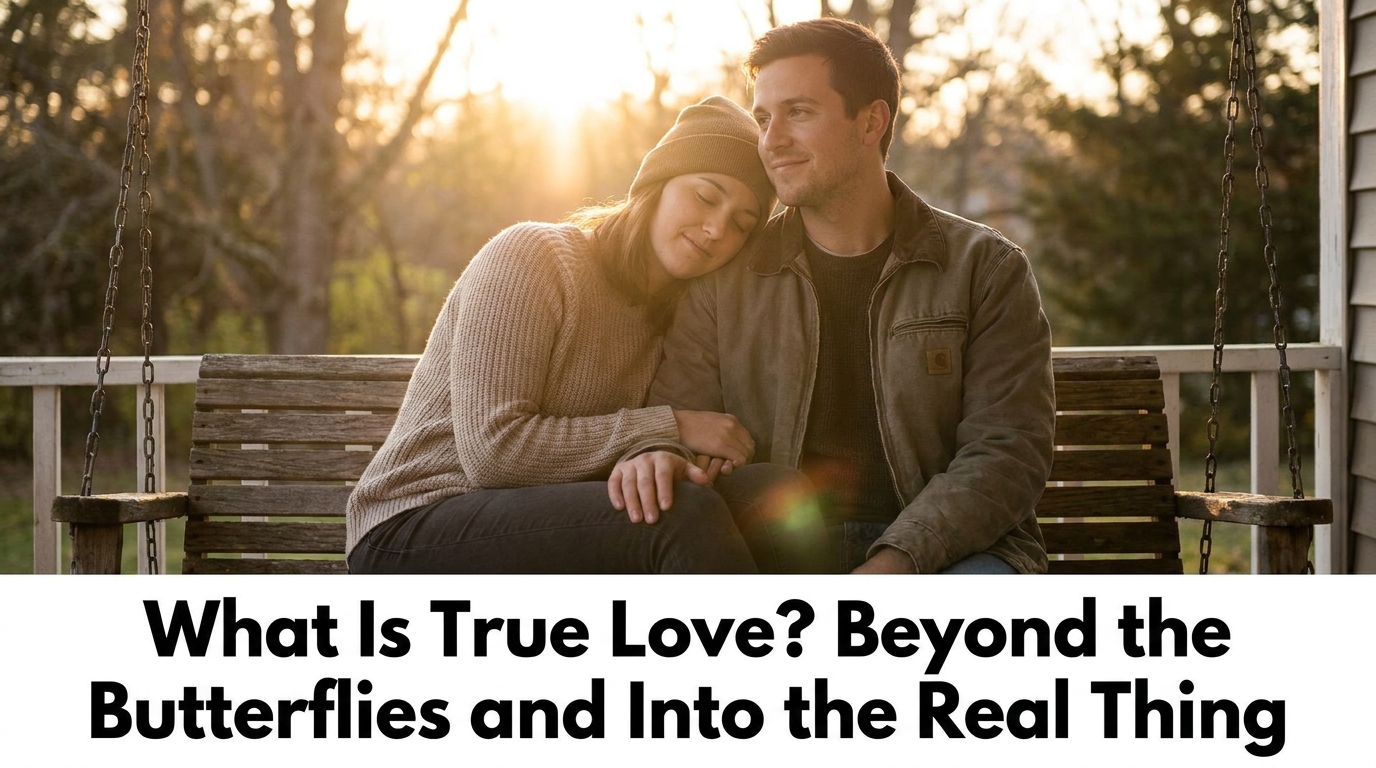
We have been told what love looks like since before we could read. It looks like the breathless first kiss. The grand romantic gesture. The declaration in the rain. The butterflies so intense you can barely eat. And so when love arrives quietly — in the Tuesday morning coffee, the way they notice when something’s wrong before you say a word, the comfort of a silence that doesn’t need filling — we sometimes wonder if this is really it. If this ordinary, steady thing is what all the songs were about.
It is. And it is more than that.
Psychologists have been studying what constitutes genuine romantic love for decades — and what the research consistently reveals is that true love looks almost nothing like its cultural depiction. A landmark study by Robert Sternberg at Yale University proposed that what we call true love is not a single feeling but a convergence of three distinct elements — intimacy, passion, and commitment — and that the presence of all three, in a relationship built on honest knowledge of another person, is what distinguishes love from infatuation, attachment from obsession, and a real partnership from a beautiful feeling that eventually fades.
Understanding what is true love is not just a romantic question. It is one of the most practically important questions a person can ask about their own life.

What True Love Is Not
Before defining what true love is, it helps to clear away what it is commonly mistaken for — because the confusion between true love and its imposters is where most romantic suffering originates.
True love is not infatuation. Infatuation is the neurochemically-driven state of early romantic obsession — the inability to think of anything else, the idealization, the physical intensity. It is real, it is extraordinary, and it is entirely unsustainable. Infatuation loves a constructed version of a person. True love knows the real one.
True love is not limerence. Limerence — the obsessive, fantasy-based state of longing for someone — can feel more intense than anything a person has ever experienced. But its defining feature is that it requires uncertainty to survive. True love does not feed on uncertainty. It is built on genuine knowing, and it deepens rather than dissolves when that knowing becomes complete.
True love is not need. Love that is primarily about what someone does for your emotional state — how they make you feel, what their attention gives you, how their presence regulates your anxiety — is closer to dependency than love. True love includes genuine care for the other person’s wellbeing, separate from what that care returns to you.
True love is not the absence of difficulty. Relationships without conflict, without hard seasons, without the need for repair and forgiveness are not evidence of true love. They are evidence of a relationship that hasn’t been tested yet. True love is not defined by the absence of difficulty. It is defined by how both people move through difficulty together.
True love is not a feeling that arrives and stays. Perhaps the most damaging cultural myth about true love is that it is something that happens to you — a feeling so strong and so certain that it carries the relationship forward on its own. True love is not a feeling that persists effortlessly. It is a feeling that is renewed, repeatedly and actively, through the choices both people make every day.

What True Love Actually Is
It Is Full Knowledge — And the Choice That Follows
The most fundamental thing that separates true love from everything that precedes it is complete knowledge. Not the knowledge of someone’s best self, curated and lit favorably. The knowledge of their worst day, their most difficult quality, their deepest fear, the version of themselves they’re least proud of — and the conscious, repeated choice to stay.
Psychologist Erich Fromm wrote in The Art of Loving that love is not primarily a feeling but a practice — a sustained orientation of care, knowledge, and will toward another person. The feeling, Fromm argued, is the beginning. The practice is what makes it real.
True love sees clearly — including the flaws, the limitations, the things that will likely never change — and does not turn away. This is not resignation or settling. It is the most honest and courageous form of choosing that exists.
It Is Safety — Complete and Unconditional
True love feels like a place you can land. Not a place where you perform your best self or manage your presentation or monitor someone’s emotional weather — but a place where you are allowed to be exactly as you are, on every kind of day, without fear of withdrawal, judgment, or loss of connection.
Attachment theory, developed by John Bowlby and later extended by researchers like Sue Johnson, identifies felt security — the deep, embodied sense that another person is a reliable source of comfort and safety — as the central feature of healthy adult romantic love. When that security is present, both people in a relationship are able to be more fully themselves, take greater risks in the world, and return to each other for genuine renewal. When it is absent — when love comes with conditions, with performances required, with parts of yourself that must be hidden — what exists may be many things, but it is not true love.
It Is Genuine Care for Their Wellbeing — Separate From Yours
True love includes what psychologists call altruistic concern — a genuine investment in the other person’s happiness, growth, and flourishing that exists independently of how that flourishing serves you. You want good things for them. You celebrate their success without reservation. You support their growth even when that growth takes them somewhere temporarily uncomfortable for you. You want them to be well, to be seen, to become more fully who they are — not as an extension of your love story, but as a person with their own complete and precious life.
This is the quality that most clearly separates love from need. Need wants someone for what they provide. Love wants for them — full stop.

It Is Consistent Action — Not Just Sustained Feeling
True love is most honestly understood not as a feeling that persists but as a series of choices — made daily, often unremarkably — that express and renew the relationship. The choice to listen when you’re tired. To repair after conflict rather than withdraw. To prioritize someone’s needs when your own are also pressing. To show up on the difficult days with the same presence as the easy ones.
This does not mean that true love requires constant sacrifice or the suppression of your own needs. It means that in a relationship characterized by true love, both people are making these choices — not always perfectly, not always simultaneously, but consistently enough that the relationship is held by something more durable than feeling alone.
Dr. Gary Chapman’s framework of love languages — the idea that people express and receive love through specific, learnable behaviors — points to this same truth: that love, in practice, is enacted. It is in the acts of service, the words of affirmation, the quality time, the physical touch, the thoughtful gestures. It is made real through the body and through behavior — not just through the heart.
It Is Mutual — And Requires Both People
True love cannot be unilateral. A person can love deeply, genuinely, and completely — and still not be in true love, if the investment is not returned in kind. True love requires reciprocity — not perfect symmetry, not identical expression, but a genuine and sustained mutual orientation of two people toward each other and toward what they are building together.
This is why recognizing true love requires looking at both people and the dynamic between them — not just the depth of feeling on one side. Love that is not received, honored, or returned cannot grow into what it has the potential to become. It can remain in the heart of the person who feels it — but it cannot become a shared life.

It Survives and Deepens Through Difficulty
Every relationship will face difficulty — conflict, loss, change, seasons of distance, and the accumulated weight of being known by someone over years. True love is not the love that avoids these seasons. It is the love that moves through them and arrives on the other side with the bond intact — often strengthened rather than weakened by the navigation.
Research by Dr. John Gottman found that couples in deeply satisfying long-term relationships are not couples without conflict. They are couples who have developed what he calls a “Sound Relationship House” — a foundation of friendship, trust, commitment, and effective conflict repair that makes difficulty navigable rather than terminal. The presence of difficulty is not evidence against true love. The way both people meet that difficulty is the evidence.
It Grows With Time Rather Than Fading
Infatuation fades. Limerence collapses when fantasy meets reality. Passionate love transitions neurochemically. But true love — built on genuine knowledge, mutual care, consistent choice, and emotional safety — does not diminish with time. It deepens.
The couples who report the deepest satisfaction in long-term relationships consistently describe a love that has expanded over years to include more dimensions of knowing, more comfort with imperfection, more appreciation for the specific irreplaceable quality of this particular person — alongside a chosen, sustainable version of passion that never entirely disappears because it is regularly, deliberately renewed.
Time is the ultimate test of true love. Not because love must be old to be real — but because true love, unlike its imposters, does not require novelty and uncertainty to survive. It thrives in the familiar. It deepens in the ordinary. It grows in the direction of more, not less, with every year that passes.
The Signs You Are In True Love
Not as a checklist — but as a set of honest questions worth sitting with:
Do you know this person fully — including what is difficult about them — and choose them anyway? Does your love for them include genuine care for their flourishing, separate from what their happiness gives you? Do you feel safe enough in their presence to be completely yourself — including the parts you’re least proud of? Is the relationship characterized by consistent, mutual investment — not perfect, but genuine and sustained? Does the relationship make both of you more fully yourselves — rather than smaller, more guarded, or more diminished? Do you choose them — actively, in small and large ways — not just feel them?
If the honest answer to most of these questions is yes, you are not just in love. You are in true love. And that is rarer, and more extraordinary, than most people understand.

The Bottom Line
What is true love? It is not the butterflies — though the butterflies are beautiful and worth savoring. It is not the intensity — though the intensity is real and tells you something important. It is not even the feeling, sustained across years, of wanting someone.
It is the knowledge of someone — complete and unfiltered — and the daily, unremarkable, extraordinary choice to love them anyway. It is safety and care and genuine investment and reciprocity and the willingness to move through difficulty without letting go. It is the Tuesday morning coffee, the imperfect repair after conflict, the quiet pride in watching someone you love become more fully who they are.
It is the thing the songs are about. Just not in the way the songs describe it.
True love is not what arrives in the beginning — dazzling and consuming and impossible to ignore. True love is what remains when everything that was performance has fallen away, and two people look at each other in the ordinary light of a shared life and still choose — clearly, fully, and without reservation — to stay.
📌 Save, Share & Follow
💾 SAVE this article — return to it whenever you find yourself wondering if what you have is the real thing. 📤 SHARE this with someone who is trying to understand the difference between love and everything that looks like it. 👉 FOLLOW TruthsInside.com for more honest, psychology-backed content on love, emotions, and the human experience.
❓ Frequently Asked Questions
Q1: How do you know if what you feel is true love or just attachment? The clearest distinction is whether your feelings include genuine care for the other person’s wellbeing — separate from how they make you feel. Attachment is primarily about what someone’s presence gives you: comfort, security, regulation. True love includes all of that, but also a genuine orientation toward the other person’s growth and happiness as something valuable in itself. The question to ask honestly is: would you want good things for this person even if those good things didn’t involve you?
Q2: Can true love exist without passion? True love without any passion is possible — particularly in long-term relationships where passion has faded due to neglect, unresolved conflict, or significant life stressors. But it represents a diminished form of what love can be. Robert Sternberg’s model identifies the coexistence of intimacy, passion, and commitment as the fullest expression of love — and the research on long-term relationship satisfaction consistently shows that couples who maintain some form of chosen, cultivated passion report significantly higher fulfillment than those who don’t.
Q3: Is it possible to fall out of true love? It is possible for a relationship that once embodied true love to lose that quality — through sustained neglect, accumulated unresolved conflict, betrayal, or the gradual erosion of the safety and mutual investment that true love requires. But this is different from the natural transition of passionate love into compassionate love, which is often mistaken for falling out of love. True love, actively maintained, tends to deepen rather than diminish. It is more vulnerable to neglect than to time.
Q4: Can you love someone truly and still choose to leave the relationship? Yes — and this is one of the most important and least discussed truths about love. Loving someone genuinely does not automatically mean a relationship is sustainable, healthy, or right for both people. Sometimes love exists alongside fundamental incompatibility, irreconcilable differences, or circumstances that make a shared life more harmful than good for one or both people. Leaving with love — with genuine care for the other person’s wellbeing, with honesty and respect — is not a contradiction. It may be one of love’s most honest expressions.
Q5: How is true love different from codependency? Codependency involves an excessive emotional reliance on another person — where your sense of self, your mood, and your functioning are so intertwined with the relationship that healthy independence becomes impossible. True love supports independence — it wants both people to be whole, self-directed, and capable of functioning fully outside the relationship, even while choosing to build a shared life within it. The simplest distinction: codependency shrinks both people. True love expands them.
🎵 Music
Maren Lull is a singer-songwriter who writes from the places most people don’t talk about out loud.
Not the dramatic grief. Not the obvious heartbreak. The quiet kind — the ordinary Tuesday emptiness, the habit of reaching for someone who isn’t there anymore, the particular exhaustion of being strong for so long that the strength itself wears thin.
Her music lives at the intersection of emotional honesty and soft beauty — breathy vocals over gentle piano, slow tempos, lyrics that feel less like songs and more like something you wrote in a private notebook at two in the morning and never showed anyone.
Maren Lull writes for the people who feel everything deeply and say very little about it. For the ones who listen to sad music not because they want to feel worse — but because being understood, even by a song, makes the feeling easier to carry.
📱 Follow Maren Lull:
→ Spotify
→ Apple Music
→ Youtube
→ Audiomack