
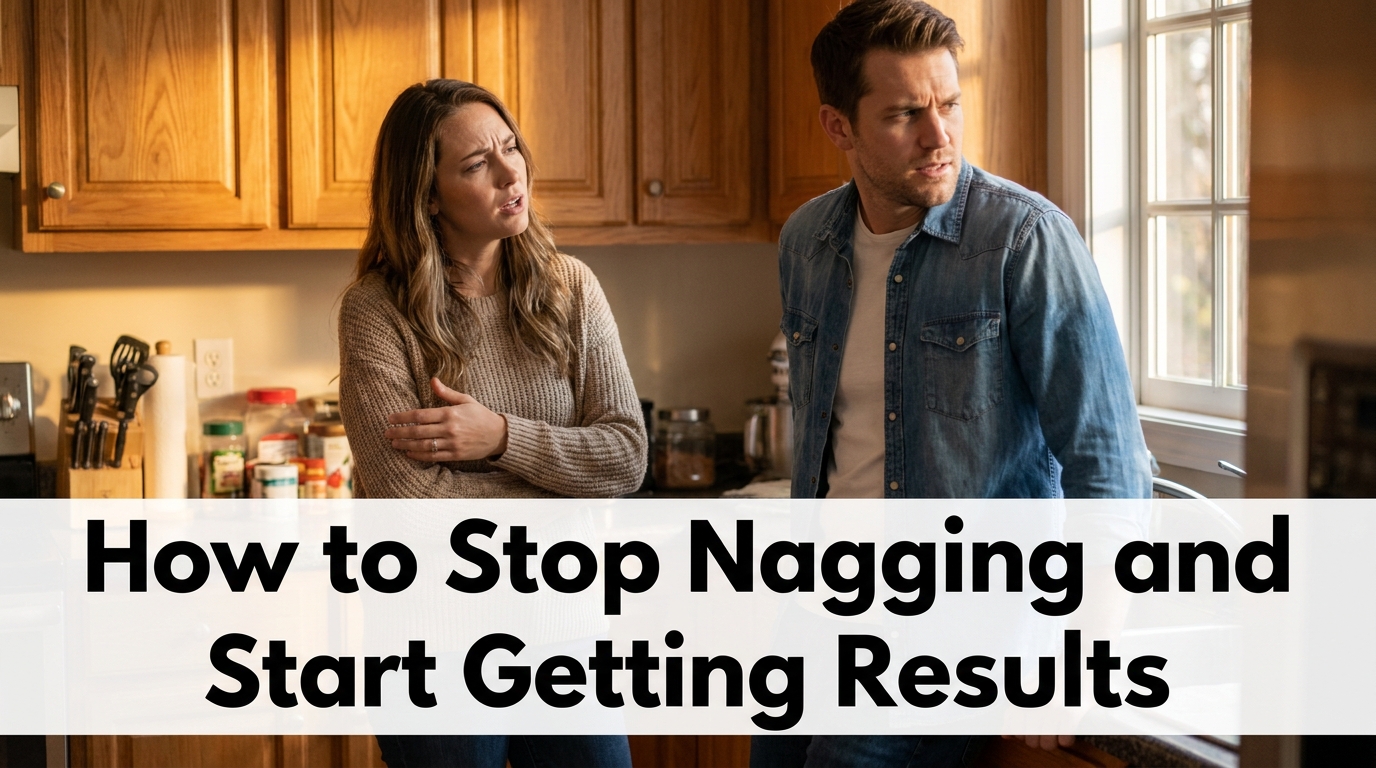
Nobody wants to be the nagger.
And nobody starts out as one.
Nagging almost always begins as a reasonable request — something genuinely needed, clearly communicated. And when that request goes unmet, it is repeated. And when it is repeated again without result, the tone shifts. The frustration enters. And suddenly the request has become something both people dread — the asker because they hate having to ask again, the person being asked because they hate the feeling of being managed.
Research from the University of Michigan found that the nagging cycle is one of the most common sources of relationship dissatisfaction — and one of the most self-reinforcing. The more someone nags, the more their partner detaches. The more the partner detaches, the more the request goes unmet. The more it goes unmet, the more the nagging intensifies.
Nobody wins. Nothing gets done. And both people end up feeling misunderstood, undervalued, and quietly resentful.
This article is not about how to get your partner to do more things. It is about how to communicate what you need in a way that actually works — for both of you.

What Nagging Actually Is — And What It Isn’t
Before exploring how to stop nagging, it is worth being honest about what nagging actually is — because the word carries a judgment that often obscures the legitimate need underneath it.
Nagging is not the problem of one person being unreasonable or controlling. It is a communication breakdown — a pattern that develops when repeated requests go unmet and the person making the request runs out of better strategies.
The person who nags is almost never doing so from a position of strength. They are doing so from a position of exhaustion, frustration, and the growing conviction that the only way to get something to happen is to keep repeating it. It is the communication equivalent of pressing a button that doesn’t work — and pressing it again, harder, because nothing else is available.
The person on the receiving end of nagging is almost never deliberately ignoring the request. They are often overwhelmed by the volume of demands, uncertain about the priority, resistant to the tone, or simply managing their own cognitive load in ways that make the request invisible until it becomes impossible to ignore.
Both people are communicating poorly. Both people are contributing to the dynamic. And both people, with different tools, can change it.
“Nagging is not a personality flaw. It is what happens when a genuine need meets a repeated communication strategy that isn’t working — and neither person knows how to try something different.” — Relationship Psychology
Why Nagging Never Works — The Psychology Behind the Cycle
Understanding why the nagging cycle is self-defeating is the first step toward genuinely breaking it.
It activates resistance. When a person feels managed, monitored, or controlled — even mildly — the psychological response is resistance. Not necessarily conscious defiance, but an automatic pull away from the thing being demanded. This is sometimes called psychological reactance — the instinctive resistance to perceived threats to autonomy. The more something is repeatedly demanded, the more the receiving person’s autonomy feels threatened — and the more resistant they become, often without fully understanding why.
It changes the emotional context of the request. A request made once is a need. A request made repeatedly, with increasing frustration, gradually becomes associated with negative emotion — the sighing, the tone, the familiar weight of yet another exchange that will not go well. Over time, the receiving partner does not just hear the request. They hear everything that has preceded it. And the emotional load attached to it makes it harder, not easier, to respond to positively.
It removes intrinsic motivation. Research on self-determination theory shows that people are most motivated to take action when it feels chosen rather than compelled. When a partner feels they are acting to avoid nagging rather than because they genuinely want to contribute or because they understand why it matters, the action is taken reluctantly and resentfully — and the pattern continues.
It signals a breakdown in the partnership. At a deeper level, chronic nagging signals — to both partners — that the system is not working. That tasks and responsibilities are not shared in a way that both people experience as fair. That something in the underlying dynamic needs to be addressed rather than managed through repetition.

12 Ways to Stop Nagging and Start Getting Real Results
1. Ask Once — Clearly, Specifically, and With a Timeframe
The most common reason requests go unmet is not unwillingness. It is vagueness.
“Can you take care of that thing?” is not a clear request. “Can you take out the recycling before you sit down tonight?” is.
The specificity matters. The timeframe matters. A request without a timeframe is a wish — one that your partner may fully intend to fulfill and simply never find the right moment for, because no moment was specified.
Ask once. Make it specific. Attach a timeframe. Then genuinely give your partner the opportunity to respond to that request before repeating it.
2. Have the Real Conversation — Not Just the Surface Request
Nagging is almost always the surface expression of something deeper. Underneath “I’ve asked you to do this three times” is often something like: I feel like I am managing everything alone. I feel like my time and energy are not valued. I feel like I am invisible in this partnership.
Those deeper feelings — legitimate, important, and genuinely worth addressing — are never going to be reached through repeated requests about the dishwasher.
Have the real conversation. Not in the middle of another request-cycle, but at a calm moment, with intention. “I want to talk about something that’s been building for me. I’ve been feeling like I’m carrying most of the mental load of managing our home, and it’s been wearing on me. Can we talk about how we share things differently?”
This conversation will not be comfortable. But it has a far better chance of producing genuine change than the fifteenth reminder about the same task.
3. Address the Mental Load — Not Just the Task
One of the most significant and most consistently underdiscussed sources of nagging is the unequal distribution of mental load in relationships — the invisible cognitive work of tracking what needs to be done, when, and by whom.
In many relationships, one partner carries a disproportionate share of this mental load. They are the one who notices that the household supplies are running low. Who remembers the appointment. Who tracks the social calendar, the maintenance schedule, the children’s needs, the administrative tasks of a shared life.
Nagging is often, at its root, the symptom of this imbalance — the frustrated communication of someone who is tired of being the only person who is tracking.
The solution is not to remind more effectively. It is to redistribute ownership. Not tasks — but ownership of tasks. There is a significant difference between “I will remind you to do X” and “you are the person responsible for managing X.” The first continues the mental load imbalance. The second addresses it.
4. Stop Assuming They Know — Ask If They Understand Why It Matters
Many unfulfilled requests persist not because a partner does not care but because they genuinely do not understand why this particular thing matters as much as it does.
The pile of mail that bothers you intensely may be background noise to them. The unmade bed that produces significant stress in you may be genuinely invisible to them. Not because they are inconsiderate — but because their internal experience of the shared space is different from yours.
Sharing the why — not as justification or complaint, but as genuine communication — can shift a request from an external demand into something understood and meaningful.
“The reason this matters to me is that when the kitchen is chaotic in the morning, I start the day already feeling behind. It affects my whole morning. That’s why I keep bringing it up.” This is not the same conversation as “I’ve asked you six times about the kitchen.” It invites understanding rather than compliance.

5. Acknowledge Their Efforts — Even When Imperfect
One of the most counterproductive patterns in the nagging cycle is the tendency to focus entirely on what has not been done, while giving little or no acknowledgment of what has.
If your partner has made a genuine effort — even if the result is not what you hoped, even if they did not do it the way you would have done it — acknowledging that effort matters. Not as a performance, but genuinely.
“I noticed you dealt with that this week. I really appreciate it.”
This is not a tactic. It is basic relational nutrition. People — including partners — are significantly more motivated to continue behaviors that are noticed and appreciated than behaviors that are only noticed in their absence. The ratio of positive to negative attention your partner receives around household contribution directly affects their motivation to contribute.
6. Let Go of How It Gets Done
This is specifically for the partner who has a specific way things should be done — and who follows up completed tasks with corrections or redos that communicate the completion was not good enough.
If you have asked your partner to load the dishwasher and they load it differently than you would, you have two genuine choices: accept their version with genuine appreciation, or do the task yourself. What is not available, without significant cost to the relationship, is asking them to do it and then redoing or correcting it — because the implicit message is: your effort was not acceptable. Which is one of the fastest ways to guarantee they stop making the effort.
Letting go of the how is not about lowering standards. It is about deciding which matters more — the task being done your way, or the task being done and both people feeling like equal contributors.
7. Use Written Systems Instead of Verbal Reminders
Much of what presents as nagging is actually a systems problem — a household that is running on one person’s memory rather than a shared, visible system.
A shared list — on paper, on a whiteboard, on a shared digital tool — removes the need for verbal reminders entirely. The task exists in the system. It does not need to live in anyone’s head or be transmitted through repeated requests.
This approach also has the significant benefit of depersonalizing the task. It is not you asking them again. It is the shared system indicating that something is outstanding. The emotional charge — the tone, the history, the implied criticism — is removed from the interaction entirely.
8. Negotiate, Don’t Demand
One of the most effective shifts available in the nagging cycle is moving from demands to negotiation — from “this needs to happen” to “how do we make this work for both of us?”
“I really need the kitchen to be clean in the evenings. I know you find it easier to tackle in the morning. Can we find something that works for both of us?” is a fundamentally different conversation than “the kitchen is a mess and I’ve asked you about it multiple times.”
The first treats your partner as an equal problem-solver. The second positions them as a non-compliant subordinate. The first is far more likely to produce a genuine, sustainable agreement. The second is more likely to produce either reluctant compliance or continued resistance.

9. Choose the Right Moment
A request made at the wrong moment is not the same as a request. It is a demand — and it will be received as one.
The wrong moment: when your partner has just walked through the door. When they are in the middle of something. When either of you is already emotionally activated. When you are both tired and the conversation is already heavy.
The right moment: when both of you are calm, not rushed, and genuinely available for a conversation that matters.
“Is now a good time to talk about how we’re managing things at home?” is both a more respectful and a more effective approach than raising the topic mid-task, mid-argument, or at the moment of maximum exhaustion.
10. Examine Your Own Role in the Pattern
This is the most uncomfortable step — and the most important.
The nagging cycle is a dynamic. Both people are contributing to it. The person who nags is contributing through repeated requests that have stopped working. The person being nagged is contributing through non-responsiveness that makes the repetition necessary.
But the person who nags also sometimes contributes in other ways: by taking tasks back when they are not done immediately. By doing everything themselves and then being resentful about it. By setting expectations that were never clearly communicated and then being frustrated when they are not met. By framing requests in ways that guarantee a defensive response.
Honest self-examination — not self-blame, but genuine curiosity about your own contribution to the cycle — is where the most productive change often begins.
11. Agree on Shared Standards Explicitly
Many nagging cycles are sustained, at root, by a difference in standards that was never explicitly discussed.
One person’s clean is another person’s disaster. One person’s urgent is another person’s eventually. One person’s obvious is another person’s invisible.
These differences are not moral failures. They are the natural result of two people with different backgrounds, different nervous systems, and different internal experiences of the shared space. But left unaddressed, they generate endless conflict.
Have the explicit conversation: what does clean mean to each of us? What counts as urgent? What are the non-negotiables? What are the things each of us genuinely does not care about?
Agreed-upon shared standards — arrived at through genuine negotiation rather than assumed by the person with higher standards — remove a significant proportion of the ongoing friction.
12. Address Deeper Issues If the Pattern Persists
If you have tried these approaches genuinely — if you have had the real conversation, redistributed ownership, used shared systems, and communicated the why — and the pattern continues, something deeper may be at work.
Chronic non-responsiveness to a partner’s clearly expressed needs can indicate several things: a significant values difference about domestic contribution, unaddressed resentment that is expressing itself through passive non-compliance, depression or executive function challenges affecting the partner’s capacity to initiate, or a fundamental power dynamic in which one partner’s needs are simply not being prioritized.
These are not nagging problems. They are relationship problems — ones that benefit from couples therapy, individual therapy, or a very direct conversation about what the pattern is actually communicating about the state of the partnership.
Nagging is always a symptom. When the symptom persists despite genuine communication efforts, the thing it is a symptom of deserves to be named and addressed directly.
The Shift That Changes Everything
The most important shift in moving from nagging to genuine communication is a shift in identity — from request-manager to equal partner.
Nagging positions one person as the keeper of standards and the other as the person who needs to be managed into meeting them. It is inherently hierarchical — and that hierarchy, however unintentional, generates resentment in both directions.
Equal partnership means both people taking genuine ownership of the shared life — not because they are reminded to, but because they have genuinely internalized their role as co-manager of what they have built together.
That internalization does not happen through repeated requests. It happens through explicit conversation, clear agreements, genuine mutual respect, and the consistent experience of both people being seen as equally responsible — and equally capable — of contributing.
The goal is not a partner who does things because you ask. It is a partnership in which both people see clearly what is needed and move toward it together — because they both choose to show up for the life they are building.
CALL TO ACTION
💾 Save this — and try one of these approaches before you say the same thing again. 📤 Share it with a couple you know who could use a better way through this. 👣 Follow Truthsinside.com for honest, psychology-backed relationship advice every week.
Frequently Asked Questions
Q1: Is nagging always the nagger’s fault? No — and framing it as fault is part of what makes the pattern so hard to break. Nagging is a dynamic, not a personality defect. It develops when a genuine need meets a repeated communication strategy that isn’t working — and when the person whose response is needed isn’t providing an alternative path to getting that need met. Both people are contributing. Both people have the capacity to change the dynamic. Locating the fault entirely in one person’s communication style ignores the other person’s contribution through non-responsiveness — which is itself a form of communication.
Q2: What if my partner says everything I say sounds like nagging? This is worth taking seriously — but so is examining whether the label is being used accurately. There is a meaningful difference between a partner who is genuinely receiving reasonable requests as criticism due to their own defensive patterns, and a partner who is using the label of nagging to deflect accountability for consistently unmet needs. The former calls for communication adjustments and possibly couples therapy to address the defensive pattern. The latter calls for a direct conversation about whether legitimate needs are being consistently dismissed and what that dismissal is communicating about the relationship.
Q3: How do you handle it when your partner does tasks but not to the standard you need? This requires honest internal examination first. Is the standard genuinely necessary — hygiene, safety, function — or is it a preference? If it is a genuine necessity, communicate it clearly and specifically: not “that’s not how you do it” but “the reason this matters to me is X, and what I need is Y.” If it is primarily a preference, consider whether insisting on your standard is worth the cost of your partner feeling their effort is never acceptable.
Standards worth maintaining should be communicated explicitly before the task, not corrected after. Standards that are primarily preferences are worth examining whether they matter more than partnership equality.
Q4: What if I stop nagging and nothing gets done? Then something important has become visible — and it deserves to be addressed directly rather than managed through repetition. If a clearly communicated, explicitly agreed-upon need consistently goes unmet after genuine effort to change the communication approach, that is not a nagging problem. That is a partnership problem — one in which your needs are not being prioritized, your agreements are not being honored, or something deeper is preventing your partner from following through. That conversation — about what the non-responsiveness is communicating and what it means for the relationship — is harder than nagging. It is also the only conversation that might actually change something.
Q5: Is couples therapy useful for nagging issues? Yes — particularly when the pattern is entrenched, when direct conversations about it have not produced change, or when the nagging cycle is a symptom of deeper issues around fairness, resentment, or power dynamics in the relationship. An attachment-informed couples therapist can help both partners understand what the pattern is actually about — what needs are being expressed and missed, what the non-responsiveness is communicating, and what changes in both partners’ behavior would genuinely shift the dynamic. Many couples report that what appeared to be a straightforward nagging issue was actually the surface expression of something much more significant — and that addressing the deeper issue resolved the surface pattern almost entirely.
🎵 Music
Maren Lull is a singer-songwriter who writes from the places most people don’t talk about out loud.
Not the dramatic grief. Not the obvious heartbreak. The quiet kind — the ordinary Tuesday emptiness, the habit of reaching for someone who isn’t there anymore, the particular exhaustion of being strong for so long that the strength itself wears thin.
Her music lives at the intersection of emotional honesty and soft beauty — breathy vocals over gentle piano, slow tempos, lyrics that feel less like songs and more like something you wrote in a private notebook at two in the morning and never showed anyone.
Maren Lull writes for the people who feel everything deeply and say very little about it. For the ones who listen to sad music not because they want to feel worse — but because being understood, even by a song, makes the feeling easier to carry.
📱 Follow Maren Lull:
→ Spotify
→ Apple Music
→ Youtube
→ Audiomack