
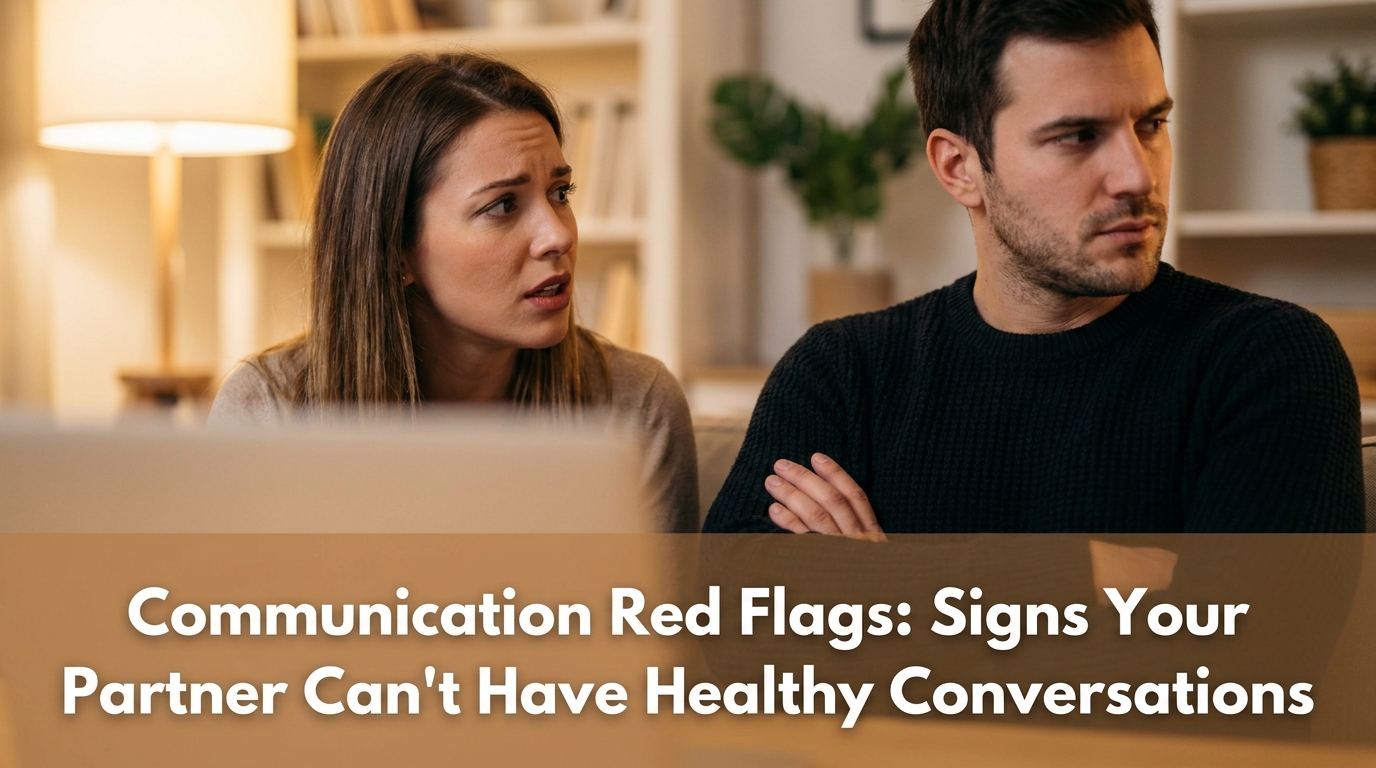
You tried to bring it up calmly. You chose your words carefully. You waited for the right moment. And somehow — again — the conversation ended with you feeling unheard, confused, or like the problem itself. Not the issue you raised. You.
If this sounds familiar, you are not failing at communication. You may be in a relationship where healthy communication is structurally not possible — not because you haven’t found the right words, but because your partner’s communication patterns make genuine dialogue almost impossible. According to Dr. John Gottman’s decades of relationship research, communication dysfunction — specifically what he identified as the Four Horsemen: criticism, contempt, defensiveness, and stonewalling — is the single strongest predictor of relationship failure, more reliable even than the presence of conflict itself. Understanding communication red flags is not about finding fault. It is about seeing clearly whether the relationship you’re in has the foundation that every healthy partnership requires — the ability to talk, honestly and safely, about what matters.

Why Communication Patterns Matter More Than Communication Frequency
Before the red flags, a distinction worth making: the problem in most relationships with poor communication is not that people don’t talk enough. It is that the quality of the communication — the safety, the honesty, the mutual respect — is structurally broken.
A couple can talk all day and never have a genuine conversation. A couple can have one honest, vulnerable exchange and move mountains. What matters is not volume but quality — and quality is determined entirely by the patterns both people bring to difficult conversations.
Healthy communication requires several conditions: emotional safety for both people to speak honestly, a genuine willingness to hear rather than simply respond, the capacity to tolerate discomfort without shutting down or attacking, and a shared commitment to understanding over winning. When any of these conditions are consistently absent in how your partner communicates, the relationship lacks something it cannot function well without.
The Communication Red Flags
1. Every Conversation About a Problem Becomes a Conversation About You
You raise an issue — something specific, something that matters to you — and somehow, within minutes, the conversation has shifted. Now the topic is your tone, your timing, your past behavior, your sensitivity, your pattern of always bringing things up. The original issue has disappeared entirely, replaced by a defense that redirects all accountability away from your partner and back onto you.
This pattern — sometimes called DARVO, an acronym for Deny, Attack, Reverse Victim and Offender — is one of the most disorienting communication dynamics in relationships because it leaves the person who raised the concern feeling guilty for raising it. The effect, whether intentional or not, is that legitimate concerns never get addressed — because the conversation never stays on them long enough.
2. They Stonewall — Consistently and Without Resolution
Stonewalling is the withdrawal of communication entirely: the silent treatment, the sudden departure from the conversation, the complete shutdown that leaves the other person with nowhere to go. Dr. Gottman’s research identified stonewalling as one of the most damaging communication behaviors in relationships — because it cuts off the possibility of repair at the moment repair is most needed.
Everyone needs to pause a heated conversation sometimes — that is healthy and appropriate. The red flag is stonewalling as a default response: the consistent use of emotional withdrawal to avoid engagement, to punish, or to exert control. A partner who stonewalls regularly is a partner who has made the discomfort of engaging more important than the wellbeing of the relationship.
3. Contempt Enters the Conversation
Contempt is different from anger. Anger still believes the other person matters. Contempt communicates that you’ve been dismissed as beneath consideration — through eye-rolling, mockery, sarcasm deployed as a weapon, condescension, or a tone that makes clear your perspective is not worthy of serious engagement. Dr. Gottman’s research found contempt to be the single most toxic communication behavior in relationships — the one variable most predictive of relationship dissolution. When contempt becomes part of how your partner communicates with you, something fundamental has shifted in how they regard you as a person.

4. They Cannot Apologize — Ever
Every relationship involves mistakes, misunderstandings, and moments where one person causes harm — intentionally or not. The capacity to acknowledge this, take genuine responsibility, and offer a real apology is not a personality bonus. It is a fundamental requirement of healthy communication and partnership.
A partner who cannot apologize — who deflects, minimizes, counter-attacks, or offers non-apologies disguised as accountability (“I’m sorry you feel that way”) — is a partner who has placed their self-image above the wellbeing of the relationship. An inability to apologize also makes repair after conflict impossible — which means that every unresolved hurt simply accumulates, quietly poisoning the relationship’s foundation.
5. They Use Your Vulnerabilities Against You
You shared something in a moment of trust — a fear, an insecurity, something from your past — and it reappeared later, in a conflict, deployed precisely where it would cause the most damage. This is one of the most serious communication red flags in any relationship because it betrays the foundational trust that vulnerability requires. When sharing yourself honestly becomes a liability — when the things you’ve revealed in safety can be weaponized — the relationship has lost the emotional security that genuine communication depends on.
6. Conversations Always Escalate Rather Than Resolve
What begins as a calm conversation becomes raised voices. What starts as an attempt to address something specific becomes a comprehensive indictment of your relationship history, your character, and your past behavior. Escalation without resolution — the consistent inability to stay in a conversation long enough to actually address what was raised — means that nothing in the relationship is ever truly worked through. Issues don’t disappear when they go unresolved. They accumulate — and they compound.

7. They Dismiss Your Feelings as Overreactions
“You’re too sensitive.” “You’re being dramatic.” “I can’t believe you’re upset about something so small.” The consistent dismissal of your emotional responses — the message, repeated in varying forms, that your feelings are disproportionate, irrational, or inconvenient — is both a communication red flag and a form of emotional invalidation that erodes self-trust over time.
In healthy communication, a partner doesn’t have to agree with your emotional response in order to take it seriously. They acknowledge it, engage with it, and treat your inner experience as something worthy of attention — even when they see the situation differently. A partner who consistently dismisses your feelings is not just communicating poorly. They are communicating that your inner world doesn’t merit consideration.
8. They Bring Up the Past to Win, Not to Understand
Every conflict becomes a referendum on the relationship’s entire history. Mistakes you made months or years ago are retrieved and deployed as evidence. The past is not raised to understand patterns or to process something genuinely unresolved — it is raised strategically, to gain leverage in the current conversation. This pattern makes genuine resolution impossible — because no current issue can be addressed when it is constantly being layered with everything that has ever gone wrong between you.
9. They Hear Criticism Where None Was Intended
You made an observation. You asked a simple question. You mentioned something gently. And it was received as an attack — triggering a defensive response that had nothing to do with what you actually said. Chronic defensiveness — the consistent interpretation of neutral communication as threat — makes honest conversation almost impossible, because every attempt to discuss anything real must be managed around the risk of triggering a defensive reaction.
Over time, the person communicating with a chronically defensive partner learns to say less, soften everything, and preemptively manage how their words will land — which means they stop communicating honestly at all. The relationship becomes a space where truth requires too much navigation to be worth speaking.

10. They Gaslight Your Experience of Conversations
The conversation happened. You remember it clearly. And now you’re being told it didn’t happen that way — that you misremembered, misunderstood, or invented the version you recall. Gaslighting in communication — the systematic denial or reframing of conversations, agreements, and exchanges — is particularly destabilizing because it targets the very foundation of shared reality that communication is supposed to build.
Over time, a partner who consistently rewrites the history of your conversations erodes your confidence in your own memory and perception — making you more dependent on their version of events and less trusting of your own. This is not poor communication. It is a form of psychological manipulation that deserves to be named clearly.
11. They Punish You for Raising Issues
After a difficult conversation — even one that went relatively well — there is a period of coldness, withdrawal, or passive aggression. The message is clear even if it is never spoken: raising concerns has a cost. Over time, this punishment — however subtle — conditions you to stop bringing things up, because the aftermath of honesty feels worse than the discomfort of silence. A relationship where one person cannot raise concerns without facing emotional punishment is not a partnership. It is a dynamic where one person’s comfort is systematically protected at the expense of the other’s voice.
12. Repair Attempts Are Ignored or Rejected
A repair attempt is any bid — however small — to de-escalate conflict and restore connection. A touch on the arm. A moment of humor. An “I don’t want to fight about this.” Dr. Gottman’s research found that the acceptance of repair attempts is one of the strongest predictors of relationship health — and their consistent rejection one of the clearest signs of a relationship in serious trouble. A partner who cannot receive a repair attempt — who remains locked in conflict even when you’ve reached toward resolution — is a partner for whom winning the argument has become more important than preserving the relationship.
Why These Patterns Develop — And Whether They Can Change
Communication patterns are not random. They develop from early experiences — with parents, caregivers, and formative relationships — that taught us what conversations are for, whether honesty is safe, and whether vulnerability leads to connection or punishment.
This matters because it means most poor communication patterns are not personality flaws or deliberate choices. They are learned responses that, with genuine awareness and sustained effort, can be unlearned. Couples therapy — particularly approaches like Emotionally Focused Therapy developed by Dr. Sue Johnson — has strong evidence for helping partners fundamentally change communication patterns when both people are genuinely committed to the work.
The key phrase is both people. Communication patterns cannot be improved unilaterally. One person learning to communicate more skillfully while their partner remains locked in contempt, stonewalling, or chronic defensiveness does not produce healthy communication. It produces one person doing all the work while the other remains unchanged.
The question to ask honestly is not whether your partner’s communication patterns can theoretically change. It is whether they recognize the problem, take genuine responsibility for their role in it, and are actively willing to do the work. That answer — honest and uncolored by hope — tells you more than anything else.

What to Do When You Recognize These Signs
Name the pattern, not just the incident. One difficult conversation can be a bad day. A pattern of the same behavior across months of conversations is a structural problem. When you address it, address the pattern — calmly, specifically, and with examples — rather than the individual incident.
Assess their response to being told. How your partner responds when you name a communication pattern is itself a significant data point. Defensiveness, dismissal, or counter-attack in response to honest feedback about communication is the pattern proving itself in real time. Genuine acknowledgment, curiosity, and willingness to engage are signs that change is possible.
Consider couples therapy — seriously. Communication patterns are some of the most difficult things to change without external support — because the patterns themselves make the conversations needed to change them almost impossible to have. A skilled couples therapist provides the structure, safety, and tools that make genuine communication work possible. This is not a last resort. It is often the most efficient path to real change.
Protect your voice in the meantime. If honest communication has become too costly in your relationship — if raising concerns triggers punishment, your feelings are consistently dismissed, or you have learned to say less to avoid conflict — notice what that has cost you. A relationship in which you have stopped speaking honestly is a relationship in which you are slowly disappearing. That cost is worth naming clearly, to yourself first.
Know the difference between unwilling and unable. Some partners genuinely cannot communicate healthily — because of unprocessed trauma, undiagnosed mental health conditions, or deeply entrenched patterns that require significant professional work. Others are simply unwilling — because the current dynamic serves them. These require very different responses. Only sustained observation and honest conversation will tell you which you are dealing with.
The Bottom Line
Communication red flags are not just signs of a difficult relationship. They are signs of a relationship that lacks the infrastructure that healthy partnerships require — the ability to raise concerns, repair after conflict, and build genuine understanding between two people who are choosing each other.
Every relationship has difficult conversations. The question is not whether conflict exists — it is whether both people can move through conflict in a way that leaves the relationship stronger rather than more damaged. When the answer to that question is consistently no, it is not a communication problem. It is a relationship problem that is expressed through communication.
You are not asking for too much when you ask to be heard. You are not being too sensitive when you need your feelings acknowledged. You are not failing at communication when every attempt ends with you feeling worse. You are simply in a relationship where the conversation was never safe to begin with — and recognizing that is the first step toward something better.
📌 Save, Share & Follow
💾 SAVE this article — return to it the next time a conversation leaves you feeling like the problem rather than the person who raised one. 📤 SHARE this with someone who has been told one too many times that they’re “too sensitive” for wanting to be heard. 👉 FOLLOW TruthsInside.com for more honest, psychology-backed relationship content that gives you language for what you’ve been feeling.
❓ Frequently Asked Questions
Q1: Is it a red flag if my partner needs time to cool down before talking? No — needing time to regulate emotionally before engaging in a difficult conversation is healthy and self-aware. The red flag is when that pause becomes permanent — when cooling down never leads back to the conversation, when the delay becomes avoidance, or when the need for space is used as a tool to prevent any difficult discussion from ever happening. The distinction is whether the pause serves the conversation or replaces it.
Q2: Can communication red flags exist in otherwise loving relationships? Yes — and this is part of what makes them so difficult to address. A partner can be genuinely loving, caring, and invested in the relationship while simultaneously having deeply ingrained communication patterns that make healthy dialogue almost impossible. The love is real. The pattern is also real. Both things can be true — and addressing the pattern does not require denying the love.
Q3: How do I bring up communication red flags without starting another argument? Choose a calm, neutral moment — not immediately after conflict. Frame it as a relationship concern rather than a personal accusation: “I’ve noticed that when we try to talk about difficult things, we often end up further apart than when we started — I’d like us to figure out how to change that together.” This positions both of you on the same side of the problem rather than opposite sides of it.
Q4: What if I recognize some of these patterns in myself? That recognition is valuable and worth taking seriously. Many of these patterns — defensiveness, difficulty apologizing, escalation — are learned responses that most people carry to some degree. The question is whether they are occasional responses you can recognize and correct, or consistent patterns that reliably prevent honest communication. If they feel entrenched, a therapist can help you understand their roots and develop genuinely different responses.
Q5: At what point do communication red flags become a reason to leave? When they have been named honestly, addressed directly, and met with consistent unwillingness to change — or when they have crossed into patterns that cause genuine psychological harm, such as sustained gaslighting, contempt, or emotional punishment for speaking honestly. Communication that erodes your self-trust, silences your voice, or consistently leaves you feeling worse than before you spoke is not a communication style difference. It is a relationship environment that is harming you — and that harm is a legitimate reason to reconsider the relationship entirely.
🎵 Music
Maren Lull is a singer-songwriter who writes from the places most people don’t talk about out loud.
Not the dramatic grief. Not the obvious heartbreak. The quiet kind — the ordinary Tuesday emptiness, the habit of reaching for someone who isn’t there anymore, the particular exhaustion of being strong for so long that the strength itself wears thin.
Her music lives at the intersection of emotional honesty and soft beauty — breathy vocals over gentle piano, slow tempos, lyrics that feel less like songs and more like something you wrote in a private notebook at two in the morning and never showed anyone.
Maren Lull writes for the people who feel everything deeply and say very little about it. For the ones who listen to sad music not because they want to feel worse — but because being understood, even by a song, makes the feeling easier to carry.
📱 Follow Maren Lull:
→ Spotify
→ Apple Music
→ Youtube
→ Audiomack