
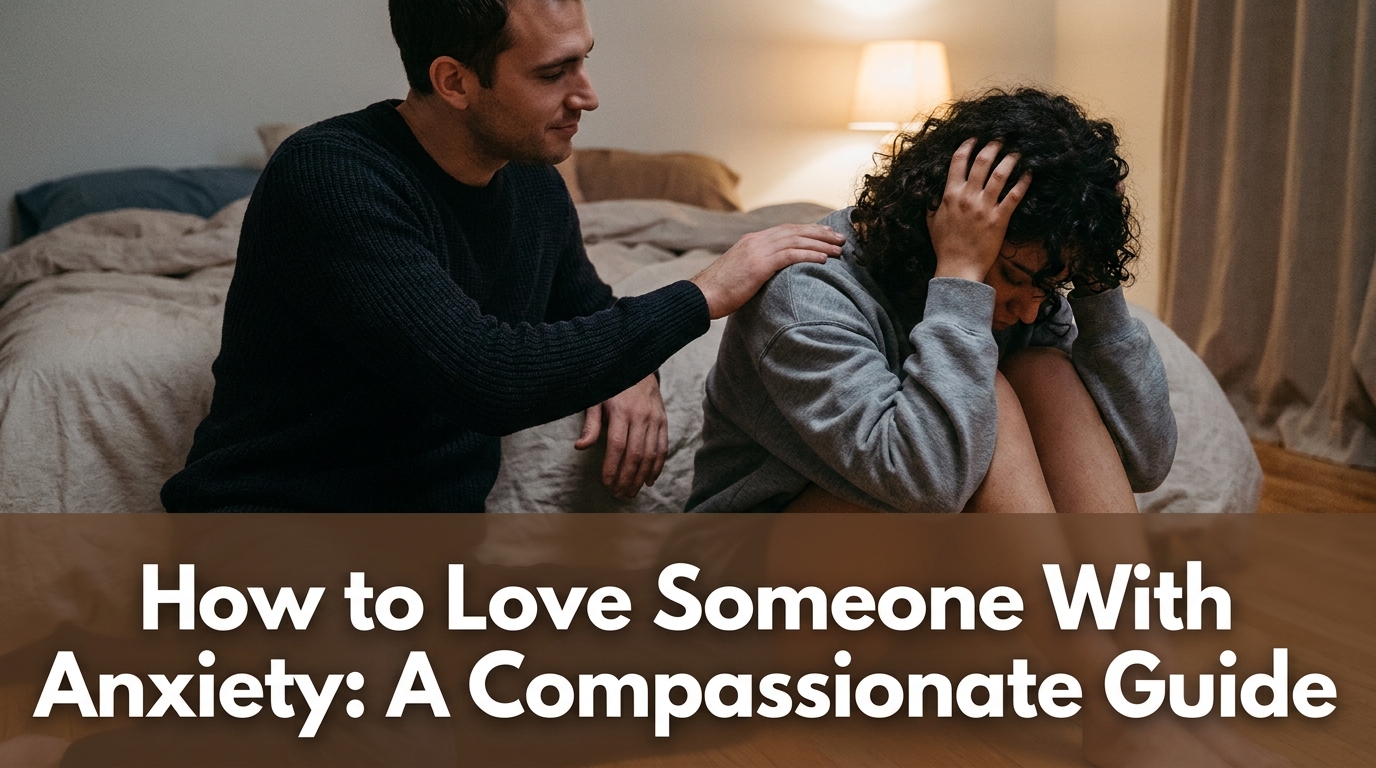
They cancel plans last minute — not because they don’t care, but because something inside them locked up and they couldn’t explain it in time. They apologize more than they should. They ask for reassurance in ways that sometimes feel like more than you know how to give. And you love them — genuinely, completely — but some days you don’t know how to reach them through it. Some days you don’t know if you’re helping or making it worse.
Loving someone with anxiety is one of the most quietly demanding things a person can do in a relationship — not because people with anxiety are difficult to love, but because anxiety itself is an invisible, relentless presence that affects everything from daily decisions to the way intimacy is experienced and expressed. According to the Anxiety and Depression Association of America, anxiety disorders are the most common mental health condition in the United States, affecting over 40 million adults — meaning that in any serious relationship, the likelihood of anxiety being part of the picture is significant. Understanding how to love someone with anxiety — with both compassion and healthy boundaries — is not just useful. For many people, it is essential.

Understanding Anxiety Before You Can Support It
Before anything else — before the practical guidance, before the specific things to say or not say — there is something foundational that every partner of someone with anxiety needs to understand.
Anxiety is not a choice. It is not a personality flaw, a dramatic response to ordinary circumstances, or evidence of weakness. It is a neurological condition in which the brain’s threat-detection system — the amygdala — becomes overactivated, registering danger where none exists or amplifying real stressors to a degree that feels physiologically overwhelming.
For someone with anxiety, the physical experience of a worried thought is not simply a cognitive event. It is a full-body response — elevated heart rate, shallow breathing, muscle tension, a nervous system flooded with cortisol and adrenaline — that feels as real and as urgent as the response to actual physical threat. The person experiencing it is not catastrophizing for effect. Their body is telling them, with full biological conviction, that something is very wrong.
Understanding this changes everything about how you respond. When your partner is anxious, they are not being irrational. They are having a genuine physiological experience that their mind is then working to make sense of. Your response to that experience — whether it communicates patience or impatience, safety or judgment — has a direct effect on how quickly their nervous system can return to calm.
What Anxiety Can Look Like in a Relationship
Anxiety expresses itself differently in different people — and recognizing its specific shape in your partner is the first step toward responding to it effectively.
It can look like needing reassurance — frequently, sometimes repetitively — about the relationship, about your feelings, about whether everything is okay between you. It can look like withdrawal when things feel overwhelming — a shutdown that can easily be mistaken for disinterest or coldness. It can look like overthinking every interaction, reading into silences, apologizing for things that don’t require apology, or becoming unusually distressed by uncertainty about plans or the future.
It can also look like irritability, difficulty sleeping, physical symptoms without clear medical cause, avoidance of situations that trigger the anxiety response, and a pervasive sense of dread that sometimes has no specific object — just a feeling that something is wrong, even when everything is fine.
In a relationship context, anxiety often manifests most visibly around commitment and vulnerability — the moments when intimacy deepens and the stakes feel highest. For someone whose nervous system is already hypervigilant, the vulnerability of being genuinely loved can itself be anxiety-provoking — not because they don’t want it, but because the possibility of losing it feels unbearable to contemplate.

How to Love Someone With Anxiety: What Actually Helps
1. Learn Their Specific Anxiety — Not Just Anxiety in General
Anxiety is not one thing. Generalized anxiety disorder, social anxiety, panic disorder, health anxiety, separation anxiety — each has a different profile, different triggers, and different ways of showing up in a relationship. Beyond clinical categories, your partner’s anxiety has its own specific shape — particular triggers, particular physical sensations, particular thought patterns that are most likely to spiral.
The most useful thing you can do early in the relationship is listen — not to fix, but to understand. Ask them, in a calm and genuinely curious moment, what their anxiety feels like from the inside. What triggers it most reliably. What helps. What makes it worse. What they need from you when it arrives. This conversation — given the right conditions of safety and unhurried time — is one of the most intimacy-building exchanges a couple can have.
2. Separate the Person From the Anxiety
Your partner is not their anxiety. They are a complete, complex, capable person who also experiences anxiety — and keeping that distinction clear, in your own mind and in how you relate to them, matters enormously for both of you.
When you conflate the person with the condition — when anxiety becomes the defining lens through which you see them — two things happen. They feel reduced to their struggle rather than seen in their fullness. And you begin unconsciously organizing the relationship around the anxiety rather than around the two of you. Neither serves the relationship or the person you love.
Your partner needs to be related to as a whole person who happens to have anxiety — not as an anxious person who also has other qualities. The distinction is subtle but profoundly important.
3. Offer Presence, Not Solutions
When your partner is in the middle of an anxious episode, the instinct — particularly for people who love them — is to fix it. To provide the reassurance, the logical counter-argument, the practical solution that should resolve the worry. This instinct comes from love. It is also, usually, exactly the wrong response.
Anxiety does not respond to logic in the acute phase because it is not a logical experience — it is a physiological one. The nervous system in the grip of anxiety is not accessible to rational argument. What it needs is co-regulation — the calming influence of a calm, present, patient other person.
This means: stay close. Don’t fill the silence with solutions. Don’t rush them through it. Breathe slowly yourself — because nervous systems genuinely co-regulate, and your calm is physiologically contagious. Say, simply: “I’m here. Take your time. You don’t have to explain anything right now.”
This is not passivity. It is one of the most active and skilled forms of support available to a partner of someone with anxiety.

4. Understand Reassurance — And Its Limits
Reassurance is one of the most natural responses to a partner’s anxiety — and in moderation, it is healthy and appropriate. “I love you.” “We’re okay.” “That’s not something you need to worry about.” These statements, offered genuinely and not compulsively, can help a nervous system find its way back to calm.
The complexity arises with reassurance-seeking that becomes a loop. If your partner asks the same question repeatedly — “Are you sure you’re not angry with me?” “Do you really love me?” “Everything is okay between us, right?” — and no amount of reassurance provides more than brief relief before the question returns, you are in a reassurance loop. And in a reassurance loop, more reassurance does not help. It reinforces the anxiety’s premise that the worry is something that needs to be resolved externally rather than managed internally.
The compassionate response to reassurance loops is not to refuse reassurance — it is to gently redirect toward the anxiety itself: “I notice you’ve asked me this a few times tonight — I wonder if the worry itself is what needs attention more than my answer. Can we talk about what’s underneath it?”
This is a difficult skill that many couples benefit from working through with a therapist — both to identify when reassurance is helpful and when it is feeding the cycle.
5. Don’t Take the Anxiety Personally
This is one of the most practically challenging aspects of loving someone with anxiety — and one of the most important.
When your partner withdraws, cancels plans, needs excessive reassurance, or becomes distressed by something that seems objectively fine, the natural response is to take it personally. To wonder what you did. To feel shut out, frustrated, or inadequate because your love doesn’t seem to be enough to make them feel safe.
Most of the time, the anxiety is not about you. It is not a reflection of the relationship’s health or your adequacy as a partner. It is a neurological experience that your partner is having — one that they did not choose and cannot simply stop having because they love you and you love them.
Distinguishing what is about you — genuine relationship concerns that deserve to be addressed — from what is anxiety doing what anxiety does, is one of the most important skills you can develop in this relationship. A therapist, either individually or as a couple, can help you develop that discernment.
6. Maintain Your Own Emotional Boundaries
Compassion without boundaries is not sustainable. Loving someone with anxiety does not mean absorbing their anxiety into your own nervous system, abandoning your own needs in service of theirs, or organizing your entire life around preventing their triggers.
You are allowed to have needs. You are allowed to feel frustrated sometimes. You are allowed to need space and to take it without guilt. You are allowed to communicate that certain patterns — particularly reassurance loops or cancellations that affect your shared life — are things you need to address together rather than simply accommodate indefinitely.
The most sustainable version of loving someone with anxiety is one where both people’s needs are visible and both people are actively working — together and individually — toward a dynamic that doesn’t require one person to shrink and the other to carry the entire emotional weight.

7. Encourage Professional Support — Without Pressure
The single most helpful thing a person with anxiety can do for themselves — and for their relationship — is work with a mental health professional. Cognitive Behavioral Therapy has strong evidence for anxiety disorders. So does Acceptance and Commitment Therapy, mindfulness-based approaches, and, in some cases, medication.
Your role as a partner is not to be your partner’s therapist. You cannot provide — and should not attempt to provide — the specialized support that professional treatment offers. What you can do is create an environment where seeking that support feels safe, supported, and genuinely encouraged rather than pressured or shamed.
The way you encourage matters as much as whether you encourage. “I think you should see someone” lands very differently from “I’ve noticed how hard this has been for you, and I want you to have all the support available — would you ever consider talking to someone about it?” Curiosity and care over urgency and judgment — every time.
8. Take Care of Your Own Mental Health
Loving someone with anxiety has a real cost — and acknowledging that cost honestly is not a betrayal of your partner. The hypervigilance, the emotional labor, the careful navigation of triggers and cycles — all of it takes something from you. And if you do not actively replenish what it takes, you will eventually have nothing left to give.
Your own therapy, your own friendships, your own interests and spaces that belong entirely to you — these are not luxuries in a relationship affected by anxiety. They are necessities. They are the foundation that makes sustained, genuine support possible rather than eventual resentment dressed as patience.
What Not to Do
Understanding what helps is only half the picture. What not to do is equally important — and some of the most well-intentioned responses to a partner’s anxiety are also the most harmful.
Do not minimize. “You’re overreacting.” “It’s not that big a deal.” “Just relax.” These responses, however well-meaning, communicate that your partner’s experience is invalid — and they make the anxiety worse, not better, by adding shame to an already overwhelming internal experience.
Do not make their anxiety your emergency. Matching your partner’s panic with your own escalation adds a second dysregulated nervous system to the situation rather than providing the co-regulation that actually helps. Your calm is the most useful thing you can bring to an anxious moment.
Do not use their anxiety against them. In conflict, raising their anxiety as a weapon — as evidence of irrationality, as a reason their perspective doesn’t deserve weight — is both cruel and deeply corrosive to the trust that makes genuine support possible. Their vulnerability is not ammunition.
Do not enable avoidance indefinitely. Anxiety is maintained and strengthened by avoidance — the cycle in which avoiding an anxiety trigger provides short-term relief while making the trigger more powerful over time. Supporting your partner sometimes means gently encouraging them toward the things that are hard, rather than always removing the difficulty. This requires sensitivity and should ideally be guided by their therapist’s approach — but unconditional accommodation of avoidance does not help.

The Bottom Line
Learning how to love someone with anxiety is not about becoming a perfect caregiver, a bottomless source of reassurance, or a person without needs of your own. It is about developing genuine understanding of what your partner experiences, building the specific skills that their particular anxiety requires, and maintaining the honest, boundaried, compassionate presence that sustains love over time rather than exhausting it.
Anxiety does not have to be the defining feature of a relationship. With understanding, professional support, and genuine mutual investment, it can be one part of a partnership that is rich, honest, and deeply loving — one where both people feel seen, supported, and safe.
Loving someone with anxiety doesn’t mean fixing them. It means learning to sit beside them in the hard moments without flinching — and trusting that your steady, patient presence is doing something their nervous system cannot do alone. That is not a small thing. It is, in its own quiet way, one of the most profound expressions of love there is.
📌 Save, Share & Follow
💾 SAVE this article — return to it when you need a reminder of what your steady presence is actually doing for the person you love. 📤 SHARE this with someone who loves a person with anxiety and is trying to figure out how to show up better. 👉 FOLLOW TruthsInside.com for more honest, psychology-backed content on love, mental health, and real relationships.
❓ Frequently Asked Questions
Q1: Is it normal to feel frustrated when loving someone with anxiety? Completely normal — and worth acknowledging honestly rather than suppressing out of guilt. Frustration is a natural response to the demands that anxiety places on a relationship. The key is what you do with that frustration: processing it in your own therapy, in conversations with trusted friends, or in honest discussions with your partner during calm moments rather than in the middle of anxious episodes. Feeling frustrated does not make you a bad partner. Expressing it destructively in moments of vulnerability does.
Q2: How do I talk to my partner about their anxiety without it becoming an argument? Timing, framing, and genuine curiosity are everything. Choose a calm, neutral moment — not during or immediately after an anxious episode. Frame it as something you want to understand better rather than something that needs to change: “I want to understand what anxiety feels like for you so I can support you better — can we talk about it?” This positions you as an ally rather than a critic and gives the conversation the best possible chance of being genuinely productive.
Q3: What if my partner refuses to get help for their anxiety? This is one of the most common and most difficult situations in relationships affected by anxiety. You cannot force professional help — and attempting to pressure or ultimatum your way to it usually increases resistance rather than reducing it. What you can do is continue to gently encourage, model your own willingness to seek support, and be honest about the impact the untreated anxiety is having on you and the relationship. If the refusal is sustained and the impact on the relationship is significant, couples therapy — framed as support for the relationship rather than treatment for the anxiety — can sometimes be an easier entry point.
Q4: Is anxiety in a relationship a dealbreaker? Anxiety itself is not a dealbreaker — any more than any other mental health condition is automatically a dealbreaker. What matters is whether both people are genuinely invested in managing it well: whether the person with anxiety is willing to seek help and take responsibility for their own mental health, and whether their partner is willing to develop the understanding and skills that genuine support requires. A relationship where both people are doing that work can be deeply healthy and deeply loving. A relationship where the anxiety is untreated, unacknowledged, and entirely managed by the partner — at the cost of that partner’s own wellbeing — is a different situation.
Q5: How do I know if I’m supporting my partner or enabling their anxiety? The clearest distinction is whether your support is helping your partner move toward greater confidence and independence — or whether it is reinforcing avoidance, increasing reassurance-seeking, and making the anxiety more entrenched over time. Support that helps looks like: calm presence during difficult moments, gentle encouragement toward professional help, honest conversations about needs, and maintaining your own boundaries. Enabling looks like: endless reassurance that provides only brief relief, organizing your entire life around avoiding your partner’s triggers, and absorbing all the consequences of their anxiety without any expectation of movement toward treatment or self-management.
🎵 Music
Maren Lull is a singer-songwriter who writes from the places most people don’t talk about out loud.
Not the dramatic grief. Not the obvious heartbreak. The quiet kind — the ordinary Tuesday emptiness, the habit of reaching for someone who isn’t there anymore, the particular exhaustion of being strong for so long that the strength itself wears thin.
Her music lives at the intersection of emotional honesty and soft beauty — breathy vocals over gentle piano, slow tempos, lyrics that feel less like songs and more like something you wrote in a private notebook at two in the morning and never showed anyone.
Maren Lull writes for the people who feel everything deeply and say very little about it. For the ones who listen to sad music not because they want to feel worse — but because being understood, even by a song, makes the feeling easier to carry.
📱 Follow Maren Lull:
→ Spotify
→ Apple Music
→ Youtube
→ Audiomack