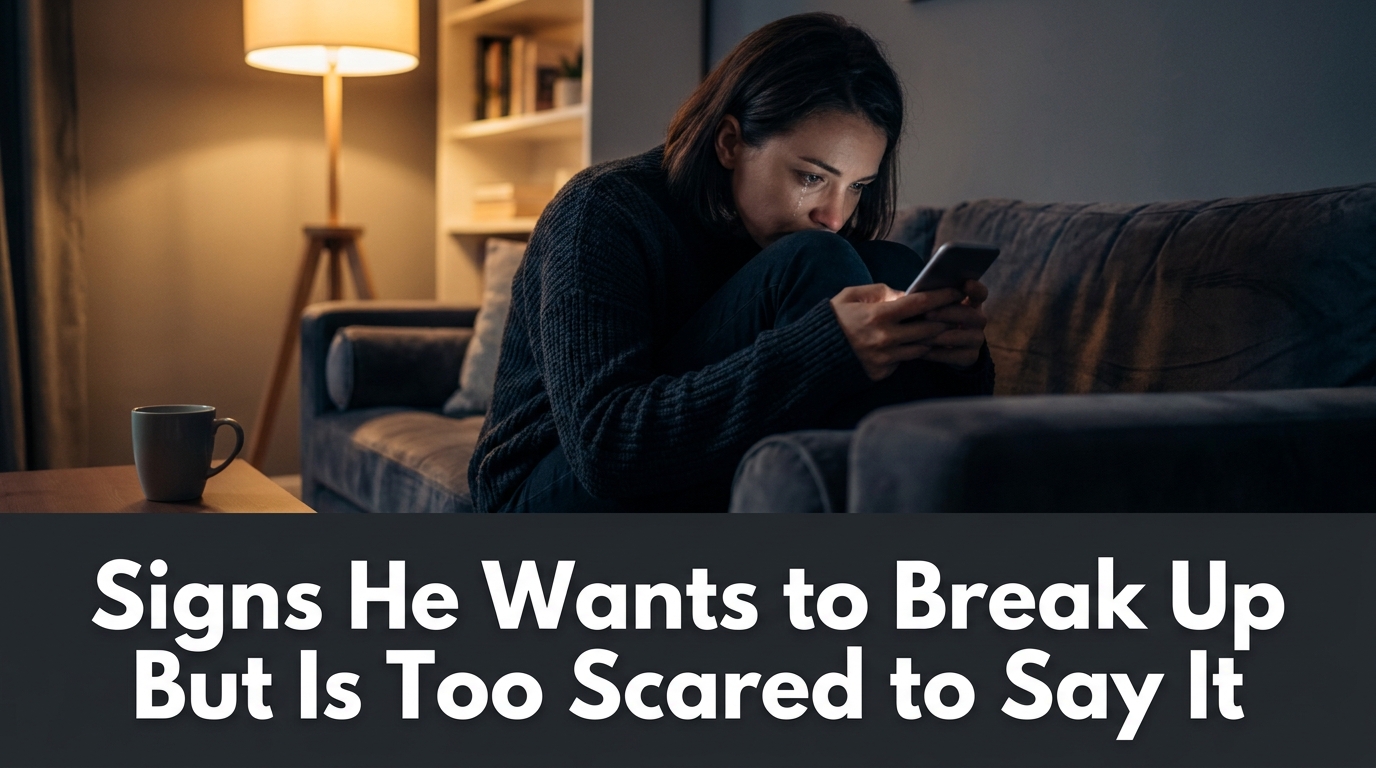
He hasn’t said anything. There’s been no fight, no formal conversation, no moment you can point to as the turning point. But something has shifted so completely that you can feel it in your body before your mind is ready to say it out loud. The warmth that used to be automatic has become something you reach for. The future you used to talk about has gone quiet. And you’re left in the most painful kind of uncertainty — not knowing, but already knowing.
Some people end relationships clearly. They have the conversation, they say the words, they give both people the dignity of a definitive ending. Others — whether from fear of conflict, guilt, emotional avoidance, or a genuine inability to tolerate causing pain — begin the withdrawal long before the words arrive.
According to relationship psychologist Dr. Ty Tashiro, passive relationship dissolution — where one partner gradually disengages without explicit communication — is one of the most psychologically damaging ways a relationship can end, precisely because it denies the other person the clarity they need to grieve and move forward. Recognizing the signs he wants to break up but is too scared to say it is not about catastrophizing. It is about seeing clearly — so you can stop waiting for something to be given to you and start deciding what you actually want to do.

Why Some Men Can’t Just Say It
Before the signs, this context matters — because understanding why he can’t say it directly changes how you respond to the situation.
Conflict avoidance is the most common driver. Many men have been conditioned — through upbringing, socialization, and relational experience — to avoid direct emotional confrontation at almost any cost. The prospect of a difficult, painful conversation in which they cause someone they care about genuine distress can feel psychologically overwhelming — so instead, they manage out. They reduce investment gradually, hoping the other person will eventually reach the conclusion themselves, sparing both of them the explicit moment.
Guilt plays a significant role too. A man who still cares about his partner — even if his romantic feelings have shifted — may genuinely not want to hurt her. The withdrawal feels, to him, kinder than the declaration. It is not. But understanding that it often comes from misguided consideration rather than cruelty changes the emotional register of your response.
Fear of her reaction is also common — particularly in relationships where conflict has historically been intense, or where a partner has expressed fears of abandonment that make the prospect of initiating a breakup feel genuinely dangerous to navigate.
None of these explanations excuse the behavior. Passive dissolution causes real harm. But understanding its roots keeps you from internalizing it as something about your worth — which is almost never what it’s about.
The Signs He Wants to Break Up But Is Too Scared to Say It
1. He Has Stopped Initiating Everything
Texts. Plans. Physical affection. Conversation. The initiating that used to feel natural and mutual has quietly become entirely yours. He responds — sometimes warmly, sometimes with effort — but he never reaches first. The relationship now exists primarily in the space you create for it, and without your initiative, it would mostly go quiet.
This is one of the clearest behavioral signals of passive withdrawal. Initiation requires investment — the active desire to bring someone into your day, your thoughts, your plans. When that desire fades, initiation fades with it. And a relationship sustained entirely by one person’s reaching is not a relationship being maintained by two.
2. The Future Has Gone Completely Quiet
There was a time when the future was something you talked about naturally — plans, trips, shared goals, casual references to a life that assumed your continued togetherness. Now those references have stopped entirely. Not just big plans — small ones too. He no longer talks about next month. He no longer assumes you’ll be there. The future, in his language, has become something he navigates alone.
Future-talk in a relationship is a form of commitment — the daily, low-level expression of the assumption that both people are building something together. When it disappears entirely, it often means one person has stopped building — and doesn’t know how to say that yet.
3. Physical Affection Has Dropped to Near Zero
Not just sex — all physical connection. The casual touch, the kiss that used to be automatic, the way he used to reach for your hand without thinking. Physical affection in a relationship tracks emotional investment closely. When a man is pulling away emotionally, the body tends to reflect that withdrawal before the words do. The absence of physical warmth — particularly when it was previously natural and consistent — is the nervous system communicating what hasn’t yet been spoken.

4. He Picks Fights Over Nothing — Then Disappears
Small arguments that seem disproportionate to the actual issue. Irritability that appears without clear cause. A low-level friction that wasn’t there before. Sometimes men who can’t say “I want to end this” unconsciously create conflict as a way of making the relationship feel worse than it is — building a case for an exit they already want but haven’t yet declared.
The pattern that follows the argument is also telling. Rather than repair — the reaching toward each other after conflict that healthy relationships depend on — he disappears. Goes quiet. The conflict doesn’t resolve into reconnection. It just ends, uncomfortably, with distance that doesn’t fully close.
5. He’s Suddenly Busy With Everything Except You
His schedule has filled in ways that consistently displace your time together. Work. Friends. Hobbies. Family. These are all legitimate parts of a full life — but the pattern worth examining is whether this busy-ness is new, whether it specifically replaces time that used to be yours, and whether it has appeared without acknowledgment or conversation about the change.
A man who is pulling away will often reorganize his time so that the relationship occupies less of it — not always consciously, but as a reflection of where his emotional investment actually is. The busyness is not the problem. The way it has quietly reprioritized you without discussion is.
6. Conversations Have Become Monosyllabic
You send a message. He replies with the minimum — “yeah,” “ok,” “sounds good.” You try to start a conversation and it dies within a few exchanges. The quality of his communication has declined not just in warmth but in engagement. He is no longer curious about your day, no longer sharing his, no longer bringing himself to the conversation as a participant.
This is not always intentional withdrawal — but it is almost always meaningful. The effort someone puts into conversation reflects the investment they feel in the connection. Monosyllabic replies from a man who once texted with care and curiosity are a significant behavioral signal that something has fundamentally changed.
7. He Has Stopped Making You Feel Chosen
There was a time when you felt specifically, deliberately chosen — through his attention, his words, his small acts of care that said you mattered to him in particular. That quality has gone. He is not unkind. He is just — neutral. Present in body. Absent in the specific attentiveness that made the relationship feel like something both of you were building rather than something he was simply still in.
Feeling unchosen in a relationship is one of the most demoralizing experiences available — particularly because it is so difficult to articulate. Nothing specific happened. But everything has quietly changed. And that change is real, even when it resists clear explanation.

8. He Has Become Vague About Everything
Plans are no longer confirmed — they are “maybe” and “we’ll see” and “I’ll let you know.” Responses that used to be direct have become evasive. When you ask direct questions about the relationship — how he’s feeling, where things are going — the answers are non-answers: “everything’s fine,” “I’ve just been stressed,” “I don’t know what you mean.”
Vagueness in a relationship context is almost always strategic — whether consciously or not. It maintains optionality. It avoids the confrontation of a definitive answer. It keeps the door technically open while the emotional investment quietly closes. When someone who was once direct with you becomes consistently vague, that shift is information worth taking seriously.
9. His Friends Are Pulling Back Too
His social world and yours have been connected — mutual friends, shared social plans, people who knew you as a couple. And now those connections have quietly cooled. His friends seem less warm. Invitations that used to include you have stopped coming. His social circle is subtly re-separating from yours in a way that suggests he may have said something — or simply that they are reading the same signs you are.
This is not always present — particularly in shorter relationships or those with less social overlap. But when it is present, it is one of the clearest external signals that the withdrawal is real rather than a temporary rough patch.
10. He’s Emotionally Present Elsewhere — Just Not With You
He comes home from time with his friends more alive than he’s been with you in months. He lights up about work, a project, a trip he’s planning — without you. He is capable of emotional engagement and genuine enthusiasm. He simply isn’t bringing it to the relationship anymore. The energy exists. It has been redirected.
This is perhaps the most clarifying sign of all — because it removes the possibility that the withdrawal is about general stress or life circumstances. He is not depleted. He is simply investing his aliveness somewhere else.

11. He Has Stopped Repairing After Conflict
Every relationship has conflict. What distinguishes healthy relationships from unhealthy ones is not the absence of conflict but the presence of repair — the reaching toward each other afterward, the acknowledgment, the restoration of warmth. He has stopped doing that. Arguments end without resolution. Difficult moments pass without either address or repair. The relationship accumulates small unresolved injuries with no mechanism for healing them — because he is no longer investing in the healing.
12. Your Instincts Have Been Telling You For a While
You have known something was wrong longer than you’ve been willing to say it. Not because you’re insecure or prone to anxiety — but because you have been paying close attention to someone you love, and your nervous system has been registering the micro-changes in his warmth, his attentiveness, and his investment for weeks or months. The instinct that has brought you to this article is not paranoia. It is perception. And it deserves to be trusted rather than rationalized away.
What to Do When You See These Signs
Have the direct conversation — once. Not an accusation, not an ultimatum, not a breakdown — a calm, honest statement of what you’ve noticed and what you need to know. “I’ve been feeling like something has shifted between us and I’d rather know the truth than keep wondering. Are you still in this?” One direct question, asked clearly and without performance, gives both of you the opportunity for the honesty that passive withdrawal has been avoiding.
Pay more attention to what follows the conversation than to the conversation itself. Whatever he says in that moment — reassurance, deflection, or honesty — what happens in the weeks afterward is the real answer. Sustained behavioral change in the direction of genuine re-engagement means something. A return to exactly the same patterns means something else.
Stop filling the silence with your effort. If you have been carrying the relationship’s momentum — initiating, planning, reaching — stop. Not as a test or a manipulation, but as an honest withdrawal of the effort that has been masking the imbalance. What remains when you stop filling the gap is an honest picture of where his investment actually is.
Know what you need — and say it. You are allowed to require honesty. You are allowed to require presence. You are allowed to say clearly that the current dynamic is not sustainable for you and that you need it to change. Not as an ultimatum but as an honest expression of what you actually need from a relationship — and what you will choose, for yourself, if that need goes unmet.
Trust the clarity when it comes. Whether it arrives through his words or through the sustained evidence of his behavior — when the picture becomes clear, trust it. Not the version you wish were true. Not the version filtered through hope. The clear, honest version that has been assembling itself through everything you’ve observed. That version is reliable. And you deserve to act on it.

The Bottom Line
Signs he wants to break up but is too scared to say it are rarely dramatic. They accumulate quietly — in the conversations that shorten, the future that goes silent, the physical warmth that withdraws, the reaching that only ever comes from one direction. By the time the pattern is undeniable, most people have been living with the knowing for longer than they’ve been willing to admit.
You deserve honesty. You deserve directness. You deserve a partner who, if they can no longer be fully present in the relationship, has the courage and the respect to say so. And if that honesty doesn’t come — if the words never arrive — you are allowed to trust what the behavior has already told you. Clearly, repeatedly, and for long enough that it has become impossible to ignore.
Waiting for someone to say what they have already shown you is not patience. It is the hope that love can be retrieved from somewhere it has already quietly left. You deserve more than to wait for words from someone whose actions have already spoken. Trust what you see. Trust what you feel. And trust yourself enough to act on it.
📌 Save, Share & Follow
💾 SAVE this article — return to it when you need permission to trust what you’ve already been seeing. 📤 SHARE this with someone who has been waiting too long for clarity that isn’t coming on its own. 👉 FOLLOW TruthsInside.com for more honest, psychology-backed relationship content that gives you real clarity when you need it most.
❓ Frequently Asked Questions
Q1: What is the difference between him wanting to break up and just going through a rough patch? Duration, pattern, and response to connection attempts are the clearest distinguishing factors. A rough patch is typically tied to identifiable external stressors, is acknowledged between both people, and responds to warmth and reconnection. Passive withdrawal toward a breakup tends to be more sustained, less explained by external circumstances, and resistant to resolution regardless of your efforts to reconnect. The clearest test: does warmth from you produce any genuine reciprocation, or does the distance hold regardless of what you offer?
Q2: Should I ask him directly if he wants to break up? Yes — once, calmly, and without making the conversation a crisis. You deserve a direct answer and asking a direct question is the most self-respecting way to get one. The key is asking from a grounded place rather than a desperate one — “I’ve noticed things feel different between us and I’d rather know the truth than keep wondering” is a clear, dignified invitation for honesty that most people, even conflict-avoidant ones, find difficult to deflect entirely.
Q3: What if he says everything is fine but the behavior doesn’t change? Then the behavior is the answer. Words in a moment of confrontation are less reliable than patterns of behavior sustained across weeks and months. If the conversation produces reassurance but no actual change in the patterns you’ve identified, you have received important information — not about what he says, but about what he is actually doing. Trust the behavior over the words.
Q4: Is it possible he doesn’t know himself that he wants to break up? Yes — and more common than people realize. Emotional ambivalence — genuinely not knowing whether you want to stay or go — produces many of the same behavioral signals as a decision already made. A man in genuine ambivalence may be withdrawing without conscious awareness of it, as his unresolved feelings express themselves through behavior before they’ve been processed into clarity. This doesn’t make the withdrawal less real or less painful — but it does mean the conversation may produce genuine surprise rather than confirmed intention.
Q5: How long should I wait before deciding to walk away? There is no universal timeline — but if you have had an honest conversation about what you’ve noticed, given it a genuine window of time for change, and the patterns have remained the same or worsened, that sustained evidence is sufficient to act on. Waiting indefinitely for clarity that never comes is not loyalty. It is the sacrifice of your present to a situation that has already told you, through consistent behavior, what it is.
🎵 Music
Maren Lull is a singer-songwriter who writes from the places most people don’t talk about out loud.
Not the dramatic grief. Not the obvious heartbreak. The quiet kind — the ordinary Tuesday emptiness, the habit of reaching for someone who isn’t there anymore, the particular exhaustion of being strong for so long that the strength itself wears thin.
Her music lives at the intersection of emotional honesty and soft beauty — breathy vocals over gentle piano, slow tempos, lyrics that feel less like songs and more like something you wrote in a private notebook at two in the morning and never showed anyone.
Maren Lull writes for the people who feel everything deeply and say very little about it. For the ones who listen to sad music not because they want to feel worse — but because being understood, even by a song, makes the feeling easier to carry.
📱 Follow Maren Lull:
→ Spotify
→ Apple Music
→ Youtube
→ Audiomack