
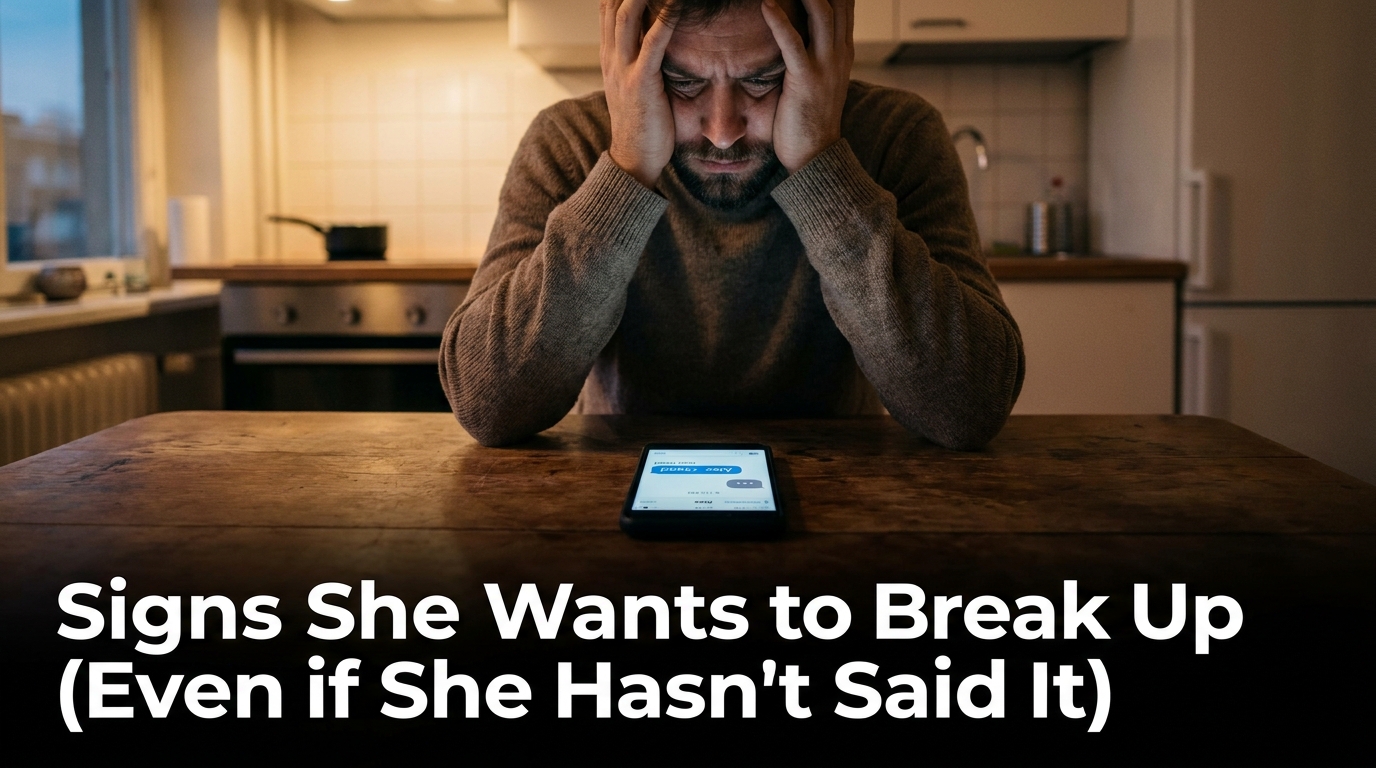
She hasn’t said anything. There’s been no conversation, no ultimatum, no defining moment you can point to. But the woman who used to text you good morning without thinking has gone quiet in ways you can feel before you can explain. The warmth is still there sometimes — just enough to make you wonder if you’re imagining the distance. And the uncertainty is doing something to you that the truth, however painful, never could.
Women, on average, process the ending of a relationship differently than men. Research published in the Journal of Social and Personal Relationships found that women tend to experience greater emotional preparation before initiating a breakup — meaning the decision has often been made, processed, and grieved internally long before it is ever spoken out loud. By the time she says the words, she may have been emotionally leaving for weeks or months. Understanding the signs she wants to break up — before the conversation arrives — is not about control or pre-emption. It is about having the clarity and the dignity to respond to what is actually happening, rather than being blindsided by a decision that her behavior has already been communicating.

Why Women Pull Away Before They Speak
Before the signs, understanding the psychology behind this pattern is worth the pause — because it changes how you receive the information.
Women are generally more emotionally process-oriented than men in relationship contexts. Before ending a relationship, many women go through an extended internal cycle of weighing, grieving, and resolving — working through the decision over weeks or months before they feel ready to externalize it. This internal processing is not dishonesty. It is the way many women protect themselves from the vulnerability of speaking a painful truth before they are certain of it.
There is also the factor of safety. Women who have experienced conflict that escalated, or who are conflict-averse, or who are genuinely uncertain about their partner’s reaction to a breakup conversation may delay the explicit conversation out of real or perceived emotional risk. The withdrawal becomes a way of managing the ending without triggering the confrontation.
And sometimes — honestly — the pulling away is not yet a decision. It is ambivalence, quietly expressing itself through behavior before it has resolved into clarity. She may not know yet that she wants to leave. She may only know that something is wrong, that she is unhappy, and that she needs distance to figure out what that means.
Understanding which of these is true in your specific situation is part of what the honest conversation — when you choose to have it — is for.
The Signs She Wants to Break Up
1. She Has Become Emotionally Unavailable
She used to share things with you — the small frustrations of her day, the things she was thinking about, the moments she wanted to process out loud. Now she keeps those things to herself. Her interior life has quietly closed to you. You ask how she is and you get the surface answer. You try to connect and find a warmth that is present but careful — there, but not fully open.
Emotional withdrawal in a woman who was previously emotionally available is one of the earliest and most significant signs that something has fundamentally shifted. She is not sharing herself with you anymore — and for most women, the withdrawal of emotional intimacy precedes the withdrawal of everything else.
2. She Has Stopped Bringing Up the Future
She used to reference the future naturally — plans, shared goals, things she was looking forward to doing with you. Now those references have gone quiet. Not just big plans — small ones too. The casual assumptions of togetherness that used to appear in everyday conversation have disappeared. She speaks about her future in the first person rather than the first-person plural.
When a woman stops building a future with you in language, it often means she has stopped building it in her mind. The future-talk disappears before the relationship officially ends because she has already begun the process of imagining a future that doesn’t include you — and the gap between that internal picture and the current reality shows up first in conversation.
3. She Is Irritable With You Specifically
The patience and warmth she extends to friends, colleagues, and strangers has not disappeared — but with you, a low-level irritability has appeared that wasn’t there before. Small things that never bothered her now do. She sighs at things you say. She is short in ways that feel disproportionate. She corrects or dismisses you in ways that feel new.
This specific irritability — reserved for you rather than generalized to her life — is worth examining honestly. It often signals that the relationship itself has become a source of frustration or emotional dissonance that she hasn’t yet found a way to address directly. The irritability is the pressure of something unspoken looking for an outlet.

4. She Has Stopped Fighting for the Relationship
There was a time when she engaged with conflicts — when she pushed back, advocated for her needs, insisted on resolution. Now she lets things go — not with peace, but with a flatness that feels like resignation. She doesn’t argue. She doesn’t push. She has gone quiet in the conflicts that used to matter to her.
As explored throughout this series, the absence of conflict is not peace. In a relationship with a history of engagement, the disappearance of a woman’s willingness to fight for what she needs is often a signal that she has stopped believing the fight is worth having. She is not at peace. She has simply quietly withdrawn her investment from the outcome.
5. Her Phone Has Become Private
This is not about suspicion or surveillance — it is about a behavioral shift worth noticing. She has become more private about her phone than she used to be. She angles the screen away. She steps out to take calls. She is more careful about what she shares from her phone life with you. The phone itself may mean nothing — what is meaningful is the behavioral shift, particularly when it is accompanied by other signs on this list.
The privacy may reflect a new emotional life she is building separately from you — conversations with friends about the relationship, the beginning of imagining a different future, or simply the instinct to create space that belongs entirely to her as the relationship’s emotional distance grows.
6. She Has Reinvested in Her Independent Life
She has reconnected with friends you rarely saw. She has picked up interests and activities that existed before you, or that don’t include you. Her social calendar has filled in a way that consistently displaces your time together. She is visibly building — or rebuilding — a life that doesn’t require your presence at its center.
This reinvestment in independence is one of the most consistent behavioral patterns that precedes a woman ending a relationship. It is not always a sign of impending breakup — healthy relationships include individual lives and independent interests. But when it appears suddenly, specifically, and alongside emotional withdrawal, it often signals that she is preparing emotionally and practically for a transition she hasn’t yet made official.
7. Physical Affection Has Become Perfunctory
She still kisses you hello. She still sits beside you. But the quality of physical affection has changed in a way you can feel even if you can’t fully articulate it. The warmth has become mechanical. The touch is present but not invested. The physical closeness that used to feel like she was choosing you has become something closer to habit or politeness.
Physical intimacy tracks emotional intimacy closely in relationships — and for most women, physical withdrawal follows emotional withdrawal as the relationship’s internal landscape shifts. The change is rarely abrupt. It arrives gradually, in the quality of touch rather than its presence, which is why it can be so difficult to name while being impossible to ignore.

8. She Compares You — To Other Men or to a Standard You Can’t Meet
Subtle comparisons have started appearing in conversation. A friend’s partner does something a particular way. She read about how healthy relationships look and it doesn’t match what you have. The implicit message, repeated in various forms, is that you are falling short of a standard she has begun applying to the relationship. These comparisons are rarely random. They reflect a woman who has begun evaluating the relationship against an alternative — and finding it lacking.
9. She Has Stopped Making You Feel Seen
She used to notice you — your mood, your effort, the specific things you did that were about her. She acknowledged them. She expressed appreciation. She made you feel that she saw what you brought to the relationship and valued it. Now that quality of attentiveness has withdrawn. You can do something meaningful and it passes without comment. The feeling of being genuinely seen by her has gone quiet — and with it, the specific aliveness that being seen by someone you love produces.
10. She Says She Needs Space — And Takes It
She has asked for space. Time to think, time alone, time to figure things out. And unlike the natural, healthy need for solitude that appears in every relationship, this feels different — less like a request for rest and more like a request for distance from the relationship itself. The space she is taking is not replenishing something between you. It is creating a separation that feels increasingly like it might become permanent.

11. Your Conversations Feel Like an Obligation to Her
She answers your questions. She responds to your texts. She shows up for plans. But the quality of her engagement has changed from genuine to dutiful. You can feel the difference between someone who is present because they want to be and someone who is present because they feel they should be. The conversations that used to flow now have a slight effortfulness to them — a quality of going through the motions that she may not even be fully conscious of.
12. She Has Told You She Is Unhappy — Even Once
This one is the most direct and the most commonly minimized. She said something — “I’ve been unhappy lately,” “I’m not sure this is working,” “I don’t know what I want” — and you heard it as venting, as a moment of frustration, as something that would pass. But a woman who says something that honest, even once, is not venting. She is showing you the edge of a decision she is working toward. The words may have been soft. They were not small.
What to Do When You See These Signs
Have the honest conversation — from a grounded place. Not from panic, not from a place of accusation, but from a genuine desire to understand what is actually happening between you. “I’ve noticed things have felt different between us lately — I’d rather know the truth than keep wondering. How are you feeling about us?” One clear, direct question asked with genuine openness creates the conditions for the honesty that both of you need.
Listen to what she says — and what she doesn’t. Her answer will tell you something. What she does in the weeks after the conversation will tell you more. Pay attention to both the words and the behavioral follow-through with equal seriousness.
Don’t try to fix it before you understand it. The instinct, when you sense something is wrong, is to do more — more attention, more effort, more grand gestures. Sometimes that helps. More often, it produces a dynamic where your increased effort meets her continued withdrawal — which is information in itself. Before you do more, understand what you’re actually responding to.
Take her unhappiness seriously — even if it’s uncomfortable. If she has told you she is unhappy, or shown you through sustained behavioral withdrawal, the most respectful response is to take that seriously rather than hoping it will resolve itself. Her unhappiness — whether or not it leads to a breakup — deserves a genuine conversation and genuine response, not management or minimization.
Know what you need too. This is not only about her. You are in this relationship too — with your own needs, your own investment, and your own right to clarity about where things stand. You are allowed to require honesty. You are allowed to say that the current uncertainty is not sustainable for you. You are allowed to make decisions based on the full picture of what you’re actually experiencing — not just on what you hope might still be possible.

The Bottom Line
Signs she wants to break up are rarely loud. They arrive in the emotional withdrawal, the future that stops being mentioned, the physical warmth that becomes perfunctory, the irritability that appears without a specific source. By the time the pattern is undeniable, she has usually been carrying this internally for longer than the behavioral signals suggest.
You deserve clarity. You deserve honesty. You deserve a partner who, if she can no longer be fully present in the relationship, has the courage to say so — or, at minimum, the willingness to respond honestly when you ask directly. And if the signs are as clear as they appear, you are not failing by seeing them. You are paying attention. And paying attention — to what is actually true rather than what you hope is true — is the most honest thing you can do for yourself and for the relationship, whatever comes next.
The truth she hasn’t said yet is already present in everything she’s been doing. You’re not misreading it. You’re not being paranoid. You are simply paying close attention to someone you love — and what you’re seeing deserves to be taken seriously, spoken about honestly, and responded to with the clarity and self-respect you have always been owed.
📌 Save, Share & Follow
💾 SAVE this article — return to it when you need permission to trust what you’ve already been sensing. 📤 SHARE this with someone who has been trying to decode a withdrawal that nobody has been honest enough to explain. 👉 FOLLOW TruthsInside.com for more honest, psychology-backed relationship content that gives you real clarity when you need it most.
❓ Frequently Asked Questions
Q1: How do I know if she’s pulling away or just going through something difficult? The key distinction is whether the withdrawal is explained by identifiable external circumstances and whether she acknowledges the distance and shows willingness to reconnect. A woman going through something difficult typically communicates that — even imperfectly — and responds to warmth and genuine offers of support. A woman who is emotionally leaving tends to maintain the distance regardless of what you offer, and may resist the very closeness that would help if her withdrawal were circumstantial.
Q2: Should I bring it up or give her space? If you have been giving space for more than a few weeks with no change in the dynamic, bringing it up is almost always the right move. Indefinite waiting rarely produces spontaneous recovery — and the longer the honest conversation is avoided, the more distance accumulates. One calm, direct conversation is almost always better than extended uncertainty. Ask from a place of genuine curiosity rather than accusation, and pay close attention to both what she says and what she does afterward.
Q3: What if she says everything is fine but nothing changes? Then her behavior is the more reliable answer. Reassurance offered in a confrontational moment is less meaningful than sustained behavioral change in the direction of genuine re-engagement. If the conversation produces “everything is fine” but the patterns identified in this article continue unchanged, you have received important information — not about what she says she feels, but about what her behavior actually reflects.
Q4: Is it possible she doesn’t realize she’s pulling away? Yes — and more common than people expect. Emotional ambivalence often expresses itself through behavior before it has been consciously processed into a decision. She may be withdrawing without full awareness that she is doing so, or without having resolved whether withdrawal is what she actually wants. This is part of why a direct, honest conversation — asked with genuine openness — can sometimes produce surprise and genuine reflection rather than a confirmed decision.
Q5: How long should I wait before deciding to walk away? If you have had an honest conversation, given it a genuine window of time — four to six weeks is a reasonable minimum — and the patterns have continued or worsened without meaningful acknowledgment or change, that sustained evidence is sufficient to act on. Waiting indefinitely for a clarity that isn’t coming is not patience or loyalty. It is the sacrifice of your own emotional wellbeing to a situation that has already communicated, through consistent behavior, what it actually is.
🎵 Music
Maren Lull is a singer-songwriter who writes from the places most people don’t talk about out loud.
Not the dramatic grief. Not the obvious heartbreak. The quiet kind — the ordinary Tuesday emptiness, the habit of reaching for someone who isn’t there anymore, the particular exhaustion of being strong for so long that the strength itself wears thin.
Her music lives at the intersection of emotional honesty and soft beauty — breathy vocals over gentle piano, slow tempos, lyrics that feel less like songs and more like something you wrote in a private notebook at two in the morning and never showed anyone.
Maren Lull writes for the people who feel everything deeply and say very little about it. For the ones who listen to sad music not because they want to feel worse — but because being understood, even by a song, makes the feeling easier to carry.
📱 Follow Maren Lull:
→ Spotify
→ Apple Music
→ Youtube
→ Audiomack