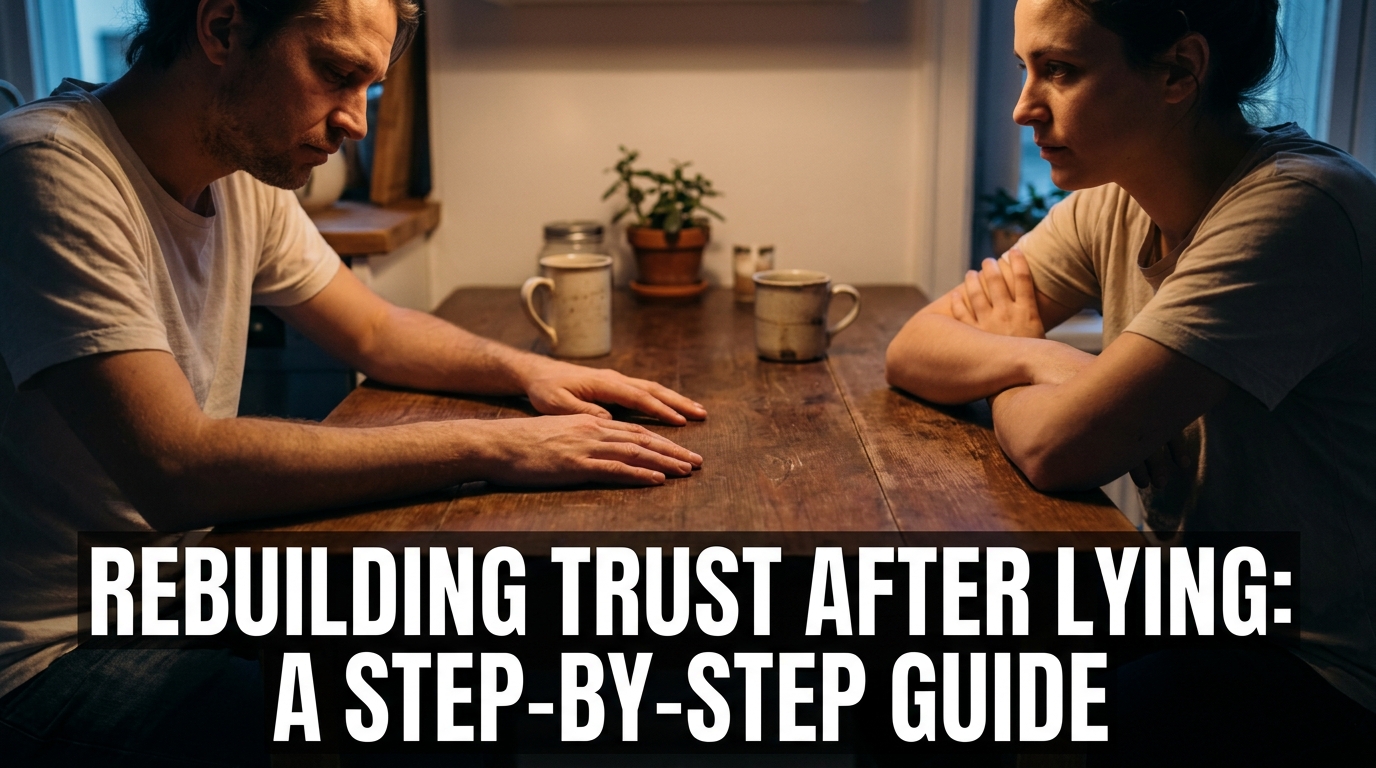
A lie changes things.
Not always dramatically. Sometimes the change is quiet — a slight shift in the quality of your partner’s attention, a new carefulness in how they word their questions, a warmth that is almost but not quite what it used to be.
And sometimes the change is seismic — the kind that reorganizes everything, that makes both people wonder whether the relationship that existed before the lie was ever fully real.
Trust, once broken through dishonesty, does not mend through time alone. Research from the Journal of Social and Clinical Psychology found that trust violations involving deliberate deception produce longer lasting damage to relationship security than many other forms of relationship harm — precisely because they call into question not just what happened but what the person believed was true across the entire relationship.
Rebuilding trust after lying is not simple. It is not quick. And it is not guaranteed.
But it is possible. And this is the step-by-step guide for doing it — honestly, practically, and with the full weight of what it actually requires.

Before the Steps: What Rebuilding Actually Requires
Before mapping the process, there are foundational truths about rebuilding trust after lying that need to be stated clearly — because without them, every step that follows will be built on unstable ground.
The Lie Must Be Fully Disclosed
One of the most consistent findings in research on trust recovery is that partial disclosure — telling some of the truth while withholding the rest — is more damaging than the original lie.
Every piece of truth that emerges later restarts the recovery process from the beginning. Every “there’s something else” confirms the fear that drove the hurt partner’s hypervigilance: that the complete truth has still not been offered. That the disclosure is still being managed rather than given.
Full, complete disclosure — however difficult, however much you fear it will end the relationship — is the only foundation on which genuine rebuilding is possible. Partial truth, however strategically offered, is still a form of deception.
Genuine Remorse Is Not the Same as Regret
Regret is self-referential — it focuses on the consequences of the lie for the person who told it. Genuine remorse is other-directed — it focuses on the harm the lie caused the person who was deceived.
The partner who says “I feel terrible about what I did” but who is primarily concerned with the impact on themselves — on the relationship they might lose, on the image of themselves as an honest person — is experiencing regret.
The partner who says “I understand what this has cost you and I am genuinely sorry for that harm” — who can receive their partner’s anger without becoming defensive, who can sit with the discomfort of having caused pain without redirecting the conversation toward their own feelings — is experiencing remorse.
Only remorse provides the foundation for genuine rebuilding.
Rebuilt Trust Is Not the Same as Pre-Lie Trust
The trust that existed before the lie included an innocence — an assumption of honesty — that is now permanently altered. That specific trust is gone. What can be built is different: trust that has been tested, that carries full knowledge, that is deliberately constructed through sustained and verified behavior change.
This rebuilt trust is not lesser. In many ways it is more durable — because it is not based on assumed honesty but on demonstrated honesty across time. But it is different. And recognizing that difference prevents both partners from trying to return to something that no longer exists, and helps them focus on building something genuinely new.
“Rebuilt trust after deception is not a return to innocence. It is the construction of something more deliberate — trust that has been chosen with full knowledge rather than assumed without it.” — Relationship Psychology
The Step-by-Step Guide
Step 1 — Tell the Complete Truth — Once, Fully, Without Omission
This is the first and most foundational step — and the one that requires the most courage from the person who lied.
Complete truth means exactly that. Not the version managed for the most favorable reception. Not the truth with certain details omitted because they seem unnecessarily hurtful. The complete truth, offered once, fully, without requiring your partner to extract additional information through questioning.
This conversation — ideally held in person, at a time when both people are calm enough to engage with it, and ideally in the presence of a couples therapist who can help both partners navigate its weight — needs to answer the questions your partner has not yet asked as well as the ones they have. Because your partner’s questions will evolve as they process what they have learned. Each new question that reveals a previously withheld detail restarts the trust recovery process.
Full truth given once is painful. The same truth revealed in stages across weeks and months is far more damaging.
Step 2 — Take Complete Responsibility — Without Explanation Alongside the Apology
This step requires resisting one of the most natural impulses available: the impulse to explain.
Explanation is not the same as justification, and in isolation — outside the immediate apology — it is entirely appropriate and eventually necessary. But explanation placed alongside the apology immediately transforms accountability into something diluted.
“I’m sorry I lied, but I was scared of how you would react” is an apology and a justification in the same breath. The justification does not cancel the apology. But it communicates: I accept responsibility for this up to a point. Beyond that point, circumstances are involved.
The complete accountability apology sounds like: “I lied to you. That was wrong. I am not going to make excuses for it.” Without the but. Without the however. Without the context that could soften what needs, right now, to land without softening.
Context — the circumstances that contributed, the internal state that preceded the lie, the underlying fear or need that was driving the behavior — has an important place in the full understanding of what happened. That place is in a later conversation, invited by your partner when they are ready for it, after the unconditional accountability has been genuinely offered.

Step 3 — Listen to Your Partner’s Response — Fully, Without Becoming Defensive
Your partner’s response to the truth and to your accountability will almost certainly be difficult to receive. Anger. Grief. Disbelief. Questions that feel like accusations. Silence that feels like punishment. The activation of every feeling the lie produced, directed at you.
Your role in this step is to receive all of it — without becoming defensive, without redirecting the conversation toward your own pain, without communicating through your response that their reaction is more than you can manage.
This is genuinely difficult. You have also been through something — the fear of disclosure, the weight of the lie, the anticipation of this moment. But the timing of when your experience gets space in this conversation is not now. Now, it is their experience that deserves space.
Practice staying present. Practice receiving the anger without flinching into defensiveness. Practice hearing the grief without trying to fix it. Practice sitting with the discomfort of being the cause of this pain without making that discomfort about yourself.
If you become flooded — if the emotional activation becomes too high to continue the conversation productively — say so directly: “I want to hear everything you need to say. I’m feeling overwhelmed right now and I’m scared I’ll respond in a way that isn’t fair to you. Can we take 20 minutes and come back?” Then actually come back.
Step 4 — Answer Every Question — Honestly, Completely, Without Irritation
In the days and weeks following disclosure, your partner will have questions. Many questions. The same questions, sometimes, asked multiple times as they attempt to integrate information that keeps not fully landing.
Every question deserves an honest, complete answer. Without irritation. Without the communicated impatience of someone who feels they have already answered this. Without the implied message that the questioning is excessive or prolonged beyond what the situation warrants.
Each question your partner asks is an attempt to understand — to integrate the new reality created by the lie into a coherent picture of what happened and why. The questioning is not persecution. It is the work of rebuilding, being done by the person who was harmed.
If you do not know the answer to a question — if the question asks you to explain something about your own behavior that you do not yet fully understand — say so honestly. “I don’t fully understand why I did that yet. I’m working on understanding it and I’ll tell you when I do.” This is more trustworthy than a constructed explanation that answers the question without being true.

Step 5 — Offer Transparency Proactively — Before Being Asked
One of the most important behaviors in rebuilding trust after lying is the shift from reactive honesty to proactive transparency.
Reactive honesty is answering questions truthfully when asked. This is necessary — but insufficient for genuine trust rebuilding.
Proactive transparency is volunteering information before being asked. Sharing your whereabouts before your partner wonders. Mentioning something relevant before it becomes a source of anxiety. Offering information that your partner would want to know without requiring them to ask for it.
This shift — from waiting to be asked to actively sharing — communicates something that words alone cannot: I understand why you need more information right now. I am not going to make you work for it. Your sense of security is more important to me than my convenience.
Proactive transparency is one of the most powerful behavioral signals available in the rebuilding process — precisely because it requires ongoing effort, cannot be faked across months, and demonstrates through consistent action rather than repeated declaration that the commitment to honesty is genuine.
Step 6 — Seek to Understand Why the Lie Happened — Genuinely
This step is for the person who lied — not as a gift to their partner, but as necessary self-understanding without which the risk of repeating the behavior remains high.
Why did you lie? Not the surface-level why — “because I was afraid of your reaction” — but the actual why. What was the fear based on? What need was the lie attempting to protect? What in your own history made dishonesty feel like an available option — like something your nervous system reached for rather than direct, honest communication?
These questions are not comfortable. They are also not optional if genuine change is the goal. Because a person who understands only that they lied — without understanding the conditions that made lying available to them — is a person who remains in those conditions.
Individual therapy is invaluable for this exploration. A skilled therapist can help you trace the behavior back to its origins — the early experiences that normalized it, the patterns it serves, the fears it protects against — and begin developing different internal responses to the situations that previously produced dishonesty.

Step 7 — Make Changed Behavior Visible and Consistent
The most important thing in rebuilding trust after lying is not anything you say. It is what you do — consistently, across time, in circumstances both significant and unremarkable.
Changed behavior needs to be:
Visible. Not assumed. Not expected to be inferred. Actively and clearly demonstrated in ways your partner can observe and that address the specific breach of trust that occurred.
Consistent. Not present when the relationship is under scrutiny and quietly reverted when it is not. Not most honest during the period when the consequences of the lie are most immediately present. Consistent across months and years — in the ordinary moments as much as the significant ones.
Sustained. Not a sprint of honesty in the immediate aftermath of disclosure followed by a gradual return to previous patterns. A permanent change in how you navigate the situations that previously produced dishonesty.
The changed behavior is the proof that the apology meant what it said. It is the evidence that the remorse was genuine. It is the most trustworthy thing available — more trustworthy than any declaration, any promise, any demonstration of regret — because it cannot be sustained through performance alone. It requires actual internal change.
Step 8 — Be Patient With Your Partner’s Healing Timeline
Your partner’s healing does not follow your preferred schedule. It does not move faster because you have apologized genuinely, because you have been transparent for six months, because you feel that enough time has passed and things should be better by now.
The healing moves at the pace the nervous system can update its assessment — which is the pace of accumulated evidence, not the pace of declarations. Anxiety reduces as reliable, consistent behavior accumulates across time. Triggers diminish as the nervous system’s threat assessment is gradually updated by the absence of new violations.
This takes longer than most people who have lied want it to take. It takes as long as it takes.
Communicating impatience with your partner’s healing timeline — however subtly, however unintentionally — communicates that their recovery is less important than your comfort with having the recovery be over. That communication damages the rebuilding more than almost anything else that can happen in this phase.
Practice genuine patience. Not performed patience — genuine internal acceptance that your partner’s healing is their healing, and that your role is to maintain the conditions that make healing possible, not to manage the pace at which it occurs.
Step 9 — Rebuild the Culture of Honesty Together
Rebuilding trust after lying is not only about the specific lie. It is about rebuilding — or building for the first time — a relationship culture in which honesty is genuinely safe, genuinely practiced, and genuinely mutual.
This requires examining what made the lie feel available or necessary in the first place. Was there something about how honesty had been received in this relationship — a partner’s reaction to previous disclosures, a pattern of conflict that made difficult truths feel too dangerous to share — that contributed to the conditions in which the lie happened?
This is not about distributing blame for the lie. The person who lied is responsible for having lied. But a genuine rebuilding examines the full relational context — not to excuse the behavior but to understand the environment in which it occurred and to change that environment together.
Both partners committing to a culture in which difficult truths are shared with care and received without punishment — however imperfectly, however gradually — creates the conditions in which future honesty becomes more available than future dishonesty.

For the Partner Who Was Lied To
Everything in the above addresses the person who lied. This section is for you — the person who was deceived.
Your anger is legitimate. Including the anger that returns after you thought it had passed. Including the anger at moments that seem unrelated to the lie itself. The anger is carrying the full weight of the betrayal — not just the lie, but what the lie says about what was concealed from you, and for how long.
Your need for answers is legitimate. The repeated questions, the need to understand, the inability to simply accept what happened and move forward — these are the nervous system’s attempt to integrate information it did not have, to construct a complete picture of reality after operating on an incomplete one. They are not excessive. They are the work of rebuilding.
You get to decide what rebuilding looks like for you. Including the decision that it is not possible. Including the decision that the lie — whatever it was — cannot become the foundation for what comes next. Your assessment of what you can and cannot sustain is yours to make, and it is legitimate regardless of how genuinely the other person is trying.
Your healing does not have a schedule. Not six months. Not a year. Not the schedule your partner’s visible remorse suggests. Your healing has its own timeline, shaped by the specific nature of the lie, the history of the relationship, and the quality of the rebuilding that is actually occurring. It takes as long as it takes. And that timeline is not something you are required to justify.
When Rebuilding Is Not the Right Answer
This needs to be said — because the impulse to try, to work through things, to not give up is sometimes itself the thing that keeps people in situations that cannot genuinely be repaired.
Rebuilding after lying is significantly less likely to succeed when the person who lied shows no genuine remorse, when lying is a pattern rather than an isolated incident, when additional lies emerge during the rebuilding process, when the person who lied is unwilling to engage with the self-examination that understanding why requires, or when the fundamental sense of security the betrayed partner needs cannot be restored regardless of the rebuilding effort.
Ending a relationship after dishonesty is not failure. It is the recognition that the specific conditions for genuine rebuilding are not present — and that spending years attempting to rebuild on a foundation that cannot hold produces a different and more prolonged kind of suffering than the grief of an honest ending.
The question is not whether rebuilding is theoretically possible. It is whether it is genuinely possible for these specific people, in this specific relationship, with the specific resources and genuine willingness that are actually present.
That question, answered honestly, is the only one that matters.
Rebuilding trust after lying is not the restoration of what was. It is the construction of something new — built with full knowledge, with genuine accountability, with sustained changed behavior, and with the deliberate choice of both people to try. That construction is difficult. It is also one of the most meaningful things two people can build together — because it is built not on assumption but on earned, demonstrated, chosen truth.
CALL TO ACTION
💾 Save this — return to it whenever the process gets hard and the steps feel unclear. 📤 Share it with someone navigating this — on either side of the lie. 👣 Follow Truthsinside.com for honest, psychology-backed relationship content every week.
Frequently Asked Questions
Q1: How long does it take to rebuild trust after lying? There is no fixed timeline — and any answer that provides one is more reassuring than accurate. The timeline depends on the nature and severity of the lie, the history of the relationship, the genuine presence of remorse and behavioral change in the person who lied, and the quality of the rebuilding process. Research on trust recovery after deliberate deception suggests meaningful healing across one to three years of sustained, genuine rebuilding effort — with professional support significantly improving both the quality and the speed of recovery.
What consistent research agrees on is that attempting to compress the timeline — declaring recovery complete before it genuinely is — tends to produce relationships that appear rebuilt while carrying the unprocessed weight of the original wound.
Q2: How do I know if my partner is genuinely changing or just afraid to lose me? Behavioral consistency across time is the most reliable indicator. Genuine change sustains transparent, honest behavior across the entire rebuilding process — not just during the period when the relationship is most acutely at risk. The impatience with the rebuilding process that “afraid to lose you” produces tends to emerge as the immediate crisis fades — in subtle communications that the healing is taking too long, that the questions are excessive, that you should be moving forward faster.
Genuine remorse sustains patience with your timeline regardless of how long it takes, because it understands that the timeline is determined by the depth of the harm, not by the convenience of either person.
Q3: My partner lied about something they say was to protect me. Does that change things? It is worth examining honestly. Protective lies — told to spare someone pain, to shield them from something genuinely difficult — are different in motivation from self-serving lies. But they are not different in their impact on trust.
The person who was lied to still lost the ability to make informed decisions about their own life, based on the reality their partner constructed for them. The motivation matters for understanding — and for assessing whether the behavior reflects a pattern of control or a misguided attempt at care. It does not change the fundamental breach of trust or the need for the rebuilding process that the lie has made necessary.
Q4: What if I am the one who lied and I do not fully understand why? This is honest and important — and worth saying directly rather than constructing an explanation that seems complete but is not fully true. “I don’t fully understand why I did it yet. I’m working on understanding it and I’ll tell you when I do” is more trustworthy than a rehearsed explanation that fills the silence without being accurate. Individual therapy is specifically valuable here — for exploring the patterns, fears, and early experiences that made dishonesty available to you as an option. Understanding why is not optional for genuine change.
It is the foundation of it. Without it, the conditions that produced the lying remain present.
Q5: Can a relationship actually be stronger after a trust violation? Yes — though this outcome is specific and not universal. Relationships that go through the full rebuilding process — complete disclosure, genuine accountability, sustained transparent behavior, therapeutic support, and honest examination of the conditions that produced the breach — often emerge with a quality of honesty and genuine knowing that was not present before.
Because the rebuilding process requires both partners to be more genuinely honest with each other than they were before the lie, the relationship that results from successful rebuilding is often more authentic than the one that preceded it. This is not inevitable. It is the outcome of genuine, sustained, mutual commitment to the process — and it is worth knowing is possible.
🎵 Music
Maren Lull is a singer-songwriter who writes from the places most people don’t talk about out loud.
Not the dramatic grief. Not the obvious heartbreak. The quiet kind — the ordinary Tuesday emptiness, the habit of reaching for someone who isn’t there anymore, the particular exhaustion of being strong for so long that the strength itself wears thin.
Her music lives at the intersection of emotional honesty and soft beauty — breathy vocals over gentle piano, slow tempos, lyrics that feel less like songs and more like something you wrote in a private notebook at two in the morning and never showed anyone.
Maren Lull writes for the people who feel everything deeply and say very little about it. For the ones who listen to sad music not because they want to feel worse — but because being understood, even by a song, makes the feeling easier to carry.
📱 Follow Maren Lull:
→ Spotify
→ Apple Music
→ Youtube
→ Audiomack