
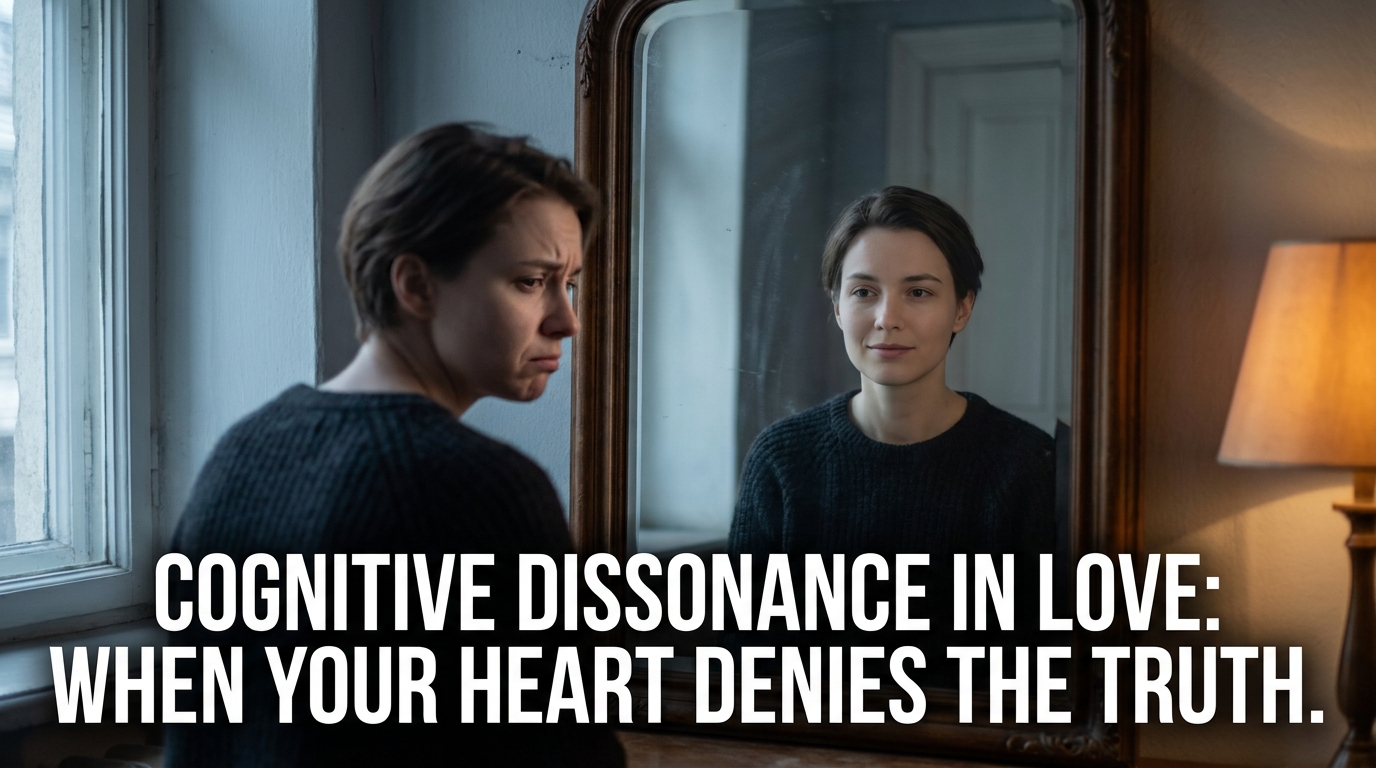
You know something is wrong.
Not the vague discomfort of ordinary relationship difficulty — something clearer than that. A specific knowledge that something important is not right. That a behavior was not acceptable. That something you were told does not match what you witnessed. That the person across from you is not who you believed them to be.
And yet you do not act on that knowledge.
You explain it away. You reframe it. You find the interpretation that allows the relationship to remain intact, that preserves the image of the person you chose, that permits you to stay where you are. You work, with remarkable cognitive effort, to maintain a reality that your own perception has already begun to contradict.
This is cognitive dissonance in relationships — one of the most powerful and most underexamined psychological forces in love, and one of the primary reasons intelligent, perceptive people stay in situations that are clearly not serving them.
Research by psychologist Leon Festinger, who first identified cognitive dissonance in the 1950s, found that when people hold two contradictory beliefs or when their beliefs contradict their actions, the discomfort produced is so significant that they will go to considerable lengths to eliminate it — usually by changing their beliefs rather than their behavior.
In love, this means that the effort required to maintain the belief that the relationship is good is often less psychologically costly, in the short term, than the effort required to accept what the evidence is actually showing.

What Cognitive Dissonance Actually Is
Cognitive dissonance is the psychological discomfort produced when a person holds two or more contradictory beliefs, or when their beliefs and their actions are in conflict.
Leon Festinger introduced the concept in 1957, and the subsequent decades of research have consistently confirmed its central finding: the discomfort of cognitive dissonance is significant enough to motivate behavior — specifically, the behavior of reducing the inconsistency.
The critical point is how people choose to reduce the inconsistency. In theory, there are three options:
Change the behavior. Act differently. Leave the relationship that evidence suggests is harmful. Stop doing the thing that contradicts your stated values.
Change the belief. Revise your assessment of the situation. Reframe the evidence. Find an interpretation that makes the contradiction disappear.
Add new beliefs that reduce the inconsistency. Find explanations, contexts, or justifications that make both beliefs simultaneously holdable — that bridge the gap between what you know and what you want to be true.
In practice, when it comes to significant relationships, option one is the most psychologically costly in the short term — it requires loss, disruption, and the admission that the decision to be in this relationship was wrong. Options two and three require only cognitive work. And so, with remarkable consistency, people choose cognitive work over behavioral change.
They change their minds rather than their situations. And they do it so efficiently, so automatically, so continuously, that most of the time they do not even notice it is happening.
“We are not rational beings who occasionally feel emotions. We are emotional beings who occasionally think rationally. And nowhere is this more consistently true than in how we defend the people we have chosen to love.” — Social Psychology Research
How Cognitive Dissonance Operates in Relationships
Cognitive dissonance in relationships is not a single event. It is an ongoing process — continuously applied to the incoming evidence that contradicts the desired belief.
The Investment Effect
The more you have invested in something — time, emotion, identity, practical life — the more cognitive work you will do to justify that investment. Psychologists call this the sunk cost fallacy: the tendency to continue investing in something not because of its future value but because of the past investment that would be “wasted” if you stopped.
In relationships, this means that the longer you have been with someone, the more significantly you have built your life around them, the more cognitive dissonance you will experience when evidence of problems emerges — because the cost of updating your belief is proportional to the investment that would be implicated in having been wrong.
This is why people who have been in problematic relationships for years often have more elaborate justification systems than people who have been in them for months. It is not that they are less perceptive. It is that the cognitive cost of acting on their perception is higher.
The Consistency Drive
Human beings have a deep-seated need for internal consistency — for their beliefs, their values, their decisions, and their self-image to form a coherent whole. Holding contradictory beliefs about a romantic partner violates this consistency profoundly.
If you chose this person — if you love this person, if you have built your life around them — and evidence emerges that they are not who you believed them to be, the threat is not only to the relationship. It is to your judgment, your perception, your competence as a human being.
The defense against that threat is to maintain the belief in the person rather than revise it. To find evidence that supports the positive image and discount evidence that contradicts it. To interpret ambiguous behavior in the most favorable possible light. To weight isolated positive moments more heavily than consistent negative patterns.
Not because you are irrational. Because consistency is a psychological need, and your mind is working hard to protect it.

The Self-Justification Cascade
Cognitive dissonance does not typically resolve through a single rationalization. It resolves through a cascade — each rationalization building on the last, each one making the next easier.
The first rationalization is the hardest. “They didn’t mean it that way.” “They were having a hard day.” “I might have misunderstood.”
Having made the first rationalization, the second is easier — because you have already established a precedent for charitable interpretation. And the third easier still. By the cascade’s end, you have built a structure of explanation sophisticated enough to accommodate almost any evidence — a structure so internally coherent that it does not feel like rationalization at all. It feels like perspective. It feels like fairness. It feels like maturity.
And the evidence that contradicts the belief continues to arrive — and continues to be processed by the structure that was built to accommodate it.
Dissonance Reduction Through Behavior Change
Cognitive dissonance in relationships also produces behavioral changes that serve to reduce the inconsistency — not by changing what is believed but by changing what is done.
The person who knows their partner behaves badly stops raising concerns — because raising concerns produces conflict that forces the inconsistency into full view, and not raising them allows the comfortable belief that things are basically fine.
The person who knows their partner is unreliable stops counting on them for things that matter — and then points to the absence of disappointment as evidence that the relationship is actually working.
The person who knows their relationship is not healthy stops talking about it to people who knew them before — because those people’s concern forces a confrontation with the dissonance that the managed relationship has made possible to avoid.
Each of these behavioral changes reduces the visible evidence of the inconsistency — which temporarily reduces the dissonance. And the temporary reduction allows the situation to continue.
The Specific Ways Cognitive Dissonance Appears in Love
Explaining Away Red Flags
“They’re just stressed.” “They had a difficult childhood.” “Nobody’s perfect.” “That’s not how they usually are.” “If you knew them like I know them, you’d understand.”
Each of these explanations contains a possible truth. Stress is real. Difficult childhoods shape people in real ways. Nobody is perfect. Character is complex.
But cognitive dissonance turns possible truths into reflexive applications — deployed not to understand the situation more accurately but to resolve the discomfort of seeing it clearly. The explanation is not sought to find out what is happening. It is deployed to make what is happening consistent with the preferred belief.
The clearest indicator that you are in cognitive dissonance rather than genuine charitable interpretation: you apply the explanation regardless of the evidence. Any behavior, however extreme, finds its way into the framework. The explanation is never falsified — because its purpose is not to be accurate but to be reassuring.
Discounting Your Own Feelings
“I’m probably overreacting.” “I’m being too sensitive.” “I always do this — I catastrophize everything.” “It’s my anxiety, not the relationship.”
These are some of the most dangerous cognitive dissonance moves available — dangerous because they are often partially grounded in real self-awareness. Some people do overreact. Some people are prone to anxiety-driven catastrophizing.
But cognitive dissonance weaponizes this self-awareness against accurate perception. It turns genuine self-knowledge into a tool for dismissing the very perceptions that self-knowledge is supposed to support.
The most reliable indicator: you are more likely to discount your feelings when they are inconvenient to the relationship than when they are not. Your “anxiety” and “overreaction” are discovered primarily in the feelings that point toward problems and rarely in the feelings that point toward everything being fine.

Selectively Weighing Evidence
The relationship has ten moments of warmth and three moments of significant harm. Cognitive dissonance ensures that the ten feel like the truth and the three feel like exceptions.
The relationship has one month of consistency and three months of painful unreliability. Cognitive dissonance ensures that the one month is remembered as evidence of the real relationship and the three months are remembered as an anomalous period that does not represent the actual pattern.
This selective evidence-weighting is not dishonest. It is automatic. The brain processes evidence differently depending on whether that evidence supports or contradicts a desired conclusion — a phenomenon psychologists call motivated reasoning.
Motivated reasoning does not feel like bias. It feels like balanced assessment. It feels like fairness. It feels like refusing to be negative or extreme.
The way to detect it is not to examine each piece of evidence in isolation but to step back and look at the full pattern — to ask: if I did not want the conclusion I am reaching to be different, would the evidence actually support a different conclusion?
The Comparison Trap
“But when things are good, they’re really good.” “No relationship is perfect.” “At least they don’t do X.” “I’ve seen worse.”
The comparison trap is cognitive dissonance seeking external reference points that make the current situation appear acceptable — or more acceptable — than a direct assessment of it would produce.
The problem with these comparisons is that they are almost always strategically chosen. Nobody in cognitive dissonance about their relationship tends to compare it to the healthiest, most genuinely loving relationship they know. They compare it to the relationship that was worse, to the abstract possibility that it could be worse, to the general truth that all relationships have difficulties.
The comparison is not being made to find the truth. It is being made to find a truth that accommodates the staying.
Minimizing the Impact of Patterns by Focusing on Incidents
Perhaps the most sophisticated and most common cognitive dissonance strategy in relationships is the decomposition of patterns into incidents — evaluating each harmful moment in isolation rather than as part of a pattern.
Each incident, evaluated alone, can often be accommodated within a charitable interpretation. The one outburst was provoked by an unusual stressor. The one betrayal was a moment of weakness. The one dismissal was a difficult communication rather than a character feature.
But the same incidents, assessed as a pattern — asked not “was this one incident acceptable” but “is this pattern of behavior acceptable” — often produce a different and more accurate conclusion.
Cognitive dissonance systematically resists the pattern-level assessment. It insists on evaluating each tree while declining to look at the forest. Because the forest, clearly seen, tends to contradict the belief that the relationship is healthy in ways that no single tree would.

The Cost of Cognitive Dissonance in Love
Cognitive dissonance in relationships is not without cost — even when it is working perfectly as a discomfort-reduction strategy.
The erosion of self-trust. Every time your own clear perception is overridden by the cognitive work of dissonance reduction, you practice trusting the explanation more than the experience. Over time, this erodes the reliability of your own perceptions — not just in this relationship, but in general. The person who has spent years managing cognitive dissonance in a relationship often emerges from it with a damaged relationship to their own inner knowing.
The accumulation of suppressed truth. The evidence that was managed rather than acted on does not disappear. It accumulates — in the body, in the background anxiety, in the creeping sense that something is profoundly wrong that has no recent specific cause because it has been building for years. Suppressed truth is not the same as resolved truth. It is just relocated.
The cost of the cognitive work itself. Managing cognitive dissonance is genuinely effortful — it uses cognitive resources that are then unavailable for other things. People in significant cognitive dissonance about their relationships frequently describe a generalized depletion, a difficulty concentrating, a sense of mental fog that has no obvious single cause. The cause is the sustained effort of maintaining an inconsistency.
The delay of necessary action. Every period of successful cognitive dissonance management is a period in which necessary action was not taken. The cost of that delay compounds over time — in years of a life invested in a situation that was not genuinely sustainable, in the increasing difficulty of leaving as investment deepens, in the damage accumulated while the situation continued.
How to Work With Cognitive Dissonance Rather Than Against Yourself
This is the most important section — and the one that requires the most honesty.
Because the goal is not to become suspicious of all positive feelings in relationships, or to interpret every charitable thought as self-deception. Cognitive dissonance is not the same as genuine complexity of feeling, or genuine uncertainty, or genuine appreciation of a partner’s real qualities.
The goal is to develop the capacity to see clearly — to distinguish between the honest assessment of a complicated but genuinely good relationship and the managed assessment of a relationship that is causing harm.
Learn to Notice the Effort
Genuine positive assessment of a relationship is generally not effortful. It does not require work. When things are genuinely good, the conclusion that they are good arrives naturally from the evidence.
When you find yourself working — constructing explanations, seeking interpretations, locating the framework that makes the behavior acceptable — that effort is itself information. Not proof that something is wrong. But a signal that deserves genuine attention.
Ask yourself: am I working to see this in the best light — or is the best light what the evidence actually shows?
Seek External Perspective — Genuinely
The people outside your relationship — who know you, who have nothing invested in your staying or going, who can see the pattern rather than each isolated incident — often have information you do not.
Their concern, when it is consistent, when it comes from multiple sources, when it predates your own but matches something you have been managing — is valuable. Not as a verdict. As information.
If you find yourself consistently defending your partner to people who consistently express concern, that pattern is worth examining. Not because external observers are always right. Because the consistent mismatch between what they see and what you are maintaining deserves honest examination.
Ask the Question You Have Been Avoiding
Every person in significant cognitive dissonance has a question they have not allowed themselves to fully ask — because fully asking it would require fully sitting with the answer.
Not “is everything perfect?” Not “do they love me?” But the specific, uncomfortable question that the pattern of evidence has been building toward.
Sit with that question. Not to catastrophize. To allow the evidence you have been managing to find its honest conclusion — without the intervention of the rationalization that has been redirecting it.
The answer does not obligate you to act immediately. But refusing to ask the question at all obligates you to continue not knowing — and not knowing has its own cost.
Work With a Therapist
Cognitive dissonance, particularly when it has been operating for a long time, has shaped not just specific beliefs but the patterns of thought used to process all incoming information. Untangling those patterns — learning to recognize the rationalization, learning to sit with the discomfort of inconsistency rather than immediately resolving it, learning to distinguish genuine assessment from managed assessment — is work that benefits significantly from professional support.
A therapist can also offer what no friend and no internal process can: a consistent, boundaried, non-invested perspective that reflects back what is actually being described rather than what the cognitive dissonance has been managing it into.

What Clarity Actually Feels Like
People who have worked through significant cognitive dissonance in a relationship often describe the experience of clarity — when it finally comes — as both relieving and disorienting.
Relieving because the effort of maintaining the inconsistency is exhausting and its cessation is genuinely restful. Like putting down something heavy you had been carrying so long you had forgotten it was not yours to carry.
Disorienting because the clarity reorganizes the past as well as the present — because the pattern, now clearly seen, was present in earlier moments that were explained differently at the time. The revision of the past that clarity requires can feel like a kind of grief.
And it is, in a sense. It is the grief of the relationship you believed you were in — the grief of discovering that the story you told yourself about it was not entirely the story that was actually happening.
That grief is real. It deserves to be honored. And it is also — on the other side of it — the beginning of something more genuinely oriented toward what you actually need and what actually serves you.
Clarity is not the end of love. It is love that finally has accurate information to work with.
Cognitive dissonance does not mean you were foolish. It means you were human — that you did what humans do when they love someone, which is work hard to believe the best. The clarity that follows is not a verdict on your past. It is the beginning of a more honest relationship with yourself — and with whoever comes next.
CALL TO ACTION
💾 Save this — it may explain something you have been trying to understand for a long time. 📤 Share it with someone who keeps defending what is hurting them and cannot explain why. 👣 Follow Truthsinside.com for honest, deeply researched content on the psychology of love, self-deception, and finding your way back to clarity.
Frequently Asked Questions
Q1: How do I know if I am in cognitive dissonance or genuinely see my partner’s complexity? The most reliable indicator is effort. Genuine appreciation of a complex but ultimately good partner generally does not require sustained cognitive work — the positive assessment arrives naturally from the evidence. Cognitive dissonance requires work: the construction of explanations, the seeking of interpretations, the management of incoming evidence. Ask yourself: am I actively working to reach a charitable conclusion — or is the charitable conclusion what the evidence actually supports? Another useful question: would I apply the same interpretive framework to a friend describing this behavior in their relationship, or does it only feel reasonable when applied to my own?
Q2: Can cognitive dissonance work in the other direction — making a good relationship seem bad? Yes — though this is less common in the specific context of romantic relationships. Anxious attachment can produce a form of cognitive dissonance in which a securely functioning relationship feels insufficient or threatening — in which the evidence of genuine safety is discounted in favor of the familiar expectation of uncertainty. This produces the experience of finding something wrong with relationships that are actually healthy. Working with a therapist to understand attachment patterns is the most useful intervention for this specific direction of cognitive dissonance.
Q3: Is it possible to be aware of cognitive dissonance and still be unable to overcome it? Yes — and this is one of the most important things to understand about how cognitive dissonance functions. Intellectual awareness of a bias does not automatically correct the bias. You can understand, at a cognitive level, that you are rationalizing — and continue to rationalize. This is why insight alone is rarely sufficient for significant behavioral change. The dissonance is motivationally driven — it serves an important psychological function — and dismantling it requires more than knowing it is there. It requires the gradual tolerance of the discomfort that its resolution involves, usually with therapeutic support.
Q4: Why do I keep defending my partner to other people even when I privately know something is wrong? Because defending your partner to other people is itself a dissonance-reduction strategy — a behavioral one rather than a cognitive one. Saying the defense out loud, to others, makes it more real. It commits you to the belief through public declaration, which increases the psychological cost of revising it. It also manages the external pressure that other people’s concern represents — which is itself a source of dissonance. Understanding this dynamic does not require that you immediately change the behavior. But it is worth asking: who are you protecting through the defense — your partner, or your current belief about the relationship?
Q5: What is the first thing I should do if I suspect I am in cognitive dissonance about my relationship? Write it down — privately, honestly, without the audience of your partner or your relationship. Writing forces the thought to take a specific, fixed form that your mind cannot simultaneously revise as you read it. Write what you have observed.
Write the explanation you have been giving it. Then write: if this were a friend describing this behavior, what would I think? The gap between what you would think if it were a friend and what you are allowing yourself to think because it is you — that gap is where the cognitive dissonance lives. You do not have to act on what you see in that gap immediately. But you should see it clearly.
🎵 Music
Maren Lull is a singer-songwriter who writes from the places most people don’t talk about out loud.
Not the dramatic grief. Not the obvious heartbreak. The quiet kind — the ordinary Tuesday emptiness, the habit of reaching for someone who isn’t there anymore, the particular exhaustion of being strong for so long that the strength itself wears thin.
Her music lives at the intersection of emotional honesty and soft beauty — breathy vocals over gentle piano, slow tempos, lyrics that feel less like songs and more like something you wrote in a private notebook at two in the morning and never showed anyone.
Maren Lull writes for the people who feel everything deeply and say very little about it. For the ones who listen to sad music not because they want to feel worse — but because being understood, even by a song, makes the feeling easier to carry.
📱 Follow Maren Lull:
→ Spotify
→ Apple Music
→ Youtube
→ Audiomack