
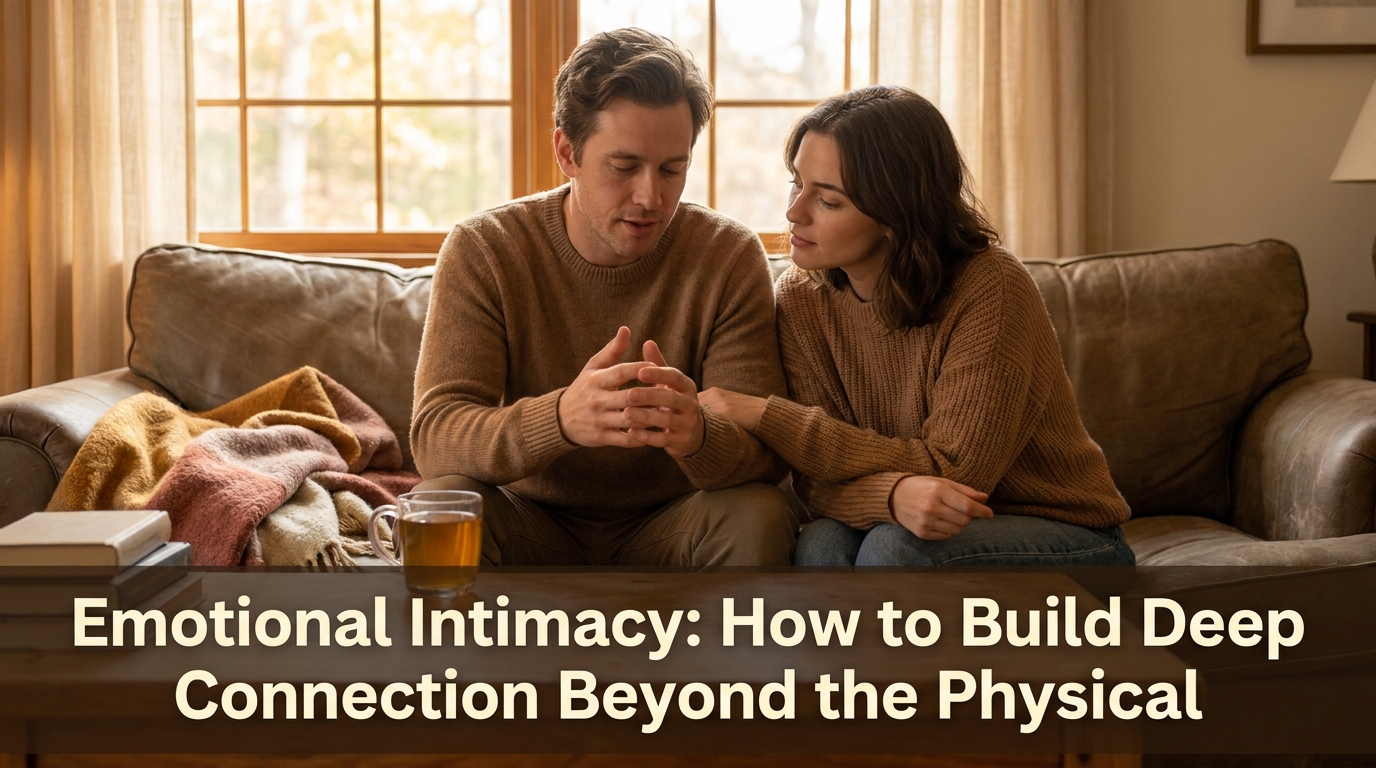
You can share a bed with someone for years and still feel alone.
Physical closeness — however real, however warm — is not the same as the closeness that makes you feel genuinely known. The closeness that means you can say the difficult thing, bring the uncomfortable feeling, be fully yourself without calculating whether it is safe to do so.
That kind of closeness is emotional intimacy. And it is both rarer and more deliberately built than most people realize.
Research from the University of Texas found that emotional intimacy is the single strongest predictor of long-term relationship satisfaction — more predictive than physical attraction, shared values, or compatibility on the standard measures that most people use to assess a relationship’s viability.
It is also, according to the same body of research, the dimension most likely to be actively neglected as relationships mature and life fills the space where genuine connection used to live.
Emotional intimacy does not just happen. It is built — through specific, deliberate, sustained practices. And it can be rebuilt, even in relationships where it has significantly eroded.
This is how.

What Emotional Intimacy Actually Is
Emotional intimacy is the experience of being genuinely known by another person — and genuinely knowing them. Not the curated version. Not the presentation. The actual interior life: the fears, the uncertainties, the things they are proud of that they do not say out loud, the things they are ashamed of that they have told almost no one.
It is built through the bidirectional exchange of genuine self-disclosure — the willingness to be fully seen, and the willingness to fully see.
It is different from liking someone, from finding them attractive, from enjoying their company, from loving them in the broad sense of genuinely caring about their wellbeing. All of those things can exist in the absence of emotional intimacy. And their absence, in the presence of genuine emotional intimacy, does not usually make a relationship feel empty.
Because emotional intimacy is the dimension of a relationship that answers the deepest human need — the need to not be alone with oneself. To have at least one person in the world with whom the full reality of who you are is known and accepted.
When that is present, almost everything else in a relationship becomes more manageable.
When it is absent, almost everything else — however good — feels insufficient.
“Emotional intimacy is not about being the same person. It is about being fully known by a different one — and finding that the knowing, rather than the sameness, is what creates connection.” — Relationship Psychology
Why Emotional Intimacy Erodes — Even in Good Relationships
Emotional intimacy does not disappear through neglect alone. It erodes through specific, identifiable dynamics — and understanding them is as important as understanding how to build it.
Life fills the space. In the early stages of a relationship, connection is the point — everything organizes around it. As life deepens, it fills the space where connection used to live. Work, children, logistics, the management of a shared life — these are real and important, but they are not the same as genuine emotional exchange. Without deliberate protection, the genuine conversations get crowded out by the necessary ones.
Vulnerability becomes less frequent. In early relationships, vulnerability is often unavoidable — you do not yet know each other, so sharing is how connection develops. As the relationship matures, the habit of sharing can quietly diminish. Both people begin to assume the other already knows — or begin to protect themselves from the vulnerability of being fully known by someone who also knows their worst moments.
Conflict goes unresolved. Accumulated unresolved conflict creates scar tissue around emotional connection. Each unaddressed grievance, each conversation that ended without genuine resolution, each moment of feeling dismissed or unheard — these create a thin layer of protection around the self that, over time, becomes a genuine barrier to intimacy.
Emotional safety is damaged. Something happened — a dismissal, a moment when vulnerability was met with ridicule or indifference, information shared in trust that was later weaponized — and the lesson was learned: it is not fully safe here. And so the sharing quietly contracts.
Parallel lives replace shared ones. The drift into parallel existence — sharing space without sharing experience, managing a household together without sharing its emotional weight — is one of the most common and most overlooked routes to emotional distance.

The Building Blocks of Emotional Intimacy
Emotional intimacy is not built through grand gestures. It is built through the accumulation of small, consistent, specific behaviors — each one a deposit in the account of genuine connection between two people.
Genuine Self-Disclosure — The Foundation
Emotional intimacy is built through the progressive, mutual sharing of genuine inner experience. Not the performing of vulnerability — the theatrical sharing of things that sound deep but carry no real risk. Genuine self-disclosure: the things that are actually difficult to say. The fears you do not usually name. The things you want that you have not admitted wanting. The uncertainties you carry but rarely voice.
This requires both the courage to share and the discipline to share reciprocally — because emotional intimacy built through one person’s disclosure while the other listens without contributing their own is not intimacy. It is one-sided exposure.
The depth of emotional intimacy in a relationship tracks directly with the depth and reciprocity of genuine self-disclosure over time. Both people moving toward greater authenticity, together, is the engine of the whole thing.
Being Truly Heard — The Experience That Changes Everything
Disclosure alone is not enough. Disclosure must be received — genuinely received, not managed or redirected or responded to before it has been fully heard.
The experience of feeling truly heard — of speaking something real and having it received with genuine attention and genuine care — is one of the most profoundly connecting human experiences available. It is the experience that David Augsburger described when he wrote that being heard is so close to being loved that for the average person the two are almost indistinguishable.
And it is an experience that is significantly rarer than it should be — because genuine listening requires the full suspension of your own internal commentary, your own formulation of a response, your own interpretation superimposed on what you are hearing.
Genuine listening is active work. It is the choice to be entirely with the other person’s experience before bringing your own.

Curiosity as an Act of Love
One of the quietest and most consistent builders of emotional intimacy is genuine curiosity about your partner — not the curiosity of the early relationship that has questions because it is still discovering, but the sustained, deliberate curiosity of a person who chooses to keep discovering someone they already know.
People change. Internally, continuously, often without announcement. The person your partner was three years ago is not exactly the person they are today. Their fears have evolved. Their relationship with themselves has shifted. Their understanding of what they want from life, from the relationship, from themselves, has developed in ways that may not have been shared.
Treating your partner as someone still worth discovering — asking questions that go somewhere, listening to the answers with genuine attention, following the thread into their inner world rather than moving on to the next item on the conversation’s surface — is both an act of love and an act of intimacy-building.
The question “how was your day” produces logistics. The question “what has been weighing on you most lately that you haven’t said out loud?” produces emotional intimacy.
The Sharing of Inner Life — Not Just Events
Most relationship conversation is about the external — what happened, who said what, what needs to be managed, what is coming up next. This is necessary and fine. It is not the same as emotional intimacy.
Emotional intimacy is built through the sharing of the inner life that exists behind the events — what you felt about what happened, not just what happened. What you thought when you heard the news, not just the news. What it is like to be you right now — not just what you are doing.
This shift from event-reporting to inner-life-sharing is not always natural, particularly for people who grew up in homes where emotional expression was not modeled or encouraged. It can be practiced. It can be made into a deliberate habit. And when both partners practice it together, the quality of connection in the relationship changes fundamentally.
Repair as an Intimacy Practice
Every relationship sustains ruptures — moments of hurt, conflict, misunderstanding, failure to show up in the way that was needed. The capacity to repair — to return to each other after rupture, to acknowledge what happened, to restore the sense of safety — is not just a conflict-management skill.
It is an intimacy practice.
Because each time a rupture is genuinely repaired — each time both people move toward each other rather than away from it, acknowledge what happened with honesty, and find their way back to safety together — the relationship’s foundation becomes more solid. Both people learn, through direct experience, that the relationship can hold difficulty. That being hurt here does not mean being abandoned. That the connection is durable enough to survive genuine imperfection.
This knowledge — built through the accumulated experience of rupture and repair — is itself a form of emotional intimacy. The specific intimacy of two people who have been through something difficult together and chosen each other anyway.

10 Practical Ways to Build Emotional Intimacy
1. Create Consistent Uninterrupted Time Together
Emotional intimacy cannot be built in the margins. It requires time that is specifically protected from the logistical demands of a shared life — time in which neither person’s primary role is household manager, parent, or domestic coordinator, but simply the person who matters most to the other.
This does not require grand date nights or elaborate plans. It requires consistency and presence — a protected hour, a shared evening walk, a morning ritual that belongs to both of you. The regularity matters more than the scale.
2. Practice the Art of the Deeper Question
Replace surface questions with ones that go somewhere. Not as an interrogation, but as genuine curiosity offered in a tone that invites rather than demands.
Questions that build emotional intimacy: What has surprised you about yourself lately? What do you think about when you cannot sleep? What are you most afraid of right now? What do you wish I understood about you that you’ve never quite found the way to say?
These questions open doors. The willingness to answer them — and to create space for your partner to answer them — is the practice of emotional intimacy in its most direct form.
3. Share Something You Have Not Said Yet
Regularly — not performatively, but genuinely — share something with your partner that you have not yet said. Something from your inner world that has not made it into the shared space between you. A fear. An uncertainty. Something you want. Something you regret. Something that happened that you have been carrying privately.
This practice, maintained over time, keeps the relationship’s emotional depth from calcifying. It continuously adds to the shared inner landscape — the accumulated, mutual knowing that is what long-term emotional intimacy actually is.
4. Put the Phones Down — Genuinely and Consistently
Physical presence without attentional presence is not intimacy-building time. It is proximity. And proximity without attention is one of the most efficient ways to share space without building connection.
Protecting certain times and spaces from digital intrusion — dinner, the first thirty minutes after both people are home, the hour before sleep — creates the conditions in which emotional intimacy becomes possible. Not guaranteed. Just possible.
The possibility requires the space. The space requires the deliberate removal of what fills it by default.
5. Respond to Emotional Bids
Relationship researcher John Gottman identified what he called bids for connection — small, often implicit attempts to connect, to share, to invite the other person’s attention. “Look at this” while showing something on their phone. “I’m tired today” in a tone that is asking for more than acknowledgment. A sigh. A pause before answering. A glance across the room.
The accumulation of how a partner responds to these bids — whether they turn toward them, ignore them, or actively turn away — predicts emotional intimacy levels more accurately than almost any other measurable behavior.
Practice turning toward bids. Not with forced enthusiasm — but with genuine acknowledgment. “Tell me more.” “What’s going on?” “I heard that.” Small turns toward the other person, repeated consistently, build the sense that this relationship is a place where connection is reliably offered and received.
6. Share Your Fears — Not Just Your Strengths
Emotional intimacy is built through the sharing of the full self — which includes the parts that are uncertain, afraid, struggling, and unresolved. Many people are comfortable sharing their competence and their achievements. Far fewer are comfortable sharing their genuine vulnerabilities — because vulnerability requires the trust that what is shared will be received with care.
The willingness to share your fears, your uncertainties, your genuine struggles — and the capacity to receive your partner’s with genuine care — is the practice that builds emotional intimacy at the deepest level.

7. Validate Before You Respond
When your partner shares something from their inner life — something difficult, something vulnerable, something that matters — the most connection-building response is validation before anything else.
Not agreement. Validation. The acknowledgment that what they are experiencing is real, that it makes sense, that you understand why they feel what they feel.
“That sounds really hard” before any advice. “I can understand why that upset you” before your perspective. “Thank you for telling me that” before anything else.
Validation communicates: I received what you offered. I took it seriously. You were right to share it with me.
Without it — with the immediate pivot to advice, to perspective, to reassurance — the sharing feels unheard even when the response is well-intentioned.
8. Revisit Your History Together — Deliberately
Shared history is one of the most underused resources for building emotional intimacy in established relationships. The experiences you have had together, the things you have survived, the people you have been to each other across different chapters — these are the material of genuine connection.
Talk about your early days together. About the moment one of you knew. About the hard thing you got through. About the version of each other that existed five years ago and how you feel about that version now.
This is not nostalgia for its own sake. It is the practice of keeping the shared story alive — of recognizing that the relationship has a history worth remembering, and that remembering it together is itself a form of intimacy.
9. Name What You Appreciate — Specifically
General appreciation — “you’re great,” “I’m lucky to have you” — is warm but not intimacy-building. Specific appreciation — the kind that names exactly what you noticed and why it mattered — communicates something far more powerful: I am paying attention. I see you. Not the general you, but the particular you.
“I noticed how patient you were with that situation today and it reminded me of why I respect you so much.”
“The way you handled that told me something about who you are that I want you to know I see.”
Specific appreciation is evidence of genuine attention — and genuine attention is one of the most fundamental expressions of love available.
10. Seek Help When the Connection Has Significantly Eroded
When emotional intimacy has eroded significantly — when the conversations are largely logistical, when genuine self-disclosure has become rare, when both people feel more like roommates than partners — the gap can sometimes feel too large to bridge without support.
Couples therapy — particularly with an attachment-informed or Emotionally Focused therapist — is one of the most effective available interventions for restoring emotional intimacy in relationships where it has eroded. It provides the safe, neutral container in which both people can begin to share what has not been shared, hear what has not been heard, and reconnect in the presence of someone whose job it is to help make that reconnection possible.
Seeking that support is not evidence of failure. It is evidence of genuine investment — in the relationship, in each other, and in the belief that what was built between you is worth the work of restoring it.
The Relationship Between Emotional Intimacy and Everything Else
It is worth saying directly: emotional intimacy is not just one component of a healthy relationship among many equals. It is the foundation on which almost everything else is built.
Physical intimacy that exists in the absence of emotional intimacy is pleasurable but hollow — and tends, over time, to feel increasingly disconnected from genuine love. Conflict resolution that occurs without emotional intimacy produces agreements that do not stick — because the underlying sense of safety that makes people willing to genuinely compromise is absent. Trust that exists without emotional intimacy is superficial — compliance without the genuine belief that the other person sees and cares about who you actually are.
When emotional intimacy is present, everything else in the relationship becomes more manageable. Conflict is less catastrophic. Physical closeness is more meaningful. Ordinary moments of shared life carry more genuine warmth. The relationship feels like a resource rather than a demand.
When it is absent, everything feels harder than it should — because the thing that makes relationship difficulty worth navigating, the thing that makes the other person feel worth choosing again and again, the thing that makes a relationship feel like home rather than a logistical arrangement — is not there.
Building it is not complicated. It requires honesty, curiosity, time, and the willingness to be known. It requires putting down what is easier to hold and picking up what is harder. It requires choosing, again and again, to be actually present with the person you love rather than merely nearby.
But nothing in a relationship produces a more consistent, more durable, more genuinely sustaining return on investment.
Emotional intimacy is not what happens when two people fall in love. It is what happens when they keep choosing to truly show up for each other — in the ordinary moments, the difficult ones, and every unremarkable space in between.
CALL TO ACTION
💾 Save this — and share it with your partner as an invitation to start one of these practices this week. 📤 Tag someone whose relationship deserves more depth than it is currently getting. 👣 Follow Truthsinside.com for honest, psychology-backed content on love, connection, and what healthy relationships actually look like.
Frequently Asked Questions
Q1: What is the difference between emotional intimacy and physical intimacy? Physical intimacy involves bodily closeness and touch — and is a genuine and important dimension of most romantic relationships. Emotional intimacy involves the closeness of inner worlds — being genuinely known and genuinely knowing, sharing the authentic interior life rather than just the physical presence. The two can coexist, complement, and deepen each other — but they are not the same thing, and one can exist without the other. Research consistently shows that emotional intimacy is a stronger predictor of long-term relationship satisfaction than physical intimacy — and that physical intimacy tends to feel more meaningful and more connected when emotional intimacy is also present.
Q2: Can emotional intimacy be built with someone who is emotionally unavailable? It is significantly more difficult — and requires honest assessment of whether the unavailability is a temporary state or a more fundamental pattern. Someone who is emotionally unavailable due to stress, depression, or a difficult life period may become more available as circumstances change — particularly if the unavailability is named and addressed directly. Someone whose emotional unavailability is rooted in avoidant attachment or a fundamental discomfort with emotional intimacy may need significant therapeutic work before genuine emotional intimacy becomes possible. The most important variable is willingness — whether the emotionally unavailable partner recognizes the pattern and is genuinely invested in changing it.
Q3: How do you rebuild emotional intimacy after a long period of distance? Gradually, without pressure, and with explicit acknowledgment of the distance itself. The attempt to immediately return to deep emotional sharing after a significant period of disconnection often produces discomfort rather than connection — because the foundation of safety that genuine sharing requires has eroded. Start with small, genuine moments of connection — a question that goes slightly deeper than usual, a brief piece of genuine self-disclosure, the explicit acknowledgment that you have been missing genuine connection. Then build from there, consistently and patiently. Couples therapy can significantly accelerate this process by providing the safe container that makes the first steps toward reconnection possible.
Q4: Is it normal for emotional intimacy to decrease over time in a relationship? It is common — but not inevitable, and not irreversible. Research shows that emotional intimacy tends to decrease as relationships mature and life fills the space where genuine connection used to live. But this is a function of where attention goes rather than an inevitable consequence of time. Couples who actively invest in emotional intimacy — through protected time, genuine self-disclosure, curiosity about each other’s evolving inner lives — consistently maintain and deepen connection over decades. The decrease is not the relationship’s natural trajectory. It is what happens when the deliberate work of connection stops.
Q5: What if I want more emotional intimacy than my partner is comfortable with? Start with a direct, honest, non-accusatory conversation about the mismatch — not mid-conflict, but at a calm moment. “I’ve been feeling like we don’t really talk the way we used to. I miss that connection. Can we talk about it?” This opens the conversation without making it a criticism.
Your partner’s response will tell you something important — whether the discomfort with emotional intimacy is about not knowing how, not feeling safe, or a more fundamental aversion. All three have different implications and different paths forward. If the conversation is difficult to have, or if it has been had without producing change, couples therapy is worth considering as the next step.
🎵 Music
Maren Lull is a singer-songwriter who writes from the places most people don’t talk about out loud.
Not the dramatic grief. Not the obvious heartbreak. The quiet kind — the ordinary Tuesday emptiness, the habit of reaching for someone who isn’t there anymore, the particular exhaustion of being strong for so long that the strength itself wears thin.
Her music lives at the intersection of emotional honesty and soft beauty — breathy vocals over gentle piano, slow tempos, lyrics that feel less like songs and more like something you wrote in a private notebook at two in the morning and never showed anyone.
Maren Lull writes for the people who feel everything deeply and say very little about it. For the ones who listen to sad music not because they want to feel worse — but because being understood, even by a song, makes the feeling easier to carry.
📱 Follow Maren Lull:
→ Spotify
→ Apple Music
→ Youtube
→ Audiomack