
A text message takes seconds to send.
And sometimes, in those seconds, a person reveals more about themselves than they intended.
Digital communication has become the primary language of modern relationships — particularly in their early stages. Before you have shared a meal, before you have read each other’s body language in real time, before you have seen how someone responds to frustration or disappointment or joy — you have a text thread.
And that text thread, if you know how to read it, contains significant information.
Research from the Pew Research Center found that 75 percent of adults in relationships say digital communication plays a significant role in their relationship dynamics. A study published in Computers in Human Behavior found that texting patterns in early relationships are significantly predictive of relationship quality and longevity.
The red flags in texting and digital communication are not dramatic. They are usually subtle — easy to explain away, easy to rationalize, easy to dismiss as overthinking.
They are also usually accurate.
Why Digital Communication Reveals So Much
In face-to-face communication, we have access to an enormous amount of information beyond words — tone, facial expression, body language, the quality of someone’s attention, how they respond to our presence in real time. Researchers estimate that 70 to 90 percent of the emotional content of face-to-face communication is carried by nonverbal channels.
Texting strips almost all of that away. What remains is words, timing, and pattern — and these carry more information than most people recognize.
Because texting is stripped of context, what a person chooses to put into it — the effort, the timing, the content, the emotional quality — becomes proportionally more revealing. The absence of tone means that tone must be deliberately created through word choice, through emoji, through the care taken with what is written. Its presence or absence tells you something.
Equally, the patterns of digital communication — consistency, reciprocity, the alignment between what someone says and what they do — are visible in a text thread in ways that are harder to obscure than they are in person.
A person can manage their in-person presentation with significant skill. The text thread, reviewed over time, is harder to manage. Patterns become visible. Inconsistencies appear. The gap between the person being performed and the person actually present becomes, with careful attention, legible.
“In the absence of body language and tone, what a person puts into a text — and what they leave out — becomes the purest available signal of where you actually stand.” — Digital Communication Research
15 Red Flags in Texting and Digital Communication
1. Extreme Inconsistency in Response Times
One day they respond within minutes, all day, attentive and warm. The next day, or the next week, hours pass with no reply — sometimes with no explanation, sometimes with a brief “sorry, was busy” that does not quite account for the gap.
Occasional inconsistency is normal. Life is genuinely variable and people are not always equally available. But a pattern of dramatic inconsistency — where responsiveness swings widely without corresponding explanation — is worth paying attention to.
It can indicate that their interest is intermittent. That other priorities are fluctuating. That the responsiveness you experienced in the good moments is not reflective of a consistent level of investment.
More specifically: watch whether the inconsistency correlates with other things. Do they disappear on certain days? Certain hours? After certain types of conversations? The correlation may tell you more than the inconsistency alone.
2. Hot and Cold Messaging — Intense Then Distant
The texting equivalent of the hot-and-cold dynamic: periods of extremely warm, frequent, emotionally engaged messaging alternating with periods of distance, brevity, or near-silence — with no clear external explanation for the shift.
This pattern is one of the most reliable early indicators of either avoidant attachment or deliberate intermittent reinforcement. The warmth creates attachment. The distance creates anxiety. The return of warmth relieves the anxiety in a way that feels profound — and the cycle conditions you to the pattern.
Notice whether the warm periods feel like genuine connection or like relief. There is a significant difference — and the difference is the difference between ordinary relationship warmth and intermittent reinforcement.
3. They Text at Specific Times Only
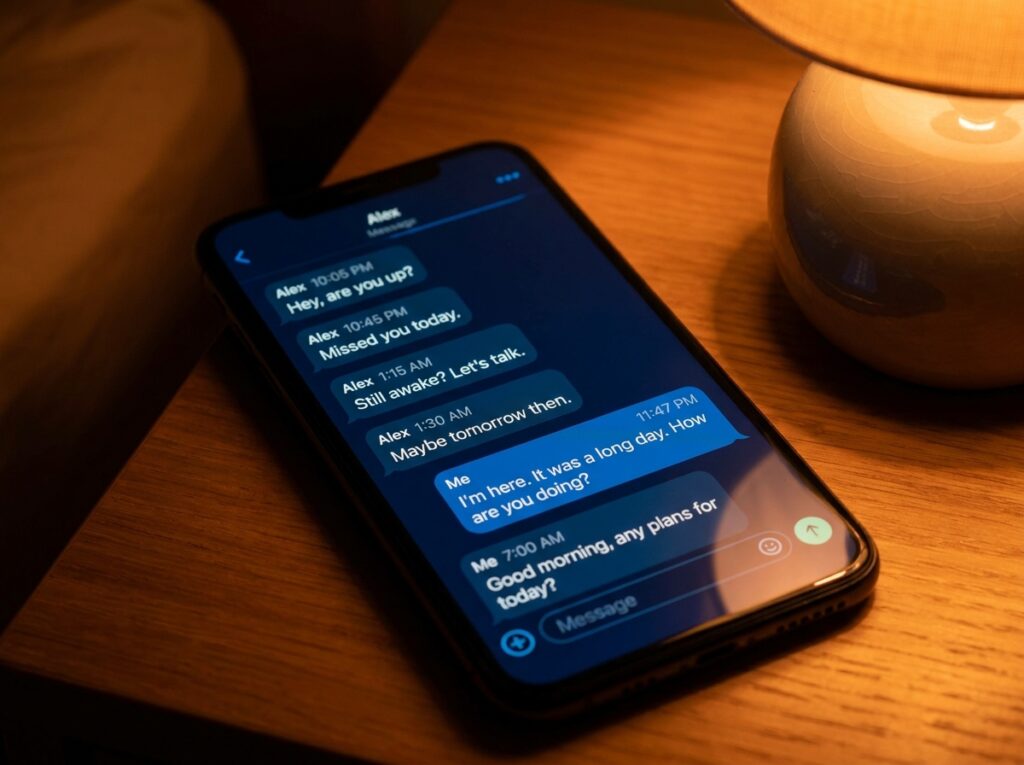
Late night only. Only when they seem to be bored or seeking entertainment. Only during hours when something else might be unavailable to them. Never in the morning or during the day.
Time-limited texting can have innocent explanations — genuinely demanding schedules, time zone differences, particular rhythms of life. But a consistent pattern of contact only within specific windows — particularly late-night windows — is worth naming and examining directly.
Someone who genuinely wants to be in your life will make some effort to be present across the ordinary hours of it.
4. They Never Initiate
Every conversation is started by you. Every check-in comes from your side. When you do not reach out, the silence is complete — not because they are busy, but because the thought to reach out did not occur to them or did not feel necessary.
Initiation imbalance is one of the clearest signals of asymmetric investment. Someone who is genuinely interested in you thinks about you between conversations. That thinking produces the impulse to reach out.
Its consistent absence does not mean they do not enjoy talking to you when you initiate. It means you are not on their mind in the way that produces the impulse to reach.
5. They Read and Do Not Reply
This one requires some nuance — because read receipts are not universal, and “read” does not always mean seen-and-choosing-not-to-reply. But a consistent pattern of messages being read and left unanswered — particularly when those messages contained something that deserved a response — is a clear communication.
It communicates: I saw this. I chose not to respond. And the choice was made without explanation.
Occasional non-replies happen. A pattern of them, particularly in response to emotionally significant messages, is the text-based equivalent of stonewalling.
6. Their Tone Changes Dramatically After Conflict
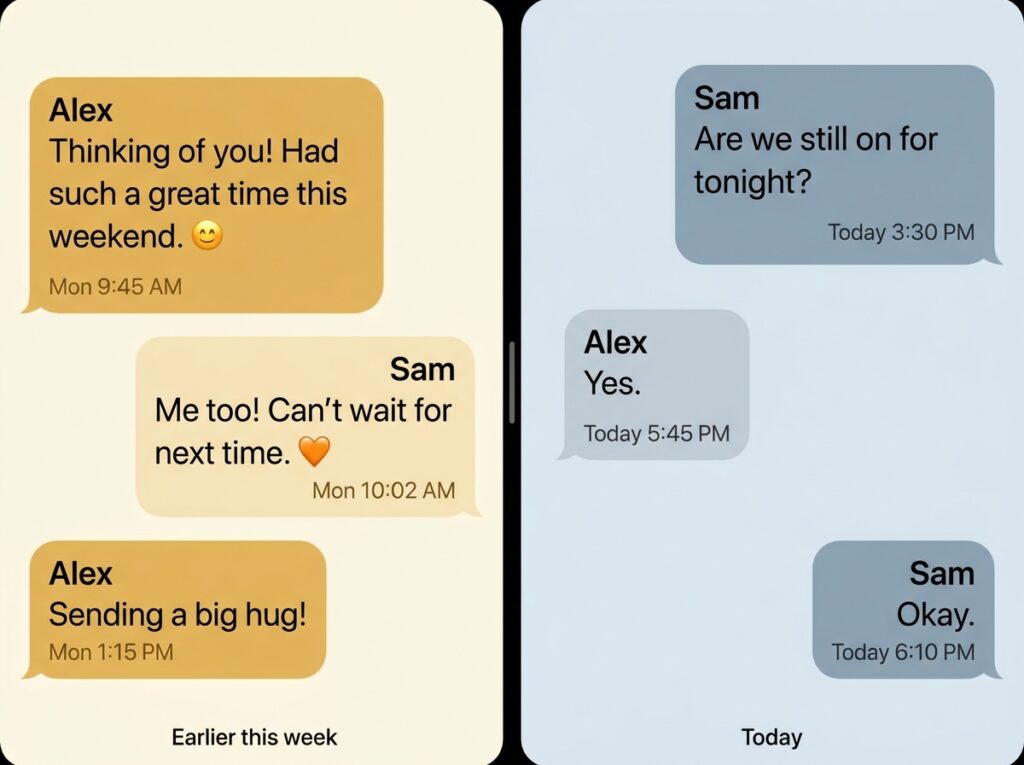
Before a disagreement — warm, engaged, thoughtful. After — clipped, brief, noticeably cooler without explicit acknowledgment of the shift.
This is the passive-aggressive text pattern. Rather than addressing what happened directly, the emotional temperature of the messages drops — communicating displeasure through withdrawal of warmth rather than through honest conversation.
Watch for whether conflict is addressed directly in their messaging or whether it is communicated through the quality of subsequent messages. Direct engagement with conflict is a positive indicator. Withdrawal of warmth as indirect punishment is a concerning one.
7. They Redirect Every Emotional Conversation to Humor or Deflection
You share something vulnerable. They respond with a joke. You raise something that matters to you. They deflect — change the subject, send a meme, turn the conversation toward something lighter before the emotional content has been acknowledged.
Some people use humor as genuine warmth — and lightness in a relationship is not inherently a red flag. But a consistent pattern of redirecting any emotional content before it has been received is a form of digital emotional unavailability.
In person, this pattern can be harder to sustain — the expression on your face, the quality of your stillness, makes deflection more visible. In text, it is easy. And its consistency across a text thread reveals something about the person’s comfort with emotional intimacy that they may not consciously intend to reveal.
8. They Make Plans Over Text That They Never Follow Through On
“We should do that.” “Let’s plan something this week.” “I’ll text you about that.”
The messages that create the feeling of investment and the implication of plans — without the follow-through that would make those plans real. This is sometimes called future faking in its digital form, and it is a specific and identifiable pattern.
Watch the ratio between plans proposed in text and plans actually executed. A significant gap between the two — with the proposals reliably not materializing into actual events — is information about the gap between this person’s words and their intentions.
9. Their Digital Persona Does Not Match Who They Are in Person
They are warm, engaged, and funny in text. In person they are distant, distracted, or notably different in energy. Or the reverse — withdrawn in text, claiming busyness or emotional depletion, but available and present in ways that contradict the digital persona.
A significant, consistent discrepancy between digital and in-person presence raises questions about which is the performance and which is the reality. Both can be genuine in different ways. But a gap that is large and persistent is worth examining.
The most concerning version: they are attentive, emotionally present, and seemingly deeply invested in text — and consistently less available, less engaged, or less warm in person. Text is easier to manage. In-person presence requires more of a person. The in-person version is usually closer to the truth.
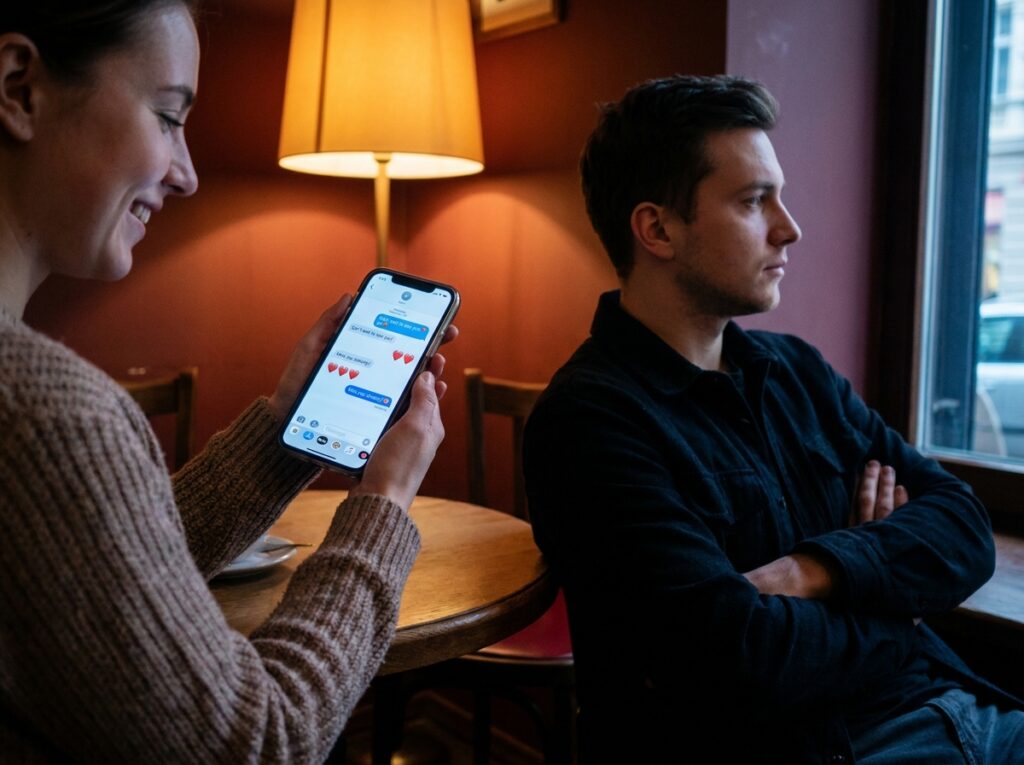
10. They Disappear After Intimacy — Physical or Emotional
The conversation was warm and vulnerable. You shared something real, or spent time together, or reached a new level of closeness. And then — the messages slow, stop, or become noticeably more distant.
This is a specific and significant pattern. It suggests that closeness is the trigger for withdrawal — that intimacy produces anxiety or discomfort that expresses itself through digital distance.
It is the avoidant attachment pattern made visible in digital form. And it is worth naming, because in its early stages it is very easy to explain as coincidence — they were just busy, it was just bad timing. The pattern reveals itself through repetition.
11. They Use Text to Fight Rather Than to Resolve
Important conflicts, significant hurts, conversations that genuinely need nuance and emotional presence — conducted entirely over text.
Text is poorly suited to conflict. Tone is lost. Misinterpretation is easy. Responses can be delayed in ways that feel like withdrawal. The visual record of the exchange makes it easy to screenshot, replay, and weaponize.
Someone who consistently initiates or sustains significant conflict through text — rather than suggesting that important conversations happen in person or by phone — is either unaware of text’s limitations as a conflict medium, or finds its limitations convenient. The distance text provides. The asynchronous nature that allows messages to be composed rather than felt in real time.
Neither is reassuring.
12. Their Affection in Text Exceeds Their Affection in Person
They send loving messages, warm check-ins, declarations of feeling — and in person are notably cooler, less affectionate, less demonstrative than the messages would predict.
Digital affection that consistently exceeds in-person affection is a form of emotional management — the creation of an impression of care through text that does not have to be sustained in real time.
It is also, for the person receiving it, genuinely confusing — because the messages feel real and the in-person distance feels like something you must have done, or something wrong with you, rather than what it actually is: a gap between the presented persona and the actual emotional availability.
13. They Monitor Your Online Activity but Withdraw From Direct Communication
They see everything — they notice immediately when you post something, reference your stories, track when you were last active. But their direct communication with you is scarce, inconsistent, or brief.
This surveillance without communication is a specific and concerning pattern. It maintains a form of presence and connection — the knowing that they are watching — without the vulnerability of actual direct engagement. It is a way of keeping tabs without showing up.
It can also be a form of control — the monitoring that communicates you are being observed without the conversation that would make the relationship feel genuine.
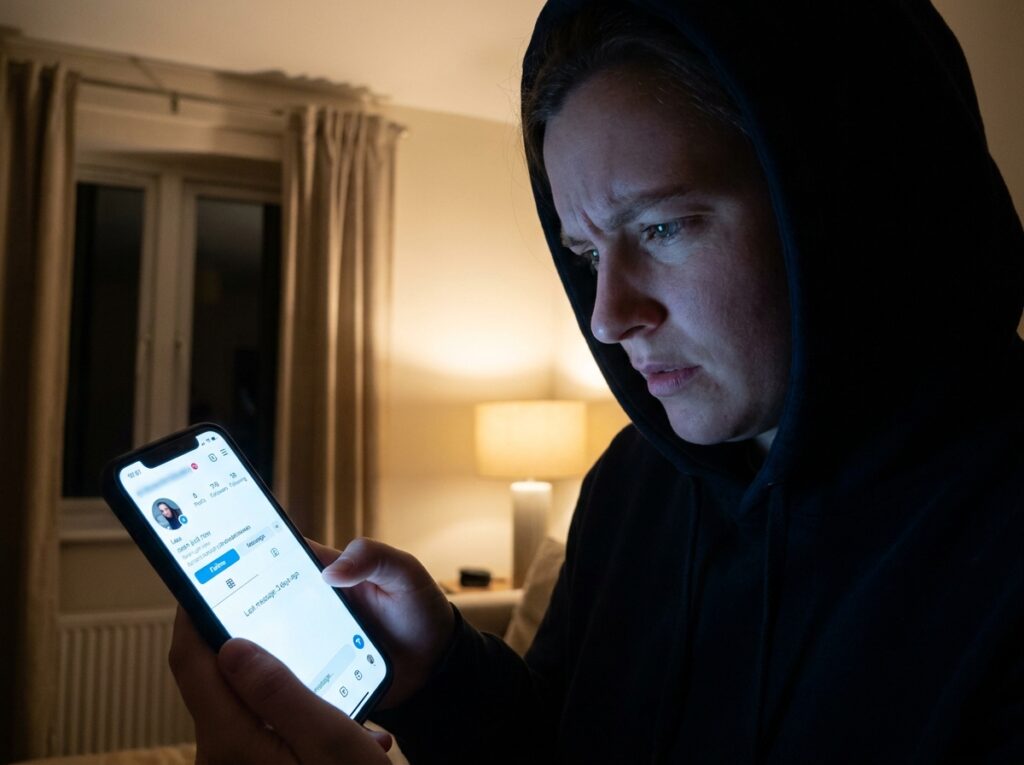
14. They Send Deliberately Ambiguous Messages
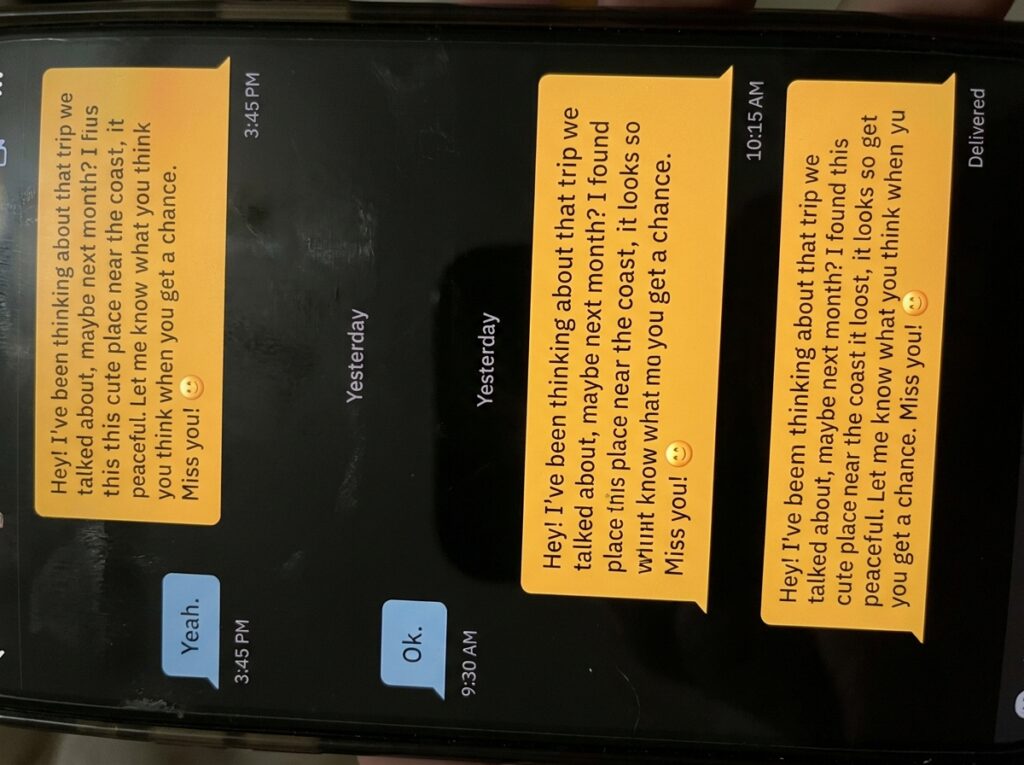
Messages that could mean several things — warm enough to maintain interest, ambiguous enough to maintain plausible deniability about intent. “Miss you” without plans to see you. “Been thinking about you” without follow-up. “We should talk” without initiating the talk.
Deliberate ambiguity in digital communication is a form of emotional management — keeping someone interested and attached while avoiding the commitment of clarity. It is the textual equivalent of breadcrumbing.
Notice whether the messages in the thread consistently provide enough clarity to build on, or whether they leave you perpetually interpreting, wondering, filling in gaps that should have been filled by the person sending the message.
15. Your Gut Responds to Their Messages — And You Dismiss It
You read a message and something registers — a slight unease, a sense that something does not quite add up, a feeling that is hard to articulate but is clearly present. And you explain it away. You rationalize. You give the benefit of the doubt.
Your nervous system processes information faster than your conscious mind. The gut response to a message — the unease, the slight wrongness — is often your brain integrating multiple signals that have not yet resolved into a conscious assessment.
Taking that response seriously — not catastrophizing it, not acting on it impulsively, but giving it genuine weight and allowing it to inform how you proceed — is one of the most important skills available in the era of digital communication.
The gut response to a text is information. It deserves to be treated as such.
What to Do When You Notice These Patterns
Name the pattern — to yourself first. Not the specific incident, but the pattern it is part of. Giving it language makes it visible and harder to rationalize away in the next cycle.
Address it directly — in person or by voice. Significant relationship concerns raised over text are vulnerable to all the limitations of text communication — they can be easily managed, redirected, or responded to in ways that look like engagement without being genuine. The most important conversations deserve the medium that makes them most possible.
Watch the response to your address. Someone who responds to a genuine concern about their communication patterns with curiosity, acknowledgment, and visible change is demonstrating something important. Someone who becomes defensive, dismissive, or who explains the pattern as entirely your interpretation is also demonstrating something important.
Trust the pattern more than any single explanation. One explanation for one incident may be entirely accurate. A different explanation for every incident in the same pattern is information about the pattern.
Know that you are allowed to have expectations. Digital communication standards in relationships are not unreasonable to discuss or maintain. You are not asking for too much by wanting consistency, by expecting a reply to a meaningful message, by finding the hot-and-cold pattern disorienting. Your expectations are legitimate. The question is whether this person is capable of or willing to meet them.
The text thread does not lie. It cannot manage its own patterns the way a person can manage their in-person presentation. Given enough time and enough attention, it tells you exactly what you need to know.
CALL TO ACTION
💾 Save this — read through your last few text threads with fresh eyes. 📤 Share it with a friend who is trying to figure out what they are seeing in their messages. 👣 Follow Truthsinside.com for honest, psychology-backed content on red flags, relationships, and the modern experience of love.
Frequently Asked Questions
Q1: Is it a red flag if someone takes a long time to reply? Not inherently — and context matters enormously. Someone with a demanding job, a particular texting style, or genuine life complexity may consistently take longer to reply without it reflecting their investment in you. The red flag is not response time in isolation. It is the combination of slow response time with other indicators — inconsistency, the absence of initiation, the pattern of engagement only on their terms — or a significant discrepancy between their response time with you and their demonstrable availability in other contexts. One data point is not a red flag. A pattern of several is.
Q2: Can you really tell a lot about someone from their texting style? Yes — with important caveats. Texting style reflects some genuine things about a person: their investment, their consistency, their emotional availability, the degree to which they think about you between conversations. It does not perfectly reflect their worth as a person, their capacity for intimacy in person, or their feelings in absolute terms. Some people are genuinely poor texters but excellent partners. The most reliable use of texting data is pattern recognition over time — not individual message analysis. A thread reviewed over weeks tells you more than any single exchange.
Q3: What if I am the one displaying some of these red flags? Honest self-reflection is always valuable — and more valuable than projection outward. If you recognize patterns like initiating infrequently, using text to deflect emotional content, or inconsistent responsiveness that reflects inconsistent investment, those are worth examining. Some of these patterns are habits that can be changed with awareness. Others may reflect deeper things — avoidant attachment, ambivalence about the relationship, discomfort with emotional intimacy — that deserve more than surface adjustment. If you are reading this and recognizing yourself rather than your partner, that recognition is itself meaningful.
Q4: My partner says I am overanalyzing their texts. Are they right? Possibly — and possibly not. There is a meaningful difference between anxious overanalysis of individual messages — reading threat into ordinary variations, catastrophizing normal response time variability — and the legitimate pattern recognition that is the focus of this article. The former is often the expression of attachment anxiety and is worth working on. The latter is the reasonable use of available information to understand a relationship dynamic. If your concern is about a pattern across many messages over time rather than a single message or moment, and if the pattern is consistent and has not resolved despite being raised, the concern is likely more legitimate than overanalytic.
Q5: Should I bring up texting concerns with someone I am newly dating? Yes — carefully and at the right time. Early in a relationship, before patterns are fully established, raising a texting concern with genuine curiosity rather than accusation is entirely appropriate. “I noticed I’ve been the one to reach out most of the time — I wanted to check in about that” is a reasonable, direct, low-pressure way to open the conversation. The response will tell you something. Someone who engages with genuine interest and makes visible effort afterward is showing you their character. Someone who becomes defensive or dismissive of what was clearly raised with care is also showing you their character.
🎵 Music
Maren Lull is a singer-songwriter who writes from the places most people don’t talk about out loud.
Not the dramatic grief. Not the obvious heartbreak. The quiet kind — the ordinary Tuesday emptiness, the habit of reaching for someone who isn’t there anymore, the particular exhaustion of being strong for so long that the strength itself wears thin.
Her music lives at the intersection of emotional honesty and soft beauty — breathy vocals over gentle piano, slow tempos, lyrics that feel less like songs and more like something you wrote in a private notebook at two in the morning and never showed anyone.
Maren Lull writes for the people who feel everything deeply and say very little about it. For the ones who listen to sad music not because they want to feel worse — but because being understood, even by a song, makes the feeling easier to carry.
📱 Follow Maren Lull:
→ Spotify
→ Apple Music
→ Youtube
→ Audiomack