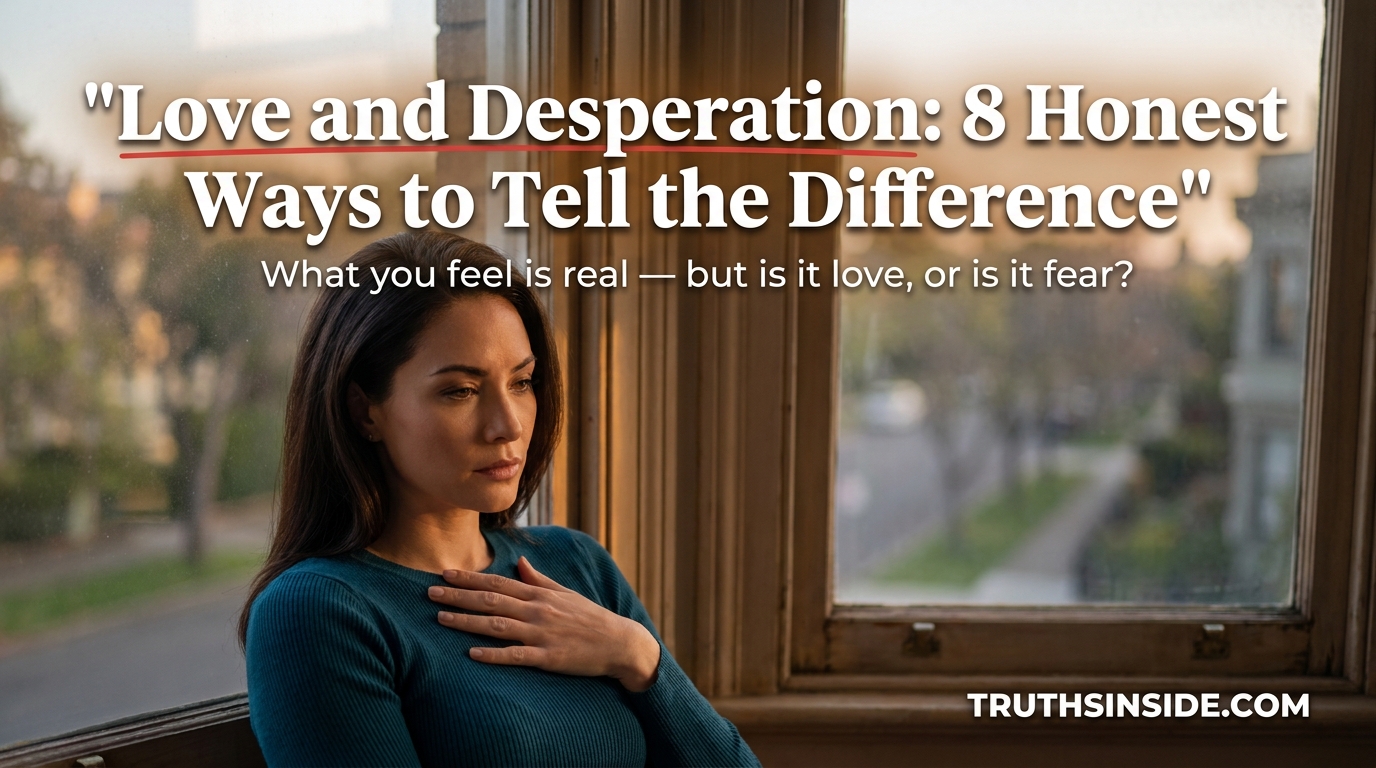
Love and desperation are two of the most easily confused emotional experiences in human relationships — and the confusion between them is responsible for more poor decisions, prolonged suffering, and misidentified connections than almost any other psychological mix-up in the entire landscape of romantic life. From the inside, they can feel nearly identical. Both are intense. Both are consuming. Both produce a powerful sense that this person, this relationship, this connection is essential — that life without it would be categorically worse than life within it, regardless of what that life within it actually looks like day to day.
The distinction between love and desperation is not about the intensity of feeling. Genuine love can be profoundly intense. Desperation can feel exactly as deep and exactly as real as the most authentic love you have ever experienced. The distinction lies not in how the feeling presents itself but in what it is rooted in — in whether the attachment to this person is built on genuine connection, shared values, and mutual flourishing, or whether it is built on the fear of loss, the avoidance of aloneness, and the specific anxiety of a nervous system that has learned to organize itself around another person’s presence as a survival requirement rather than a chosen joy.
Research from Dr. Helen Fisher’s neuroimaging studies at Rutgers University found that romantic love and anxious attachment — the neurological state most closely associated with desperation — activate different regions of the brain with measurably different chemical signatures. Genuine love activates the brain’s reward and bonding systems in ways associated with satisfaction, calm, and the experience of genuine pleasure. Desperate attachment activates threat-response systems — producing the urgency, obsessive thinking, and emotional volatility characteristic of a nervous system responding to perceived danger rather than chosen connection. Understanding which system is running your experience of this relationship may be one of the most important acts of self-awareness available to you. This article offers 8 honest ways to begin that understanding.
Why Love and Desperation Are So Easy to Confuse
Before examining the 8 ways to tell them apart, it is worth understanding why love and desperation are so frequently and so genuinely mistaken for each other — because the confusion is not a failure of intelligence or self-awareness. It is the predictable result of how both experiences present themselves in the body and the mind.
Both love and desperation produce intensity. Both generate a preoccupation with the other person that crowds out other concerns. Both create a felt sense of this person’s irreplaceability — the specific conviction that no one else would produce what this person produces in you.
The difference is in the quality of the intensity. Genuine love’s intensity is rooted in abundance — in the genuine richness of what is shared, the authentic pleasure of the other person’s presence, the expanding quality of a connection that makes life feel larger and more meaningful. Desperation’s intensity is rooted in scarcity — in the fear of losing something that feels essential to survival, the anxiety of a nervous system that has made another person’s presence a regulatory requirement rather than a joyful addition.
From the inside, abundance and scarcity can feel identical in their urgency. The body does not automatically label its own states with clinical accuracy. What you experience as deep love may be deep love. What you experience as deep love may also be deep fear. Distinguishing between the two requires a particular quality of honest self-examination that most of us were never explicitly taught to practice.

Way #1: Love and Desperation — Ask What You’re Actually Afraid Of Losing
One of the clearest and most revealing ways to distinguish between love and desperation is to examine honestly what you are most afraid of losing in the relationship — because genuine love and desperate attachment fear very different things.
Genuine love fears losing the specific person — their particular qualities, their specific presence, the unique experience of being known and chosen by them. The grief of genuine love is grief for a person, irreplaceable in their individuality.
Desperate attachment fears losing what the person represents — the status of being in a relationship, the relief from loneliness, the emotional regulation that this person’s presence provides, the specific identity of being someone’s partner. The grief of desperate attachment is grief for a function — and the uncomfortable truth is that a different person who provided the same function might eventually produce the same feeling of essential connection.
Sit with this question honestly: if this specific person remained in your life but as a close friend rather than a romantic partner — if the emotional connection remained but the romantic relationship ended — what would you grieve most? If the answer is primarily about them — their specific presence, their specific way of knowing you, the irreplaceable quality of who they are — that points toward love. If the answer is primarily about what changes for you — the status, the company, the relief from aloneness — that points toward desperation.
📃 Related article: Love-Hate Dynamic: 7 Reasons Toxic Love Traps You
Way #2: Notice Whether Their Wellbeing Matters as Much as Your Access to Them
Genuine love is genuinely other-oriented — it holds the other person’s wellbeing, flourishing, and happiness as something that matters independently of what that wellbeing means for you and your access to them.
Desperation, by contrast, is fundamentally self-oriented — even when it presents itself in the language of devotion and care. It is primarily concerned with maintaining access to the other person, with preserving the relationship’s existence, with ensuring that the function the other person serves in your emotional life continues to be available.
This distinction manifests in specific, observable ways. If this person told you they would be significantly happier in a different relationship — one that was not with you — what would you feel first? Genuine love’s first response, however painful, is oriented toward their happiness. Desperate attachment’s first response is oriented toward the threat to your own emotional security.
This is not a judgment. Wanting someone to stay because you need them is deeply human. But examining whether your care for this person is genuinely about them — or primarily about what losing them would mean for you — is one of the most honest diagnostic questions available for distinguishing love from desperation.
Way #3: Examine Whether You Love Who They Are or Who You Need Them to Be
Genuine love is rooted in the actual person — in their specific character, their real values, their authentic way of moving through the world, including their flaws, their inconsistencies, and the dimensions of who they are that don’t serve your needs particularly well.
Desperation frequently attaches not to the actual person but to a constructed version of them — an idealized image that emphasizes what they provide and minimizes what they actually are. The desperate attachment is to the role this person plays rather than to the full, complex, imperfect human inhabiting it.
This distinction becomes most visible in how each responds to the other person’s reality failing to match the projected image. Genuine love, confronted with the gap between who the person is and who we hoped they might be, adjusts — incorporating the fuller reality into an attachment that remains genuine even when imperfect.
Desperate attachment, confronted with the same gap, experiences it as a threat — and responds either by minimizing the reality to preserve the image, or by escalating anxiety about whether this person can continue to reliably provide the function they were selected to provide.
Ask yourself honestly: do I love this person as they actually are — including the parts that don’t serve me? Or am I attached to what I need them to be, and anxious about the gap between the two?
“Love sees a person and chooses them. Desperation needs a function and finds someone to fill it. The difference between those two foundations determines everything that gets built on top of them.”
Way #4: Notice How You Feel When the Relationship Is Calm and Secure
One of the most psychologically revealing ways to distinguish love from desperation is to examine your emotional experience during the periods when the relationship is calm, stable, and not under any particular threat. No conflict. No uncertainty. No withdrawal from the other person. Just the ordinary, unexciting texture of a secure relationship.
Genuine love feels good in the calm. The security and stability of a relationship that is consistently warm and available is itself a source of genuine pleasure — a felt sense of rightness, of being in a place that suits you, of warmth that is enjoyable rather than merely relieving.
Desperate attachment frequently finds the calm uncomfortable — not consciously, but in the specific way that anxiety without an immediate trigger tends to generate its own objects. People in relationships driven primarily by desperate attachment often find themselves manufacturing conflict during calm periods, experiencing inexplicable restlessness, or finding the security of a stable relationship less emotionally vivid than the relief that followed the last period of instability.
If the relationship’s most intense moments of felt connection consistently occur in the aftermath of threat, conflict, or insecurity rather than in the ordinary warmth of consistent calm — that pattern is important information about what the attachment is actually responding to.
Way #5: Ask Whether You Feel More Yourself or Less Yourself in This Relationship
This way of distinguishing love from desperation draws on one of the most reliable markers of relationship health available — the quality of the self that emerges within the relationship.
Genuine love, consistently, produces a version of you that feels more fully yourself — more authentic, more expansive, more capable of being honest, vulnerable, and genuinely present. The relationship makes you more rather than less. You bring your actual opinions, your real feelings, your genuine needs — and they are received in ways that make bringing them feel worthwhile.
Desperate attachment frequently produces the opposite. Because it is primarily oriented toward maintaining access to the other person rather than toward genuine mutual knowing, it tends to generate a version of you that is carefully managed — edited for maximum appeal, shaped to fit what you believe the other person needs you to be, and progressively smaller than the self that exists outside the relationship’s anxious performance.
If you consistently feel more fully yourself when this person is not present — more relaxed, more honest, more genuinely alive — than when they are, that contrast is not a small thing. It is one of the most direct measures of whether what you are experiencing within this relationship is love’s expansion or desperation’s contraction.

Way #6: Examine How You Handle the Thought of Them Being With Someone Else
The response to imagining a partner with someone else is one of the most psychologically revealing tests available for distinguishing love from desperation — not because jealousy is itself diagnostic, but because of what the jealousy is specifically responding to.
Genuine love’s response to the thought of a partner with someone else is grief — a sadness rooted in the specific loss of this particular connection, this particular person’s specific choosing of you. It is personal and relational.
Desperate attachment’s response is frequently more primal — a threat response rooted primarily in the loss of security, of status, of the emotional regulatory function the other person provides. The jealousy is less about them choosing someone else and more about you being displaced from a position you need.
Additionally, desperate attachment tends to generate jealousy preemptively and without specific cause — an ongoing, low-grade anxiety about the relationship’s security that does not require any particular trigger to activate. This ambient jealousy is the nervous system monitoring, continuously, a resource it has classified as essential to survival.
Genuine love exists with a baseline of trust that does not require continuous monitoring — because it is rooted in genuine connection rather than in the management of access to something the nervous system cannot afford to lose.
📃 Related article: What Does It Actually Feel Like to Fall in Love? Science + Real Stories
Way #7: Notice Whether the Relationship Expands or Contracts Your World
A reliable and practical way to distinguish love from desperation is to observe, honestly, what the relationship has done to the breadth of your life since it began.
Genuine love tends to expand the world — it adds warmth, connection, and a specific kind of courage that comes from being genuinely supported. The best versions of love make both people more willing to take risks, pursue growth, and engage with the world because they have a genuine secure base to return to.
Desperate attachment tends to contract the world — gradually concentrating all emotional meaning in one person and one relationship until everything outside it feels less vivid and less significant. Friends fade. Individual pursuits shrink. The scope of daily life narrows to the orbit of the relationship because everything outside that orbit feels insufficient to address the underlying anxiety.
This contraction does not announce itself dramatically. It happens in the gradual accumulation of declined invitations, abandoned interests, and friendships that quietly atrophied while the relationship absorbed all available emotional energy.
If you look at the scope of your life at the beginning of this relationship compared to its scope now — and find it significantly narrower without a corresponding increase in genuine fullness — that contraction is worth examining honestly.
Way #8: Ask Yourself What You Would Choose if Fear Were Not a Factor
The final and most directly revealing way to distinguish love from desperation is also the one that requires the most honest courage to sit with: ask yourself what you would choose — about this relationship, this person, this future — if fear were genuinely not a factor.
Not fear of being alone. Not fear of starting over. Not fear of what ending the relationship would mean logistically, socially, or for your sense of self. Not fear of confirming that the years invested were given to the wrong person. If all of those fears were somehow genuinely neutralized — if the choice were purely about what you genuinely want rather than what you are afraid of losing — what would you choose?
The honest answer to this question is not always comfortable. Sometimes it confirms what you hoped — that you genuinely want this relationship, this person, this future, and that the love you feel is rooted in authentic desire rather than in the management of fear.
Sometimes it reveals something different. That what you are most committed to is not the specific person but the specific relief their presence provides. That what feels like love is genuinely better described as the absence of the specific anxiety that their absence would produce.
Neither answer is a verdict on your character. Both are honest information about what your emotional experience is actually rooted in — and that honesty, however difficult, is the foundation on which every genuinely loving, genuinely chosen relationship must eventually be built.
“Love is what remains when you remove the fear. If removing the fear removes the relationship — that is the most important thing the relationship has ever told you about itself.”

What to Do With What You Find
Sitting with these 8 questions honestly — and arriving at answers that suggest the attachment you have been calling love may be significantly rooted in desperation — is a genuinely disorienting experience. It does not mean your feelings are fake. It does not mean the relationship has no value. And it does not automatically mean the relationship should end.
What it means is that you have information — honest, important, difficult information about the emotional foundation on which this relationship is currently built. And that information deserves to be engaged with rather than suppressed back into the comfortable ambiguity of calling everything love and moving on.
If what you found is primarily desperation, the most important work is not immediately about the relationship. It is about yourself. Specifically — understanding the underlying needs, wounds, and fears that desperate attachment is attempting to address. A therapist who works with attachment and relationship patterns can help you identify where the desperation is rooted, what it is trying to protect you from, and how to build the internal security that makes genuine, freely-chosen love possible.
Because genuine love — the kind rooted in abundance rather than scarcity, in desire rather than fear, in the specific person rather than the function they provide — is not just a better experience of relationship. It is a fundamentally different one. And it becomes available in direct proportion to the degree that the fears driving desperate attachment are honestly faced and gradually healed.
You deserve a love that you choose freely. Not a relationship you cling to because the alternative feels unsurvivable. The difference between those two experiences is the difference between a life built on a foundation of genuine connection — and one built on the management of a fear that was never truly about the person at all.
💾 Save this article — return to it the next time you’re trying to understand what you’re actually feeling and why.
📤 Share it with someone navigating a relationship they can’t quite make sense of from the inside.
👣 Follow Truthsinside.com for more honest, deeply researched content on love, emotions, and the psychology of what we feel and why.
📃 Related article: The 5 Love Languages Explained: Which One Are You?
FAQ: Love and Desperation
Q1: What is the main difference between love and desperation?
The core difference is in the root of the attachment. Genuine love is rooted in authentic connection to a specific person — their actual qualities, their real presence, and the genuine pleasure of mutual knowing and choosing. Desperation is rooted in fear — of aloneness, of loss, of the removal of a person who has become an emotional regulatory resource. Both can feel equally intense. The difference lies in what they are actually responding to beneath the intensity.
Q2: Can desperate attachment become genuine love over time?
Yes — under specific conditions. When the underlying fears driving desperate attachment are addressed through honest self-examination and therapeutic work, the attachment can gradually shift from fear-based to choice-based. This typically requires individual therapeutic support, the development of internal security that does not depend on the other person’s continuous presence, and a genuine relationship dynamic that provides enough consistent safety for the nervous system to gradually recalibrate. The shift is real and possible — but it requires work that goes beyond simply staying in the relationship and hoping the feeling evolves.
Q3: Is it possible to be in love and also desperate at the same time?
Absolutely — and for many people, the experience is genuinely both simultaneously. Genuine love and desperate attachment are not mutually exclusive. A relationship can contain authentic connection, genuine care, and real compatibility while also activating desperate attachment patterns rooted in earlier relational wounds. The coexistence of both does not invalidate the love. It does suggest that the relationship and both individuals within it would benefit from honest examination of what is driving the desperate dimension.
Q4: How do I stop feeling desperate in a relationship?
The most effective path involves addressing the underlying source of the desperation rather than the surface behavior it produces. Desperate attachment is typically rooted in early relational experiences where love was inconsistently available — creating a nervous system that learned to treat attachment figures as scarce and their loss as threatening. Individual therapy, particularly attachment-focused approaches, helps identify and gradually heal these roots. Building a life with genuine meaning, connection, and security that exists independently of the relationship also significantly reduces the desperation that comes from having organized all emotional meaning around one source.
Q5: What does healthy love actually feel like compared to desperate love?
Healthy love feels like a genuine addition to a life that is already functional and meaningful on its own — warm, expansive, chosen, and comfortable in its own security. Desperate love feels like a requirement — urgent, consuming, and organized around the management of the anxiety that the other person’s absence produces. Healthy love is calm enough to tolerate distance without crisis. Desperate love experiences distance as threat. Healthy love makes you more yourself. Desperate love makes you smaller, more careful, and progressively more organized around someone else’s emotional state than your own.
🎵 Music
Maren Lull is a singer-songwriter who writes from the places most people don’t talk about out loud.
Not the dramatic grief. Not the obvious heartbreak. The quiet kind — the ordinary Tuesday emptiness, the habit of reaching for someone who isn’t there anymore, the particular exhaustion of being strong for so long that the strength itself wears thin.
Her music lives at the intersection of emotional honesty and soft beauty — breathy vocals over gentle piano, slow tempos, lyrics that feel less like songs and more like something you wrote in a private notebook at two in the morning and never showed anyone.
Maren Lull writes for the people who feel everything deeply and say very little about it. For the ones who listen to sad music not because they want to feel worse — but because being understood, even by a song, makes the feeling easier to carry.
📱 Follow Maren Lull:
→ Spotify
→ Apple Music
→ Youtube
→ Audiomack