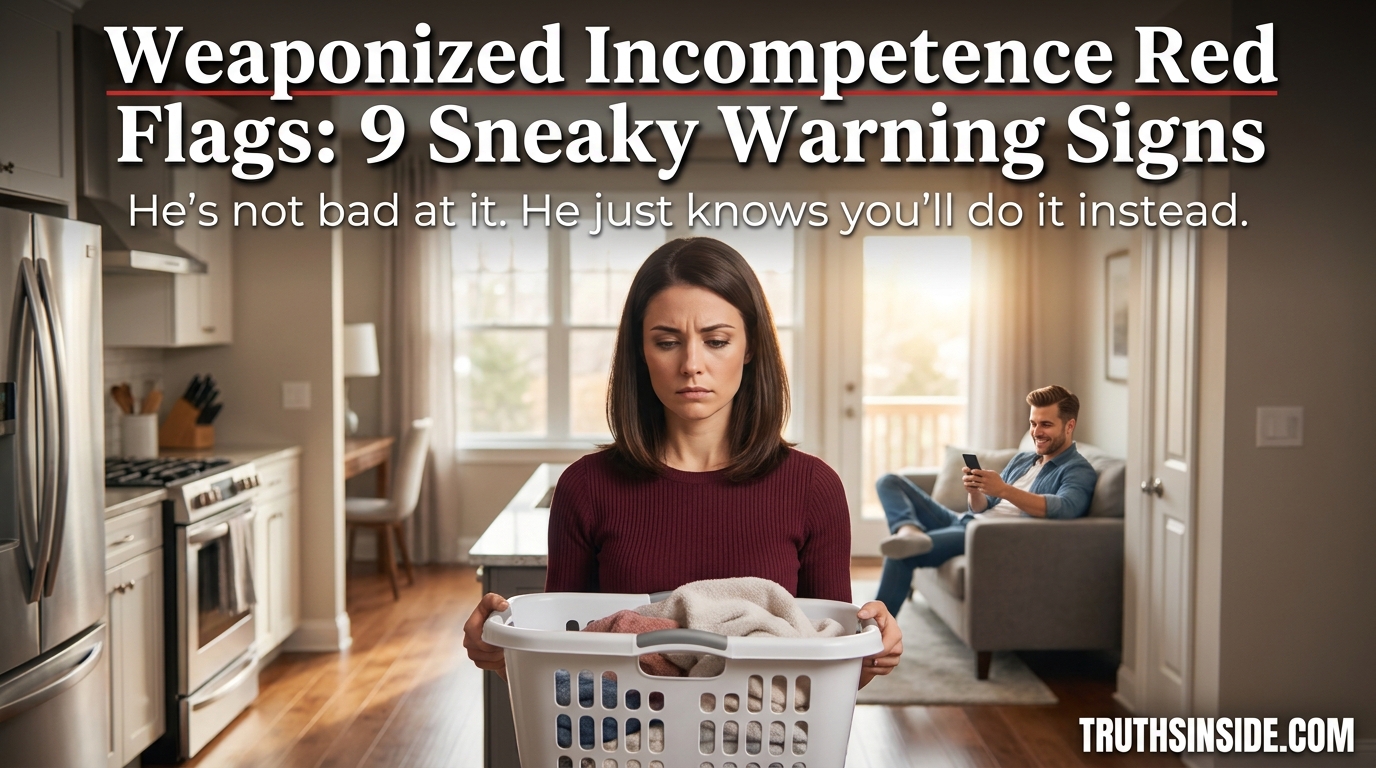
Weaponized incompetence red flags are among the most frustrating and most frequently dismissed warning signs in modern relationships — because they hide behind something that looks, on the surface, like harmless inability. Your partner can’t seem to load the dishwasher correctly. They forget appointments you’ve mentioned multiple times. They attempt a household task so poorly that you end up redoing it yourself — and somehow, over time, simply taking it over entirely. From the outside, this might look like ordinary human fallibility. From the inside, it produces a specific, exhausting, and increasingly resentful dynamic in which one person carries the full cognitive and practical weight of shared life while the other moves through it largely unburdened.
Weaponized incompetence — sometimes called “strategic incompetence” — is the pattern in which a person deliberately performs tasks poorly, claims inability to do things they are capable of doing, or feigns helplessness in specific contexts in order to avoid responsibility and transfer the burden of that responsibility to their partner. The term gained significant cultural attention in recent years, but the dynamic itself is far from new. Research on the unequal distribution of domestic labor consistently documents a persistent pattern in which one partner — disproportionately women in heterosexual relationships — carries a dramatically larger share of both physical and cognitive household labor than the other.
A study published in the Journal of Marriage and Family found that even in dual-income households where both partners work equivalent hours professionally, women perform an average of significantly more domestic labor and mental load management than their male partners — and that a substantial portion of this imbalance is maintained not by explicit negotiation but by the other partner’s consistent underperformance creating a vacuum that the higher-performing partner inevitably fills. This article identifies 9 specific weaponized incompetence red flags — the signs that what you are dealing with is not genuine inability but deliberate, strategic helplessness that is costing you far more than it should.
The Difference Between Genuine Incompetence and Weaponized Incompetence
Before examining the 9 red flags, a critical distinction must be made — because not every person who struggles with domestic tasks or organizational responsibilities is engaging in weaponized incompetence. Genuine incompetence exists. People have genuinely different skill sets, different upbringings, different levels of experience with various household tasks. Someone who grew up in a household where they were never taught to cook, clean, or manage domestic organization may genuinely need time, patience, and explicit teaching to develop those competencies.
The distinction between genuine incompetence and weaponized incompetence lies in three specific factors: selectivity, response to teaching, and motivation.
Genuine incompetence is not selective — it applies consistently across tasks regardless of the person’s interest or motivation. Weaponized incompetence is remarkably selective — mysteriously absent when the task is something the person wants to do.
Genuine incompetence responds to patient teaching and clear instruction — the person learns, improves, and gradually develops the competency being requested. Weaponized incompetence is resistant to all teaching — no matter how clearly the task is explained or demonstrated, the performance remains consistently inadequate in ways that ensure the other person takes over.
And genuine incompetence is not motivated by the outcome of incompetent performance. Weaponized incompetence is — the inadequate performance consistently produces the outcome of reduced responsibility, which is exactly what the pattern is designed to achieve.

Red Flag #1: Weaponized Incompetence Red Flags — Their Helplessness Is Strangely Selective
The single most revealing characteristic of weaponized incompetence is its remarkable selectivity. A partner who genuinely cannot manage a task will struggle with it consistently — regardless of whether the outcome of that struggle serves them or inconveniences them.
A partner who is weaponizing incompetence will struggle with tasks whose burden falls on you when they are not done — and demonstrate no such difficulty with tasks that serve their own interests or pleasure.
They cannot remember to schedule the dentist appointment. But they can manage a complex fantasy football league with meticulous attention to detail. They cannot figure out how to operate the washing machine. But they can install and navigate any piece of technology that interests them within minutes.
This selectivity is the clearest possible evidence that the issue is not ability. It is motivation. And the pattern of motivation — reliably present when the task serves them, reliably absent when the task serves the household — is the defining fingerprint of weaponized incompetence.
Pay attention to whether their incompetence follows a consistent pattern of convenient failure. When the tasks they cannot perform are disproportionately the ones whose undone state creates work for you — that pattern is not coincidence. It is the architecture of the dynamic.
📃 Related article: 15 Signs She Is Testing You: Why Women Test Men and What to Do
Red Flag #2: They Do It Badly Enough That You Take Over
One of the most effective and most commonly employed expressions of weaponized incompetence is performing a task just badly enough that the other person’s standards — or simply the basic requirements of the task’s completion — cannot tolerate the result.
The dishes are washed but left visibly dirty. The laundry is done but shrunk, inside-out, and mixed incorrectly. The children are fed but given something nutritionally inadequate. The grocery shopping is completed but with such a baffling selection of items that it creates more work than it saves.
Each individual failure carries a plausible explanation. But the consistent pattern — in which every task attempted produces a result poor enough to require intervention — is not accidental. It reliably produces the outcome of the other partner stepping in, correcting, and eventually simply taking over to ensure the task is done adequately.
Over time, this pattern is extraordinarily effective. The person who keeps stepping in gradually assumes full ownership of the task — often without any explicit conversation, simply through the accumulated logic of “it’s easier if I just do it myself.” Which is, of course, precisely the conclusion the pattern was designed to produce.
Red Flag #3: Teaching Them Makes No Lasting Difference
In a relationship with a genuinely incompetent but genuinely well-intentioned partner, patient teaching produces learning. When you explain how to do something clearly, demonstrate it, and provide feedback — performance improves over time. Not perfectly, not immediately, but measurably and in the right direction.
In a relationship where weaponized incompetence is operating, teaching produces no lasting improvement. You explain the same task the same way for the fifth time and the performance is essentially identical to the first. The instruction is received, apparently understood, and then somehow does not translate into changed behavior the next time the task arises.
This resistance to learning is one of the most important diagnostic features of weaponized incompetence — because genuine inability responds to genuine teaching. Strategic incompetence cannot afford to respond to teaching, because improvement would eliminate the justification for continued avoidance.
The teaching also frequently produces a secondary dynamic worth noting: the burden of teaching itself falls on the partner who is already carrying the larger share of labor. You are not only doing more — you are also responsible for educating your partner in how to do their share. This additional labor is itself a form of the imbalance being perpetuated.
“There is a specific exhaustion that comes from teaching someone how to be your partner. That is not a teaching problem. That is a motivation problem.”
Red Flag #4: They Never Initiate — They Only Respond When Directly Asked
In a genuinely equal partnership, both people notice what needs to be done and act on that noticing without requiring explicit direction. The dishes need washing — one person washes them, not because they were asked but because they saw the need and responded to it.
In a relationship where weaponized incompetence is operating, one partner consistently notices and acts while the other consistently waits to be directed. The incompetent partner never initiates household tasks, organizational responsibilities, or the management of shared logistics — not because they don’t notice, but because not noticing is far more advantageous than noticing.
And even when directly asked — when a specific request is made clearly and with explicit expectation — the response is frequently incomplete, delayed, or performed in a way that requires follow-up management.
The mental load researcher and sociologist Dr. Allison Daminger documented this dynamic extensively — the way that the cognitive labor of noticing, anticipating, and directing falls entirely on one partner, while the other operates in a reactive mode that requires continuous management and produces none of the organizational leadership that functioning shared life requires.
This is not a communication problem solvable by clearer asking. A partner who only acts when directed and only adequately when supervised has made a choice — conscious or not — about the distribution of responsibility in the relationship.
Red Flag #5: Their Incompetence Disappeared When They Were Single
One of the most clarifying questions available to anyone navigating suspected weaponized incompetence is also one of the simplest: how did this person manage before you?
Did they live independently — manage their own household, feed themselves, maintain their own living space, keep their own appointments, manage their own finances? Did they function as a capable adult in the world before the relationship created someone available to manage things for them?
If the answer is yes — if they demonstrably managed all of these things before the relationship and have gradually ceded responsibility for them since — that history is significant evidence about the nature of the current incompetence.
Genuine inability does not disappear when a person is single and reappear when they are in a relationship. Strategic incompetence does — because it only becomes functionally useful when there is someone else available to absorb the responsibility being avoided.
The person who managed their own life competently before the relationship and cannot seem to manage basic responsibilities within it has not lost ability. They have found someone whose standards, conscientiousness, or conflict avoidance makes the performance of helplessness a reliably effective strategy.

Red Flag #6: They Use Praise as a Deflection From Responsibility
A particularly sophisticated expression of weaponized incompetence is the strategic use of praise — enthusiastic, genuine-seeming appreciation for everything the other partner does — as a mechanism for naturalizing the imbalance rather than addressing it.
“You’re so much better at this than I am.” “I don’t know what I’d do without you.” “You’re amazing — I could never manage all of this.”
These statements feel like appreciation. They produce, momentarily, a sense of being valued. And they function, very effectively, to frame the imbalanced labor distribution as a natural and even flattering reflection of superior competence rather than as an unfair burden being placed on one person.
The praise also makes the imbalance harder to address directly — because raising it risks appearing ungrateful for the appreciation, demanding perfection from someone who is “trying their best,” or diminishing the genuine affection that may accompany the strategic compliment.
A partner who consistently praises rather than shares is not appreciating your labor. They are managing it — keeping you invested in performing it by making that performance feel like a reflection of your exceptional capability rather than an inequitable division of shared responsibility.
Genuine appreciation includes action. It includes the motivated attempt to share the burden being praised. Praise without that attempt is a management strategy, not an expression of gratitude.
📃 Related article: Signs He Likes You But Is Scared: 18 Behaviors Men Show When Afraid to Commit
Red Flag #7: Conflict About the Imbalance Goes Nowhere
When you raise the imbalance — when you name the pattern, express how it is affecting you, and ask for genuine change — what happens?
In a relationship with a genuinely well-intentioned partner who has been unaware of the imbalance, this conversation produces genuine reflection, honest acknowledgment, and motivated effort to change the dynamic. The conversation goes somewhere productive.
In a relationship where weaponized incompetence is operating, this conversation goes through a predictable and ultimately frustrating cycle. Defensiveness arrives first — the incompetence is genuine, the effort is real, the expectation is unreasonable. Then, sometimes, a period of improved performance — temporary, and precisely long enough to demonstrate willingness without establishing a permanent pattern. Then a gradual return to the original dynamic.
The conversation about the imbalance is itself an expression of the imbalance — because addressing it falls entirely on the person who is already carrying more than their share. And the cycle of raising it, seeing temporary improvement, watching the return — this cycle is one of the most exhausting and most demoralizing features of the weaponized incompetence dynamic.
If you have had this conversation more than twice with the same person about the same pattern — and the pattern has not fundamentally changed — the pattern is not changing because it is not being experienced as a problem that requires change.
Red Flag #8: The Mental Load Is Entirely Yours
Visible household labor — the physical tasks of cleaning, cooking, and maintaining a shared space — is only part of what sustains a functioning shared life. Equally significant, and far less visible, is the mental load: the cognitive labor of noticing what needs to be done, remembering what has been arranged, anticipating what will be needed, planning, scheduling, and managing the logistics of life.
In relationships where weaponized incompetence is operating, the mental load is almost universally carried by one partner alone. Not only are they performing the majority of physical tasks — they are also the sole keeper of the household’s cognitive infrastructure. They remember the appointments, track the bills, plan the social calendar, manage the children’s schedules, and hold in their mind the entirety of the logistical web that makes shared life function.
The incompetent partner, meanwhile, is free of this cognitive burden entirely. They don’t know what needs to be done because they have never needed to know — someone else has always carried that awareness.
This invisible labor is real, significant, and chronically exhausting. And it is not distributed by accident. It falls to the person whose standards and conscientiousness make them willing to carry it — and remains absent from the partner for whom the consequences of not carrying it are reliably absorbed by someone else.
Red Flag #9: You Have Stopped Asking and Simply Started Doing
The final and most personally significant red flag of weaponized incompetence is the one that reveals how completely the pattern has settled into the relationship’s structure — the moment you realize you stopped asking for help entirely and simply began doing everything yourself.
This shift is not dramatic. It happens gradually — one task at a time, one frustrated resignation at a time — until the division of labor has become so normalized that neither person explicitly acknowledges it anymore. You don’t ask because asking produces friction, inadequate performance, or temporary improvement that doesn’t last. It’s simply easier to do it yourself.
But “easier to do it yourself” is the final destination of weaponized incompetence — the complete transfer of responsibility from the person who should be sharing it to the person whose standards, patience, and conflict avoidance make them the more convenient carrier.
And the cost of arriving at this destination is significant. Not just the physical exhaustion of doing more. But the resentment that accumulates quietly beneath the accommodation. The loneliness of being the only functional adult in a partnership. The gradual erosion of respect for the person you are carrying. And the slow, sustained damage to the relationship’s foundation that unchallenged imbalance inevitably produces.
“The moment you stopped asking and simply started doing everything — the relationship stopped being a partnership. It became a service arrangement. And you became the only employee.”

What to Do If You Recognize These Red Flags
Recognizing weaponized incompetence red flags in your relationship is both validating and complicated — because it requires sitting with the possibility that what has felt like your partner’s limitation is actually a pattern of avoidance that has been costing you significantly.
The first step is to name it clearly — to yourself, and then, when you feel ready, to your partner. Not as an accusation designed to produce defensiveness, but as an honest description of what you have observed and what it has cost you. “I’ve noticed that the household responsibilities are not shared equally. I’ve tried to address this before and the pattern hasn’t changed. I need that to change.”
The response to that conversation is itself important data. A partner who genuinely was unaware of the pattern — and who genuinely cares about the relationship and about your wellbeing — will respond with honest reflection and motivated effort. A partner whose incompetence has been strategic will respond with the same defensive, temporarily improving, ultimately unchanged cycle that has characterized the pattern so far.
Couples therapy with a therapist who understands domestic labor dynamics and relationship imbalance can provide the structured space for this conversation to occur with professional facilitation — and can help both partners examine the pattern honestly without the conversation collapsing into defensiveness.
And if the pattern does not change — if every honest conversation, every clearly expressed need, every request for genuine partnership produces the same cycle of temporary adjustment and ultimate return — then the question is not how to fix the pattern. The question is whether you are willing to continue carrying everything in a relationship that has demonstrated it will not share the weight.
You deserve a partner who shows up — not because you asked perfectly, not because you managed the request correctly, but because they have genuinely decided that your shared life is something they are equally responsible for building.
💾 Save this article — share it with yourself the next time you wonder if you’re asking for too much.
📤 Share it with someone who has been exhausted by a relationship that was never quite a partnership.
👣 Follow Truthsinside.com for more honest, research-backed content on relationship red flags, patterns, and the dynamics that matter most to recognize.
📃 Related article: Gaslighting in Relationships: How to Recognize, Name, and Leave It
FAQ: Weaponized Incompetence Red Flags
Q1: What is weaponized incompetence?
Weaponized incompetence is the pattern in which a person deliberately performs tasks poorly or claims inability to do things they are capable of doing — in order to avoid responsibility and transfer that responsibility to their partner. It differs from genuine incompetence in its selectivity, its resistance to teaching, and its consistent production of the outcome of reduced personal responsibility.
Q2: Is weaponized incompetence always intentional?
Not always consciously. Some people engage in this pattern without full awareness — having learned through experience that underperformance reliably results in someone else taking over, without explicitly deciding to exploit that dynamic. Whether conscious or not, the impact is identical. And whether conscious or not, genuine change requires the person to develop awareness of the pattern and motivated commitment to breaking it.
Q3: Can weaponized incompetence exist in any relationship dynamic?
Yes. While research documents it most frequently in heterosexual relationships where women carry disproportionate domestic labor, the pattern can exist in any relationship configuration — same-sex partnerships, relationships where the dynamic is reversed, and workplace relationships where strategic underperformance transfers responsibility to colleagues. The core mechanism — performing helplessness to avoid responsibility — is not gender-specific.
Q4: How do I address weaponized incompetence without it turning into a fight?
Focus on the observable pattern rather than the inferred intention. Describing what you observe — “I’ve noticed I’m managing most of our household tasks and the mental load of our shared life” — is more likely to open genuine conversation than attributing deliberate intent — “you’re pretending to be helpless on purpose.” Request specific, concrete changes with clear expectations and genuine accountability. And observe whether the response produces sustained change or the familiar cycle of temporary adjustment and return.
Q5: When does weaponized incompetence become a reason to leave?
When it has been honestly and directly addressed multiple times, has produced no sustained change, and is causing significant ongoing harm to your wellbeing, your sense of self, and your respect for the relationship. A partner who has been clearly told that the imbalance is causing harm and who has not made genuine, sustained effort to address it has communicated something important about their investment in the relationship’s fairness. That communication deserves to be taken seriously — and responded to with the same honesty with which it was delivered.
🎵 Music
Maren Lull is a singer-songwriter who writes from the places most people don’t talk about out loud.
Not the dramatic grief. Not the obvious heartbreak. The quiet kind — the ordinary Tuesday emptiness, the habit of reaching for someone who isn’t there anymore, the particular exhaustion of being strong for so long that the strength itself wears thin.
Her music lives at the intersection of emotional honesty and soft beauty — breathy vocals over gentle piano, slow tempos, lyrics that feel less like songs and more like something you wrote in a private notebook at two in the morning and never showed anyone.
Maren Lull writes for the people who feel everything deeply and say very little about it. For the ones who listen to sad music not because they want to feel worse — but because being understood, even by a song, makes the feeling easier to carry.
📱 Follow Maren Lull:
→ Spotify
→ Apple Music
→ Youtube
→ Audiomack