
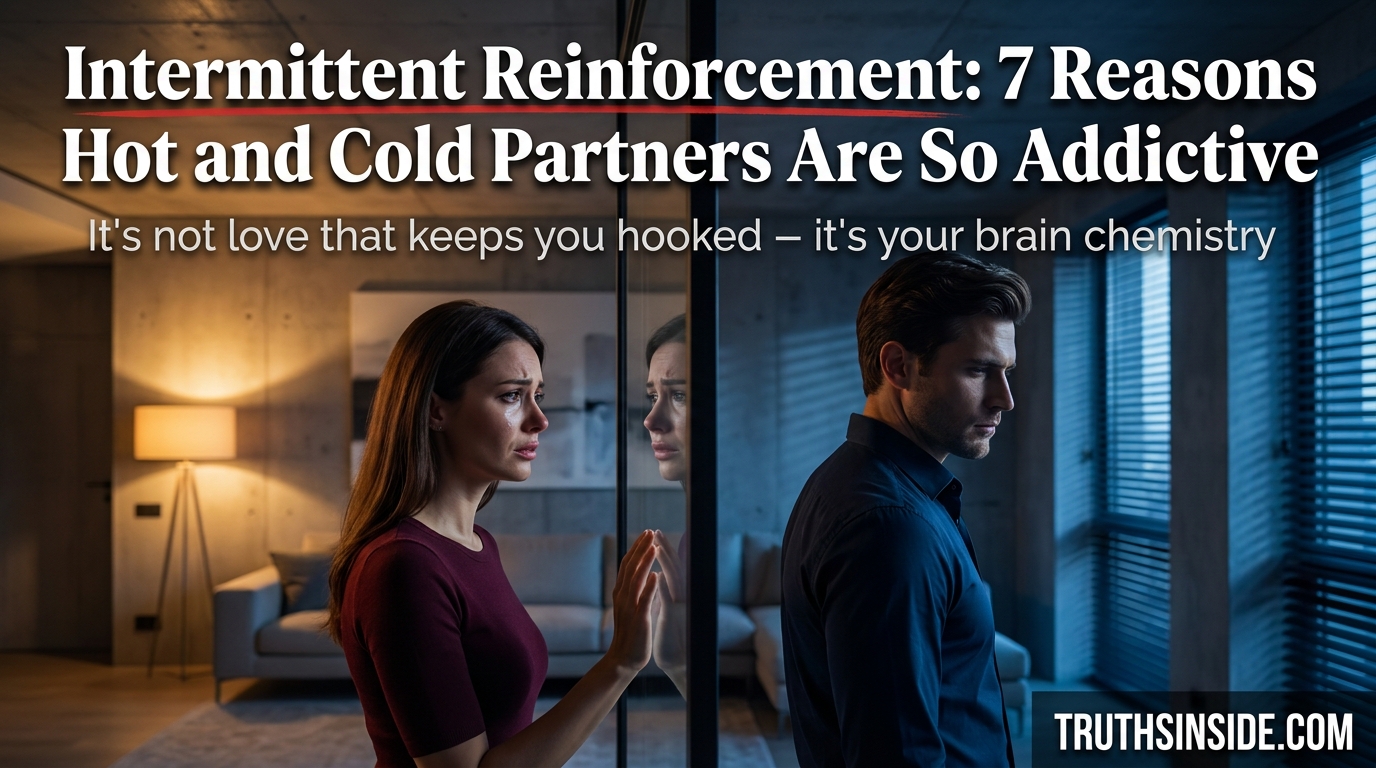
Intermittent reinforcement is the psychological mechanism that explains one of the most confusing and most painful experiences in modern relationships — the way a partner who is sometimes warm, sometimes cold, sometimes present and sometimes completely withdrawn can produce an attachment more powerful, more consuming, and more difficult to escape than anything a consistently loving relationship has ever created. It is the reason intelligent, self-aware people find themselves obsessively checking their phone for a message from someone who has hurt them repeatedly.
It is the reason the relationship that caused the most damage is often the one that feels the most impossible to leave. And it is the reason that knowing something is bad for you and being neurologically free to walk away from it are two entirely different states.
The science begins in a laboratory. B.F. Skinner’s foundational behavioral research in the 1950s and 1960s demonstrated that animals — and humans — respond most powerfully and most persistently to rewards that arrive unpredictably. When a reward is delivered consistently, the brain learns to expect it and its motivational power diminishes. When a reward is delivered intermittently — sometimes arriving, sometimes not, with no reliable pattern — the brain’s dopamine system activates with extraordinary intensity. The seeking behavior becomes compulsive, the attachment to the reward source becomes consuming, and the resistance to extinction — to stopping the behavior even in the complete absence of reward — becomes remarkable.
In relationships, that reward is love, warmth, and the specific relief of a partner returning after a period of withdrawal. And research published in the Journal of Personality and Social Psychology confirms that relationships characterized by intermittent reinforcement produce measurably stronger emotional attachment, higher levels of relationship preoccupation, and significantly greater difficulty leaving than relationships where affection and warmth are consistently provided. This article examines 7 specific reasons why intermittent reinforcement makes hot and cold partners so neurologically, psychologically, and emotionally addictive — and what genuine freedom from this pattern actually requires.
What Intermittent Reinforcement Actually Looks Like in a Relationship
Before examining the 7 reasons, it is worth grounding the concept in the specific texture of how intermittent reinforcement actually manifests in real relationships — because in real life, it rarely looks like a deliberate manipulation strategy. It often feels, from both sides, like the natural rhythm of a passionate and complicated love.
The hot phase is real. The warmth, the attention, the specific quality of being fully chosen by this person — these experiences are not fabricated. They are genuine expressions of connection that create genuine neurological reward.
The cold phase is also real. The withdrawal, the emotional distance, the sudden unavailability that arrives without clear reason or warning — these are also genuine. And their arrival, unpredictable and unexplained, immediately activates the seeking behavior that the hot phase created.
The cycle does not require conscious intention from either partner. Many people who create intermittent reinforcement dynamics are not deliberately manipulating. They are expressing their own unresolved attachment wounds, their own patterns of approach and withdrawal, in ways that interact with their partner’s attachment system to produce a dynamic that neither person fully understands and neither can quite stop.

Reason #1: Intermittent Reinforcement Hijacks the Brain’s Dopamine System
The most foundational reason hot and cold partners are so addictive is neurological — and it operates entirely beneath conscious awareness. The brain’s dopamine system, which governs motivation, seeking behavior, and the experience of reward, responds to unpredictable rewards with dramatically greater activation than it does to predictable ones.
Neuroscientist Wolfram Schultz’s landmark research on dopamine neurons demonstrated that these neurons fire most powerfully not in response to the reward itself — but in response to the uncertainty of whether the reward will arrive. The anticipation of an unpredictable reward produces a stronger dopamine response than the certainty of a consistent one.
In the context of a hot and cold relationship, this means that the very unpredictability that makes the relationship so painful is simultaneously what makes it neurologically compelling. Every unanswered text, every cold withdrawal followed by a warm return, every unpredictable shift in emotional availability trains the dopamine system to fire with increasing intensity.
The brain becomes consumed by seeking — by the question of when the warmth will return, what will produce it, how to secure it. This seeking is not a choice. It is the neurological output of a dopamine system operating exactly as designed — in conditions specifically calibrated to maximize its activation.
📃 Related article: Love-Hate Dynamic: 7 Reasons Toxic Love Traps You
Reason #2: The Relief of Return Feels Like Love
One of the most psychologically sophisticated dimensions of intermittent reinforcement is the way the relief produced by a partner’s return after a period of withdrawal gets misidentified — genuinely, not deliberately — as love.
When a hot and cold partner withdraws, the nervous system moves into a state of genuine distress. Cortisol rises. Anxiety activates. The absence of the attachment figure is processed by the brain’s social bonding systems as a genuine threat.
When the partner returns — when the warmth resurfaces after the cold — the relief of that return produces a significant neurochemical response. Dopamine releases. Oxytocin rises. The distress resolves, and the resolution of distress feels, from the inside, almost identical to the experience of profound connection.
This is one of the most important and most disorienting discoveries available to anyone in a hot and cold relationship: what feels like the deepest love — the most intense connection — may actually be the neurological relief of a distress response ending.
The connection is real. The feeling is real. But it is being amplified, dramatically, by the contrast between the preceding distress and the current relief. And that amplification makes the relationship feel more significant, more meaningful, and more irreplaceable than a consistently warm relationship — where the absence of distress means the absence of that particular amplification — ever fully can.
Reason #3: Unpredictability Creates Obsessive Preoccupation
Research on the psychology of uncertainty consistently shows that unpredictable social situations demand significantly more cognitive resources than predictable ones — because the mind must remain continuously alert to a situation whose parameters keep shifting.
In a hot and cold relationship, this cognitive demand becomes all-consuming. Your mind cannot settle into a stable understanding of the relationship — because the relationship keeps changing. Is this a good day or a bad one? Is the warmth real this time or temporary? What caused the shift? What will maintain the connection? What will trigger the next withdrawal?
These questions do not resolve. They cycle. And in cycling, they occupy a disproportionate share of mental and emotional bandwidth — crowding out other relationships, other interests, other dimensions of life that don’t carry the same urgency.
This preoccupation is not a personality flaw. It is the predictable cognitive output of a nervous system trying to make sense of a fundamentally unpredictable social situation. The mind is doing exactly what minds are designed to do — seeking patterns, anticipating change, allocating attention to the most uncertain and therefore most potentially significant element of the social environment.
The hot and cold partner, by being the most uncertain element of your emotional landscape, becomes the most cognitively prominent — not because they deserve that prominence, but because uncertainty commands it automatically.
“You are not obsessed with them. You are obsessed with the uncertainty of them. And your brain cannot look away from an unresolved question.”
Reason #4: The Pattern Mimics Early Attachment Wounds
For many people who find themselves most powerfully affected by intermittent reinforcement dynamics, the pattern resonates so deeply because it is not new. It is familiar — the emotional texture of an early attachment relationship where love was real but inconsistent, where warmth was genuine but not reliably available, where the experience of being loved was intertwined from the beginning with the experience of uncertainty.
Children who grow up with inconsistently available caregivers — parents whose warmth and attention were genuine but unpredictably offered — develop attachment patterns specifically calibrated to navigate that inconsistency. They become hypervigilant to the caregiver’s emotional state. They develop sophisticated pattern-recognition systems for predicting when warmth will arrive. They learn to experience the moments of connection with particular intensity — because they have learned those moments are precious and temporary.
These early attachment patterns do not disappear in adulthood. They transfer directly into the template for romantic relationships — making the hot and cold dynamic feel not just familiar but, on some deeply encoded level, like what love is.
The person who grew up with inconsistent love does not choose hot and cold partners because they enjoy suffering. They choose them because the nervous system recognizes the dynamic as the version of love it was designed to navigate — and experiences consistent, available love as something that, however objectively preferable, doesn’t quite register with the same depth of familiarity.
Reason #5: Each Cycle Deepens the Trauma Bond
With each repetition of the hot and cold cycle — each withdrawal followed by return, each rupture followed by reunion — the psychological bond to the partner deepens rather than weakens. This counterintuitive deepening is the mechanism at the heart of trauma bonding, and it is one of the most important reasons intermittent reinforcement makes hot and cold partners so genuinely difficult to leave.
Dr. Patrick Carnes’ research on trauma bonding identified the specific conditions under which intermittent harm and comfort produce the strongest and most durable attachments. The key element is the dual role of the partner — as both the source of the distress and the source of its relief.
When the only available relief from the pain produced by a partner’s withdrawal is the partner’s return, the brain forms an attachment to that partner that is qualitatively different from — and significantly more binding than — attachments formed in consistently safe relationships.
Each cycle through the pattern reinforces the neural pathways associated with the bond. Each return produces a relief response that deepens the association between this specific person and the resolution of distress. And each withdrawal reactivates the seeking behavior that makes the next return feel even more necessary.
The bond does not weaken with repetition. It strengthens — until leaving feels not just emotionally difficult but neurologically impossible.

Reason #6: The Good Moments Become Disproportionately Significant
In a consistently warm and loving relationship, positive moments are the norm — they register as pleasant but not extraordinary, because they are part of the expected baseline of the relationship’s emotional texture.
In a hot and cold relationship, positive moments are not the norm. They arrive against a backdrop of uncertainty, withdrawal, and the chronic low-grade anxiety of not knowing when the warmth will next appear.
This contrast dramatically amplifies the perceived significance of every positive moment. The good day feels extraordinary. The warm text feels like a breakthrough. The moment of genuine connection feels like everything the relationship is capable of — and the memory of that moment becomes the primary evidence cited by the mind when justifying continued investment in the pattern.
Research on contrast effects in psychology confirms that the perceived value of any experience is significantly influenced by the experience that precedes it. A warm moment that follows a period of cold withdrawal is experienced as profoundly more significant than the identical warm moment in a consistently loving relationship — because the contrast amplifies the subjective value of the reward.
This is why the best moments in intermittent reinforcement relationships often feel like the best moments of a person’s entire romantic life. Not necessarily because they are objectively superior — but because they are arriving in conditions specifically designed to maximize their neurological and emotional impact.
📃 Related article: 15 Signs She Is Testing You: Why Women Test Men and What to Do
Reason #7: Leaving Means Losing the Best High You’ve Ever Felt
The final and perhaps most honest reason intermittent reinforcement makes hot and cold partners so addictive is the specific loss that leaving represents — not just the loss of the person, but the loss of the neurochemical state that the relationship’s pattern has made uniquely available.
The highs of an intermittent reinforcement relationship — the relief of return, the intensity of connection amplified by contrast, the dopamine surge of an unpredictable reward finally arriving — are, neurologically speaking, among the most powerful emotional experiences available to the human nervous system.
Leaving the relationship means leaving those highs. And replacing them with the consistent warmth of a healthy relationship — however objectively better, however clearly preferable — initially feels, to a nervous system calibrated by intermittent reinforcement, like a significant downgrade.
This is precisely the experience that leads many people back to hot and cold relationships after leaving — not because they have forgotten why they left, but because the consistent warmth of what came after doesn’t produce the same neurochemical intensity. The nervous system, trained by the pattern, experiences the absence of the cycle’s highs as a form of withdrawal — and reaches back toward the source of the most powerful reward it has known.
Understanding this mechanism is not a reason to return to the pattern. It is the most important reason to give the nervous system sufficient time and distance to recalibrate — to relearn what genuine, consistent love feels like at a neurological level — before making any decisions about what to pursue next.
“The healthy relationship that follows a hot and cold one will feel quieter. That quiet is not emptiness. It is your nervous system finally, slowly, learning what safe feels like.”

How to Break Free From the Intermittent Reinforcement Cycle
Understanding intermittent reinforcement intellectually is a meaningful first step — but it does not, on its own, neutralize the pattern’s neurological hold. Freedom from the cycle requires more than knowing what it is. It requires creating the specific conditions under which the brain can begin to restructure the attachment it has formed.
The most essential condition is physical and digital distance. Every contact with a hot and cold partner — even painful contact — reactivates the dopamine cycle and resets the neurological withdrawal process. Distance is not cruelty. It is the creation of the neurological space necessary for the brain to begin restructuring around the pattern’s absence.
Therapeutic support is not optional in this process — it is foundational. A therapist who understands attachment, intermittent reinforcement, and trauma bonding can help you identify the early attachment wounds the pattern is resonating with, develop the self-awareness to recognize the cycle’s activation in real time, and build the neurological tolerance for consistent love that the pattern has eroded.
Be genuinely patient with the withdrawal phase. The period immediately following the end of an intermittent reinforcement relationship is neurologically analogous to substance withdrawal — not metaphorically, but structurally. The dopamine system is deprived of its primary activation source. The seeking behavior intensifies before it diminishes. The urge to return to the pattern can feel overwhelming.
This urge is not love speaking. It is withdrawal. And withdrawal, however uncomfortable, is the evidence that the neurological restructuring has begun.
The nervous system does recalibrate. The seeking behavior does diminish. The capacity for consistent love does return — often with a clarity and a gratitude that the hot and cold cycle never allowed. But it requires time, distance, support, and the specific courage of someone who understands what their brain is doing and chooses to outlast it anyway.
💾 Save this article — return to it when the pull back toward the pattern feels stronger than the memory of why you left.
📤 Share it with someone whose relationship has been described in terms that sound exactly like this.
👣 Follow Truthsinside.com for more deeply researched psychology and relationship content that helps you understand not just your relationships — but the neuroscience driving them.
📃 Related article: Signs He Likes You But Is Scared: 18 Behaviors Men Show When Afraid to Commit
FAQ: Intermittent Reinforcement
Q1: What is intermittent reinforcement in relationships?
Intermittent reinforcement in relationships is a pattern where affection, warmth, and positive connection are delivered unpredictably — sometimes present, sometimes completely absent — creating a neurological dynamic similar to addiction. The unpredictability of the reward activates the brain’s dopamine system more powerfully than consistent affection does, producing strong attachment, obsessive preoccupation, and significant difficulty leaving the relationship.
Q2: Is intermittent reinforcement always intentional?
No — and this is important. Many people who create intermittent reinforcement dynamics are not deliberately manipulating their partners. They are expressing their own unresolved attachment wounds, emotional dysregulation, or avoidant patterns in ways that produce the hot and cold dynamic without conscious strategic intent. Whether intentional or not, the impact on the person experiencing it is identical — and requires the same level of honest assessment and, often, the same therapeutic response.
Q3: Why does leaving a hot and cold partner feel so much harder than leaving a consistently loving one?
Because the intermittent reinforcement pattern produces a stronger neurological attachment than consistent love does — through the dopamine amplification of unpredictable reward, trauma bonding through cycles of distress and relief, and the disproportionate significance of good moments amplified by contrast. The nervous system has been trained by the pattern to experience this specific relationship as its primary source of the most powerful reward available — making the prospect of leaving neurologically comparable to losing access to an addictive substance.
Q4: How long does it take to recover from an intermittent reinforcement relationship?
Recovery timelines vary significantly based on relationship length, the depth of early attachment wounds the pattern resonated with, and the quality of therapeutic support engaged during the process. Most people describe the most acute phase of the withdrawal-like response lasting several weeks to several months. Full recalibration — reaching a place where consistent, available love feels genuinely satisfying rather than comparatively flat — often takes longer, particularly for those whose early attachment history made them especially susceptible to the pattern. Professional therapeutic support significantly accelerates the process.
Q5: Can a relationship with intermittent reinforcement become healthy?
In rare cases — where the partner creating the hot and cold dynamic genuinely recognizes the pattern, engages in sustained individual therapeutic work addressing its attachment origins, and demonstrates consistent behavioral change over an extended period — the relationship dynamic can shift toward something healthier. However, this requires both partners to be working actively and simultaneously: one on producing consistent availability, the other on recalibrating their nervous system’s response to it. Without both components, the dynamic typically reasserts itself — because the pattern is maintained not just by one partner’s behavior but by the neurological responses of both.
🎵 Music
Maren Lull is a singer-songwriter who writes from the places most people don’t talk about out loud.
Not the dramatic grief. Not the obvious heartbreak. The quiet kind — the ordinary Tuesday emptiness, the habit of reaching for someone who isn’t there anymore, the particular exhaustion of being strong for so long that the strength itself wears thin.
Her music lives at the intersection of emotional honesty and soft beauty — breathy vocals over gentle piano, slow tempos, lyrics that feel less like songs and more like something you wrote in a private notebook at two in the morning and never showed anyone.
Maren Lull writes for the people who feel everything deeply and say very little about it. For the ones who listen to sad music not because they want to feel worse — but because being understood, even by a song, makes the feeling easier to carry.
📱 Follow Maren Lull:
→ Spotify
→ Apple Music
→ Youtube
→ Audiomack