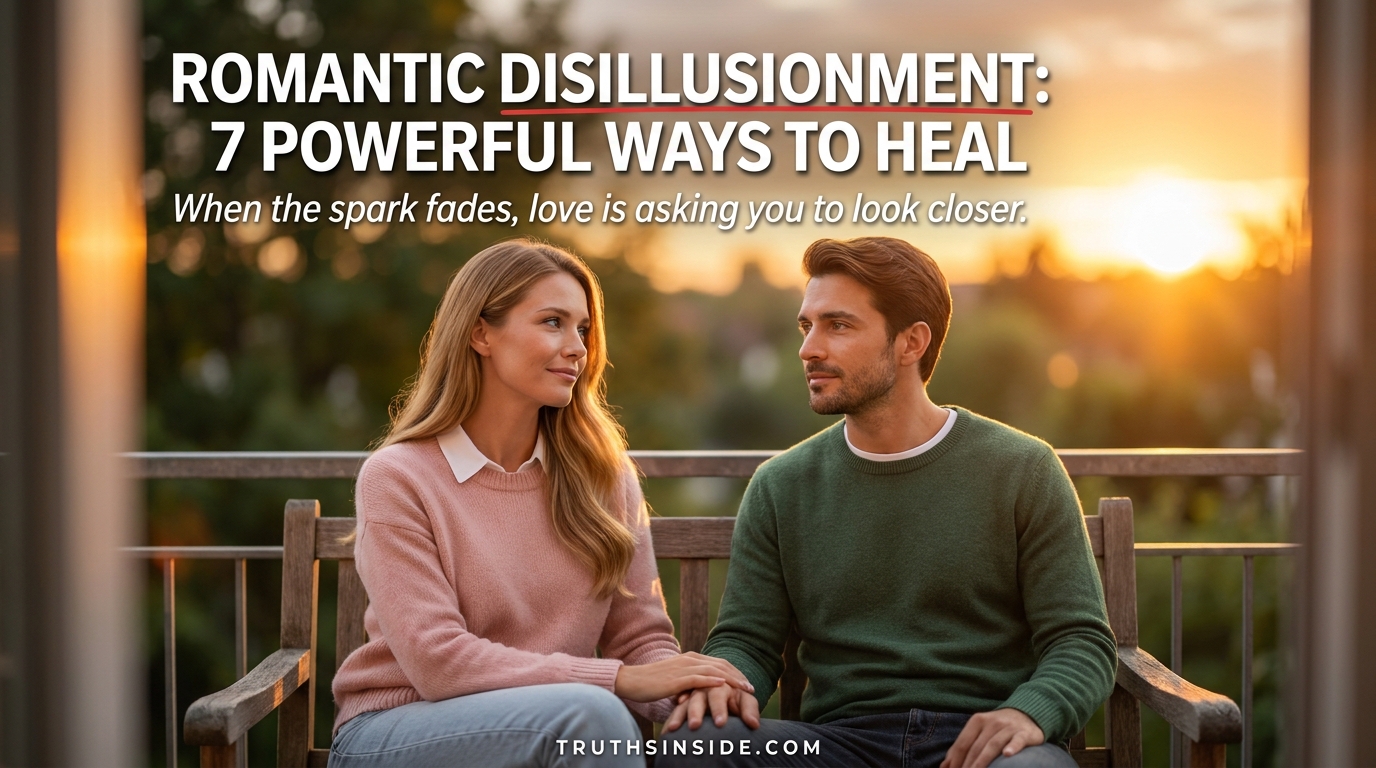
Romantic Disillusionment: What to Do When Love Loses Its Magic
Romantic disillusionment is the quiet moment you realize the person you once adored has become someone you simply live with. The butterflies are gone, the texts are shorter, and you wonder, with a pang of guilt, whether the magic was ever real. If you feel this way, you are not broken. Longitudinal research on newlyweds shows that marital satisfaction tends to decline gradually in the early years, and psychologist Dorothy Tennov estimated that the intense rush of infatuation often lasts only eighteen months to three years.
It can feel lonely to admit this out loud. Society sells love as an endless spark, so when the spark softens, you may assume something has gone wrong with your partner, your relationship, or your heart. Many people suffer in silence, scrolling past other people’s perfect anniversaries and quietly asking what changed. Romantic disillusionment is not a verdict. It is a transition, and how you move through it shapes everything that comes next.
In this guide, you will learn what romantic disillusionment is, why it happens, what research says about the brain and long-term love, and seven powerful ways to heal. You will also see when it may be time to seek extra support. Read gently, because the goal is not to blame your partner or yourself. It is to understand this moment well enough to move through it with compassion and hope.
“The magic does not disappear. It changes shape, and you are invited to learn its new language.”
What Is Romantic Disillusionment?
Romantic disillusionment is the emotional letdown that follows when your idealized picture of love collides with everyday reality. In the early months, you see your partner through a golden filter. Their quirks seem charming, their flaws seem small, and every day feels like a story. Over time, the filter fades, and you begin to see an ordinary human being with habits, moods, and limits. That shift can feel like loss.
It often arrives quietly. There may be no betrayal and no big fight, just a slow dimming. You might feel numb, restless, or oddly sad while sitting beside someone you care about. Romantic disillusionment is common in dating, marriage, and long-term partnerships alike, and it does not automatically signal that the relationship is failing. More often, it signals that the relationship is changing.
Romantic Disillusionment vs. Falling Out of Love
The two can look alike, but they are not the same. Falling out of love implies the connection itself has ended. Romantic disillusionment describes the collapse of an illusion, which can actually make room for a more honest bond. A useful clue is whether you still want the relationship to work. If you feel sad about the lost magic and miss closeness, this is more likely than indifference. Persistent sadness, hopelessness, or loss of interest in everything may point to something else, such as depression, and deserves professional support.
📃 Related article: Emotional Enmeshment: 7 Hidden Signs of Harm
The Science Behind Romantic Disillusionment
Hedonic Adaptation: Why Wonderful Becomes Ordinary
Psychologists use the term hedonic adaptation to describe how we get used to positive changes. A well-known longitudinal study by Richard Lucas and colleagues found that people’s life satisfaction rose around marriage and then, on average, drifted back toward its earlier baseline. Studies following newlyweds also show that marital satisfaction tends to decline gradually in the early years. The very thing that thrilled you becomes your normal, and normal quietly stops sparkling.
The Brain on New Love
Brain imaging by anthropologist Helen Fisher and psychologist Arthur Aron showed that intense early romantic love activates dopamine-rich reward regions, the same systems involved in motivation and craving. That intensity feels like destiny, but it is partly neurochemical, and it naturally settles. Dorothy Tennov, who coined the term limerence, estimated that the rush of infatuation often lasts eighteen months to three years.
The encouraging news comes from a later imaging study led by Bianca Acevedo, which found that some couples married for around two decades still showed brain activity similar to early love, alongside calmer attachment-related patterns. Romantic disillusionment, then, is not proof that long-term passion is impossible. It suggests that sustaining it takes intention.
Idealization, Reality, and the Shape of Love
Psychologist Sandra Murray and colleagues found that people who idealized their partners tended to be happier later, which suggests positive illusions can protect a relationship. When those illusions crack, disappointment follows. Robert Sternberg’s triangular theory of love adds another lens: passion tends to fade faster than intimacy and commitment. Romantic disillusionment is often passion cooling before the other two sides have grown strong enough to carry the relationship.

5 Signs of Romantic Disillusionment
Not everyone experiences it the same way, but these signs appear again and again. If a few feel familiar, you are not alone, and you are not doing love wrong.
Sign 1: You Feel Flat Around Someone You Love
You are not angry, just oddly empty. Moments that once made your heart race, such as a text, a touch, or a shared joke, now barely register. This emotional flatness is one of the most common signs of romantic disillusionment, and it often leaves people feeling guilty because nothing is technically wrong.
Sign 2: Their Small Quirks Suddenly Irritate You
The laugh you once adored now grates. The habits you found endearing now feel like evidence. When the golden filter fades, small details become magnified, and romantic disillusionment can turn tiny differences into daily friction.
Sign 3: You Daydream About a Different Life
You imagine other cities, other partners, or simply a version of yourself without obligations. Fantasy is a normal response to feeling stuck, and it does not always mean you want to leave. It often means something in your current life needs more freedom, novelty, or recognition.
Sign 4: Conversations Shrink Into Logistics
Who is picking up the kids, what is for dinner, which bill is due. When most of your talks are about managing life rather than sharing it, closeness quietly erodes. Romantic disillusionment grows in the gap where curiosity used to live.
Sign 5: You Compare Your Relationship to Everyone Else’s
Social media shows other couples at their best: sunsets, surprises, perfect captions. Comparing your ordinary Tuesday with their highlight reel can deepen romantic disillusionment, because it measures your real relationship against a curated fantasy.

Why Love Loses Its Magic
Understanding the causes can lighten the shame. Romantic disillusionment rarely comes from one big failure. It tends to build from many small, ordinary forces that go unnoticed until the distance feels wide.
Routine Replaces Novelty
Predictable days soothe us, but they also flatten experience. When every evening looks like the last, your brain stops registering your partner as new or interesting. Psychologist Arthur Aron’s self-expansion model suggests that couples feel closer when they grow and discover things together. Without fresh experiences, romantic disillusionment finds room to settle in.
Stress Steals Attention
Work pressure, finances, parenting, and exhaustion leave little energy for tenderness. Your partner becomes a teammate in survival mode instead of a source of joy. Romantic disillusionment often appears in seasons of overload, when love is not gone but buried under tasks.
Unspoken Expectations Turn Into Resentment
Many of us carry silent scripts about how love should feel and how a partner should behave. When reality does not match, disappointment grows quietly. Without honest conversation, those unmet expectations harden into resentment, and romantic disillusionment deepens.
Social Media Raises the Bar
Never before have we seen so many other people’s love stories. Curated anniversary posts, surprise proposals, and couples traveling the world can quietly raise the standard of what a relationship should feel like every day. When your real life, with its laundry and long workweeks, cannot match the highlight reel, disappointment creeps in. The comparison is unfair, because you are measuring your whole relationship against someone else’s best five seconds, yet it can still sting.
Life Transitions Change the Rhythm
Big changes, such as a new baby, a demanding promotion, a move, or caring for aging parents, rearrange how couples spend time and energy. Roles shift, and tenderness often gets pushed to the bottom of the list. Neither of you did anything wrong. The relationship simply has to learn a new rhythm, and until it does, the distance can feel like proof that love has faded. Often it is just a sign that the old routines no longer fit.
“Disappointment is not the opposite of love. Often it is love meeting reality for the first time.”
7 Powerful Ways to Heal Romantic Disillusionment
You cannot force the old spark back, but you can build a new warmth on purpose. These seven approaches draw on relationship psychology and are designed to be small, kind, and doable, even when you feel tired.
1. Name It Without Shame
Start by admitting what you feel, privately or with your partner. Saying “I miss how we used to feel” is not an accusation. It is an invitation. Naming romantic disillusionment takes away its secrecy, and secrecy is what makes disappointment feel like a personal failure rather than a shared, solvable experience.
2. Get Curious About Each Other Again
People keep changing, but couples often stop asking questions. Psychologist John Gottman’s idea of love maps encourages partners to keep updating what they know about each other’s dreams, worries, and daily world. Ask something you do not already know the answer to. Curiosity is one of the fastest antidotes to romantic disillusionment because it turns a familiar person back into a fascinating one.
3. Try Something New Together
Research by Arthur Aron and colleagues found that couples who shared novel, mildly exciting activities reported greater relationship satisfaction. Take a different route, cook a new cuisine, try a class, or plan a small adventure. Novelty recreates a little of the early excitement and gives you fresh shared memories, which helps counter romantic disillusionment.
4. Turn Toward Small Bids for Connection
Gottman observed that couples who stay close respond to each other’s everyday bids: a comment, a joke, a sigh, a touch. Turning toward a bid says, “I see you.” Over weeks, these tiny moments rebuild trust and warmth. When romantic disillusionment has set in, small responsive gestures often matter more than grand romantic ones.
5. Create Rituals of Connection
Rituals make closeness dependable. It might be a six-second kiss at the door, a ten-minute check-in with no phones, or a weekly date night. Choose something small enough to sustain. Predictable moments of attention counter the drift that feeds romantic disillusionment, because connection becomes a habit instead of an accident.
6. Reignite Touch and Intimacy Slowly
Desire rarely returns on command. Start with non-demanding affection: holding hands, long hugs, sitting close while you talk. Then talk honestly about what feels good and what you miss. Therapist Esther Perel suggests that desire thrives on a bit of mystery and autonomy, so seeing your partner as a separate, interesting person can help. Gentle, pressure-free closeness softens romantic disillusionment from the body up.
7. Reconnect With Yourself
Sometimes romantic disillusionment is partly about losing touch with who you are. Revive a hobby, deepen a friendship, move your body, and invest in your own growth. When you bring a fuller self to the relationship, your partner meets someone alive and interesting, and you feel less dependent on them to supply all of your joy.
You do not need to try all seven at once. Choose the one that feels least intimidating and practice it for two weeks. Small, consistent efforts accumulate, and even one warm moment a day can change the emotional climate of a relationship. Progress will not be perfectly linear, and that is normal. What matters is that both of you keep turning toward each other, even imperfectly.

A Gentle Self-Check: What Are You Really Missing?
Before deciding what your feelings mean, take a quiet moment with these questions. There are no wrong answers, only clues.
- Do I miss my partner, or do I miss the way I felt at the beginning?
- When did we last laugh together until it hurt?
- What need of mine have I stopped mentioning?
- Am I tired, stressed, or lonely in ways that have little to do with them?
- If we added more play, touch, or novelty, would I still want this life?
If your answers lean toward missing closeness and warmth, that is encouraging. It suggests the connection is still alive underneath the routine, and that romantic disillusionment may be pointing you toward what needs care rather than toward the exit.
When to Seek Extra Support
Some seasons are too heavy to navigate alone. Consider speaking with a licensed couples therapist if you feel stuck in the same arguments, if communication has broken down, or if romantic disillusionment has lasted a long time without improving. A therapist can help you understand patterns and practice new skills. If you feel persistently hopeless, or if your relationship involves disrespect, control, or fear, reach out to a mental health professional or a trusted person for guidance. Your wellbeing comes first.
📃 Related article: Reconnect Emotionally: 7 Proven Ways to Heal
Frequently Asked Questions
What causes romantic disillusionment?
Romantic disillusionment usually grows from a mix of hedonic adaptation, routine, stress, and unmet expectations. As the early rush of infatuation settles, idealized views of a partner give way to realistic ones, which can feel like disappointment even when the relationship is fundamentally healthy.
Is romantic disillusionment a sign that I should leave?
Not necessarily. It is a common stage and often a signal that the relationship needs attention, curiosity, and honest conversation. It may be worth reconsidering the relationship if disrespect, lack of safety, or deep incompatibility is present, but disappointment alone is not a verdict.
How long does romantic disillusionment last?
There is no fixed timeline. For some couples it passes in weeks once they reconnect, while for others it lingers for months or years without intentional change. Taking small, consistent steps and seeking support when needed usually helps it ease.
Can the magic come back after romantic disillusionment?
Many couples report that love becomes deeper and more resilient after this stage. The early rush may not return in the same form, but warmth, desire, and affection can be rebuilt through novelty, attention, and honest communication.
Is romantic disillusionment the same as depression?
No, but they can overlap. Romantic disillusionment focuses on feelings about the relationship, while depression involves broader, persistent sadness, loss of interest, or hopelessness across life. If you are worried about your mood, talk to a licensed mental health professional.
Final Thoughts
Romantic disillusionment feels like losing something precious, and in a sense you are. You are losing a fantasy. But what waits on the other side can be sturdier: a love that sees the real person, chooses them anyway, and keeps learning how to be tender. Be patient with the process, curious about your partner, and kind to yourself. The magic is not gone. It is waiting for a new kind of attention.
Enjoyed this article? Save it for the days when love feels quiet, share it with someone who needs a little hope, and follow Truthsinside.com for more heartfelt insights into love and emotions every week.
🎵 Music
Maren Lull is a singer-songwriter who writes from the places most people don’t talk about out loud.
Not the dramatic grief. Not the obvious heartbreak. The quiet kind — the ordinary Tuesday emptiness, the habit of reaching for someone who isn’t there anymore, the particular exhaustion of being strong for so long that the strength itself wears thin.
Her music lives at the intersection of emotional honesty and soft beauty — breathy vocals over gentle piano, slow tempos, lyrics that feel less like songs and more like something you wrote in a private notebook at two in the morning and never showed anyone.
Maren Lull writes for the people who feel everything deeply and say very little about it. For the ones who listen to sad music not because they want to feel worse — but because being understood, even by a song, makes the feeling easier to carry.
📱 Follow Maren Lull:
→ Spotify
→ Apple Music
→ Youtube
→ Audiomack