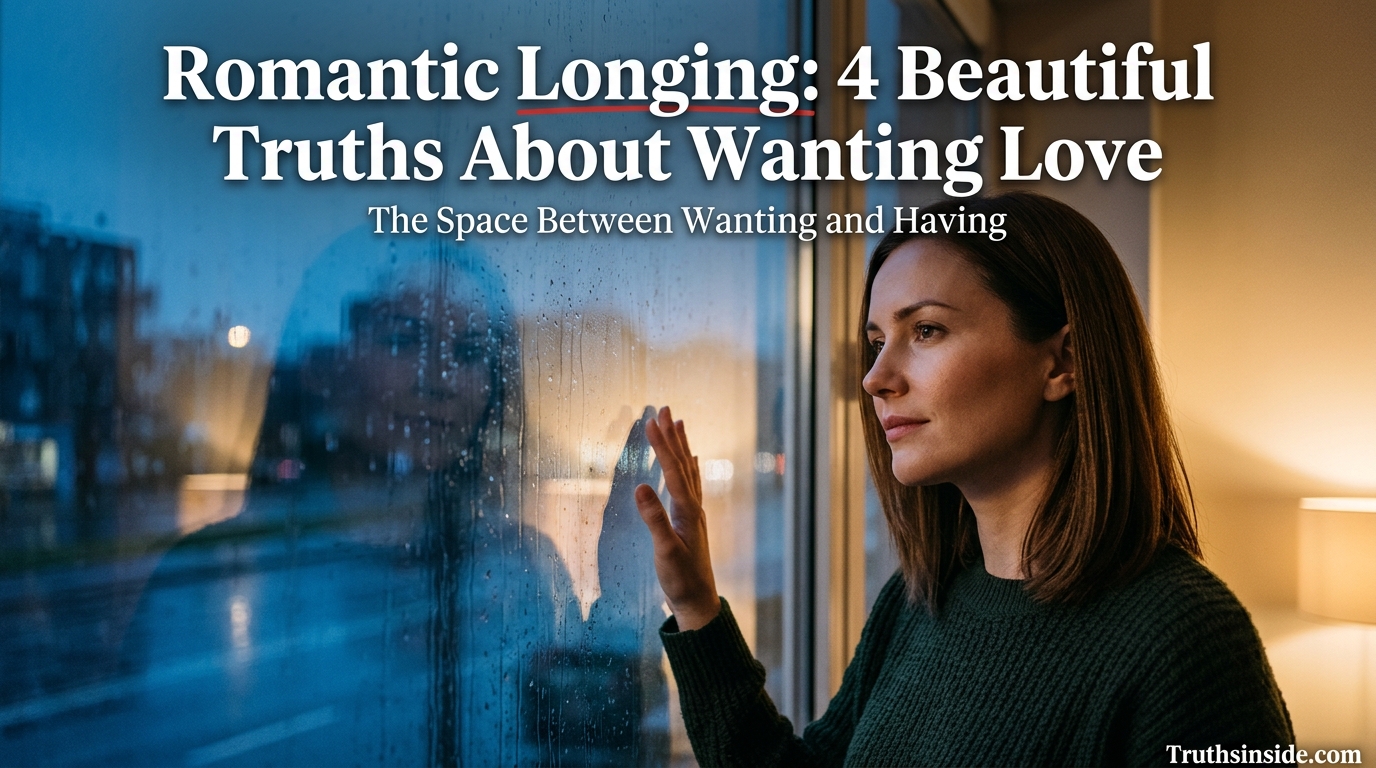
Romantic Longing: The Beautiful and Painful Space Between Wanting and Having
Have you ever ached for someone so intensely that their absence felt louder than their presence ever could? That specific, bittersweet pull has a name: romantic long. Neuroscience research has found that yearning for a person activates the brain’s dopamine-driven reward system in strikingly similar ways to addiction, which explains why romantic long can feel so consuming, so physical, and so hard to simply reason your way out of. It is one of the most universal human emotions, and yet it remains one of the least talked about honestly.
Romantic long isn’t just missing someone — it’s a complex emotional state that lives in the gap between desire and fulfillment. It can appear in the early stages of a new connection, in the quiet stretches of a long-distance relationship, in the aftermath of a breakup, or even within a committed relationship where something has grown distant. Wherever it shows up, romantic long carries both an aching pain and, strangely, a kind of beauty — a reminder of how deeply humans are wired to connect.
This article explores what romantic long actually is from a psychological perspective, why it feels so intense, the different forms it can take, and how to hold this feeling in a way that is healthy rather than consuming.
What Is Romantic Longing?
Romantic long is the emotional and physiological experience of deeply wanting closeness with someone who is emotionally or physically unavailable in the moment — whether due to distance, timing, uncertainty, or the end of a relationship. Unlike simple missing, romantic long often carries a heightened intensity, a sense of preoccupation, and sometimes even physical sensations like a tightness in the chest or a restless, unsettled energy.
Psychologists describe romantic long as existing on a spectrum. On one end, it can be a gentle, wistful ache — the kind felt during a temporary separation from a loving partner. On the other end, it can become an overwhelming, almost obsessive preoccupation, particularly in situations involving unrequited love or ambiguous relationships. Understanding where your own romantic long falls on this spectrum is an important first step toward processing it in a healthy way, rather than being swept entirely under its intensity.
📃 Related article: Maintain Your Identity: 7 Powerful Tips for Love
The Psychology and Neuroscience Behind Romantic Longing
Anthropologist and researcher Dr. Helen Fisher, known for her extensive work on the neuroscience of love, has found that romantic longing activates the same brain regions associated with substance craving, particularly the ventral tegmental area, which plays a central role in motivation and reward. This helps explain why romantic longing can feel so difficult to control with logic alone — it isn’t purely emotional, it’s deeply neurochemical.
Fisher’s research also suggests that romantic longing often intensifies, rather than fades, when a relationship faces obstacles or uncertainty — a phenomenon sometimes called “frustration attraction.” This is part of why unavailable or inconsistent partners can trigger such powerful longing, even more powerful than the longing felt for someone who is consistently present. Recognizing this neurochemical pattern doesn’t diminish the realness of romantic longing, but it does offer helpful context: intensity of feeling is not always the same thing as compatibility or rightness.
“Romantic longing isn’t proof that something is meant to be. It’s proof that your brain is deeply, chemically invested in the possibility.”
Understanding this distinction can be incredibly freeing, especially for anyone who has mistaken intensity for destiny.
The Different Faces of Romantic Longing
Romantic longing doesn’t show up the same way for everyone, and recognizing its different forms can help you understand your own emotional experience more clearly.
For some, it appears as the early, giddy ache of a new connection — the anticipation of a text, the replaying of a single conversation, the hope of what could become. For others, romantic longing shows up in long-distance relationships, where love is real and mutual, but physical closeness remains just out of reach for weeks or months at a time. It can also emerge after a breakup, when the mind continues reaching for a person who is no longer part of daily life. And sometimes, quietly, romantic longing appears inside an existing relationship — a yearning for the emotional closeness a couple once shared before life, stress, or distance crept in.

Why Romantic Longing Feels So Painful
Part of what makes romantic longing so painful is the uncertainty woven into it. When the object of longing is unreachable, whether through distance, unavailability, or absence, the mind often fills that uncertainty with imagined scenarios, replayed memories, and hopeful projections about the future. This mental looping can amplify the emotional intensity far beyond what the actual situation might warrant, creating a cycle that feels difficult to escape.
There’s also a deeper psychological layer at play. Romantic longing frequently taps into our earliest attachment wounds, echoing childhood experiences of wanting closeness from a caregiver who wasn’t always emotionally available. For people with anxious attachment styles in particular, romantic longing can feel especially overwhelming, since it activates long-standing fears around abandonment and not being enough. Recognizing this connection doesn’t erase the pain, but it can offer meaningful context for why certain kinds of longing feel disproportionately intense compared to the situation itself.
“The ache of romantic longing often says less about the person you’re missing and more about the parts of you still waiting to be held.”
This awareness can be the first step toward处理ing romantic longing with more self-compassion rather than judgment.

How to Hold Romantic Longing in a Healthy Way
Romantic longing doesn’t need to be eliminated or suppressed — in many cases, it simply needs to be understood and gently managed. Start by naming the feeling directly instead of avoiding it; simply acknowledging “I am experiencing romantic longing right now” can create a small but meaningful sense of emotional distance from the intensity.
Grounding practices, like deep breathing or physical movement, can help regulate the nervous system when longing feels overwhelming, since much of its intensity is physiological as well as emotional. Journaling about the feeling, rather than acting impulsively on it, allows space for reflection before decisions are made. It also helps to gently examine whether the romantic longing is rooted in genuine compatibility or in the intensity created by unavailability and uncertainty. Finally, nurturing other meaningful relationships and personal fulfillment outside of the specific person can soften the sharp edges of longing without dismissing its validity.

Romantic longing is one of the most deeply human emotions we experience — painful, yes, but also proof of our profound capacity to care, connect, and hope for something meaningful.
Frequently Asked Questions
1. Is romantic longing the same as love?
Not exactly. Romantic longing is an intense desire for closeness, which can exist alongside love but doesn’t always indicate long-term compatibility on its own.
2. Why does romantic longing feel stronger for unavailable people?
Research suggests uncertainty and obstacles can intensify longing due to a neurochemical pattern known as frustration attraction, making unavailable connections feel more consuming.
3. Is it normal to feel romantic longing while in a relationship?
Yes, especially during periods of emotional distance. It often signals a desire to reconnect rather than a problem with the relationship itself.
4. How long does romantic longing typically last?
This varies significantly by individual and circumstance, but with healthy processing, the intensity of romantic longing generally softens over time.
5. When should romantic longing be a concern?
If it becomes obsessive, interferes with daily functioning, or is tied to an unhealthy or unavailable connection, it may be worth exploring with a therapist.
If this article gave language to something you’ve felt, Save it for the moments you need the reminder, Share it with someone who understands this ache, and Follow Truthsinside.com for more honest reflections on love and emotion.
🎵 Music
Maren Lull is a singer-songwriter who writes from the places most people don’t talk about out loud.
Not the dramatic grief. Not the obvious heartbreak. The quiet kind — the ordinary Tuesday emptiness, the habit of reaching for someone who isn’t there anymore, the particular exhaustion of being strong for so long that the strength itself wears thin.
Her music lives at the intersection of emotional honesty and soft beauty — breathy vocals over gentle piano, slow tempos, lyrics that feel less like songs and more like something you wrote in a private notebook at two in the morning and never showed anyone.
Maren Lull writes for the people who feel everything deeply and say very little about it. For the ones who listen to sad music not because they want to feel worse — but because being understood, even by a song, makes the feeling easier to carry.
📱 Follow Maren Lull:
→ Spotify
→ Apple Music
→ Youtube
→ Audiomack