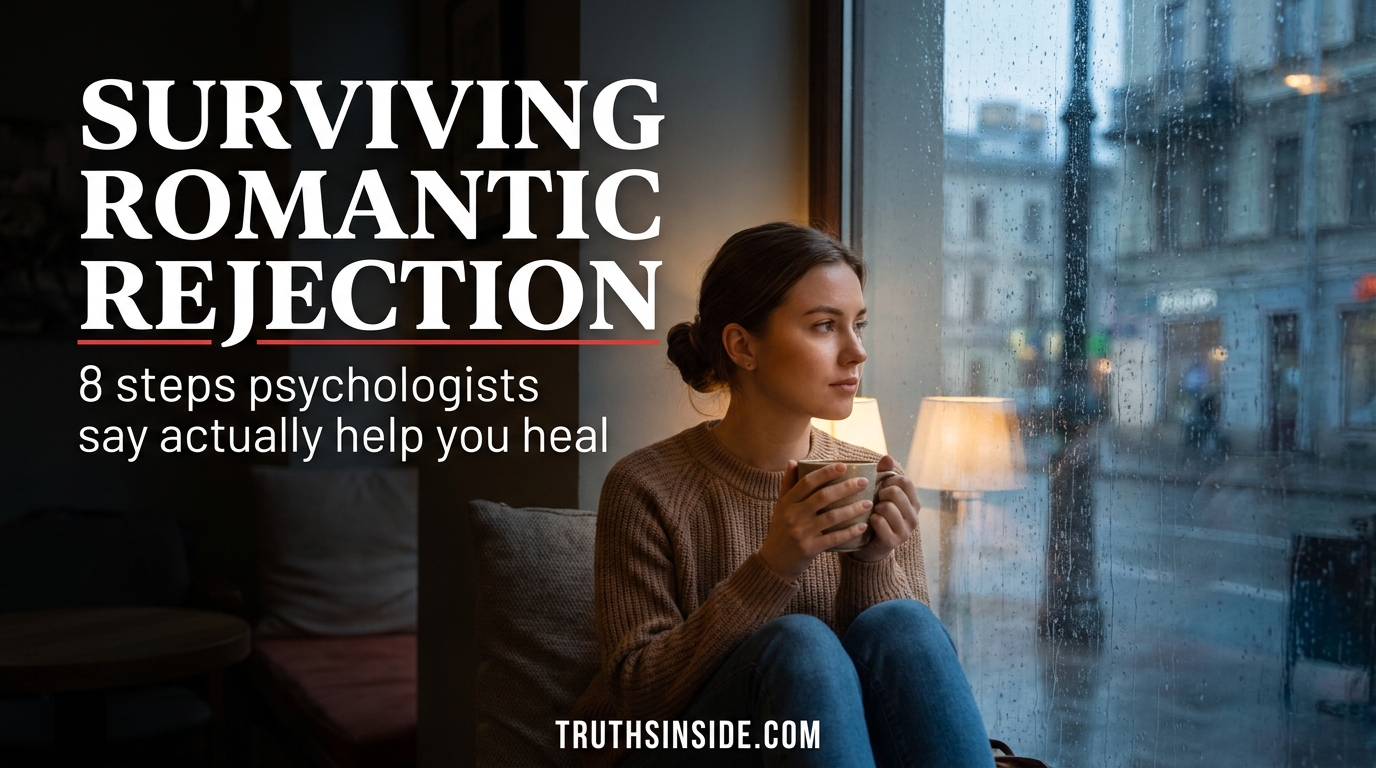
Romantic Rejection: How to Survive Being Turned Down
Being turned down by someone you wanted activates the same brain regions as physical pain, according to a landmark study published in the Proceedings of the National Academy of Sciences. Researchers at Columbia University found that romantic rejection lights up the anterior cingulate cortex and insula — areas also triggered by burns and broken bones. Surviving romantic rejection, in other words, isn’t just an emotional metaphor. Your nervous system genuinely registers it as an injury.
That explains why rejection can feel so disproportionately devastating, even after a short-lived connection or a single unanswered message. The pain is real, measurable, and — most importantly — temporary. Understanding the psychology behind why it hurts this much is often the first step toward surviving romantic rejection without letting it quietly reshape your self-worth.
This article walks through what actually happens in your brain and body after rejection, the most common ways people cope poorly, and the research-backed steps that make surviving romantic rejection not just possible, but a genuine catalyst for growth.
Why Romantic Rejection Hurts So Much
The intensity of rejection often surprises people, especially when the relationship was brief. Social psychologists explain this through the lens of evolutionary biology: for most of human history, social exclusion from a group or potential partner carried real survival risk. The brain still treats romantic rejection with that same ancient alarm system, regardless of how logically “small” the situation may seem.
Dr. Guy Winch, a psychologist who has extensively researched emotional pain, notes that rejection also damages self-esteem disproportionately compared to other painful experiences, because it often triggers a cascade of self-critical thinking. This is a major reason surviving romantic rejection requires more than just waiting for time to pass — it requires actively managing the self-critical narrative that tends to follow.
“Rejection doesn’t just hurt in the moment — it can quietly convince you of things about yourself that simply aren’t true.” — adapted from Dr. Guy Winch’s research on emotional first aid
The Stages Most People Go Through
Surviving romantic rejection typically isn’t linear. Most people move through phases resembling shock, denial, rumination, anger, and eventually acceptance — though not always in a clean sequence. It’s common to feel a wave of clarity one day and a fresh sting of hurt the next.
Recognizing these stages as a normal part of the process, rather than a sign that something is wrong with you, can significantly ease the experience. Emotional processing research consistently shows that rejection recovery timelines vary widely, and comparing your pace to someone else’s — or to an arbitrary internet timeline — often does more harm than good.
📃 Related article: Loving Someone With Addiction: 6 Hard Truths
Mistake 1: Replaying the Rejection on Loop
One of the most common obstacles to surviving romantic rejection is rumination — repeatedly replaying the conversation, the moment, or the imagined reasons behind it. While it feels like problem-solving, research on rumination consistently shows it prolongs emotional pain rather than resolving it.
The brain often mistakes rumination for productive reflection, but there’s a meaningful difference. Reflection asks, “What can I learn?” Rumination asks, “What’s wrong with me?” on an endless loop. Recognizing which one you’re doing is often the first step toward interrupting the cycle.

Mistake 2: Taking It as Proof of Personal Inadequacy
Rejection often gets internalized as evidence of a deep personal flaw — “I’m not attractive enough,” “I’m too much,” “no one will ever choose me.” Psychologists refer to this as a fundamental attribution error: assuming rejection reflects a fixed, global truth about your worth rather than a specific mismatch, timing issue, or the other person’s own unrelated circumstances.
Surviving romantic rejection in a healthy way requires separating the event from your identity. Someone declining a relationship with you is information about compatibility or timing — it is not a verdict on your value as a person, regardless of how convincingly it can feel that way in the moment.
Mistake 3: Isolating Instead of Reaching Out
It’s tempting to withdraw completely after rejection, avoiding friends and routines until the sting fades. But social psychology research consistently shows that connection — not isolation — is what accelerates emotional recovery. Isolation tends to amplify rumination and self-critical thinking rather than resolve it.

Reaching out doesn’t require processing every detail with everyone in your life. Even brief, low-pressure social contact — a walk with a friend, a family dinner, a casual conversation — has been shown to buffer against the isolating effects of emotional pain.
Step 1: Name the Pain Instead of Minimizing It
A crucial early step in surviving romantic rejection is acknowledging that it genuinely hurts, rather than rushing to minimize it with phrases like “it wasn’t that serious anyway.” Emotional suppression research consistently finds that avoided emotions tend to resurface more intensely later, rather than disappearing.
Naming the specific emotion — disappointment, embarrassment, grief, anger — has been shown in affective labeling studies to reduce the intensity of the emotional response itself. This isn’t about wallowing; it’s about giving your brain an accurate signal to process rather than suppress.
Step 2: Reframe Rejection as Redirection
One of the more empowering reframes in surviving romantic rejection is viewing it as incompatibility information rather than failure. A romantic mismatch, however painful, is data about fit — not a referendum on your desirability or worth as a partner.
This reframe isn’t about pretending the pain doesn’t exist. It’s about placing that pain within an accurate context: not everyone who declines you is rejecting your value; many are simply recognizing an incompatibility that would have caused both of you more pain further down the line.
“Rejection is redirection — not because it feels good, but because it’s often accurate.” — a common therapeutic reframe used in relationship coaching
Step 3: Rebuild Self-Worth from Sources Outside the Relationship
Rejection can temporarily narrow your sense of identity down to the relationship that ended. A key part of surviving romantic rejection is deliberately reconnecting with sources of self-worth that exist independently of romantic validation — friendships, hobbies, career accomplishments, personal goals.

Psychological research on self-concept clarity shows that people with a broader, more diversified sense of identity tend to recover from romantic setbacks more quickly than those whose self-worth was heavily concentrated in the relationship itself.
Step 4: Set a Boundary on Contact
Maintaining contact with someone shortly after rejection — checking their social media, texting “just to talk,” or hoping for a change of heart — is one of the most common ways people unintentionally prolong their own pain. Behavioral research on emotional attachment consistently shows that intermittent contact after a relationship ends slows recovery more than a clean break.
Surviving romantic rejection well often means creating enough space to let the initial emotional intensity settle before deciding what kind of relationship, if any, makes sense going forward — whether that’s friendship, distance, or no contact at all.
Step 5: Give Yourself a Realistic Timeline
There’s no universal formula for how long rejection should take to process, but research suggests most people experience the sharpest emotional intensity within the first two to four weeks, with gradual improvement after that. Expecting an unrealistic, faster timeline often leads to unnecessary self-judgment when the pain lingers longer than hoped.
Patience with your own timeline is itself a component of surviving romantic rejection well. Healing isn’t a failure to “get over it fast enough” — it’s simply the nervous system doing what nervous systems do after a genuine emotional injury.
📃 Related article: Love Maps: 5 Ways They Predict Lasting Love
When Rejection Becomes a Pattern
For some people, rejection triggers a disproportionately intense reaction rooted in earlier attachment wounds or a history of instability in close relationships. If romantic rejection consistently feels unbearable rather than simply painful, or triggers prolonged periods of hopelessness, it may be worth exploring these patterns with a licensed therapist, since deeper attachment work often provides relief that self-help strategies alone cannot.
Frequently Asked Questions
How long does it typically take to recover from romantic rejection?
Research suggests the sharpest emotional intensity generally fades within two to four weeks, though full emotional recovery varies significantly based on relationship depth and individual coping style.
Is it normal to still think about someone months after being rejected?
Yes, occasional thoughts are normal, especially around anniversaries or reminders. The key distinction is whether those thoughts are intrusive and distressing or simply passing reflections.
Does staying friends after rejection help or hurt the healing process?
Research generally suggests that maintaining close contact soon after rejection slows emotional recovery. A period of distance before deciding on a possible friendship tends to support healthier healing.
Can rejection actually make someone stronger?
Many people report post-rejection growth, including increased self-awareness and clearer relationship standards, once the acute pain has passed and genuine reflection becomes possible.
When should someone seek professional help after rejection?
If rejection triggers prolonged hopelessness, significant disruption to daily functioning, or intense reactions that feel disproportionate to the situation, speaking with a licensed therapist is strongly recommended.
If this gave you some clarity or comfort, don’t keep it to yourself. Save this article for the next time rejection catches you off guard. Share it with someone who’s healing right now. And Follow Truthsinside.com for more research-backed insight into love, emotions, and the psychology of moving forward.
🎵 Music
Maren Lull is a singer-songwriter who writes from the places most people don’t talk about out loud.
Not the dramatic grief. Not the obvious heartbreak. The quiet kind — the ordinary Tuesday emptiness, the habit of reaching for someone who isn’t there anymore, the particular exhaustion of being strong for so long that the strength itself wears thin.
Her music lives at the intersection of emotional honesty and soft beauty — breathy vocals over gentle piano, slow tempos, lyrics that feel less like songs and more like something you wrote in a private notebook at two in the morning and never showed anyone.
Maren Lull writes for the people who feel everything deeply and say very little about it. For the ones who listen to sad music not because they want to feel worse — but because being understood, even by a song, makes the feeling easier to carry.
📱 Follow Maren Lull:
→ Spotify
→ Apple Music
→ Youtube
→ Audiomack