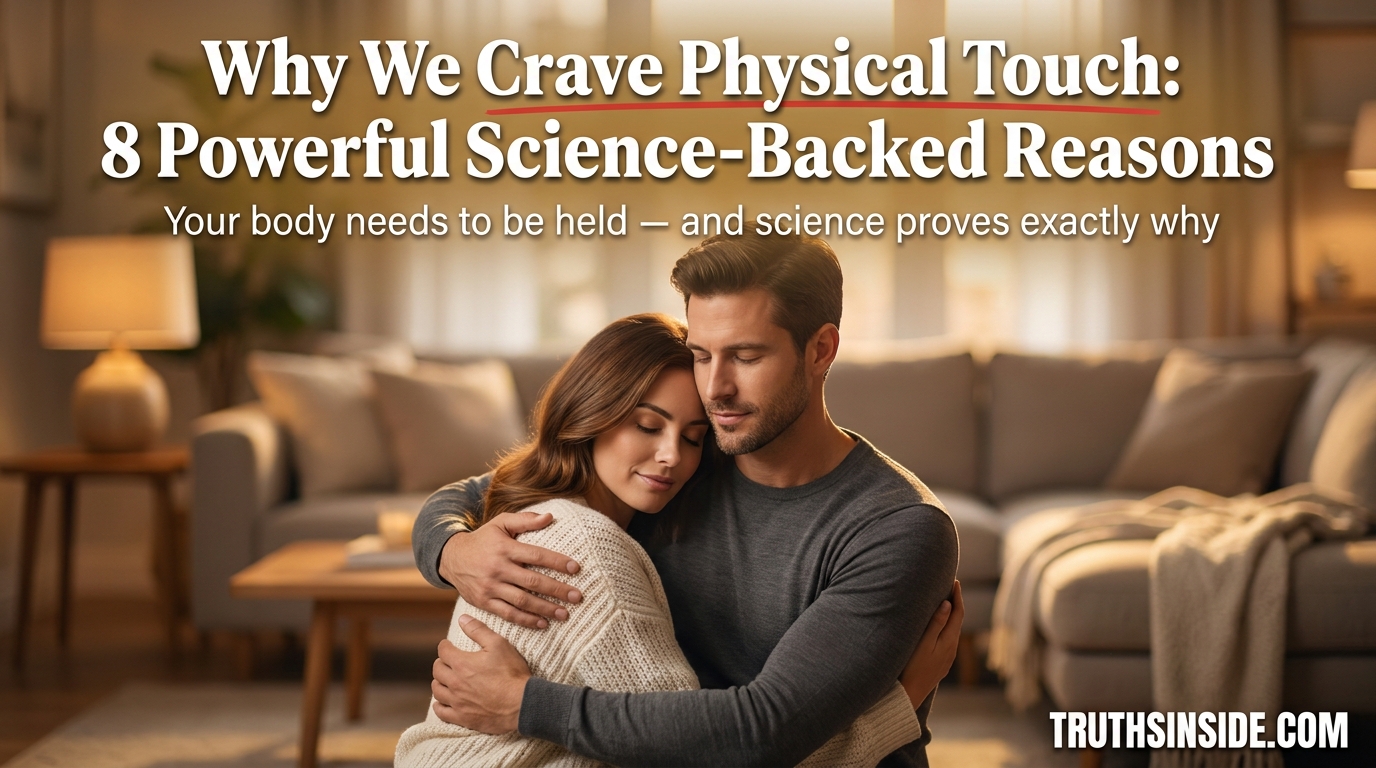
Why we crave physical touch — even outside of romantic or sexual contexts — is one of the most fascinating and most deeply human questions science has ever explored. It is the reason a hug from the right person can dissolve a tension that hours of conversation couldn’t touch. It is the reason holding someone’s hand during a frightening moment can make that moment more bearable. It is the reason solitary confinement is considered one of the most psychologically devastating punishments a human being can endure — not because of the absence of stimulation, but because of the absence of contact.
Touch is the first sense we develop in the womb and the last sense to leave us as we age. According to research from the Touch Research Institute at the University of Miami — the world’s first center dedicated entirely to the study of touch — physical contact influences nearly every major system in the human body, from immune function and cardiovascular health to emotional regulation, pain perception, and cognitive performance. A meta-analysis of 212 studies published in Psychological Bulletin found that physical touch has measurable positive effects on both physical and psychological wellbeing across every stage of human life, from infancy through old age.
And yet, in a culture that simultaneously sexualizes touch and pathologizes its expression between non-romantic adults, millions of people are living in a state of what researchers call “touch starvation” — a chronic deficit of meaningful physical contact that quietly erodes mental health, emotional resilience, and the fundamental sense of being connected to other human beings. This article explores 8 powerful, science-backed reasons why we crave physical touch — and why honoring that craving, in all its non-sexual expressions, may be one of the most important things we can do for our wellbeing and our relationships.
Touch Is Not a Luxury — It Is a Biological Language
Before we examine the 8 specific reasons we crave physical touch, it’s worth reframing how we understand touch itself — because the cultural conversation around it has done considerable damage to our relationship with one of our most essential human needs.
Touch is frequently discussed as though it were an optional enhancement to human experience — a nice addition when available, but certainly not a necessity. This framing is not only inaccurate. It is, in the light of decades of research, genuinely harmful. Touch is not a luxury. It is a biological language — the first and most fundamental means by which human beings communicate safety, care, belonging, and love.
Long before we had words, we had touch. Infants who are not held enough fail to thrive — not metaphorically, but clinically. The devastating cases documented in Romanian orphanages in the 1990s, where children received adequate food and shelter but almost no physical contact, showed that the absence of touch alone produced measurable developmental delays, emotional dysregulation, attachment disorders, and in the most severe cases, failure to survive.
Touch communicates what language cannot always reach. It crosses the boundary between two nervous systems in a way that words, however carefully chosen, simply cannot replicate. Understanding this — truly understanding it — changes how we think about our need for physical contact and why meeting that need, in healthy and consensual ways, is not indulgence. It is self-care at the most fundamental biological level.

Reason #1: Why We Crave Physical Touch — Oxytocin, the Bonding Hormone
The most well-known neurochemical story behind our craving for physical touch involves oxytocin — often called the “bonding hormone” or the “love hormone” — a neuropeptide released by the brain in response to physical contact. When you hug someone, hold hands, receive a pat on the back, or are simply touched with warmth and intention, your brain releases oxytocin — and the effects are immediate, measurable, and profound.
Oxytocin lowers cortisol — the body’s primary stress hormone — reducing the physiological markers of anxiety and activating a state of calm that the nervous system registers as safety. It increases feelings of trust and social connection. It reduces fear responses in the amygdala — the brain’s threat-detection center — making the world feel, at a neurological level, slightly less dangerous.
Research from the University of Zurich found that participants who received oxytocin through touch showed significantly higher levels of trust, generosity, and willingness to be vulnerable compared to those who did not. In relationship contexts, this means that the simple act of touching your partner — a hand on their arm, a brief embrace, a moment of physical closeness — is not just emotionally meaningful. It is actively building the neurochemical foundation of trust and safety that healthy relationships depend on.
The craving for this oxytocin response is not weakness or neediness. It is your nervous system correctly identifying that physical contact with a safe person is one of the fastest and most effective routes to emotional regulation available to the human body.
📃 Related article: What Does It Actually Feel Like to Fall in Love? Science + Real Stories
Reason #2: Touch Regulates the Nervous System in Ways Nothing Else Can
One of the most powerful reasons we crave physical touch is its unparalleled ability to regulate the autonomic nervous system — the system that governs our body’s stress and calm responses. When we are held, stroked, or touched with warmth and care, the parasympathetic nervous system activates — triggering what scientists call the “rest and digest” response that counters the stress-driven “fight or flight” state.
This regulation happens faster through touch than through almost any other intervention. A person in acute emotional distress can be verbally reassured for minutes with limited effect. The same person, held firmly and warmly, often begins to physiologically calm within seconds — heart rate slowing, breathing deepening, muscle tension releasing.
Dr. Stephen Porges, whose Polyvagal Theory has transformed our understanding of the nervous system’s social engagement functions, has documented extensively how physical co-regulation — the process by which one person’s calm nervous system helps regulate another’s through physical proximity and contact — is a fundamental feature of human neurological design.
This is why being held by someone you trust can make an unbearable moment suddenly more bearable. It is not a psychological trick. It is your nervous system receiving the co-regulatory signal it was designed to receive — and responding accordingly.
Reason #3: Physical Touch Communicates Emotions More Accurately Than Words
In 2009, researchers at UC Berkeley conducted a fascinating study in which participants attempted to communicate a range of specific emotions — gratitude, sympathy, anger, love, fear — to a stranger through touch alone, with no verbal or visual communication. The results were remarkable.
Strangers were able to accurately identify the emotion being communicated through touch at rates far exceeding chance — in some cases identifying specific emotions with greater accuracy than participants achieved through facial expressions or tone of voice alone.
This finding points to something extraordinary about the nature of physical touch as communication. Touch is not merely a supplement to emotional expression. It is, in many contexts, a more direct and accurate emotional channel than language itself.
Think about the moments in your own experience when words genuinely failed — when no combination of sentences could communicate what you were feeling — and physical contact said everything. The hand held in silence during grief. The embrace that conveyed what “I love you” alone could not. The gentle touch on a shoulder that communicated “I see you” more clearly than any spoken reassurance.
We crave physical touch in part because our nervous systems know, at a level deeper than conscious thought, that it is one of the most honest and complete forms of communication available to us. In a world where so much is filtered, performed, and carefully constructed, the directness of touch feels like relief.
“Touch is the language the body speaks before the mind finds words. And sometimes — it says everything the words never could.”
Reason #4: Touch Reduces Physical Pain — Not Just Emotional Pain
The connection between physical touch and pain reduction is one of the most surprising and well-documented findings in touch research — and one of the clearest demonstrations that our craving for physical contact is not purely emotional but deeply physiological.
Multiple studies have demonstrated that physical touch — particularly the kind that communicates warmth, care, and safety — activates the body’s endogenous opioid system, releasing natural pain-reducing chemicals that measurably decrease the perception of physical pain.
A landmark study published in Social Cognitive and Affective Neuroscience found that holding a romantic partner’s hand during a painful procedure significantly reduced participants’ self-reported pain levels and showed corresponding changes in brain activity in regions associated with pain processing. Even viewing a photograph of a loved one produced measurable pain reduction — but physical touch produced the strongest effect.
This is why the instinct to reach for someone’s hand when you’re afraid, or to place a caring hand on someone who is hurting, is so universal across cultures and throughout human history. Touch is not just comfort. It is biochemically active pain management — delivered not by a pharmacy but by the simple, extraordinary act of one human being choosing to be physically present with another.
Reason #5: Skin Hunger Is a Real and Medically Recognized Condition
“Skin hunger” — also called “touch starvation” — is the term researchers and clinicians use to describe the state of chronic deprivation of meaningful physical contact. And it is far more widespread, and far more medically significant, than most people realize.
A study conducted by Tiffany Field at the Touch Research Institute found that Americans are among the least touch-oriented cultures in the developed world — with adults reporting dramatically lower rates of casual, nonsexual physical contact with friends, family, and colleagues than counterparts in European and Latin American cultures.
The health consequences of touch starvation are significant and well-documented. Chronic absence of physical contact is associated with elevated cortisol levels, impaired immune function, increased rates of anxiety and depression, disrupted sleep, and a measurably diminished sense of social connection and belonging.
During the COVID-19 pandemic, when physical contact was dramatically reduced for millions of people across the world, mental health researchers documented a sharp and widespread increase in symptoms consistent with touch starvation — confirming what the research had long suggested. Physical contact is not a social nicety. It is a health variable — one whose chronic absence produces real, measurable, and serious consequences for both body and mind.
Recognizing skin hunger in yourself is the first step toward addressing it — through intentional physical connection with safe people in your life, whether that is a trusted friend, a family member, a partner, or even the documented benefits of professional therapeutic touch such as massage therapy.

Reason #6: Touch Deepens Emotional Intimacy in Relationships
In romantic relationships specifically, physical touch — beyond and separate from its sexual dimension — is one of the most powerful builders and maintainers of emotional intimacy. The couple who holds hands while watching television. The partners who embrace for a genuine, unhurried moment before leaving for work. The instinct to reach for each other during a difficult conversation. These moments are not incidental to the relationship’s emotional depth. They are constitutive of it.
Research from Brigham Young University found that couples who engaged in regular nonsexual physical affection — hugging, hand-holding, gentle touch during conversation — reported significantly higher levels of relationship satisfaction, emotional closeness, and felt sense of being loved than couples who primarily expressed affection verbally or through acts of service.
The mechanism behind this is partly oxytocin — as discussed — but also involves what researchers call “affective touch” — touch processed by a specific type of nerve fiber called C-tactile afferents, which respond specifically to gentle, stroking touch and send signals directly to the brain’s emotional processing centers.
These nerve fibers appear to exist specifically for the purpose of processing social, bonding touch — suggesting that our skin is not merely a physical boundary but an active social organ, designed to participate in the building and maintenance of emotional connection. When partners neglect this dimension of their relationship — allowing the physical language of affection to atrophy — they are often surprised to find that emotional intimacy quietly diminishes alongside it.
📃 Related article: The 5 Love Languages Explained: Which One Are You?
Reason #7: Touch Communicates Safety to Traumatized Nervous Systems
For people who carry the weight of past trauma — particularly developmental trauma involving inconsistent, frightening, or absent early caregiving — the craving for physical touch can be particularly intense and particularly complicated. Because touch, for people whose early experiences of it were associated with fear or harm, carries a dual charge: the deep biological need for contact existing alongside a nervous system that has learned to associate closeness with danger.
This complexity does not eliminate the craving — if anything, it intensifies it. But it creates a situation in which the healing power of safe, consensual, caring physical touch is most needed precisely for the people who find it most difficult to receive.
Trauma-informed therapists and somatic practitioners have documented extensively how the experience of safe physical touch — experienced consistently enough and with enough genuine care — can gradually begin to revise the nervous system’s association between touch and threat.
This process is slow, deeply personal, and not something that can be rushed or forced. But the research supporting the healing potential of safe touch for traumatized nervous systems is significant and growing. It points to something profound about why we crave physical touch even when our history has made that craving painful: because somewhere beneath the fear, the body still knows what it was designed for — and it has not given up on the possibility of being held safely.
Reason #8: Touch Reminds Us We Are Not Alone
Perhaps the deepest and most existentially significant reason we crave physical touch is the most simple: touch reminds us, at a level beneath language and conscious thought, that we are not alone in the world.
Loneliness — true, deep loneliness — is not merely the absence of people. It is the absence of felt connection. And felt connection, for human beings, is profoundly physical. We do not only feel connected through shared ideas, shared laughter, or even shared love expressed in words. We feel connected through the undeniable, present-tense reality of another body in contact with ours.
Research from the University of Chicago found that perceived social isolation — loneliness — is associated with a 26% increased risk of premature mortality, a risk comparable to smoking 15 cigarettes per day. And while loneliness is multidimensional, the physical dimension of connection — the simple, irreplaceable experience of being touched — appears to play a significant role in its relief.
When someone holds your hand, what they are communicating is not merely warmth or affection. They are communicating, through the oldest and most honest language available to our species: I am here. You are not alone. You are real to me. You matter.
In a world that increasingly conducts connection through screens, through carefully curated distance, through the mediated channels of digital communication — that message, delivered through the simple and ancient act of physical contact, may be more necessary than it has ever been.
“To be touched with care is to be reminded, in the most ancient language humans know, that you belong to this world and to each other.”

What to Do With This Craving — Honoring Your Need for Touch
Understanding why we crave physical touch is only the beginning. The more important question is what to do with that understanding — particularly in a world where the social scripts around touch are often confusing, limited, or insufficient to meet our actual needs.
Start by taking your own touch needs seriously. Not as something to be embarrassed about or minimized, but as a legitimate aspect of your wellbeing that deserves attention and intentional care. Notice where your life currently offers meaningful physical contact — and where it doesn’t.
In your relationships, be willing to express your need for touch directly and specifically. Many people assume their partner knows they need more physical affection — and many partners genuinely don’t. A direct, vulnerable conversation about your touch needs — what feels connecting, what feels comforting, what you’ve been missing — is an act of profound relational intimacy in itself.
Explore the nonsexual dimensions of touch in your relationships. Hand-holding. Extended hugs. A hand on the back during a hard conversation. Sitting close enough to feel each other’s warmth. These small, consistent acts of physical presence build the emotional foundation of connection in ways that no amount of words can replicate.
And if your life currently lacks the safe human contact your nervous system is designed for — whether through circumstance, geography, loss, or the particular weight of this season of your life — know that this absence is not a reflection of your worth or your lovability. It is a circumstance. And like all circumstances, it can change. The craving you feel is not a problem. It is your humanity, fully intact, reminding you of what you were made for.
💾 Save this article — share it with yourself on the days when needing to be held feels like too much to ask.
📤 Share it with someone in your life who needs permission to admit how much they need human connection.
👣 Follow Truthsinside.com for more deeply researched, honestly written content about love, emotions, and the science of what makes us human.
FAQ: Why We Crave Physical Touch
Q1: Is craving physical touch outside of a sexual context normal?
Completely normal — and in fact, the research suggests that the need for nonsexual physical contact is one of the most fundamental and universal aspects of human experience. Touch is the first sense we develop and one of our primary biological mechanisms for emotional regulation, social bonding, and stress reduction. The cultural tendency to conflate all physical touch with sexual intent is a relatively modern and culturally specific distortion — not a biological reality.
Q2: What is skin hunger and how do I know if I have it?
Skin hunger, or touch starvation, is the state of chronic deprivation of meaningful physical contact. Signs include a persistent sense of loneliness despite social connection, heightened emotional sensitivity, difficulty self-regulating, a strong and sometimes uncomfortable longing to be held or touched, and a sense of physical restlessness that doesn’t resolve with rest. It is increasingly recognized as a genuine health concern with measurable physiological effects.
Q3: Can physical touch needs be met through non-human sources — pets, weighted blankets, etc.?
Research suggests that some forms of touch need can be partially met through non-human contact. Pet ownership has been associated with reductions in cortisol and increases in oxytocin similar to those produced by human touch. Weighted blankets activate deep pressure receptors in the skin in ways that produce calming effects. However, the social and emotional dimensions of human touch — particularly its capacity for communicating specific emotions and mutual connection — appear to be uniquely met by contact with other people.
Q4: Why do some people seem to need more physical touch than others?
Individual differences in touch needs are influenced by a combination of factors including attachment style, early caregiving experiences, neurological sensitivity, cultural background, and personal history with touch. People with anxious attachment styles often report stronger cravings for physical contact, while those with avoidant attachment styles may find touch uncomfortable despite also having underlying needs for connection. These differences are not permanent — they can shift with healing, relationship experience, and intentional work.
Q5: How can couples who have different touch needs find a balance?
Open, non-judgmental communication is the foundation. Both partners should feel safe expressing their touch needs and their comfort levels without shame or defensiveness from either side. Compromise typically involves the higher-touch partner identifying the forms of contact that feel most connecting to them and the lower-touch partner engaging with those forms intentionally and consistently — while both work to understand the underlying needs driving their respective orientations. A couples therapist can be invaluable in navigating significant mismatches in physical affection needs.
🎵 Music
Maren Lull is a singer-songwriter who writes from the places most people don’t talk about out loud.
Not the dramatic grief. Not the obvious heartbreak. The quiet kind — the ordinary Tuesday emptiness, the habit of reaching for someone who isn’t there anymore, the particular exhaustion of being strong for so long that the strength itself wears thin.
Her music lives at the intersection of emotional honesty and soft beauty — breathy vocals over gentle piano, slow tempos, lyrics that feel less like songs and more like something you wrote in a private notebook at two in the morning and never showed anyone.
Maren Lull writes for the people who feel everything deeply and say very little about it. For the ones who listen to sad music not because they want to feel worse — but because being understood, even by a song, makes the feeling easier to carry.
📱 Follow Maren Lull:
→ Spotify
→ Apple Music
→ Youtube
→ Audiomack