Parental alienation red flags are among the most important — and most frequently overlooked — warning signs in any co-parenting relationship. They don’t arrive with labels. They don’t announce themselves as abuse. They emerge slowly, disguised as parental concern, protective instinct, or simply the messy aftermath of a painful separation.
But beneath that disguise lies one of the most psychologically damaging dynamics a child can be subjected to — and one of the most devastating forms of loss a loving parent can experience. Because parental alienation doesn’t just damage a relationship. It rewrites a child’s emotional reality from the inside out.
Parental alienation occurs when one parent — consciously or unconsciously — engages in a pattern of behavior designed to damage, undermine, or destroy the child’s relationship with the other parent. According to the American Psychological Association, parental alienation affects an estimated 22 million Americans and is increasingly recognized by mental health professionals and family courts as a serious form of psychological harm to children.
A study published in the Journal of Forensic Sciences found that children subjected to sustained parental alienation show measurable long-term impacts including anxiety, depression, impaired trust in relationships, identity confusion, and significantly higher rates of substance use in adulthood.
What makes parental alienation particularly difficult to identify is its gradual, incremental nature. Each individual behavior — a negative comment here, a cancelled visit there, a subtle eye roll during a phone call — can be rationalized or minimized in isolation. It is the pattern, sustained over time and viewed in its entirety, that reveals the true nature of what is happening.
This article identifies 9 critical parental alienation red flags in co-parenting relationships — warning signs that, taken together, demand serious attention, documentation, and action for the protection of your child.
Understanding Parental Alienation: What It Is and What It Isn’t
Before examining the specific red flags, it’s essential to establish a clear understanding of what parental alienation actually is — and what it is not — because confusion on this point frequently allows genuinely harmful behavior to be minimized or misidentified.
Parental alienation is not a child’s natural preference for one parent over another. Children can legitimately feel more comfortable with one parent for entirely healthy, contextual reasons — temperament match, lifestyle alignment, or simply the normal variation of close relationships. This is not alienation.
Parental alienation is also not the appropriate protective response of a parent whose child has genuinely been harmed by the other parent. A parent who limits contact in response to documented abuse, neglect, or credible safety concerns is acting in the child’s genuine interest — not engaging in alienation.
Parental alienation is a pattern of behavior — deliberate or not — in which one parent systematically undermines the child’s relationship with the other parent without legitimate cause. It involves the manipulation of a child’s perceptions, emotions, and loyalties in ways that serve the alienating parent’s needs at the profound expense of the child’s psychological wellbeing.
The distinction matters enormously — both for accurately identifying genuine alienation and for ensuring that legitimate child protection concerns are not dismissed under the label of alienation. The red flags that follow are specifically patterns of behavior that cross that line.

Red Flag #1: The Child Returns Using Language Beyond Their Age
One of the earliest and most reliable parental alienation red flags is when a child begins returning from time with the alienating parent using language, phrases, or accusations that are clearly not their own.
A seven-year-old who suddenly describes the other parent as “emotionally abusive” or “a narcissist” — terms they have never been taught and do not have the cognitive framework to understand independently — is almost certainly repeating what they have been told to say.
Children naturally express feelings in age-appropriate language. When that language suddenly becomes adult, legalistic, or suspiciously aligned with the alienating parent’s grievances, it is a significant warning sign that the child is being coached — whether explicitly through direct instruction or implicitly through exposure to adult conversations they should never have been part of.
This coaching does not always look dramatic. It can be as subtle as a parent who speaks negatively about the other parent within earshot of the child, or who asks leading questions after visits designed to elicit negative responses.
Document the specific language your child uses carefully — including the context in which it appeared, the timing relative to visits, and any escalating pattern. This documentation becomes critically important if the situation progresses to legal involvement.
📃 Related article: Gaslighting in Relationships: How to Recognize, Name, and Leave It
Red Flag #2: Visits Are Consistently Interfered With or Cancelled
Co-parenting requires both parents to honor the agreed-upon schedule — not as a bureaucratic formality, but as an expression of genuine respect for the child’s right to meaningful time with both parents. A pattern of consistently interfered with, cancelled, or sabotaged visits is one of the most direct parental alienation red flags in co-parenting relationships.
The interference rarely looks flagrant from the outside. It arrives as scheduling conflicts that always seem to land on the other parent’s time. Sudden illnesses that emerge precisely when a visit is scheduled. Extracurricular activities booked without consultation that overlap with the other parent’s designated days.
Each individual instance carries a plausible explanation. The pattern, over time, does not. When one parent’s time with their child is being consistently eroded through a steady accumulation of “unfortunate coincidences,” the cumulative effect on the parent-child relationship is significant — and entirely intentional in many cases.
Research from the American Journal of Family Therapy found that interference with visitation is one of the most frequently reported and legally recognized behaviors in documented parental alienation cases. If this pattern is occurring, keeping meticulous records of every cancelled or interfered-with visit — including dates, stated reasons, and any communications — is an essential protective step.
Red Flag #3: The Child Is Used as a Messenger or Spy
Healthy co-parenting requires direct adult communication between parents. When one parent begins routing communication through the child — using them to deliver messages, financial information, or requests that should be handled between adults — it is both a failure of co-parenting responsibility and a significant parental alienation red flag.
Using a child as a messenger places them in an impossible emotional position. It forces them to carry adult information across the boundary between two households, making them a participant in dynamics they should be completely shielded from.
More sinister is the use of children as informants — asking them detailed questions about the other parent’s home life, romantic relationships, financial situation, or daily activities. Questions like “Did daddy have anyone over this weekend?” or “What does mommy spend her money on?” have no legitimate parenting purpose.
They exist to gather information and, in the process, to subtly communicate to the child that monitoring the other parent is a normal and expected part of their role.
Children subjected to this dynamic often experience significant loyalty conflict — feeling torn between their love for both parents and their perceived obligation to report to one of them. This conflict, sustained over time, is genuinely psychologically damaging and represents a serious boundary violation of the child’s emotional safety.
“A child should never be the bridge between two adults who refuse to build one themselves. That weight is too heavy for any child to carry.”
Red Flag #4: Negative Comments About the Other Parent Are Made Directly to the Child
Speaking negatively about a co-parent directly to a shared child is one of the most commonly occurring and most consistently damaging parental alienation behaviors. It ranges from overt — telling a child that the other parent doesn’t love them or is a bad person — to subtle, delivered through tone, sighs, and carefully worded implications that communicate contempt without stating it explicitly.
Children are exquisitely sensitive to the emotional communications of their primary caregivers. A parent does not need to say “your father is a terrible person” for a child to absorb a message of contempt. A parent who consistently tenses when the other parent’s name is mentioned, or who responds to positive reports from visits with visible displeasure, is communicating powerfully — and the child receives and integrates that message.
Dr. Richard Warshak, one of the foremost researchers on parental alienation, has extensively documented the psychological harm caused by negative parental messaging. His research shows that children regularly exposed to one parent’s contempt for the other internalize it in ways that damage not only the targeted parent-child relationship but the child’s own sense of identity.
This happens because children understand, at a deep level, that they are made of both parents. To be taught to hate one parent is, in some sense, to be taught to hate part of themselves. The damage this creates runs deep — and lasts long.
Red Flag #5: The Child’s Rejection of a Parent Doesn’t Match Their Experience
When a child begins expressing rejection of a loving parent — refusing visits, making accusations, or describing the relationship in starkly negative terms — one of the most important questions is whether the child’s stated reasons align with their actual documented experience with that parent.
In genuine cases of parental alienation, they typically do not. A child who has had consistently warm, safe, and loving experiences with a parent but who now claims to hate them — often citing reasons that are vague, borrowed, or inconsistent — is showing one of the clearest signs of alienation-driven attitude change.
The rejection is manufactured, not organically developed. And when gently and carefully questioned by a neutral professional, the child’s explanations often fall apart or reveal their origin in the other parent’s narrative.
This is not to say that children’s expressed preferences should be dismissed. A child’s voice matters enormously in co-parenting situations. The red flag is the specific pattern of wholesale rejection of a previously loving relationship, driven by reasons that don’t survive gentle scrutiny and that emerged suddenly following an escalation of conflict between the parents.
Family courts and mental health professionals are increasingly trained to recognize this pattern — but it requires documentation of the prior positive relationship and the specific timeline of the change in the child’s attitude.
Red Flag #6: Inappropriate Adult Information Is Shared With the Child
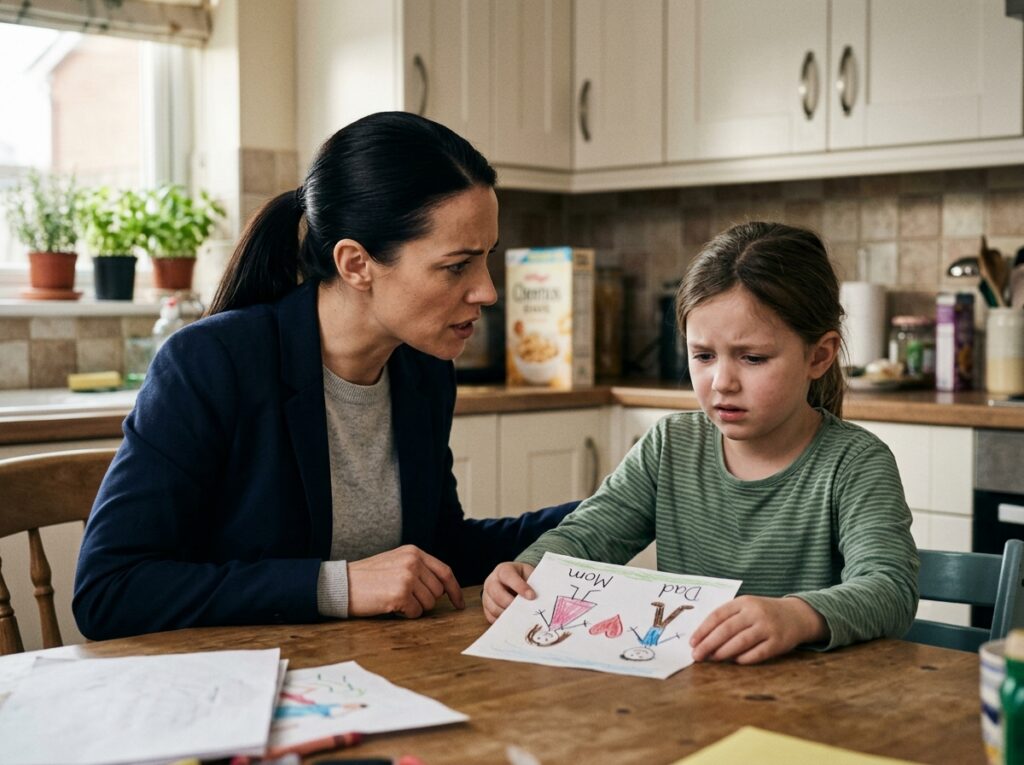
Children deserve to be shielded from the adult complexities of their parents’ separation — the legal proceedings, the financial disputes, the intimate details of what went wrong in the relationship, and the grievances each parent holds against the other.
A co-parent who deliberately or carelessly exposes a child to this information is not being transparent with their child. They are weaponizing information to shape the child’s perception of the other parent.
This red flag manifests in various ways: showing a child court documents, explaining in detail why the divorce was the other parent’s fault, sharing information about the other parent’s past mistakes or personal failures, or describing the other parent’s behavior in ways designed to position them as the villain of the family’s story.
Children who are subjected to this kind of information overload feel compelled to take sides — because the information they’ve been given frames the situation as one that requires a judgment. The parent providing the information has already made clear, through the very act of sharing it, which judgment they expect.
Research consistently shows that children triangulated into parental conflict show higher rates of anxiety, depression, and behavioral dysregulation — regardless of how contentious the co-parenting relationship may be. Shielding children from adult grievances is not weakness. It is the most child-centered thing a parent can do.
📃 Related article: 15 Subtle Red Flags in a New Relationship Most People Miss
Red Flag #7: Communication Between the Child and Other Parent Is Monitored or Blocked
A child’s right to open, relaxed, and unmonitored communication with both parents is a fundamental element of their psychological wellbeing in a co-parenting situation. When one parent consistently interferes with that communication — monitoring calls, ending conversations prematurely, or creating an atmosphere in which the child feels watched during contact with the other parent — it is a serious parental alienation red flag.
The interference can be remarkably subtle. A parent who sits silently in the same room during phone calls between the child and the other parent creates a monitoring presence that a child will feel acutely. A parent who asks detailed questions about what was said after every call teaches the child that their communication is under surveillance.
Over time, a child subjected to this kind of interference learns to self-censor in their relationship with the other parent — calling less, sharing less, emotionally withdrawing in ways that mirror the rejection they feel is expected of them.
The relationship gradually hollows out — not because the love is gone, but because the space for it to breathe has been systematically closed off. This slow suffocation of the parent-child bond is one of the most painful and preventable outcomes of parental alienation behavior.
Red Flag #8: The Child Is Forced to Choose Between Parents
Healthy co-parenting never places a child in the position of having to choose between their parents — not explicitly, and not through the subtle architecture of emotional pressure and loyalty tests. A child who is made to feel that loving one parent is a betrayal of the other is experiencing one of the most psychologically corrosive forms of parental alienation.
This red flag appears in various forms. A parent who becomes visibly hurt or withdrawn when the child expresses enjoyment of time with the other parent communicates, powerfully, that the child’s positive feelings are unwelcome.
A parent who frames decisions — even ordinary ones like holiday scheduling — as tests of the child’s loyalty is manufacturing conflict where none needs to exist.
Children are not equipped to navigate this kind of loyalty conflict. Their developmental capacity for managing competing emotional obligations to primary attachment figures is simply not sufficient for the task being imposed on them.
The result is typically a child who feels chronically guilty, chronically anxious, and who gradually learns to suppress their authentic feelings about both parents in order to survive the impossible position they have been placed in. This suppression, sustained over years, becomes one of the defining wounds of their emotional development.
“A child’s love for both parents is not a competition. The parent who makes it one has already lost — and their child pays the price.”
Red Flag #9: Complete Resistance to Any Co-Parenting Communication or Cooperation
Effective co-parenting requires a baseline level of direct communication, mutual flexibility, and cooperative decision-making about the child’s welfare. A co-parent who consistently refuses to engage in direct communication, who rejects every proposed accommodation regardless of its merit, and who responds to cooperative overtures with hostility or legal threats is exhibiting one of the clearest structural parental alienation red flags.
This resistance is rarely framed as such from the inside. The alienating parent typically presents themselves as responding to genuine concerns or protecting the child from the other parent’s influence.
But the pattern — consistent refusal to cooperate on any matter, regardless of how clearly child-centered the request is — reveals a priority system in which winning the conflict with the ex-partner consistently supersedes the genuine interests of the child.
Children observe this dynamic. They feel the hostility in the handoffs, hear it in the clipped phone calls, and absorb the message it communicates about what relationships look like when they become difficult.
The long-term modeling impact of sustained co-parenting hostility on a child’s own relationship patterns and conflict resolution capacity is significant and well-documented. It represents yet another dimension of the harm that parental alienation inflicts on its youngest and most vulnerable victims — harm that extends far beyond childhood and into every relationship they will ever attempt to build.

What to Do If You Recognize These Parental Alienation Red Flags
If you have recognized several of these red flags in your co-parenting situation, the most important thing to understand is this: you are not helpless, and your child is not beyond reach. Parental alienation, when identified and addressed appropriately, is something that families can heal from — particularly when intervention occurs before the patterns become deeply entrenched.
Begin by documenting everything with meticulous care. Dates, times, specific incidents, exact language used by the child, cancelled visits, intercepted communications — all of it. Documentation is the foundation of any legal or therapeutic response, and courts consistently respond to patterns revealed by careful records rather than isolated incidents.
Seek professional support — both for yourself and for your child. A therapist who specializes in family dynamics and parental alienation can provide your child with a safe, neutral space to process their experience without loyalty conflict. They can also provide professionally informed documentation that carries significant weight in family court proceedings.
Consult a family law attorney who has specific experience with parental alienation cases. Laws and court responses vary significantly by jurisdiction, but family courts are increasingly educated about this dynamic and responsive to well-documented evidence of alienating behavior.
And perhaps most importantly — maintain consistent, loving, patient presence. It is the most powerful antidote to parental alienation available to a targeted parent. Children who maintain any channel of positive connection with the targeted parent are significantly more likely to recover that relationship over time.
Your consistent love, even in the face of manufactured rejection, is not futile. It is the most important thing you can offer your child right now.
💾 Save this article — return to it as a reference if your co-parenting situation continues to develop.
📤 Share it with a parent, family member, or friend who is navigating a difficult co-parenting dynamic and needs to see these warning signs clearly named.
👣 Follow Truthsinside.com for more honest, research-backed content on relationships, family psychology, and the patterns that matter most to protect.
FAQ: Parental Alienation Red Flags
Q1: What is the difference between parental alienation and a child legitimately not wanting to see a parent?
The critical distinction lies in the cause of the child’s reluctance. Legitimate reluctance stems from the child’s own genuine experiences with that parent — documented instances of harm, neglect, or behavior that has genuinely frightened or hurt them. Parental alienation-driven reluctance, by contrast, is disproportionate to the child’s actual experience with the targeted parent, emerged suddenly in correlation with the alienating parent’s behavior, and is characterized by borrowed language and inconsistent reasoning when questioned by a neutral professional.
Q2: Can parental alienation occur unintentionally?
Yes — and this is an important nuance. Not all alienating behavior is deliberately malicious. Some parents engage in alienating behavior as an unconscious expression of their own unresolved grief, anger, or fear following the separation — genuinely believing they are acting in the child’s best interest while actually causing harm. Unintentional alienation is still damaging to the child and still requires intervention, but it may be more amenable to therapeutic correction than deliberate, calculated alienation.
Q3: How does parental alienation affect children long-term?
Research consistently documents significant long-term psychological impacts on children who experience sustained parental alienation. These include anxiety and depression, difficulty forming and maintaining trusting relationships in adulthood, identity confusion rooted in the rejection of part of their own heritage and family, higher rates of substance use, and a complicated grief process related to the loss of the relationship with the targeted parent — even when that relationship is eventually restored.
Q4: What should I do if I think I am the alienating parent?
Recognizing that your own behavior may be contributing to alienating dynamics is a profound act of self-awareness and parental courage. The most important step is to seek individual therapy with a professional who specializes in co-parenting and family systems — someone who can help you distinguish between legitimate protective instincts and responses driven by your own unresolved conflict with your ex-partner. The willingness to examine this honestly is the most genuinely child-protective thing you can do.
Q5: Does parental alienation hold up in family court?
Increasingly, yes. Family courts across the United States and internationally have become significantly more educated about parental alienation over the past two decades, and many jurisdictions now explicitly recognize it as a factor in custody determinations. Well-documented patterns of alienating behavior — supported by communication records, witness testimony, and professional psychological evaluation — can meaningfully influence custody arrangements, visitation orders, and in serious cases, primary custody decisions. Consulting a family law attorney with specific experience in parental alienation cases is essential for understanding the legal landscape in your specific jurisdiction.
🎵 Music
Maren Lull is a singer-songwriter who writes from the places most people don’t talk about out loud.
Not the dramatic grief. Not the obvious heartbreak. The quiet kind — the ordinary Tuesday emptiness, the habit of reaching for someone who isn’t there anymore, the particular exhaustion of being strong for so long that the strength itself wears thin.
Her music lives at the intersection of emotional honesty and soft beauty — breathy vocals over gentle piano, slow tempos, lyrics that feel less like songs and more like something you wrote in a private notebook at two in the morning and never showed anyone.
Maren Lull writes for the people who feel everything deeply and say very little about it. For the ones who listen to sad music not because they want to feel worse — but because being understood, even by a song, makes the feeling easier to carry.
📱 Follow Maren Lull:
→ Spotify
→ Apple Music
→ Youtube
→ Audiomack