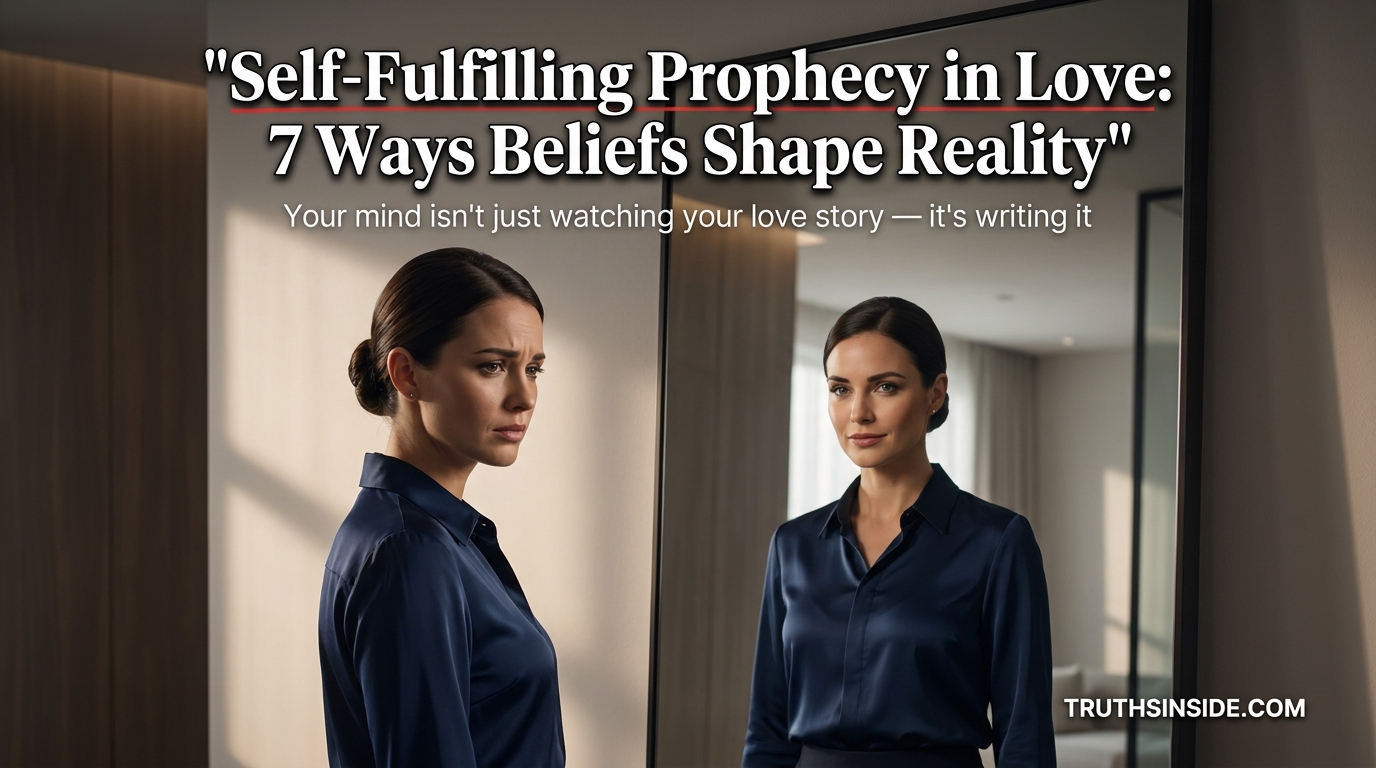
Self-fulfilling prophecy in love is one of the most quietly powerful — and most quietly destructive — psychological forces operating in your relationship life right now. It is the mechanism by which what you believe about love, about yourself as a partner, and about what you deserve, stops being a mere thought and starts becoming a lived reality. Not through magic. Not through fate. But through the thousands of small, often unconscious choices, interpretations, and behaviors that your beliefs silently drive — day after day, relationship after relationship — until the life you’re living begins to look exactly like the story you told yourself it would.
The concept of the self-fulfilling prophecy was formally introduced by sociologist Robert K. Merton in 1948, who defined it as a false definition of a situation that evokes behavior which makes the originally false conception come true. In the decades since, psychologists have documented its presence in virtually every domain of human experience — in academic performance, in professional achievement, in health outcomes, and perhaps most profoundly, in the domain of romantic relationships.
A landmark study published in the Journal of Personality and Social Psychology found that individuals’ beliefs about relationship quality and partner behavior directly and measurably influenced their own actions — which in turn produced the very partner responses they had anticipated, confirming their original belief in a closed, self-reinforcing loop.
What makes the self-fulfilling prophecy in love so particularly difficult to interrupt is that it operates largely beneath conscious awareness. You do not sit down and decide to sabotage a relationship or push away a partner who is trying to love you well. You simply follow the internal logic of what you believe to be true — and your behavior, your interpretations, and your emotional responses all align seamlessly with that belief, steering the relationship toward the outcome your mind already expected. In this article, we examine 7 specific ways this phenomenon shapes your relationship reality — and what it takes to begin rewriting the story.
The Psychology Behind the Prophecy
Before we explore the 7 ways self-fulfilling prophecy operates in love, it’s worth understanding the psychological machinery that drives it — because understanding the mechanism is the first step toward interrupting it.
At the core of the self-fulfilling prophecy in relationships is what psychologists call a “relationship schema” — a deeply held cognitive framework, usually formed in early childhood and refined through subsequent relationship experiences, that tells you what love looks and feels like, how partners behave, what you deserve, and what outcomes are available to you in romantic connection.
These schemas operate like a lens through which every relationship experience is filtered. They determine what you notice and what you dismiss, what you interpret as evidence of love and what you interpret as evidence of impending abandonment, what behaviors you consider normal and which you consider threatening. And critically — they shape your own behavior in ways that tend to produce the very relational outcomes the schema predicts.
A person who grew up believing they were fundamentally unlovable will not simply observe their relationships neutrally. They will unconsciously scan for evidence of that unlovability in every interaction, misread neutral behaviors as confirmation of it, and behave in ways — withdrawing, testing, pushing — that make it more likely their partner will eventually pull away. When the partner pulls away, the belief is confirmed. The schema strengthens. And the cycle begins again in the next relationship, now carrying even more neurological weight.
Understanding this cycle with compassion — for yourself and for the people whose schemas have shaped how they’ve loved you — is where the possibility of genuine change begins.

Way #1: Your Beliefs About Worthiness Drive Who You Choose
The self-fulfilling prophecy in love begins long before you’re in a relationship — it begins in who you choose to pursue and who you allow yourself to be chosen by. Your deep beliefs about your own worthiness of love act as an invisible filter on the entire field of potential partners, steering you toward people and dynamics that feel familiar — regardless of whether familiar means healthy.
People who carry a deep, often unconscious belief that they are not fully worthy of love — a belief formed not through rational analysis but through early experiences of inconsistency, criticism, or emotional unavailability from caregivers — tend to find secure, consistently loving partners strangely uncomfortable. The reliability feels boring. The openness feels suspicious. The absence of drama and uncertainty feels like the absence of passion. And so they gravitate, again and again, toward partners who replicate the emotional texture of what they learned love feels like — uncertain, earned, slightly out of reach.
This is not a conscious choice. Nobody chooses suffering deliberately. But the nervous system seeks familiarity, not health — and until the underlying belief about worthiness is examined and challenged, it will continue to operate as a compass pointing toward the same destination regardless of how many times you try to change direction.
The first step toward interrupting this particular manifestation of the self-fulfilling prophecy is developing the ability to notice your own internal response to secure love — and to distinguish between “this doesn’t feel right” and “this doesn’t feel familiar.” Those two sensations can feel identical from the inside. Learning to tell them apart is the beginning of choosing differently.
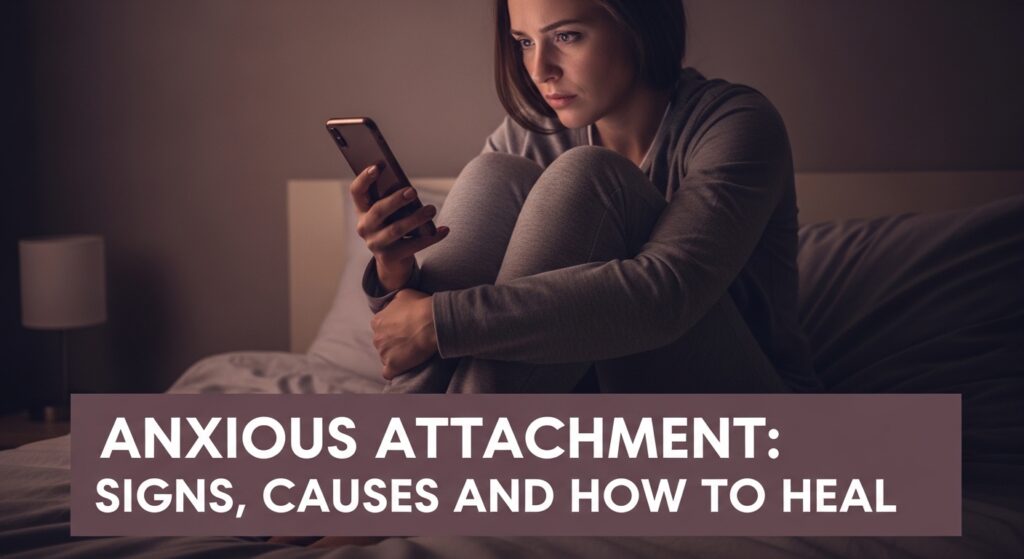
📃 Related article: Anxious Attachment: Signs, Causes, and How to Heal
Way #2: Negative Expectations Change How You Interpret Your Partner’s Behavior
One of the most well-documented manifestations of the self-fulfilling prophecy in love is the way negative expectations systematically distort how we interpret our partner’s behavior — turning neutral or even positive actions into evidence for what we already believe.
If you believe, at some deep level, that partners inevitably leave — you will experience your partner’s need for an evening alone as the beginning of withdrawal. If you believe you are fundamentally too much for people, you will hear gentle feedback as devastating rejection. If you believe love always comes with control, you will interpret your partner’s genuine concern as the early warning of something sinister.
Psychologists call this “confirmation bias” in relationships — the tendency to notice, remember, and weight evidence that confirms our existing beliefs while dismissing or minimizing evidence that contradicts them. It operates with particular power in intimate relationships because the stakes are high enough that the mind works overtime to protect itself from being caught off guard by an outcome it already expects.
The tragic irony is that this interpretive distortion often creates the very dynamic it’s trying to anticipate. A partner who is consistently misread as withdrawing or uncaring will eventually become frustrated, confused, or genuinely distant — not because the original belief was accurate, but because the behavior it produced created a new reality that now confirms it.
Research from the Journal of Experimental Social Psychology confirms that people in relationships consistently seek and find evidence for their pre-existing relationship beliefs — even when that evidence requires significant interpretive work to construct. Awareness of this tendency is not sufficient to eliminate it, but it is the essential first step toward questioning the automatic interpretations your beliefs generate.
“What you believe about love doesn’t just color how you see your relationship. It becomes the architecture of the relationship you build.”
Way #3: Self-Doubt Creates the Distance It Most Fears
Perhaps the most painful expression of the self-fulfilling prophecy in love is the way self-doubt — the deep, persistent belief that you are not enough, not lovable enough, not interesting enough, not stable enough — generates the very relational distance it is most terrified of.
When someone believes they are fundamentally insufficient as a partner, that belief manifests in behaviors that are entirely logical from inside the belief system but deeply damaging to the relationship from the outside. Constant reassurance-seeking that eventually exhausts a partner. Preemptive emotional withdrawal designed to protect against anticipated rejection. Testing behaviors intended to discover whether the partner will leave — which, if persistent enough, eventually encourage exactly that. Jealousy rooted not in genuine threat but in the internal certainty that eventually someone better will come along and the partner will recognize their mistake.
Each of these behaviors is the self in self-doubt trying to protect itself. Each of them, paradoxically, moves the relationship closer to the feared outcome. And when the outcome arrives — when the partner does withdraw, or become frustrated, or eventually leave — the belief that generated the whole cycle feels completely vindicated.
Interrupting this pattern requires something genuinely difficult: the willingness to sit with the discomfort of vulnerability without immediately acting on the anxiety it produces. To receive love without immediately testing whether it’s real. To trust, incrementally and imperfectly, even when trust feels like the most dangerous thing you could do. This is not easy work. But it is the work that breaks the cycle.
Way #4: What You Expect From Your Partner, They Often Become
The self-fulfilling prophecy in love does not only operate within the person who holds the belief — it reaches outward and shapes the behavior of partners themselves. This is one of the most fascinating and sobering findings in relationship psychology: what we consistently expect from our partners, and how we communicate that expectation through our behavior and emotional responses, powerfully influences who those partners actually become within the relationship.
Psychologists call this the “Pygmalion effect” in relationships — the phenomenon by which high expectations tend to produce better outcomes and low expectations tend to produce worse ones, not because the expectation magically changes reality, but because expectations shape behavior, and behavior shapes response.
A partner who is consistently treated as trustworthy, capable, and genuinely good — whose best qualities are noticed, named, and responded to with warmth — tends to inhabit those qualities more fully over time. A partner who is consistently treated with suspicion, low expectations, or as a disappointment waiting to happen tends to disengage, become defensive, or gradually embody the very inadequacy they’re being held to.
This is not to say that people are infinitely malleable or that toxic behavior can be transformed through positive expectation alone. It is to say that the relational environment we create through our expectations and responses is a powerful shaping force on the partnership — and that examining what we are consistently signaling to our partners about who we believe them to be is a profound act of relationship intelligence.

Way #5: Past Relationship Wounds Become Present Relationship Scripts
Every significant relationship we have experienced — romantic or otherwise — leaves behind what psychologists call “relational templates”: internalized scripts about how relationships work, how they end, and what role we play within them. These templates, formed from lived experience and emotional memory, become the unconscious blueprint from which we approach every subsequent relationship.
The self-fulfilling prophecy operates with particular power through these relational scripts. A person who experienced betrayal in a significant relationship does not simply remember being betrayed. They absorb a lesson — sometimes articulated, often not — that partners cannot be trusted, that love comes with hidden costs, that letting someone fully in is a setup for eventual devastation. And that lesson travels with them into every relationship that follows, shaping their behavior in ways that reflect its logic.
They keep an emotional exit route available at all times. They resist full vulnerability. They interpret ambiguous situations through the lens of anticipated betrayal. And in doing so, they often create the very relational conditions — emotional unavailability, constant guardedness, difficulty with genuine intimacy — that make the relationship harder for their partner to sustain. The prophecy fulfills itself not because love is inherently unsafe, but because the script written by past wounds tells the nervous system to behave as though it is.
Healing these relational scripts is not a quick process. It typically requires both the self-awareness to recognize where the script is running and the therapeutic support to do the deeper work of revising it at the level where it actually lives — not just intellectually, but emotionally and somatically. But it is entirely possible. And the relationships on the other side of that work feel categorically different from anything the old script could have produced.
📃 Related article: Signs He Likes You But Is Scared: 18 Behaviors Men Show When Afraid to Commit
Way #6: Beliefs About Love’s Permanence Affect How Hard You Try
One of the more subtle but consistently impactful manifestations of the self-fulfilling prophecy in love involves what psychologist Carol Dweck would recognize as a “fixed mindset” about relationships — the belief that love either works or it doesn’t, that compatibility is either there or it isn’t, and that effort, growth, and intentional investment cannot meaningfully change the outcome of a relationship.
People who hold this belief tend to interpret early difficulties as confirmation that the relationship is wrong rather than as the normal friction of two people learning to build something together. When conflict arises, they withdraw rather than engage — because in their framework, if it were right, it wouldn’t be this hard. When the initial chemistry stabilizes into something quieter and more domestic, they interpret the shift as the love dying rather than deepening. And when the relationship eventually struggles — as every relationship does — they exit, carrying the belief fully intact into the next attempt.
The self-fulfilling element is elegant and devastating: by withdrawing effort at the first sign of difficulty, they ensure that the relationship never receives what it would need to grow through the difficulty — which means the difficulty does, in fact, end the relationship, which confirms that the relationship was never right.
Shifting toward a “growth mindset” in relationships — the belief that love is something that can be developed, deepened, and intentionally built through challenge — is one of the most powerful reframes available to anyone who has found themselves in this pattern. It doesn’t make hard relationships easy. But it keeps you in them long enough to discover whether the difficulty is a signal to leave or an invitation to grow.
“The relationship you believe is possible is the ceiling of the relationship you will build. Raise the belief — and the ceiling rises with it.”
Way #7: The Story You Tell Others Reinforces the Story You Tell Yourself
The self-fulfilling prophecy in love is not only maintained internally — it is actively reinforced through the narratives we construct and share with the people around us. The story you tell your friends about your relationship, the way you describe your partner, the framing you consistently apply to your romantic experiences — all of these are not neutral reports. They are interpretations that, through repetition, deepen and solidify the underlying belief.
When someone consistently describes their relationship in catastrophic terms — “he never listens,” “she always does this,” “it’s always the same thing” — they are not simply venting. They are reinforcing a cognitive framework that makes it harder to notice the moments when the pattern breaks, when the partner does listen, when things genuinely are different. The narrative becomes self-sustaining, filtering experience through a lens that confirms it and discarding what doesn’t fit.
This works in the positive direction as well — which is exactly why consciously shifting the narrative is one of the most accessible and genuinely effective interventions available. Not through toxic positivity or denial of real problems, but through the deliberate practice of also noticing and naming what is working, what has improved, what your partner does that reflects genuine care and effort.
Research on “positive relationship narratives” from the Journal of Family Psychology found that couples who were coached to consciously reshape how they described their relationship — focusing not on rewriting facts but on broadening the narrative to include positive evidence — reported measurable improvements in relationship satisfaction within weeks. The story you tell is not separate from the reality you experience. It is, in a very real and documented sense, part of how that reality is constructed.
How to Begin Rewriting Your Relationship Prophecy
Recognizing the self-fulfilling prophecy in love is profound — but recognition alone does not break the cycle. What breaks the cycle is the deliberate, sustained, compassionate work of examining the beliefs at its root and choosing, incrementally and imperfectly, to respond differently than the belief dictates.
Start with curiosity rather than judgment. When you notice yourself interpreting a partner’s behavior in a particular way, pause long enough to ask: Is this what is actually happening — or is this what I expected to happen? That single question, practiced consistently, creates a small but significant gap between belief and automatic response. In that gap, choice becomes possible.
Work with a therapist if the beliefs feel deeply rooted — particularly if they connect to early attachment experiences or significant relational wounds. The self-fulfilling prophecy in love is most powerfully interrupted not through willpower alone but through the kind of deep, relational healing that therapeutic work makes possible.
And extend yourself the same compassion you would offer someone you love. The beliefs that have been quietly writing your love story were not chosen carelessly. They were formed in response to real experiences, as your best attempts to make sense of what love meant in the environment where you learned it. They deserve to be examined with curiosity and changed with intention — not condemned.
You are not your prophecy. And your love story is not yet finished.

Final Thoughts: Your Beliefs Are Not Your Destiny
The self-fulfilling prophecy in love is real, it is documented, and for many people it has been quietly running their romantic lives for years without their awareness. But awareness changes everything — not instantly, not painlessly, but genuinely and permanently.
The beliefs that have shaped your relationship reality up to this point were not formed in a vacuum. They were learned responses to real experiences, forged in environments where they made sense and served a purpose. They do not make you broken. They make you human. And the fact that they were learned means they can, with intention and support, be unlearned — or at least examined closely enough that they no longer run the show unopposed.
Your love life is not a fixed script written by your past. It is a living story — one that you have far more authorship over than the self-fulfilling prophecy would have you believe. The pen has always been in your hand. It’s time to write something different.
💾 Save this article — return to it when an old belief starts to feel like an inevitable truth.
📤 Share it with someone you care about who keeps finding themselves in the same relationship patterns and can’t understand why.
👣 Follow Truthsinside.com for more deeply researched psychology and relationship content that helps you understand not just your relationships — but yourself.
📃 Related article: 15 Signs She Is Testing You: Why Women Test Men and What to Do
FAQ: Self-Fulfilling Prophecy in Love
Q1: What is a self-fulfilling prophecy in relationships?
A self-fulfilling prophecy in relationships is when a belief about love, yourself, or your partner — regardless of whether it’s objectively true — generates behaviors and interpretations that make the belief come true. For example, believing a partner will eventually leave may cause behaviors like emotional withdrawal or constant testing that make the partner more likely to actually leave, confirming the original belief.
Q2: How do I know if a self-fulfilling prophecy is affecting my relationship?
Look for patterns. If you find yourself in the same type of relationship repeatedly, experiencing the same problems with different partners, or consistently interpreting your partner’s behavior in ways that lead to conflict or distance — a self-fulfilling prophecy may be operating. The key signal is the loop: belief drives behavior, behavior produces outcome, outcome confirms belief.
Q3: Can self-fulfilling prophecies be positive in relationships?
Absolutely. Positive relationship beliefs — “my partner is fundamentally trustworthy,” “we can work through hard things together,” “I deserve to be loved well” — generate behaviors and interpretations that make those things more likely to be true. The mechanism is identical; what differs is the direction. Cultivating consciously positive relationship beliefs is one of the most evidence-supported strategies for improving relationship quality.
Q4: Is it possible to break a self-fulfilling prophecy on your own?
Partial interruption is possible through self-awareness, journaling, and the deliberate practice of questioning automatic interpretations. However, because the deepest relationship schemas are rooted in early emotional experience and operate largely below conscious awareness, the most significant and durable change typically occurs within a therapeutic relationship — particularly approaches like Cognitive Behavioral Therapy, Schema Therapy, or Emotionally Focused Therapy, all of which directly address the belief systems driving relational patterns.
Q5: What’s the first step to changing a negative self-fulfilling prophecy in love?
The first step is developing awareness of the belief itself — naming it clearly and specifically, rather than experiencing it as a vague feeling or an obvious truth about reality. Many people carry beliefs like “I’m unlovable” or “love always ends in abandonment” without ever having examined them as beliefs rather than facts. Once a belief is named and recognized as a belief — something learned, not something objectively true — the possibility of questioning it, and eventually revising it, becomes genuinely available.
🎵 Music
Maren Lull is a singer-songwriter who writes from the places most people don’t talk about out loud.
Not the dramatic grief. Not the obvious heartbreak. The quiet kind — the ordinary Tuesday emptiness, the habit of reaching for someone who isn’t there anymore, the particular exhaustion of being strong for so long that the strength itself wears thin.
Her music lives at the intersection of emotional honesty and soft beauty — breathy vocals over gentle piano, slow tempos, lyrics that feel less like songs and more like something you wrote in a private notebook at two in the morning and never showed anyone.
Maren Lull writes for the people who feel everything deeply and say very little about it. For the ones who listen to sad music not because they want to feel worse — but because being understood, even by a song, makes the feeling easier to carry.
📱 Follow Maren Lull:
→ Spotify
→ Apple Music
→ Youtube
→ Audiomack