Emotional Flooding: Why You Shut Down in Arguments (And What to Do)
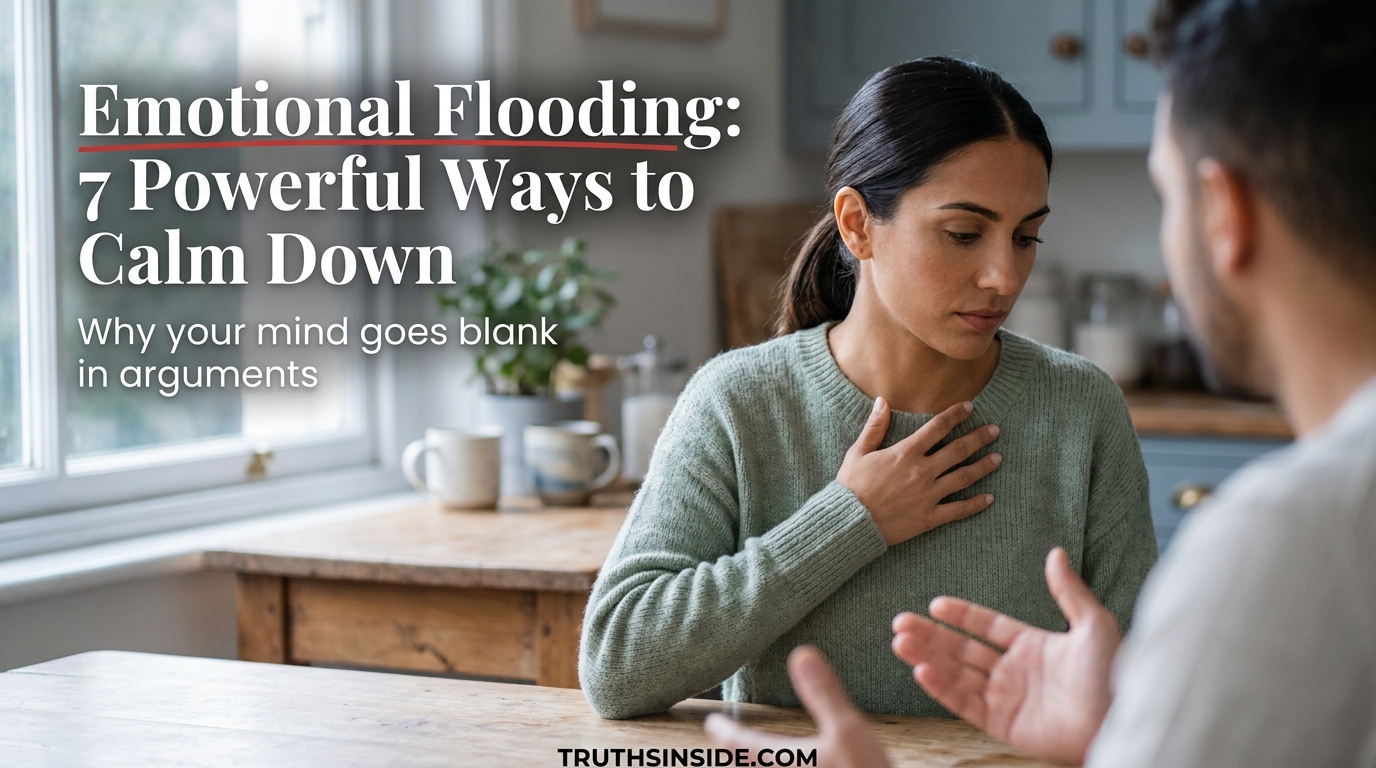
Emotional flooding is the moment your mind goes blank, your chest tightens, and a perfectly reasonable conversation turns into something you cannot navigate. You wanted to explain yourself. Instead you went quiet, stared at the floor, or walked out of the room, and later you replayed it all with shame. If that sounds familiar, nothing is wrong with your character. Your body simply did what bodies do under threat.
Relationship researcher John Gottman found that when a person’s heart rate climbs above roughly 100 beats per minute during conflict, they are often flooded, and the thinking part of the brain stops working well. In his laboratory, couples in that state struggled to listen, empathize, or solve problems. Work by Gottman and Robert Levenson also linked high physiological arousal during arguments to lower relationship satisfaction over time. Emotional flooding is not a personality flaw. It is a measurable stress response.
This guide explains what emotional flooding is, what happens in your brain and body, and why it makes you shut down in arguments. You will learn seven powerful ways to calm down, how to explain it to your partner without sounding defensive, and when it may point to something deeper. You do not have to stay stuck in silence. You can learn to pause, recover, and come back.

What Emotional Flooding Really Is
Emotional flooding describes a state of physical and emotional overwhelm in which you can no longer process what is happening around you. Gottman calls it diffuse physiological arousal. Your heart rate jumps, stress hormones such as adrenaline and cortisol surge, your breathing turns shallow, and your muscles tighten. Your thinking narrows to the oldest survival options: fight, flee, or freeze. Words you would normally find easily simply disappear.
Emotional flooding can happen in any heated moment, but it shows up most often in close relationships, because the stakes feel so high. A raised voice, a critical tone, or a feeling of being cornered can set it off. Once the alarm begins, reasoning gets harder with every passing second, which is why a flooded argument so rarely goes anywhere useful.
The Body Hijack
Author Daniel Goleman popularized the phrase amygdala hijack to describe what happens next. The amygdala, a small almond-shaped structure deep in the brain, helps detect threats. When it signals danger, the prefrontal cortex, which handles reasoning, perspective-taking, and self-control, becomes less effective. Neuroscientists remind us that the real story involves many brain networks, not one structure. Still, the metaphor captures the lived experience of emotional flooding: you know what you want to say, but you cannot reach it.
Emotional Flooding Is Not the Same as Not Caring
Many people who experience emotional flooding are accused of not caring, because they go silent at the very moment their partner needs a response. The opposite is often true. Flooded people usually care so much that their bodies cannot handle the intensity. Silence is not indifference. It is a nervous system running out of capacity. Understanding this difference is the first step toward repairing the hurt on both sides.
The Science Behind Emotional Flooding
Psychiatrist Dan Siegel describes a helpful idea called the window of tolerance: the zone of arousal in which you can feel strong emotions and still think clearly. Inside the window, you can listen, reflect, and respond. Outside it, you slip into hyperarousal, which feels like panic, rage, or racing thoughts, or into hypoarousal, which feels like numbness, blankness, or collapse. Emotional flooding is what it feels like to be pushed out of that window.
Shutting down usually belongs to the second category. Some researchers connect it to the freeze response described in polyvagal theory, developed by Stephen Porges, although parts of that theory remain debated among scientists. What most experts agree on is the practical point: when your body judges a conversation to be dangerous, it prioritizes protection over communication.
Trying to hide the reaction does not help. In a well-known 1993 experiment, James Gross and Robert Levenson found that people who suppressed visible emotion while watching a distressing film showed increased sympathetic nervous system activation. Pushing the feeling down did not make the body calmer. This helps explain why a stony face during an argument often hides a pounding heart.
Recovery also takes time. Gottman reports that it takes the body at least twenty minutes to calm down after flooding, because stress hormones linger in the bloodstream long after the argument ends. That is why a quick apology or a deep breath rarely works. Real recovery needs a genuine break.
Common Signs of Emotional Flooding
Emotional flooding looks different from person to person, but the signs tend to appear in three places. Learning your own pattern gives you a head start, because noticing the first sign is the earliest chance to step out of the spiral.
- In the body: a racing or pounding heart, chest tightness, shallow breathing, a hot face, sweaty palms, a clenched jaw, a knot in the stomach, or trembling.
- In the mind: a blank mind, trouble finding words, tunnel vision, racing thoughts, feeling trapped, or a sense that nothing you say will matter.
- In behavior: going silent, avoiding eye contact, walking away, agreeing just to end the conversation, snapping, crying, or repeating the same sentence.
If several of these appear at once, you are probably already flooded. If you notice only one or two, you may still have time to pause before the rest arrive.
📃 Related article: Reconnect Emotionally: 7 Proven Ways to Heal
Why Emotional Flooding Makes You Shut Down in Arguments
Not everyone responds to emotional flooding in the same way. Some people become louder and more reactive. Others become quiet and still. The quiet response, which Gottman calls stonewalling, is one of the four patterns he identified as predictors of relationship breakdown. Understanding why it happens makes it much easier to change.
Shutting Down Is a Protective Strategy
When a conversation feels overwhelming and you cannot fight or flee, freezing becomes the body’s last remaining option. Shutting down in an argument is often a learned strategy rather than a conscious choice. If you grew up in a home where conflict was frightening, unpredictable, or punished, your nervous system may have learned that silence is the safest way to survive. The habit can follow you into adult relationships, even when your partner is kind and the stakes are low.
How It Looks From the Other Side
Your partner does not see your racing heart. They see someone who has stopped responding. Researchers describe a common demand-withdraw pattern in couples, in which one partner pushes for discussion while the other pulls away, and each reaction fuels the other. The pursuing partner feels abandoned and pushes harder. The withdrawing partner feels attacked and retreats further. Emotional flooding sits at the center of this loop, and neither person is the villain.
“Going silent in an argument is rarely a sign that you do not care. It is often a sign that your body has decided the conversation is no longer safe.”

7 Powerful Ways to Calm Emotional Flooding
You cannot think your way out of emotional flooding while it is happening, because the part of your brain you would use is the part that has gone offline. The solution is to work with your body first and your words second. These seven steps are ordered from prevention to repair, and each one is small enough to practice this week.
1. Learn Your Early Warning Signs
The earlier you catch emotional flooding, the easier it is to stop. Pay attention to the first physical signal that appears in your body, such as a tight jaw, a warm face, or a faster pulse. Rate your intensity from zero to ten during hard conversations. When you reach a six or seven, you are approaching the edge of your window of tolerance. That is the moment to act, not at a nine.
2. Agree on a Time-Out Signal
Walking out without a word feels like abandonment to your partner. A pre-agreed signal turns the same behavior into care. Choose a phrase together when you are both calm, such as “I’m getting flooded and I want to keep talking, so I need a break.” Add a promise to return at a specific time. Gottman’s research suggests that a clear, respectful time-out, with a promise to come back, is one of the most effective ways to interrupt a spiral.
3. Take a Full Twenty Minutes
A short break often fails because the body has not yet recovered. Give yourself at least twenty minutes, and longer if you need it. During that time, avoid rehearsing the argument in your head, planning your rebuttal, or telling the story to yourself as a list of your partner’s faults. Those thoughts keep your stress response running. Choose something soothing instead, such as a walk, music, a shower, or a simple chore.
4. Slow Your Breathing
Breathing is one of the few body systems you can control that also speaks directly to your stress response. Try a longer exhale than inhale, such as breathing in for four counts and out for six. A 2023 study led by Melis Yilmaz Balban at Stanford found that five minutes a day of cyclic sighing, which uses two inhales through the nose followed by one long exhale, improved mood and reduced breathing rate more than mindfulness meditation. Even a few slow rounds can help emotional flooding begin to ease.
5. Name What You Feel
Putting a feeling into words can calm it. In a 2007 brain-imaging study, Matthew Lieberman and colleagues found that labeling an emotion was associated with reduced amygdala activity. Try a simple sentence in your head or on paper: “I feel overwhelmed, and underneath that I feel afraid of being judged.” You do not need to solve the feeling. You only need to name it accurately. Precision, rather than intensity, is what brings the relief.
6. Ground Yourself With Your Senses
When emotional flooding pulls your attention into a spiral of thoughts, your senses bring you back to the room. Splash cold water on your face, hold something cold in your hands, press your feet into the floor, or try the 5-4-3-2-1 method, in which you name five things you see, four you feel, three you hear, two you smell, and one you taste. These small actions tell your nervous system that you are safe in the present, even if the argument felt dangerous a moment ago.
7. Return With a Soft Start
The break only works if you come back. When you return, begin gently. Gottman calls this a soft start-up: describing your feelings and needs without blame. Instead of “You always attack me,” try “I felt overwhelmed earlier, and I want to understand what you were trying to tell me.” Ask your partner to repeat what they said before the break, and offer to do the same. Repair is where trust is built.
How to Talk to Your Partner About Emotional Flooding
The best time to talk about emotional flooding is when you are both calm, not in the middle of an argument. Open with the experience, not the excuse. You might say, “When we argue, my body gets overwhelmed and I go quiet. It is not because I do not care. I would like us to find a way to pause that works for both of us.”
Explain what your silence means and what you need. Many partners feel enormous relief to learn that the withdrawal is physiological, not personal. You can also ask what the silence feels like for them. Listen without defending. Their feelings are real too, and acknowledging them builds goodwill.
Then make a plan together. Decide on your time-out phrase, how long breaks will last, where each of you will go, and who will restart the conversation. Write it down if it helps. The plan matters less than the shared commitment: you are working as a team against the pattern, not against each other.

If Your Partner Experiences Emotional Flooding
If you are the partner who wants to keep talking, emotional flooding can feel like being shut out. It helps to remember that pushing harder usually deepens the freeze. When you notice your partner glazing over, slow down. Lower your voice, soften your tone, and offer a break without punishment. Saying “Let’s pause and come back in half an hour” is a gift, not a defeat.
Avoid ultimatums, sarcasm, or phrases like “Why won’t you just talk to me?” which add pressure to a nervous system that is already overloaded. Instead, show that the relationship is safe. A hand on the shoulder, if welcome, or a calm sentence such as “I’m not going anywhere” can lower the threat. Then keep your promise to return, because a pause only feels safe if the conversation does resume.
Building Long-Term Resilience Against Emotional Flooding
Tools for the moment matter, but your baseline matters too. When you are chronically stressed, sleep-deprived, hungry, or overstretched, your window of tolerance shrinks, and emotional flooding arrives faster. Protecting sleep, eating regularly, moving your body, and limiting caffeine and alcohol may seem unrelated to arguments, yet they directly shape how much stress your nervous system can absorb.
Daily regulation practices help as well. A few minutes of slow breathing, a short walk, journaling, or quiet time can widen your window over weeks. Practice the skills when you are calm, so that they are familiar when you are not. Like any skill, they work best when they are automatic. Be patient with yourself, too. Progress rarely looks like never getting overwhelmed again. It looks like noticing sooner, recovering faster, and coming back to the conversation a little more gently each time.
Finally, consider working with a therapist, especially one trained in couples therapy, emotionally focused therapy, or trauma-informed care. A professional can help you understand where your shutdown response began and how to build new patterns safely. Needing support is not a failure. It is a smart way to change something that is hard to change alone.
📃 Related article: Psychology of Jealousy: 7 Painful Hidden Truths
When Emotional Flooding Points to Something Deeper
Occasional emotional flooding is normal. Frequent flooding, especially when it comes with panic attacks, flashbacks, numbness, or fear of your partner, may signal anxiety, unresolved trauma, or an unsafe relationship. If you feel flooded in nearly every conversation, or if disagreement leaves you terrified rather than merely overwhelmed, speak with a licensed mental health professional.
It is also important to separate emotional flooding from fear of abuse. Staying silent to avoid being hurt, controlled, or punished is a safety response, not a communication problem. If you are afraid of your partner, support is available. In the United States, the National Domestic Violence Hotline can be reached at 1-800-799-7233, or by texting START to 88788.
“You are not broken because your body protects you. You are learning to teach it that you are safe enough to stay.”
Frequently Asked Questions About Emotional Flooding
What is emotional flooding in a relationship?
Emotional flooding is a state of physical and emotional overwhelm during conflict in which your heart rate rises, your thinking narrows, and you struggle to listen or respond. It is a stress response, not a choice, and it can happen to anyone.
How long does emotional flooding last?
Gottman’s research suggests that it takes at least twenty minutes for the body to calm down after flooding. Some people need longer, especially if the argument touched an old wound. Use the time for soothing activities, not for rehearsing the fight.
Is shutting down in arguments the same as stonewalling?
They overlap. Stonewalling is the behavior of withdrawing and going silent, and emotional flooding is often the reason behind it. The behavior can look like indifference, but it frequently comes from overwhelm, which is why understanding the cause matters.
Can emotional flooding be prevented?
You cannot eliminate it, but you can reduce it. Notice early warning signs, take agreed breaks, practice slow breathing, protect your sleep, and talk openly with your partner. Over time, your window of tolerance widens, and emotional flooding becomes less frequent and less intense.
Save, Share, Follow
If this guide helped you understand why you go quiet when things get heated, save it so you can return to the seven steps before your next hard conversation. Share it with a partner, friend, or anyone who has ever felt misunderstood in the middle of an argument. And follow Truthsinside.com for more science-backed insights on relationships, psychology, and the emotions that shape them.
🎵 Music
Maren Lull is a singer-songwriter who writes from the places most people don’t talk about out loud.
Not the dramatic grief. Not the obvious heartbreak. The quiet kind — the ordinary Tuesday emptiness, the habit of reaching for someone who isn’t there anymore, the particular exhaustion of being strong for so long that the strength itself wears thin.
Her music lives at the intersection of emotional honesty and soft beauty — breathy vocals over gentle piano, slow tempos, lyrics that feel less like songs and more like something you wrote in a private notebook at two in the morning and never showed anyone.
Maren Lull writes for the people who feel everything deeply and say very little about it. For the ones who listen to sad music not because they want to feel worse — but because being understood, even by a song, makes the feeling easier to carry.
📱 Follow Maren Lull:
→ Spotify
→ Apple Music
→ Youtube
→ Audiomack