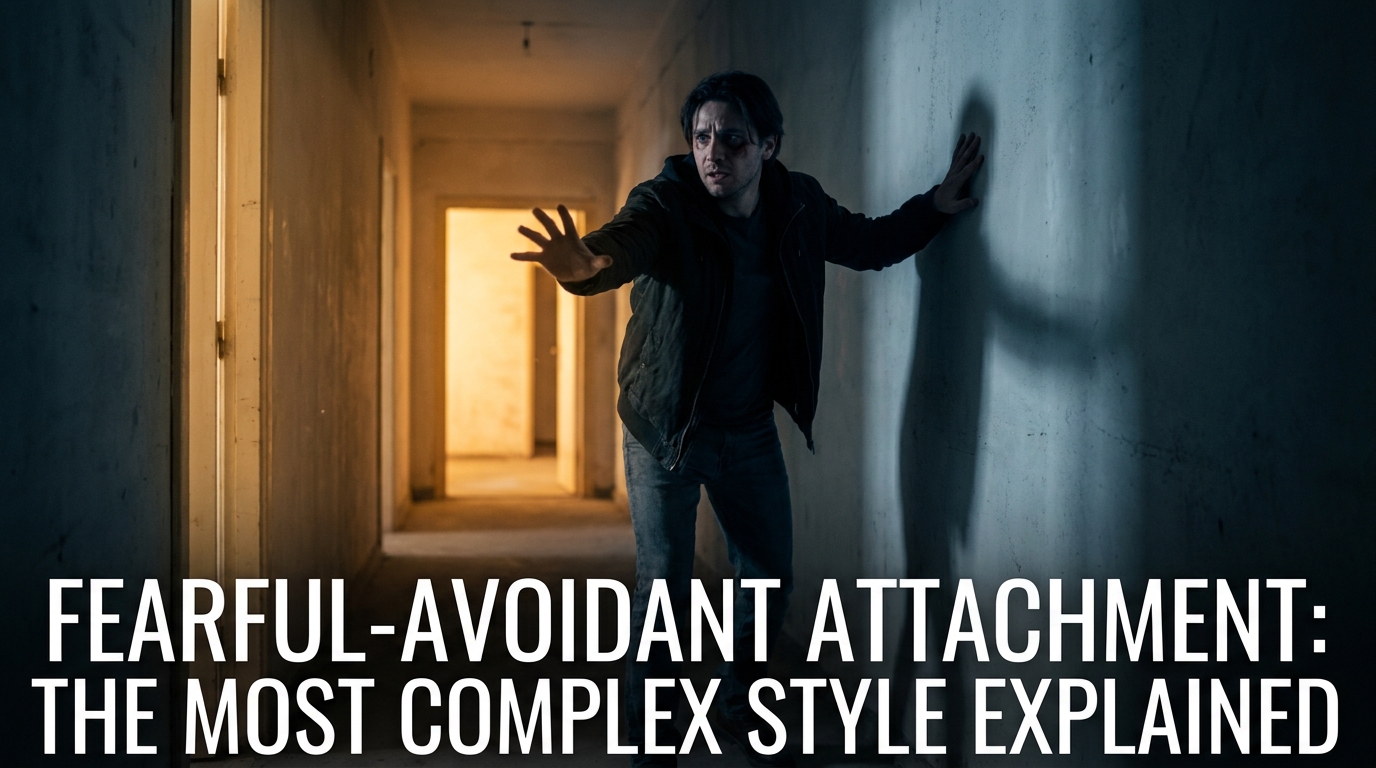
They want you close. Then they push you away. Then they pull you back in. Then they disappear again. And all of it — every contradiction, every reversal, every moment of warmth followed by cold — feels completely genuine. Because it is. Fearful-avoidant attachment — also called disorganized attachment — is widely considered the most complex and the most painful of all four attachment styles.
Unlike anxious attachment, which pursues, or avoidant attachment, which withdraws, fearful-avoidant attachment does both — simultaneously, and often without understanding why. Research suggests that fearful-avoidant attachment affects approximately 5 to 10 percent of the adult population, though many experts believe it is significantly underdiagnosed — particularly in individuals with trauma histories. If you have ever felt simultaneously desperate for love and terrified of it, this article was written for you.

What Is Fearful-Avoidant Attachment?
Fearful-avoidant attachment — known in clinical literature as disorganized attachment — sits at the intersection of the other insecure attachment styles, borrowing elements from both anxious and avoidant patterns without the internal consistency of either. It was first identified through Mary Ainsworth’s Strange Situation research and later expanded by researchers Mary Main and Judith Solomon in the 1980s, who noticed a group of children whose responses to caregiving didn’t fit neatly into any existing category. These children showed no organized strategy for managing their attachment needs — hence the term disorganized.
In adults, fearful-avoidant attachment is characterized by a fundamental and irresolvable internal conflict: an intense desire for closeness and love, paired with an equally intense fear of it. Both the longing and the terror are real. Both operate simultaneously. And the result is a relational experience that feels, to both the person living it and the people who love them, profoundly contradictory and exhausting.
At the core of fearful-avoidant attachment is a belief system that operates on two levels simultaneously. On one level: I want love, I need connection, I am desperate for closeness. On another: love is dangerous, people hurt you, getting close means getting hurt. These two beliefs are not resolved — they coexist in constant, painful tension.
Unlike dismissive-avoidant attachment — where the person has deactivated their attachment needs and genuinely believes they don’t need closeness — fearful-avoidant individuals are acutely aware of their longing for connection. They simply cannot access it safely.
“The fearful-avoidant person doesn’t just fear abandonment or engulfment — they fear both, at the same time, in the same relationship.” — Attachment Psychology Research
The Origins of Fearful-Avoidant Attachment
Fearful-avoidant attachment almost always develops in response to early experiences in which the primary caregiver was simultaneously the source of comfort and the source of fear or pain. This creates an impossible bind for the child’s developing nervous system — one that leaves a permanent mark on how they experience love.
Trauma in the Caregiving Relationship
The most consistent predictor of disorganized attachment is early relational trauma — abuse, neglect, or severe emotional instability within the caregiving relationship. When the person a child depends on for survival is also the person who frightens, harms, or profoundly destabilizes them, the child’s attachment system has nowhere safe to orient.
In a typical threat response, a child moves toward their caregiver for safety. But when the caregiver is the threat, that movement is impossible. The child simultaneously wants to approach — because approach is biologically driven — and wants to flee — because approach means danger. The result is a frozen, disorganized response: the nervous system activating both the attachment drive and the threat response at the same time, with no resolution possible.
This neurological freezing — approach and avoidance triggered simultaneously — becomes the template through which all future close relationships are experienced.
Witnessing Frightening Behavior
A caregiver does not have to be directly abusive to create disorganized attachment. A parent who is severely mentally ill, who dissociates, who behaves in frighteningly unpredictable ways, or who themselves is traumatized and unresolved can produce the same neurological bind in a child — even without intent to harm.
The child does not need to be the direct target of frightening behavior for the association between love and danger to form. Witnessing it is often enough.
Early Loss or Abandonment
Significant early loss — the death of a primary caregiver, sudden separation, or abandonment — can also contribute to fearful-avoidant patterns, particularly when no consistent, safe attachment figure was available to help the child process and integrate the loss. Unresolved grief in the caregiving system ripples forward into the child’s attachment organization.
Generational Trauma
Fearful-avoidant attachment is also frequently transmitted generationally. A parent who carries their own unresolved disorganized attachment — their own unprocessed trauma — often creates, without awareness or intent, the conditions for disorganized attachment in their children. The trauma does not have to be repeated identically. It simply has to remain unresolved and therefore present in the emotional field of the relationship.

Signs of Fearful-Avoidant Attachment in Adults
Because fearful-avoidant attachment borrows from both anxious and avoidant patterns, its signs can appear contradictory — which is precisely what makes it so difficult to recognize and so exhausting to live inside.
You desperately want closeness — and run from it when it arrives. The longing for deep, genuine connection is real and intense. But when someone actually offers it, something shifts. The closeness that felt like everything you wanted suddenly feels threatening. And you find yourself pulling back from the very thing you’ve been reaching for.
Your relationships follow an intense push-pull cycle. You pursue intensely when someone seems distant. When they move toward you, you feel suffocated and create distance. When they pull back in response, the panic returns and you pursue again. This cycle — pursue, withdraw, pursue, withdraw — can repeat indefinitely, leaving both partners bewildered and exhausted.
You sabotage relationships that are going well. When a relationship feels genuinely good — safe, loving, consistent — an internal alarm system activates. Something this good will be taken away. Better to leave before being left. Better to destroy it before it destroys you. And so, at the moment of greatest intimacy, the relationship gets sabotaged — consciously or not.
You struggle to trust — even people who have consistently shown trustworthiness. A partner’s consistent care and reliability does not necessarily register as safety. Instead, it can produce suspicion — what are they hiding? When will this change? The nervous system, trained to associate love with danger, struggles to update its threat assessment even in the face of contradictory evidence.
You swing between emotional extremes. Intensely present one day, completely withdrawn the next. Deeply loving in one moment, cold and distant in another. These oscillations are not manipulation — they are the authentic expression of a nervous system that has no organized strategy for managing the simultaneous activation of attachment longing and threat response.
Intimacy feels both necessary and terrifying. Not one or the other — both at the same time. You need connection the way you need air. You also experience it, at a deep nervous system level, as something dangerous. Holding both of these truths simultaneously is the defining experience of fearful-avoidant attachment.
You have a complex relationship with your own emotions. Sometimes they feel overwhelming and uncontrollable. Other times they feel completely inaccessible — as if there is nothing there. The emotional experience of fearful-avoidant attachment is frequently described as all or nothing, flooded or empty, with very little stable middle ground.
You often feel like too much and not enough simultaneously. Too emotional, too intense, too needy — and at the same time, not loving enough, not consistent enough, not capable of giving what a partner needs. Both criticisms feel accurate. Both feel crushing.

How Fearful-Avoidant Attachment Affects Relationships
Of all the attachment styles, fearful-avoidant attachment creates the most complex and often the most painful relational dynamics — for both the person who has it and the people who love them.
The Impossible Push-Pull
The push-pull dynamic of fearful-avoidant attachment is not strategic. It is not a game or a manipulation. It is the authentic behavioral expression of a nervous system that is simultaneously activating two incompatible drives — connection and self-protection — with no way to resolve the conflict between them.
From the outside, this looks like hot and cold behavior. From the inside, it feels like being torn apart. The fearful-avoidant person is not choosing to be inconsistent. They are experiencing genuine conflict — wanting to stay and needing to flee — in rapid alternation or simultaneously.
For their partners, this dynamic is deeply disorienting. The warmth is real. The withdrawal is also real. Making sense of both at the same time is extraordinarily difficult without understanding the attachment framework behind it.
Intense but Unstable Relationships
Fearful-avoidant individuals often form intensely passionate connections — the initial stages of their relationships are frequently characterized by extraordinary depth, chemistry, and mutual vulnerability. They are capable of profound intimacy — in bursts. But sustaining that intimacy over time, as the relationship deepens and the stakes feel higher, triggers the threat response with increasing frequency.
The result is relationships that feel more alive than anything either partner has experienced — and simultaneously more unstable, more painful, and more exhausting.
The Self-Fulfilling Prophecy
At the core of fearful-avoidant attachment is a belief: love leads to pain. And this belief, held deeply enough, tends to generate the evidence that confirms it. By pushing partners away, sabotaging good relationships, and creating chaos at moments of genuine connection, the fearful-avoidant person recreates the very painful relational experiences they feared — and interprets each one as further proof that love is not safe.
Breaking this cycle requires seeing the self-fulfilling nature of the pattern — which is extraordinarily difficult to do from inside it, and one of the primary reasons professional support is so valuable.
Difficulty With Both Intimacy and Separation
One of the most defining features of fearful-avoidant attachment in relationships is that neither closeness nor distance feels comfortable. Close enough to be hurt. Distant enough to feel abandoned. The window of tolerable connection is narrow, unstable, and easily overwhelmed — leaving very little space in which an ordinary relationship can comfortably exist.

How to Heal Fearful-Avoidant Attachment
Healing fearful-avoidant attachment is some of the deepest and most challenging inner work a person can undertake. But it is also some of the most transformative. Because fearful-avoidant attachment is rooted in early relational trauma, the healing is also relational — it happens through new experiences of safe connection that gradually teach the nervous system what it never learned: that love does not have to hurt.
1. Understand the Pattern Without Shame or Self-Judgment
The first step is recognition — seeing the pattern clearly and naming it honestly, without shame. Fearful-avoidant attachment is not a character flaw or a sign of being fundamentally broken. It is an adaptive response to genuinely dangerous or frightening early experiences. The nervous system did exactly what it needed to do to survive. That adaptation simply needs updating.
Approaching the pattern with curiosity rather than shame — what is this protecting? where did it come from? what does it cost me now? — creates the internal safety necessary for change to begin.
2. Trauma-Informed Therapy Is Essential
Because fearful-avoidant attachment is almost always rooted in early relational trauma, healing it typically requires more than talk therapy alone. Trauma-informed therapeutic approaches that work directly with the nervous system are particularly effective.
EMDR — Eye Movement Desensitization and Reprocessing — is highly effective for processing the unresolved traumatic memories that underpin disorganized attachment. It works at the level of the nervous system rather than the rational mind — which is where fearful-avoidant attachment lives.
Internal Family Systems — IFS — is profoundly useful for understanding the different internal parts driving fearful-avoidant behavior: the part that desperately wants love, the part that is terrified of it, the part that protects through withdrawal, the part that pursues. Bringing these parts into relationship with each other — rather than having them fight for control — is central to healing.
Emotionally Focused Therapy — EFT — particularly in couples settings, helps both partners understand the attachment dynamics driving their behavior and find new ways of responding to each other that create safety rather than threat.
Somatic therapies — approaches that work directly with the body and nervous system — are also valuable, because the trauma underlying disorganized attachment is stored not just in memory and belief but in the body itself.
3. Build a Relationship With Your Window of Tolerance
The window of tolerance — the zone of emotional arousal in which a person can think, feel, and relate effectively — is often narrow in fearful-avoidant individuals. Too much intensity pushes them into overwhelm. Too little pushes them into numbness. Healing involves gradually widening this window — building the capacity to stay present with emotional experience, including the experience of closeness, without immediately fleeing or shutting down.
This is done incrementally, through practice, therapeutic support, and the consistent experience of having emotional states witnessed and held without judgment.
4. Learn to Recognize and Name What Is Happening in Real Time
One of the most practically powerful healing tools for fearful-avoidant attachment is developing the capacity to notice, in real time, when the attachment system is being activated — and to name it, internally or to a trusted person, before acting on it.
“I notice I am wanting to pull away right now. This feels like my threat response activating, not evidence that this relationship is actually dangerous.” This kind of real-time awareness creates a pause between the trigger and the response — a pause in which a different choice becomes possible.
5. Practice Micro-Doses of Vulnerability
Grand gestures of openness are not the goal — and are often counterproductive, triggering the threat response at exactly the moment they were meant to create connection. Instead, practice small, deliberate acts of vulnerability in safe relationships. Sharing one feeling instead of suppressing it. Staying in a conversation that feels uncomfortable for thirty seconds longer than usual. Asking for something small instead of managing alone.
Each micro-dose of chosen vulnerability, met with a safe response, teaches the nervous system incrementally: this is different from before. Closeness here does not lead to pain.
6. Be Patient With Yourself — and Ask the Same of Your Partner
Healing fearful-avoidant attachment is not linear. There will be progress and regression. There will be moments of genuine openness followed by retreat. There will be times when old patterns reassert themselves despite genuine intention and effort.
What matters is not perfection but direction — and the consistent, compassionate recommitment to the process each time the pattern pulls you back. Extended self-compassion — treating yourself with the same understanding you would offer a friend carrying this weight — is not a luxury in this process. It is a necessity.

A Note to Those Who Love a Fearful-Avoidant Person
If you love someone with fearful-avoidant attachment — if you have felt the disorientation of their warmth and their withdrawal, the joy of their closeness and the pain of their disappearance — please understand this clearly: their behavior is not a reflection of your worth. It is not evidence that you are unlovable or that the love between you is not real.
The push-pull is not about you. It is about a nervous system that learned, in its most formative years, that love and danger live in the same place. Their running is not rejection — it is the only survival strategy they have ever known.
That said — loving someone through their fearful-avoidant attachment without losing yourself in the process requires clear boundaries, significant self-awareness, and ideally your own therapeutic support. You cannot heal them. You cannot love them into security. But you can choose to be a steady, non-reactive presence that makes safety marginally more imaginable — and that, over time, can be part of what makes healing possible.
You also have every right to decide what you can and cannot sustain. Loving someone does not obligate you to remain in a dynamic that is breaking you.
Fearful-avoidant attachment is not a personality. It is a wound. And wounds, with the right care, the right conditions, and enough time — heal.
💾 Save this — it may be the missing piece that finally makes sense of everything. 📤 Share it with someone who has always felt caught between wanting love and being afraid of it. 👣 Follow Truthsinside.com for honest, deeply researched content on attachment, psychology, and healing.
Frequently Asked Questions
Q1: What is the difference between fearful-avoidant and dismissive-avoidant attachment? The key difference is the relationship to attachment needs. Dismissive-avoidant individuals have largely deactivated their attachment system — they genuinely believe they don’t need closeness and feel relatively comfortable with emotional distance. Fearful-avoidant individuals have not deactivated their attachment needs — they feel them intensely and are acutely aware of their longing for connection. The difference is that for fearful-avoidants, that longing is paired with equally intense fear. Dismissive-avoidants minimize their need for love. Fearful-avoidants desperately want it and are terrified of it simultaneously.
Q2: Is fearful-avoidant attachment always caused by trauma? Almost always — though the definition of trauma needs to be understood broadly. Not all fearful-avoidant attachment develops from dramatic or obvious traumatic events. Chronic emotional neglect, growing up with a severely depressed or anxious caregiver, witnessing frightening behavior, or experiencing early loss without adequate support can all create the neurological conditions for disorganized attachment without a single identifiable traumatic incident. The common thread is early experiences in which the caregiving relationship itself became a source of fear or profound unpredictability.
Q3: Can fearful-avoidant attachment be fully healed? Yes — though fully is a nuanced term. Most people with fearful-avoidant attachment who engage seriously with therapeutic work and healing practices do not become perfectly securely attached overnight. What they do develop is what researchers call earned security — a gradually acquired capacity for stable, trusting connection that was not available in childhood. The old patterns may resurface under stress. But with self-awareness, they become increasingly recognizable, manageable, and less dominant over time. Full healing is possible. It is also a lifelong practice rather than a destination.
Q4: How do I know if I have fearful-avoidant rather than anxious or avoidant attachment? The clearest indicator is the simultaneous presence of both the anxious and avoidant experiences — craving closeness and fearing it at the same time, rather than predominantly one or the other. Anxiously attached people primarily pursue and fear abandonment. Avoidantly attached people primarily withdraw and fear engulfment. Fearful-avoidant individuals experience both drives in rapid alternation or genuine simultaneity. The push-pull behavior — pursuing when distant, withdrawing when close — is the most consistent behavioral marker. A trauma history is also a strong indicator.
Q5: What is the best relationship dynamic for a fearful-avoidant person? A securely attached partner with strong emotional regulation, clear boundaries, and the capacity to be consistent without being reactive provides the most healing relational environment for fearful-avoidant individuals. The most important qualities are non-reactivity to the push-pull — not pursuing intensely when the fearful-avoidant withdraws, and not becoming cold or retaliatory — and consistent availability that does not waver based on the fearful-avoidant’s behavior. Couples therapy is strongly recommended to help both partners understand the dynamic and develop new responses that interrupt the cycle rather than intensifying it.
🎵 Music
Maren Lull is a singer-songwriter who writes from the places most people don’t talk about out loud.
Not the dramatic grief. Not the obvious heartbreak. The quiet kind — the ordinary Tuesday emptiness, the habit of reaching for someone who isn’t there anymore, the particular exhaustion of being strong for so long that the strength itself wears thin.
Her music lives at the intersection of emotional honesty and soft beauty — breathy vocals over gentle piano, slow tempos, lyrics that feel less like songs and more like something you wrote in a private notebook at two in the morning and never showed anyone.
Maren Lull writes for the people who feel everything deeply and say very little about it. For the ones who listen to sad music not because they want to feel worse — but because being understood, even by a song, makes the feeling easier to carry.
📱 Follow Maren Lull:
→ Spotify
→ Apple Music
→ Youtube
→ Audiomack