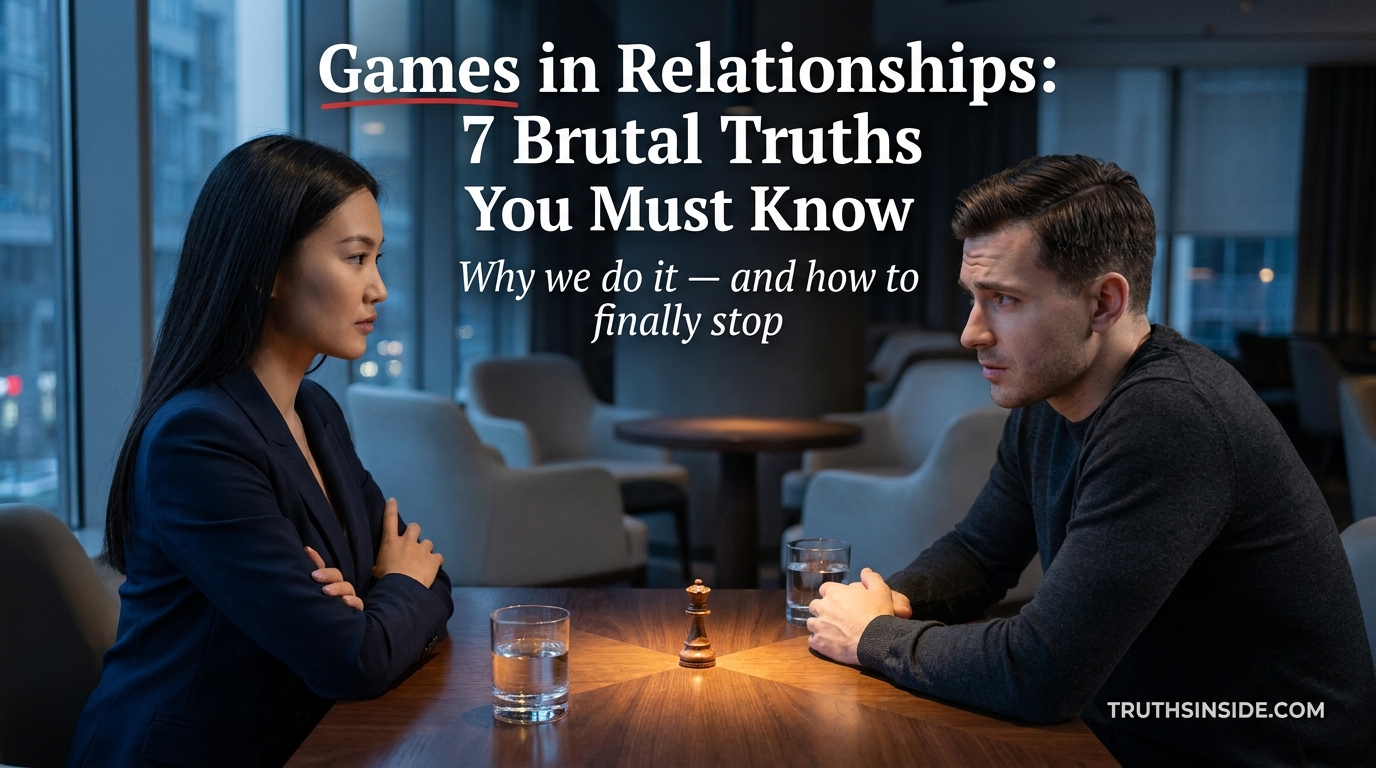
Why We Play Games in Relationships (And How to Stop)
Games in relationships are far more common than most people admit — and far more psychologically complex than most people realize. If you’ve ever deliberately waited to reply to a message, pulled away when someone got too close, or tested a partner’s loyalty without telling them, you’ve played a game. And you’re in very good company.
Research published in the Journal of Social and Personal Relationships found that over 69% of adults reported using at least one form of strategic emotional behavior in a romantic relationship. The reasons behind these behaviors aren’t always about manipulation or malice. More often, they’re rooted in fear, attachment wounds, and learned patterns that began long before this relationship ever started. Understanding those roots is where genuine change begins.
This isn’t a comfortable topic. Most people don’t like to admit they play games — it conflicts with the self-image of being a straightforward, emotionally mature person. But self-awareness requires honesty before it requires pride. The goal of this article is not to shame anyone for patterns they may not have even consciously chosen. It’s to shine a clear, psychologically grounded light on why these behaviors develop, what they’re really protecting, and most importantly — how to stop.
Because here’s what’s true: games in relationships always cost more than they protect. Every calculated move, every withheld truth, every emotional test creates a layer of distance between two people who, underneath all the strategy, probably just want the same thing — to be loved without losing themselves in the process.
What Are Relationship Games, Exactly?
Before unpacking the psychology, it helps to define the territory. Relationship games aren’t always dramatic or obvious. They exist on a wide spectrum — from subtle to deeply damaging. Common examples include playing hard to get, deliberately making a partner jealous, withholding affection as punishment, pretending to be less invested than you are, keeping score of perceived slights, hot and cold behavior designed to keep someone off-balance, and testing a partner’s feelings without asking directly.
Some of these behaviors might seem harmless or even socially normalized — pop culture has spent decades glamorizing “the chase” and rewarding emotional unavailability as attractive. But psychologically, each of these patterns has a cost. They prevent authentic connection. They breed anxiety and insecurity in the partner on the receiving end. And they keep the person playing them locked in a cycle of self-protection that ultimately produces the very loneliness they were trying to avoid.
Recognizing the full range of what “playing games” actually looks like is step one. Because many people engage in these behaviors on autopilot — not as deliberate strategies, but as deeply ingrained emotional reflexes they never learned to question.

The Psychology Behind Why We Play Games
Fear of Vulnerability
At the core of nearly every relationship game is one thing: fear of being truly seen and then rejected. Vulnerability — the act of showing real feelings, real needs, real investment — feels like handing someone a weapon they could use against you. For people who have been hurt before, that fear is not irrational. It’s learned. It’s protective. And it makes complete sense given what they’ve been through.
The problem is that the armor designed to prevent hurt also prevents connection. When you hide your real feelings behind strategic behavior, you may protect yourself from rejection — but you also make genuine intimacy structurally impossible. You can’t be loved for who you really are if you never show who you really are. The game keeps you safe and lonely at the same time.
Psychologist Brené Brown’s research on vulnerability confirms this paradox clearly: the people who experience the deepest connection are those who are willing to be seen without guarantees. Games are the opposite of that. They are the architecture of conditional showing up — I’ll let you see me only if it’s safe, only if you’ve proven yourself, only if I have the upper hand.
📃 Related article: 15 Signs She Is Testing You: Why Women Test Men and What to Do
Attachment Style as the Blueprint
Attachment theory — developed by John Bowlby and expanded by researchers Mary Ainsworth and later Amir Levine — is arguably the single most useful psychological framework for understanding relationship games. Your attachment style, formed in early childhood through your relationship with caregivers, becomes the unconscious blueprint for how you behave in adult romantic relationships.
People with anxious attachment styles tend to play games driven by fear of abandonment — testing partners, seeking reassurance through indirect means, manufacturing drama to confirm that the other person will stay. People with avoidant attachment styles play different games — pulling away when closeness increases, minimizing emotional needs, performing indifference to maintain a sense of control and independence. Disorganized attachment (sometimes called fearful-avoidant) produces the most confusing game patterns — simultaneously craving and fearing closeness, pushing people away and then desperately wanting them back.
The critical insight here is that these aren’t personality flaws. They are adaptive strategies that were once necessary for emotional survival. Understanding your attachment style doesn’t excuse the behavior — but it does explain it with a compassion that makes change possible.
“Most relationship games aren’t about winning. They’re about surviving. The person playing them learned, somewhere along the way, that being real was too dangerous to risk.”
Societal and Cultural Conditioning
It would be incomplete to discuss relationship games without acknowledging the role that culture plays in teaching them. From a young age, many people are socialized with messages that equate emotional unavailability with attractiveness. “Don’t seem too eager.” “Let them chase you.” “Never be the first to say I love you.” These are not fringe ideas — they are mainstream relationship advice that millions of people receive from friends, family, movies, and social media.
This cultural conditioning normalizes strategic emotional behavior and frames it as smart rather than harmful. It teaches people — particularly women — that interest should be performed through absence, and teaches men that emotional investment is weakness. Over time, these scripts become default behavior patterns. People play games not because they are manipulative by nature, but because they were taught that games are how romantic interest is correctly expressed.
Unlearning these scripts is deeply uncomfortable work. It requires questioning advice that came from people who genuinely loved you and meant well. But those scripts, however well-intentioned, were built on a fundamental misunderstanding of what creates lasting emotional connection.

The Real Cost of Playing Games
Games in relationships are never free. They carry a price paid in slow, compounding emotional currency. The immediate payoff — feeling in control, feeling protected, maintaining the upper hand — is real but short-lived. The long-term costs are far heavier.
For the person playing the games, the cost is authenticity. You cannot build a real relationship on a strategic performance of yourself. Whatever connection develops is built on a version of you that isn’t entirely true — which means even when someone loves you, you can’t fully receive it. Because some part of you knows they don’t have the real you.
For the person on the receiving end, the cost is psychological safety and self-trust. Consistent hot and cold behavior, unexplained withdrawal, and emotional testing create a state of chronic low-grade anxiety. The receiving partner begins questioning their own perceptions — wondering what they did wrong, how to fix something they can’t identify, whether they are enough. This is the lived experience of emotional insecurity manufactured by relational games.
And for the relationship itself — the cost is depth. Two people locked in strategic behavior can produce excitement and chemistry, but they cannot produce true intimacy. Real intimacy requires mutual honesty, consistent emotional presence, and the courage to need each other without performing indifference. Games are architecturally incompatible with that.
📃 Related article: Signs He Likes You But Is Scared: 18 Behaviors Men Show When Afraid to Commit
How to Stop Playing Games — Practical Psychology
Step 1: Identify Your Pattern With Honesty
You cannot stop a pattern you haven’t clearly named. Sit with this question without self-judgment: What specific game behaviors do I engage in, and what feeling am I trying to avoid when I do them? Write it down. “I go cold when things get serious because I’m terrified of being left.” “I make him jealous because I need to know he cares without having to ask.” Naming it precisely removes its automatic power.
Step 2: Trace It Back
Every game has a history. Ask yourself when you first learned that this behavior kept you safe. Was it in a previous relationship? In your family of origin? When did being direct feel dangerous? Tracing the pattern back to its source doesn’t excuse it — it contextualizes it, which is the first step toward choosing differently.
Step 3: Practice Radical Directness in Small Doses
You don’t have to overhaul your entire emotional style overnight. Start with small acts of directness. Reply to the message when you want to reply. Say “I enjoyed spending time with you” instead of manufacturing mystery. Express a real feeling instead of testing to see if it gets noticed. Each small act of genuine expression builds the emotional muscle of authenticity.
“The moment you stop performing and start being real is the moment a real relationship becomes possible. Not before.”
Step 4: Build Tolerance for Uncertainty
Most games are played to manage the uncertainty of not knowing how someone feels. The truth is — that uncertainty cannot be eliminated. Games create a false sense of control over outcomes that are fundamentally uncontrollable. Building tolerance for “I don’t know yet, and I can be okay in that space” is some of the most important psychological growth available to adults in relationships.
Mindfulness-based approaches, journaling, and therapy are all effective tools for increasing this tolerance. So is simply sitting with the discomfort of sending the honest message and waiting — without the game — for a genuine response.
Step 5: Choose Relationships Where You Don’t Feel the Need to Perform
Sometimes, the games are symptoms of the wrong match, not just personal wounds. If you consistently feel the need to strategize, test, and protect yourself around a specific person — pay attention to that. Healthy relationships are ones where both people can exhale. Where directness feels safer than strategy. If that baseline safety doesn’t exist and cannot be built, the relationship itself may be the problem — not just your patterns within it.

When Games Become a Pattern You Can’t Break Alone
For some people, relationship games are so deeply wired into their emotional operating system that self-awareness and good intentions aren’t enough to shift them. If you find that you consistently repeat the same strategic behaviors despite understanding why they’re harmful, despite wanting to stop, despite damaging relationships that mattered to you — that is a signal worth taking seriously.
Individual therapy — particularly approaches rooted in attachment theory, Internal Family Systems (IFS), or schema therapy — can be profoundly effective at reaching the younger, wounded parts of yourself that learned games as survival tools. Working with a therapist doesn’t mean something is catastrophically wrong with you. It means you’re taking the thing that’s keeping you from real love seriously enough to get real help.
The people who do this work — who genuinely excavate why they play games and choose something different — report not just better relationships, but a fundamentally different experience of themselves. Less performing. Less calculating. More present. More free.
📃 Related article: What Does It Actually Feel Like to Fall in Love? Science + Real Stories
A Final Word on Choosing Authenticity
Games in relationships are human. They are understandable. They come from real pain, real fear, and real cultural programming that most of us absorbed without consent. But understanding them is not the same as being bound by them. You get to choose, starting today, to be more real than strategic.
That doesn’t mean being careless with your heart. It doesn’t mean sharing everything immediately or abandoning healthy boundaries. It means choosing directness over performance wherever you can. It means expressing what’s real instead of engineering a reaction. It means trusting that the right person — the one worth having — will not be driven away by your honesty. They will be drawn to it.
The most magnetic thing a person can be in a modern relationship landscape flooded with strategy and performance is simply, courageously, genuinely themselves.
💾 Save this. Share it with someone stuck in the cycle. Follow Truthsinside.com for psychology-backed relationship truth that actually changes things.
FAQ
Q1: Is playing games in relationships always intentional?
No — and this is crucial to understand. Many relationship games are completely unconscious. They are automatic emotional responses shaped by past hurt, attachment wounds, and cultural conditioning. People often don’t realize they’re playing games until they examine their behavior patterns honestly, usually with the help of therapy or deep self-reflection.
Q2: Can a relationship survive if one person has been playing games?
Yes, absolutely — if the person becomes aware of the pattern and actively works to change it, and if the other partner is willing to rebuild trust. Transparency, consistent behavioral change over time, and often professional support are the key ingredients. Awareness without changed behavior, however, is not enough.
Q3: What’s the difference between healthy boundaries and playing games?
Healthy boundaries are clear, communicated, and consistent — “I need time to myself on weekends” is a boundary. Games are covert and designed to create an emotional reaction — going cold without explanation to see if someone chases you is a game. The defining difference is honesty. Boundaries are spoken. Games are performed.
Q4: Why do some people prefer partners who play games?
This is more common than people realize and usually traces back to attachment patterns. People with anxious attachment may interpret emotional unavailability as exciting or desirable because it triggers their pursuit response. The anxiety of wondering “do they like me?” can be misread as chemistry or passion. Therapy and self-awareness help break this cycle.
Q5: How do I know if I’m playing games or just protecting myself?
Ask yourself this: Am I being indirect about something I could simply say out loud? If yes — that’s likely a game. Healthy self-protection looks like communicating needs clearly. It looks like taking time before responding because you genuinely need to process — not to manufacture tension. The test is always: could I say what I’m doing and why, openly, to the other person? If not — look closer.
🎵 Music
Maren Lull is a singer-songwriter who writes from the places most people don’t talk about out loud.
Not the dramatic grief. Not the obvious heartbreak. The quiet kind — the ordinary Tuesday emptiness, the habit of reaching for someone who isn’t there anymore, the particular exhaustion of being strong for so long that the strength itself wears thin.
Her music lives at the intersection of emotional honesty and soft beauty — breathy vocals over gentle piano, slow tempos, lyrics that feel less like songs and more like something you wrote in a private notebook at two in the morning and never showed anyone.
Maren Lull writes for the people who feel everything deeply and say very little about it. For the ones who listen to sad music not because they want to feel worse — but because being understood, even by a song, makes the feeling easier to carry.
📱 Follow Maren Lull:
→ Spotify
→ Apple Music
→ Youtube
→ Audiomack