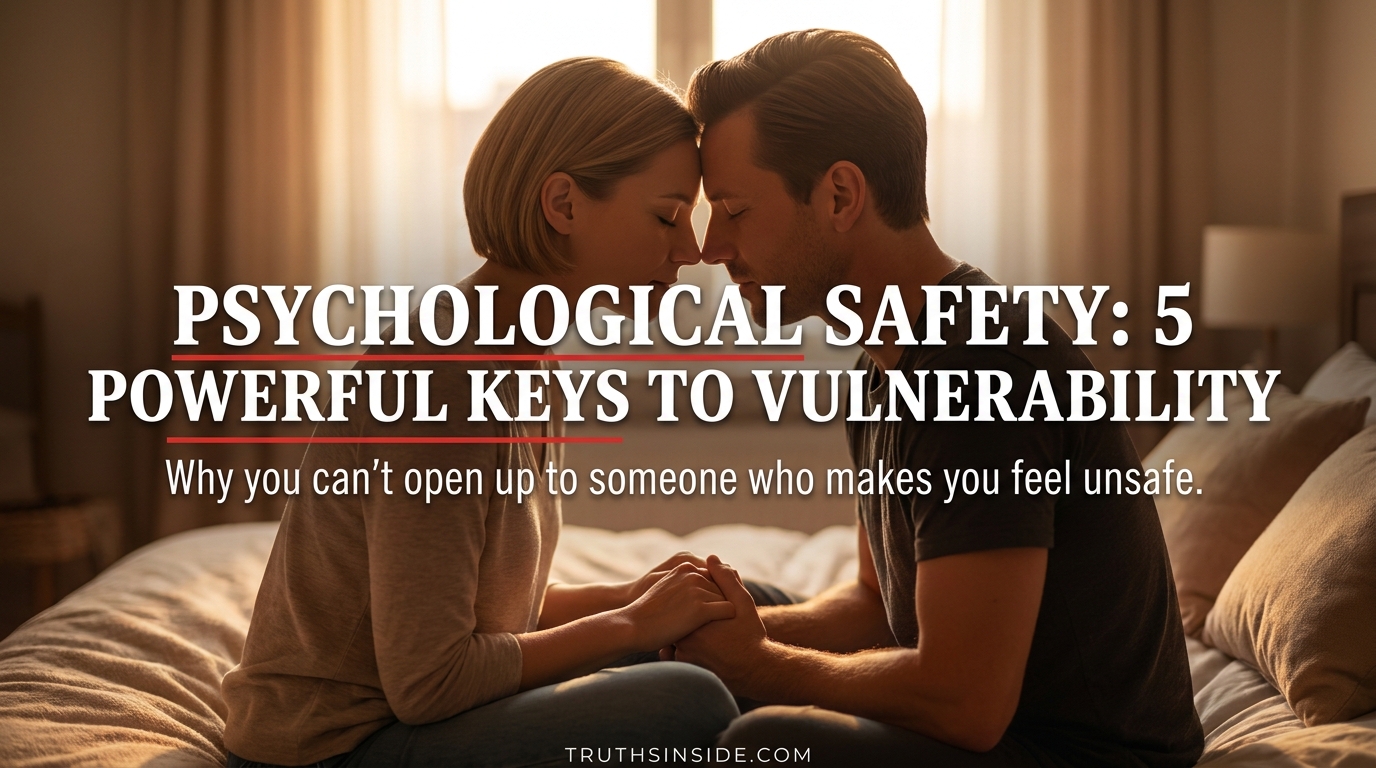
Have you ever wanted to say something vulnerable to your partner — how scared you really are, how much you needed them last week, how much a comment actually hurt — and stopped yourself, because some part of you didn’t trust how they’d react? That hesitation isn’t a lack of love. It’s a lack of psychological safety, and without it, real intimacy simply cannot exist.
Organizational psychologist Amy Edmondson first popularized the term “psychological safety” in workplace research, defining it as a shared belief that a person won’t be punished, humiliated, or rejected for speaking up. The same principle applies directly to romantic relationships: partners can only be as vulnerable as they feel safe to be. Studies on relationship satisfaction consistently link emotional safety to higher intimacy, better conflict resolution, and stronger long-term bonds.
This article explores what psychological safety actually means in the context of love, why so many relationships lack it even when both partners care deeply, and the specific, research-backed ways you can build it — so that vulnerability stops feeling like a risk and starts feeling like home.
What Is Psychological Safety in a Relationship?
Psychological safety in a relationship is the felt sense that you can express your true thoughts, fears, needs, and mistakes without facing ridicule, punishment, contempt, or abandonment. It doesn’t mean the absence of conflict — even psychologically safe couples disagree. What it means is that disagreement doesn’t threaten the emotional bond itself.
Dr. John Gottman’s decades of relationship research identified contempt, criticism, defensiveness, and stonewalling as the strongest predictors of relationship breakdown — behaviors that, over time, erode psychological safety until one or both partners stop showing up authentically. When a partner rolls their eyes at a vulnerable confession, mocks a fear, or goes cold during hard conversations, the nervous system quickly learns a lesson: it isn’t safe to be fully seen here.
Once that lesson is learned, people adapt. They stop sharing. They perform a curated, guarded version of themselves. And ironically, the relationship can look calm on the surface while growing more emotionally distant underneath — because psychological safety, once damaged, doesn’t repair itself without intentional effort.
📃 Related article: Codependent No More: 7 Signs to Break Free Today
Why Vulnerability Requires Psychological Safety First
Brené Brown’s research on vulnerability describes it as “uncertainty, risk, and emotional exposure” — and no one willingly exposes themselves in an environment that feels dangerous. This is why so many people insist they “just aren’t good at opening up,” when the real issue may be that they’ve never actually experienced a relationship with enough psychological safety to make opening up feel survivable.
Neuroscience backs this up. When someone feels judged or threatened, the brain’s amygdala activates a stress response, prioritizing self-protection over connection. In that state, honest, vulnerable communication becomes almost physiologically difficult — the nervous system is too busy guarding the exits. Psychological safety effectively turns off that alarm system, allowing the more reflective, connective parts of the brain to stay engaged during hard conversations.
This is why yelling, sarcasm, guilt-tripping, or silent treatment during conflict are so damaging — even if a relationship is otherwise loving. Each of these behaviors, repeated over time, teaches a partner’s nervous system that vulnerability leads to pain, which shuts the door on genuine closeness long after the specific argument has ended.
“You cannot ask someone to be vulnerable with you and punish them the moment they are.”

Signs Psychological Safety Is Missing in Your Relationship
There are consistent patterns that reveal when psychological safety is low, even in relationships that otherwise seem functional. Recognizing them is the first step toward change.
You rehearse what you say before saying it. If you find yourself mentally editing your words to avoid a negative reaction, this signals a lack of psychological safety — you’re managing your partner’s potential response instead of expressing yourself freely.
Mistakes feel catastrophic. In a psychologically safe relationship, admitting “I messed up” is uncomfortable but survivable. Without it, small mistakes trigger disproportionate fear, shame spirals, or over-apologizing.
You avoid certain topics entirely. Finances, past relationships, insecurities, mental health — if entire categories of conversation feel off-limits because of how your partner might react, safety is missing.
Conflict escalates quickly. Disagreements that spiral into contempt, stonewalling, or personal attacks are a clear sign that the relationship lacks the safety needed to disagree constructively.
You feel more like yourself around friends than your partner. This is one of the clearest indicators. When you’re more guarded with the person you’re closest to than with casual acquaintances, psychological safety has likely broken down somewhere along the way.
How to Build Psychological Safety With Your Partner
1. Respond to vulnerability with curiosity, not judgment. When your partner shares something difficult, resist the urge to fix, minimize, or criticize. Simple responses like “thank you for telling me” or “that makes sense” go further than advice in building psychological safety.
2. Repair after conflict — every time. Gottman’s research shows that successful repair attempts after arguments are one of the strongest predictors of long-term relationship health. A sincere apology or a moment of reconnection after a fight rebuilds the safety that conflict temporarily disrupts.
3. Separate the behavior from the person. Criticizing “you never listen to me” attacks identity, while “I felt unheard in that conversation” addresses behavior. This distinction protects psychological safety even during necessary, honest conflict.
4. Create predictable emotional responses. Unpredictability — sometimes warm, sometimes cold, sometimes explosive — keeps a partner’s nervous system on high alert. Consistency, even in small daily interactions, is one of the quiet foundations of lasting psychological safety.
5. Normalize imperfection. Let your partner see you get things wrong without collapsing into defensiveness. Modeling that mistakes don’t equal unworthiness gives your partner permission to do the same.
“Safety isn’t built in grand gestures. It’s built in a thousand small moments of feeling met instead of managed.”

Psychological Safety and Attachment Styles
Attachment theory offers additional insight into why psychological safety matters so deeply. People with anxious attachment styles often need more explicit reassurance to feel safe, while those with avoidant attachment styles may need more space and less pressure to open up quickly. Neither style is a flaw — but without awareness, partners can unintentionally undermine each other’s sense of safety by expecting the same responses from very different nervous systems.
Securely attached individuals tend to have grown up in environments with consistent, responsive caregiving, which taught their nervous system that closeness is safe by default. Those with anxious or avoidant patterns often had less predictable early environments, meaning psychological safety in adult relationships has to be built more deliberately, and often more slowly, through consistent, patient effort from both partners.
Understanding your own and your partner’s attachment style isn’t about assigning blame — it’s about building a shared language for what safety looks like for each of you specifically, rather than assuming your needs are universal.
📃 Related article: Smart People: 7 Shocking Reasons They Stay Stuck
What Happens When Psychological Safety Is Present
Relationships with strong psychological safety look markedly different from those without it. Partners argue, but they don’t attack. They admit fears, insecurities, and mistakes without spiraling into shame. They ask for what they need directly instead of testing or withdrawing to see if their partner will notice.
Perhaps most importantly, psychologically safe relationships allow both people to keep growing and changing without fear that evolution will be met with rejection. This is what researchers describe as a “secure base” — a relationship stable enough to explore vulnerability from, rather than one that requires constant vigilance to maintain.

Frequently Asked Questions
What is psychological safety in a relationship?
Psychological safety is the felt sense that you can express your true thoughts, needs, and mistakes without facing punishment, ridicule, or rejection from your partner.
How do I know if my relationship lacks psychological safety?
Common signs include rehearsing what you say before saying it, avoiding certain topics, and feeling more like yourself around friends than around your partner.
Can psychological safety be rebuilt after it’s broken?
Yes, though it takes consistent effort. Sincere repair after conflict, predictable emotional responses, and nonjudgmental reactions to vulnerability can gradually rebuild trust and safety over time.
Does psychological safety mean avoiding all conflict?
No. Psychologically safe couples still disagree — the difference is that conflict doesn’t threaten the emotional bond or escalate into contempt, stonewalling, or personal attacks.
How does attachment style affect psychological safety?
Anxious and avoidant attachment styles often need different things to feel safe — more reassurance versus more space — so understanding these differences helps partners build safety more effectively together.
If this gave you language for something you’ve felt but couldn’t name, save this article for later, share it with someone you love, and follow Truthsinside.com for more research-backed psychology content.
🎵 Music
Maren Lull is a singer-songwriter who writes from the places most people don’t talk about out loud.
Not the dramatic grief. Not the obvious heartbreak. The quiet kind — the ordinary Tuesday emptiness, the habit of reaching for someone who isn’t there anymore, the particular exhaustion of being strong for so long that the strength itself wears thin.
Her music lives at the intersection of emotional honesty and soft beauty — breathy vocals over gentle piano, slow tempos, lyrics that feel less like songs and more like something you wrote in a private notebook at two in the morning and never showed anyone.
Maren Lull writes for the people who feel everything deeply and say very little about it. For the ones who listen to sad music not because they want to feel worse — but because being understood, even by a song, makes the feeling easier to carry.
📱 Follow Maren Lull:
→ Spotify
→ Apple Music
→ Youtube
→ Audiomack