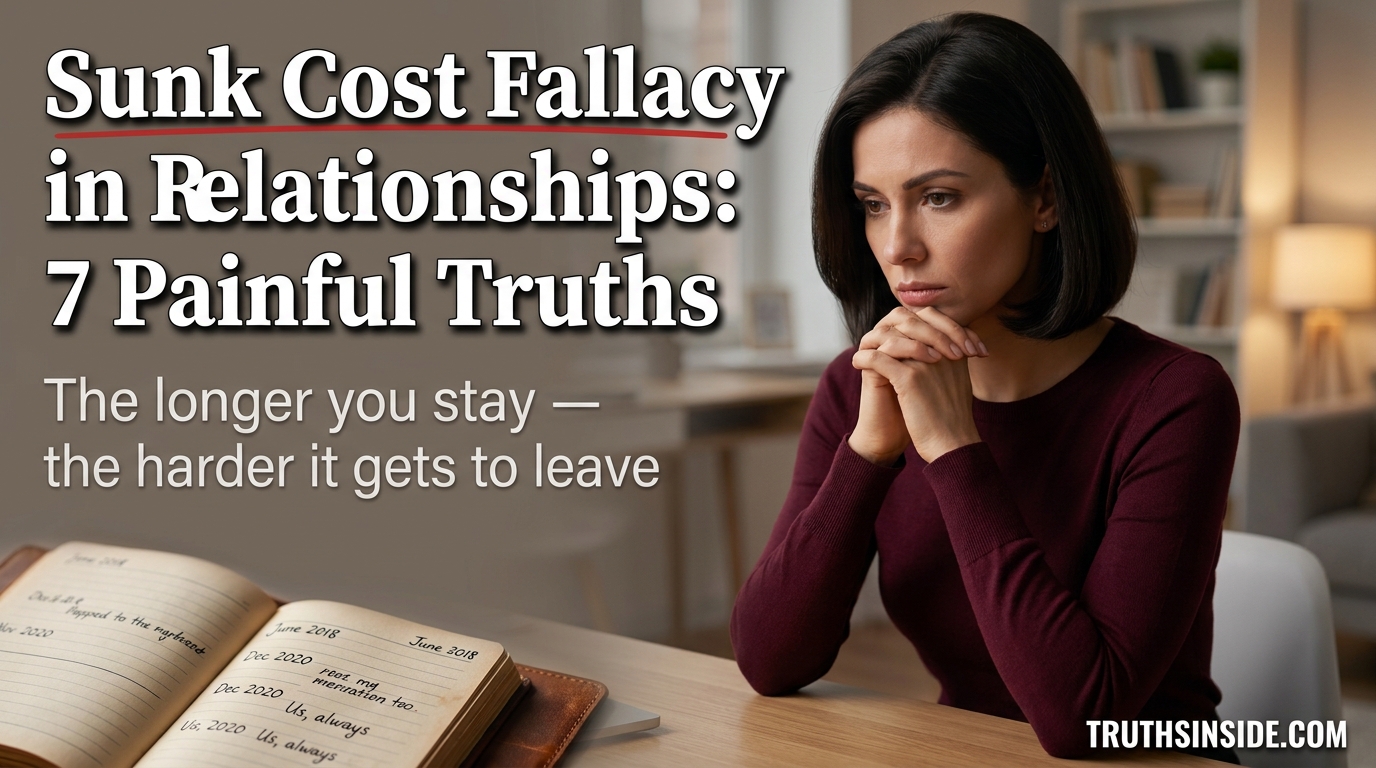
Sunk cost fallacy in relationships is one of the most psychologically powerful and least openly named reasons people stay in partnerships that are no longer serving them — sometimes for years, sometimes for decades past the point where they privately knew something was deeply wrong. It is the invisible logic that says: I have given too much to walk away now. The years invested. The sacrifices made. The version of the future you built inside your mind around this person and this relationship. All of it accumulates into a weight that makes leaving feel not like freedom but like loss — like admitting that everything you gave was for nothing.
The sunk cost fallacy is a well-documented cognitive bias originally identified in the field of behavioral economics. It describes the human tendency to continue investing in something — money, time, energy, emotion — based on what has already been spent rather than on an honest assessment of what continuing to invest will actually produce. Nobel Prize-winning psychologist Daniel Kahneman, whose research on cognitive bias transformed our understanding of human decision-making, demonstrated that people are significantly more motivated by the fear of losing what they have already invested than by the rational prospect of future gain.
In relationships, this bias operates with particular emotional force. Because what has been invested is not money — it is the most personal and irreplaceable currency human beings possess: time, love, vulnerability, and the specific chapters of a life given to another person. A study published in the Journal of Personality and Social Psychology found that individuals reported significantly higher relationship commitment when they focused on past investment rather than future satisfaction — even when those two measures pointed in completely opposite directions.
You can know, intellectually and completely, that the relationship is not making you happy — and still feel psychologically compelled to stay because of everything you have already put into it. This article names 7 painful truths about why — and what it takes to finally think differently.
The Psychology Behind Staying Too Long
Before examining the 7 truths, it is worth understanding precisely why the sunk cost fallacy is so particularly powerful in the context of romantic relationships — more so than in almost any other domain of human decision-making.
In financial contexts, sunk cost thinking is irrational but relatively contained. The money is spent. The investment failed. The decision to continue throwing good money after bad is clearly separable from the emotional identity of the person making it.
In relationships, the investment is identity itself. When you have spent years building a life with someone — when that person is woven into your daily routines, your social world, your future plans, and your understanding of who you are — the decision to leave is not experienced as a financial correction. It is experienced as a fundamental reorganization of self.
This is why sunk cost thinking in relationships resists the kind of rational override that sometimes works in other contexts. It is not just the time and energy that feel lost when you consider leaving. It is the version of yourself that existed within the relationship, the future you had planned within it, and the meaning the relationship gave to the sacrifices you made along the way.
Understanding this — with genuine compassion for how human this response is — is the beginning of being able to think about it differently.

Truth #1: Sunk Cost Fallacy in Relationships Makes Past Investment Feel Like a Reason to Stay
The most fundamental expression of the sunk cost fallacy in relationships is the direct equation of past investment with present justification for staying. The longer you have been in the relationship, the more powerful this equation becomes — because the more you have invested, the greater the perceived loss of leaving.
Five years feels like too much to walk away from. Ten years feels impossible. Twenty years feels unthinkable.
But this logic contains a critical flaw that is worth naming clearly: the time, love, and energy you have already invested in this relationship are gone regardless of what you decide next. They do not return if you stay. They are not recovered by continuing. The question that actually determines your future is not “how much have I already given?” It is “what will staying or leaving produce from this point forward?”
Past investment is real. It deserves to be honored and grieved. But it is not a reliable guide to future decisions — because it tells you nothing about what the next year, or the next five years, of your life will look and feel like.
Staying because of what you’ve already given is spending more of your irreplaceable present to protect an investment in your past. And no amount of additional time changes what was already spent.
📃 Related article: Love-Hate Dynamic: 7 Reasons Toxic Love Traps You
Truth #2: The Relationship’s Best Moments Are Not a Prediction of Its Future
One of the ways the sunk cost fallacy maintains its grip in relationships is through the selective recall of the relationship’s best moments — the times it was genuinely good, genuinely loving, genuinely what you hoped it could be. These memories become the justification for continued investment: it has been this good before, it can be this good again.
But the history of a relationship’s best moments is not a reliable predictor of its future unless the conditions that produced those moments are consistently present — and in many relationships where sunk cost thinking is keeping someone anchored, those conditions have not been reliably present for a very long time.
The best version of the relationship — the version that lives most vividly in memory and that the sunk cost fallacy uses most effectively — may represent a small fraction of the relationship’s actual emotional texture. The majority may have been characterized by the very patterns, deficits, and disconnections that have been producing the doubt for months or years.
Honoring what was genuinely good does not require staying. It requires acknowledging the full truth of the relationship — not just its peaks, but its persistent reality — and making decisions from that complete picture rather than from the curated highlights that sunk cost thinking consistently surfaces.
Truth #3: Staying Out of Guilt Is Not the Same as Staying Out of Love
The sunk cost fallacy in relationships frequently operates through guilt — a specific, sustained guilt rooted in the awareness of how much the other person has invested, how much they would be hurt by the ending, and how much the relationship means to them even when it no longer holds the same meaning for you.
This guilt is real and it deserves compassion. But it is important to name clearly what it is — and what it is not.
Staying in a relationship primarily because leaving would hurt the other person, or because you feel responsible for the investment they have made, is not an act of love. It is an act of conflict avoidance — one that keeps both people in a dynamic that is not genuinely meeting either person’s deepest needs.
The person being stayed with out of guilt deserves a partner who is genuinely there — not someone maintaining the form of a relationship while privately knowing it has already ended in every way that matters. And the person staying out of guilt is quietly accumulating a resentment that will eventually express itself — in withdrawal, in emotional absence, in the particular bitterness of someone who gave years they didn’t genuinely choose to give.
Genuine love sometimes means having the honest, difficult conversation that sets both people free — even when that conversation is the hardest thing either of you will face.
“Staying because you feel guilty is not loyalty. It is a kindness to yourself that you are framing as a kindness to them — and it costs both of you far more than honesty would.”
Truth #4: The Fear of Wasted Time Is Actually Creating More Wasted Time
Perhaps the most painfully ironic expression of the sunk cost fallacy in relationships is its self-defeating logic around time. The fear of having wasted the years already spent is so powerful that it drives the decision to spend additional years in the same dynamic — which, mathematically and emotionally, produces exactly the outcome it was trying to prevent.
If five years in a relationship that is not right feels like a waste you cannot accept, staying for ten years does not reduce that waste. It doubles it.
The time already spent cannot be reclaimed by spending more. But the time ahead of you — the years that have not yet been lived — is still entirely available to be directed toward something genuine, something healthy, and something that actually reflects who you are and what you need.
Every day the sunk cost fallacy keeps you in a relationship that is not right is a day redirected away from the life and love that are genuinely possible for you. And those days accumulate, quietly and irreversibly, into seasons and years of a life that never quite became what it could have been — not because the right things weren’t available, but because the wrong investment made it impossible to see them clearly.
Truth #5: Your Investment Does Not Obligate Your Partner to Change
One of the most painful dimensions of the sunk cost fallacy in relationships is the implicit belief that the depth of your investment creates an obligation — that having given so much, for so long, the other person owes you the change you’ve been hoping for.
This belief is understandable. It is also false.
People change when they are genuinely motivated to change — when the recognition of a pattern, a wound, or a behavioral habit creates sufficient internal discomfort that the work of changing becomes worth doing. That motivation is internal. It is not produced by the accumulation of another person’s patience, sacrifice, or sustained investment.
A partner who has not changed through five years of your hope and patience will not necessarily change through six or seven. The timeline of your investment has no bearing on the timeline of their growth — or on whether that growth will occur at all.
Waiting for someone to become who you need them to be is not a relationship strategy. It is sunk cost thinking dressed as hope. And it keeps you in a position of perpetual waiting for a change that may never come — while the relationship continues to cost you exactly what it has always cost you.

Truth #6: The Sunk Cost Fallacy Keeps You From the Life That’s Actually Waiting
Every month spent in a relationship that the sunk cost fallacy is maintaining is a month not spent building, exploring, healing, and becoming fully available for the life and the love that are genuinely possible.
This is not a small cost. It is, in many ways, the largest cost — because it operates not just on the present but on the future. It delays healing. It delays growth. It delays the possibility of genuine connection with someone whose relationship with you would not require you to stay out of obligation to the past.
The life available to you on the other side of an honest ending is not a consolation prize. For many people, it is the beginning of the most genuinely alive period of their adult experience — a season of self-reclamation, authentic connection, and the particular freedom of someone who has finally stopped spending their most valuable resources on something that stopped growing long ago.
That life requires a decision. Not a perfect decision, made with complete certainty and zero grief. Just an honest one — made from your clearest self, with full acknowledgment of what you are leaving and full trust in what becomes possible when you do.
📃 Related article: Signs He Likes You But Is Scared: 18 Behaviors Men Show When Afraid to Commit
Truth #7: Leaving Is Not Admitting It Was a Waste — It’s Refusing to Waste What’s Left
The deepest and most liberating reframe available to anyone trapped by the sunk cost fallacy in relationships is this: leaving is not a declaration that the relationship meant nothing. It is a declaration that your future means something.
Every relationship — even one that ends, even one that caused genuine pain — contains something real. The love was real. The growth was real. The experiences were real. None of that is erased by the decision to end. None of it becomes meaningless because the relationship did not last forever.
What leaving does is redirect the investment of your present and future self away from something that is no longer growing and toward the full, open possibility of what comes next.
The years already given were not wasted simply because the relationship ends. They were the chapters that made you who you are today — the experiences that taught you what you need, what you deserve, and what you are capable of in love.
What would be a waste is spending the next chapter of your life in the same place — not because it is right, not because it is growing, but because you are afraid that leaving would mean admitting that the previous chapters didn’t matter.
They mattered. And so does everything that comes after them.
“Leaving doesn’t mean the time you gave was wasted. It means you finally decided that the time you have left is worth something too.”

How to Begin Thinking Beyond the Sunk Cost
Recognizing the sunk cost fallacy in your own relationship thinking is genuinely difficult — because from the inside, it does not feel like a cognitive bias. It feels like loyalty, like love, like the reasonable weight of everything you have shared with another person.
The first step toward clearer thinking is separating two questions that the sunk cost fallacy consistently conflates. The first question is backward-looking: what have I already invested? The second is forward-looking: what will staying or leaving produce from here? These are different questions. They deserve different weight in your decision-making — and the sunk cost fallacy consistently gives the first question power it does not deserve over the second.
Begin asking the forward question honestly. Not “how much have I given?” but “what is this relationship consistently producing in my life right now?” Not “how long have we been together?” but “who am I becoming inside this relationship — and is that the person I want to be?”
Seek therapeutic support if the bias feels deeply entrenched. A skilled therapist can help you separate genuine love and genuine potential from the cognitive pull of past investment — and can support the grief that comes with honestly acknowledging what the relationship is, rather than what you have hoped it would become.
And extend yourself the profound compassion that this recognition deserves. Staying too long is one of the most human things a person can do. It is not weakness. It is not stupidity. It is the evidence of how deeply you loved and how fully you invested — and both of those things say something genuinely beautiful about who you are, even as the decision they produced deserves to be honestly examined and changed.
💾 Save this article — return to it when the pull of past investment starts to feel louder than the truth of your present.
📤 Share it with someone you love who has been in the same relationship longer than makes sense — and who deserves to hear this with compassion.
👣 Follow Truthsinside.com for more honest, deeply researched psychology and relationship content that helps you make decisions from clarity rather than from fear.
📃 Related article: Attachment Theory Explained: Which Style Are You?
FAQ: Sunk Cost Fallacy in Relationships
Q1: What is the sunk cost fallacy in relationships?
The sunk cost fallacy in relationships is the cognitive bias that causes people to remain in unsatisfying or unhealthy relationships based on the time, love, and energy already invested — rather than on an honest assessment of what the relationship is currently providing and what it is likely to provide in the future. It produces the feeling that leaving would mean “wasting” everything already given, which keeps people invested in relationships that no longer serve their genuine wellbeing.
Q2: How do I know if the sunk cost fallacy is affecting my relationship decisions?
Key indicators include: your primary reasons for staying center on how long you’ve been together or how much you’ve sacrificed rather than on genuine current happiness and future potential; you find yourself thinking “I’ve come this far — I can’t quit now” more than “this relationship is genuinely good for me”; you stay primarily to avoid the feeling that the investment was wasted rather than because the relationship is producing something you genuinely value; and leaving feels more like loss of the past than loss of something present and real.
Q3: Is it always wrong to factor past investment into relationship decisions?
Not entirely. The history of a relationship contains genuine information — about patterns, about growth, about both partners’ capacity for change and repair. Completely ignoring history in relationship decision-making is not wise. The problem is when past investment becomes the primary or dominant reason for staying — when it overrides honest assessment of the present reality and future potential. Past investment should inform decisions. It should not determine them.
Q4: Can recognizing the sunk cost fallacy help me decide to stay as well as leave?
Yes — and this is an important point. Recognizing the sunk cost fallacy means committing to make relationship decisions based on honest present and future assessment rather than past investment. Sometimes that honest assessment reveals that the relationship has genuine current value and genuine future potential — and that staying is the right decision for reasons that have nothing to do with sunk cost thinking. The goal is not to leave every relationship where sunk cost thinking has been present. The goal is to make decisions from clarity rather than from the cognitive bias of past investment.
Q5: How do I actually leave a relationship when the sunk cost fallacy is keeping me stuck?
The most effective approach combines several elements: therapeutic support to process both the bias and the grief that comes with honest recognition of what the relationship is; a deliberate practice of forward-focused thinking — consistently redirecting attention from what has been invested to what staying will produce; building or rebuilding an individual identity outside the relationship that makes leaving feel less existentially threatening; and allowing yourself to grieve the relationship and the future you imagined within it — not as a reason to stay, but as an honest honoring of what was real, before redirecting your energy toward what comes next.
🎵 Music
Maren Lull is a singer-songwriter who writes from the places most people don’t talk about out loud.
Not the dramatic grief. Not the obvious heartbreak. The quiet kind — the ordinary Tuesday emptiness, the habit of reaching for someone who isn’t there anymore, the particular exhaustion of being strong for so long that the strength itself wears thin.
Her music lives at the intersection of emotional honesty and soft beauty — breathy vocals over gentle piano, slow tempos, lyrics that feel less like songs and more like something you wrote in a private notebook at two in the morning and never showed anyone.
Maren Lull writes for the people who feel everything deeply and say very little about it. For the ones who listen to sad music not because they want to feel worse — but because being understood, even by a song, makes the feeling easier to carry.
📱 Follow Maren Lull:
→ Spotify
→ Apple Music
→ Youtube
→ Audiomack