Most people imagine abuse as something they would immediately recognize. A raised voice. A visible bruise. An obvious threat. But the most dangerous form of relationship abuse leaves no physical marks at all — and by the time most people recognize it, they are already deep inside it with no clear path out.
Coercive control is a pattern of behavior used by one partner to dominate, manipulate, and strip away the freedom of another — and it affects millions of people worldwide. Research from the UK’s Office for National Statistics found that 1 in 5 adults will experience coercive control in their lifetime, and the majority will not identify what is happening to them as abuse for months or even years. In the United States, coercive control is now recognized as a form of domestic abuse in multiple states, reflecting how seriously researchers and lawmakers have come to take its devastating psychological impact.
What makes coercive control so insidious — and so dangerous — is precisely how invisible it is in the early stages. It does not announce itself. It disguises itself as love, protection, and devotion. It hides inside behaviors that feel flattering before they feel frightening. This article is going to pull back the curtain on exactly how it works, what the red flags look like before most people are willing to name them, and what you can do if any of this feels uncomfortably familiar.
What Coercive Control Actually Is
Coercive control is not a single incident. It is not one argument that went too far or one moment of jealousy that crossed a line. It is a sustained pattern — a deliberate and calculated campaign by one person to dominate and control another through a combination of tactics that erode identity, autonomy, and eventually reality itself.
The term was formalized and brought into mainstream awareness by Professor Evan Stark, a forensic social worker and researcher whose 2007 book Coercive Control: How Men Entrap Women in Personal Life fundamentally changed how domestic abuse is understood in the academic and legal world. Stark argued — and has since been widely supported by research — that physical violence is often the least damaging aspect of an abusive relationship. The psychological architecture of control that surrounds it is what truly destroys a person.
Coercive control typically involves a combination of the following core tactics: isolation from support networks, micromanagement of daily life, financial control, surveillance and monitoring, emotional manipulation including gaslighting, intimidation without physical violence, and the systematic destruction of the victim’s self-worth and confidence.
What is critical to understand is that these tactics are rarely all present at the beginning. They are introduced gradually — sometimes over months, sometimes over years — in a slow and deliberate process that makes each escalation feel like a natural extension of what came before it. By the time the full picture is visible, leaving often feels impossible.
Why Coercive Control Is So Easy to Miss
The reason coercive control is so difficult to identify — especially from the inside — comes down to three interconnected factors: gradual escalation, the disguise of love, and the systematic dismantling of the victim’s ability to trust their own perceptions.
Gradual escalation means that no single behavior ever feels dramatic enough to name as abuse. Controlling partners do not reveal their full nature on the first date. They reveal it in increments so small that each step seems reasonable in isolation. By the time behaviors become obviously harmful, the victim has already been conditioned to accept them as normal.
The disguise of love is perhaps the most psychologically sophisticated element of coercive control. The behaviors that will later become controlling are initially framed as care. Jealousy is presented as devotion. Monitoring is framed as protection. Isolation is disguised as a desire for closeness. The victim is not experiencing these things as red flags in the beginning — they are experiencing them as evidence that this person loves them deeply.
The destruction of self-perception happens as a direct result of sustained gaslighting, criticism, and emotional manipulation. Over time, the victim stops trusting their own instincts, their own memory, and their own interpretation of events. When you can no longer trust your own mind, identifying abuse becomes nearly impossible — because the very tool you would use to identify it has been compromised.
“Coercive control does not lock the door from the outside. It convinces you, slowly and deliberately, that you no longer want to leave.”
The Red Flags of Coercive Control You Are Most Likely to Miss
These are not the obvious red flags. These are the ones that hide in plain sight — the ones that feel like love before they feel like control.
Red Flag 1: Intensity That Feels Like Passion
In the early weeks of a relationship with a coercive controller, the connection often feels electric, overwhelming, and unlike anything you have experienced before. They text constantly. They want to see you every day. They tell you they have never felt this way about anyone. They use the word “soulmate” within the first month.
This is called love bombing — and it is the foundation upon which coercive control is built. The intensity serves two purposes: it creates deep emotional attachment extremely quickly, and it establishes a precedent of total enmeshment that will later become the justification for controlling behavior.
When the love bombing phase transitions — and it always does — the controlling partner uses the intimacy and attachment they have manufactured to justify increasingly intrusive behavior. “I just love you so much, that is why I need to know where you are.” The passion was real to you. To them, it was strategic.
Red Flag 2: Jealousy Framed as Devotion
Early jealousy from a new partner is one of the most universally misread red flags in romantic relationships. A partner who gets upset when you spend time with friends, who checks your phone “just to feel secure,” who wants to know exactly who you were talking to and why — these behaviors are frequently interpreted as signs of deep investment and caring.
Research from the National Domestic Violence Hotline consistently identifies early jealousy as one of the top precursors to escalating controlling behavior. The jealousy itself is not a sign of love — it is a sign of possessiveness. And possessiveness is not love. It is the early stage of ownership.
Watch how your partner handles your independence. Do they celebrate it or quietly punish it? A partner who sulks when you go out with friends, who creates emotional tension every time you spend time away from them, who makes you feel guilty for having a life outside the relationship — that is not devotion. That is the beginning of a cage.
Red Flag 3: Subtle Criticism Disguised as Helpfulness
Coercive controllers rarely begin with overt insults. Instead, they introduce criticism through a frame of helpfulness, concern, or superior knowledge. “I just think you could do better with your career.” “I am only saying this because I love you — that outfit is not really flattering.” “I worry about you when you drink — you make bad decisions.”
Each comment, taken alone, sounds caring. But when these comments are consistent, targeted, and always directed at the same person’s choices, appearance, intelligence, or competence — they are not help. They are a systematic campaign to make you feel smaller, less capable, and more dependent on the person offering the “help.”
Over time, this pattern achieves exactly what it is designed to achieve. The victim begins to second-guess their own choices. They start consulting the controlling partner before making decisions. They begin to believe that they genuinely need this person’s guidance to function well. That dependency is not love. It is manufactured helplessness.
Red Flag 4: Isolation That Happens Gradually
Nobody announces that they are going to cut you off from your support network. It happens through incremental steps that each feel individually reasonable.
First, your partner expresses that they feel your friends do not really like them. Then, they express hurt feelings when you choose to spend time with those friends. Then, spending time with friends becomes associated with conflict and emotional tension. Then, it becomes easier to just stay home. Then, you realize you have not seen your closest friends in three months — and somehow that happened without anyone ever explicitly telling you not to see them.
This is isolation by design. Coercive controllers isolate their victims from support networks because support networks are threats to control. Friends and family who know you well are capable of reflecting back to you what they are witnessing — and that reflection is dangerous to a controller. Without your support network, you have no external reality check. You have only the reality your partner is constructing for you.
Red Flag 5: Monitoring and Surveillance Presented as Trust
In 2025, digital surveillance has become one of the most common tools of coercive control — and one of the most normalized. Location sharing between partners is increasingly common, and while mutual, consensual location sharing can be a benign convenience, it becomes a red flag when it is demanded rather than offered, when checking becomes obsessive, or when not sharing is treated as evidence of dishonesty.
Demanding access to a partner’s phone, social media accounts, and email is not a sign of a healthy relationship. It is a sign of control. A partner who reads your messages, monitors your followers, checks your location multiple times per day, or becomes upset when you do not answer within minutes is engaging in surveillance behavior — regardless of how they frame it.
The framing is always the same: “If you have nothing to hide, why does it bother you?” This is a manipulation tactic. Privacy is not secrecy. Every person in a healthy relationship is entitled to some degree of privacy, and the demand to eliminate it entirely is a serious red flag.
Red Flag 6: Financial Control and Economic Abuse
Financial control is one of the most powerful and least discussed tools of coercive control. It can take many forms: demanding access to a partner’s bank accounts, controlling all household spending, sabotaging a partner’s employment by creating conflicts or making them late, running up debt in a partner’s name, or withholding money as punishment.
Economic abuse is effective as a control mechanism precisely because it creates genuine material dependency. A person who has no financial independence has no practical means of leaving a relationship — even when they desperately want to. This is not accidental. It is strategic.
Early warning signs include a partner who insists on managing all finances “to make things simpler,” who discourages you from working or furthering your career, who creates financial obligations that tie you to them early in the relationship, or who monitors and controls your personal spending in ways that feel demeaning rather than collaborative.
“The most dangerous prisons are the ones with no visible bars — where the door looks open but leaving still feels impossible.”
Red Flag 7: Gaslighting Your Reality
Gaslighting is the psychological manipulation tactic that makes coercive control so difficult to escape — because it targets the victim’s ability to perceive and trust reality itself.
Gaslighting involves the consistent denial, distortion, or reframing of events in ways that make the victim doubt their own memory, perception, and sanity. “That never happened.” “You are being oversensitive.” “You always do this — you twist everything.” “I never said that. You are imagining things.”
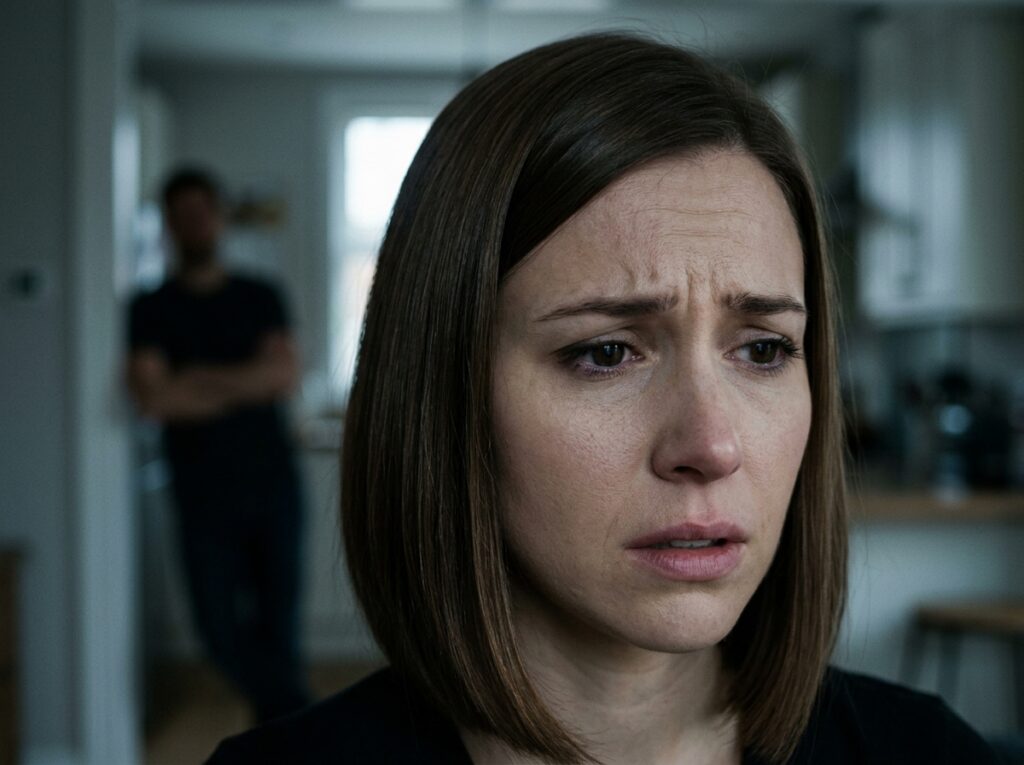
Over time, repeated gaslighting creates what psychologists call cognitive dissonance — a painful state of holding two contradictory beliefs simultaneously. The victim knows what they experienced, but they have been told so consistently that their experience is wrong that they can no longer be certain. This uncertainty is the most effective tool a coercive controller has, because a person who cannot trust their own mind cannot trust their own judgment enough to leave.
The Psychological Impact of Coercive Control
The damage coercive control inflicts on a person’s psychological health is profound, lasting, and frequently underestimated by people who have not experienced it.
Survivors of coercive control commonly report symptoms that closely mirror those of Complex Post-Traumatic Stress Disorder — including hypervigilance, emotional numbness, difficulty making decisions, deep shame, and a fragmented sense of identity. This is not coincidental. The sustained, deliberate assault on a person’s autonomy, self-worth, and reality perception that characterizes coercive control is traumatic in the full clinical sense of the word.
Research published in the Journal of Interpersonal Violence found that survivors of coercive control reported higher levels of psychological distress than survivors of relationships that involved physical violence alone. This finding challenges the still-prevalent cultural belief that “real” abuse requires physical evidence. The wounds of coercive control are invisible — but they are no less real, and in many cases they take significantly longer to heal.
Recovery is possible, and it happens. But it typically requires professional therapeutic support, time, and the rebuilding of the self-trust that was systematically dismantled by the controlling partner. This is not a quick process — and survivors deserve patience and compassion rather than the question that is most frequently and harmfully asked: “Why did you not just leave?”
What to Do If This Feels Familiar
If you have been reading this article and recognizing your relationship — or a past relationship — in these descriptions, please hear this clearly: what you experienced or are experiencing is not your fault, and you are not alone.
If you are currently in a relationship that feels controlling:
Do not confront your partner about this article or your concerns until you have a safety plan in place. Reach out confidentially to a domestic abuse hotline — in the United States, the National Domestic Violence Hotline is available 24 hours at 1-800-799-7233 or by texting START to 88788. In the UK, the National Domestic Abuse Helpline is available at 0808 2000 247.
Connect with people you trust. Even one conversation with a trusted friend or family member can begin to restore the external perspective that coercive control works so hard to eliminate.
Seek professional support. A therapist experienced in trauma and domestic abuse can provide a safe space to process what you have experienced and begin rebuilding your sense of self and reality.
Document what you can. If it is safe to do so, keep a private record — a journal, a notes app with privacy settings, screenshots — of incidents that concern you. This documentation can be important if legal action becomes necessary.

You Deserve to Know What Love Actually Feels Like
Real love does not monitor you. It does not isolate you. It does not make you doubt your own memory or shrink your world until the only person left in it is the one doing the shrinking.
Real love feels like safety. It feels like freedom. It feels like being known fully — including your imperfections — and being chosen anyway. It does not come with conditions, surveillance, or the slow erosion of everything that makes you who you are.
If you have lost sight of what that feels like, it does not mean you are incapable of finding it. It means you were with someone who needed you to forget — and remembering is the most powerful act of resistance you have.
Quick Recap: Coercive Control Red Flags
- Love bombing and overwhelming early intensity
- Jealousy and possessiveness framed as devotion
- Subtle, consistent criticism disguised as helpfulness
- Gradual isolation from friends and family
- Monitoring, surveillance, and demands for digital access
- Financial control and economic dependency
- Gaslighting and the systematic destruction of self-trust
CTA Section
💾 Save this article — it could help you recognize what is happening before it goes further, or help someone you love find the words for what they are experiencing.
📤 Share it without hesitation. Coercive control thrives in silence. Every share is a lifeline someone might desperately need today.
➕ Follow Truthsinside.com for honest, research-backed content on red flags, relationships, psychology, and everything it takes to protect your emotional health.
📃 Related article: The 5 Love Languages Explained: Which One Are You?
FAQ: Coercive Control and Red Flags
Q1: Is coercive control considered illegal?
Yes — in a growing number of jurisdictions. The United Kingdom was one of the first countries to criminalize coercive control under the Serious Crime Act 2015, carrying penalties of up to five years in prison. In the United States, recognition varies by state, but an increasing number of states have passed or are passing legislation that specifically identifies coercive control as a form of domestic abuse with legal consequences. Internationally, awareness and legislation continue to expand rapidly.
Q2: Can coercive control happen in same-sex relationships?
Absolutely and unequivocally yes. Coercive control is not limited by gender, sexual orientation, or relationship structure. While research has historically focused on male perpetrators and female victims due to the demographics of most reported cases, coercive control occurs in same-sex relationships, with female perpetrators toward male victims, and in all relationship configurations. The tactics and their psychological impact are consistent regardless of who is involved.
Q3: How is coercive control different from a controlling personality?
A controlling personality refers to someone who has a general tendency toward wanting order, predictability, and influence in various areas of life — including relationships. This can be problematic but is not always abusive. Coercive control, by contrast, is a deliberate and sustained pattern specifically designed to dominate and deprive another person of their freedom and autonomy. The key distinctions are intentionality, pattern, and impact. Coercive control causes measurable psychological harm and progressively restricts the victim’s independence.
Q4: Why do victims of coercive control stay in the relationship?
This question is important to answer with care, because it is frequently asked in a way that implies fault on the part of the victim. People stay in coercively controlling relationships for complex, completely understandable reasons — including genuine love for the person the controller appeared to be at the beginning, financial dependency, fear of escalation if they try to leave, the destruction of self-trust caused by gaslighting, isolation from support networks, and the very real statistical risk that leaving can be the most dangerous moment in an abusive relationship. Leaving is not simple. It requires safety planning, support, and courage that survivors demonstrate every single day.
Q5: Can a coercive controller change?
Research on this question is sobering. Genuine, sustained change in coercively controlling individuals is rare and requires intensive, specialized intervention — not standard couples counseling, which can actually be dangerous in the context of coercive control as it gives the controlling partner a new audience and platform for manipulation. Change requires the controlling individual to fully acknowledge their behavior, take complete responsibility without minimization, and engage in long-term specialized behavior change programs. It is possible in rare cases — but the burden of proof for that change must be extremely high, and a victim’s safety must always come first.
🎵 Music
Maren Lull is a singer-songwriter who writes from the places most people don’t talk about out loud.
Not the dramatic grief. Not the obvious heartbreak. The quiet kind — the ordinary Tuesday emptiness, the habit of reaching for someone who isn’t there anymore, the particular exhaustion of being strong for so long that the strength itself wears thin.
Her music lives at the intersection of emotional honesty and soft beauty — breathy vocals over gentle piano, slow tempos, lyrics that feel less like songs and more like something you wrote in a private notebook at two in the morning and never showed anyone.
Maren Lull writes for the people who feel everything deeply and say very little about it. For the ones who listen to sad music not because they want to feel worse — but because being understood, even by a song, makes the feeling easier to carry.
📱 Follow Maren Lull:
→ Spotify
→ Apple Music
→ Youtube
→ Audiomack