Have you ever sent a text to someone you love and then spent the next two hours analyzing why they have not replied yet? Have you ever felt completely fine in a relationship on the surface, but underneath — quietly terrified that it could fall apart at any moment? If any of that sounds achingly familiar, you are not broken. You may simply have an anxious personality, and it is showing up in your love life in ways you might not even fully recognize yet.
Anxiety is one of the most common mental health experiences in the world, affecting over 284 million people globally according to the World Health Organization. But what rarely gets discussed is how deeply anxiety infiltrates the way we love — the way we attach, the way we communicate, the way we interpret silence, and the way we respond to intimacy. For people with an anxious personality, romantic relationships are not just emotionally meaningful. They can feel like the most terrifying thing in the world.
This article is not here to diagnose you or label you as “too much.” It is here to help you understand yourself — and the people you love — with more clarity, compassion, and actionable insight than you have probably ever been given before. Because understanding how anxiety shows up in love is the very first step toward changing the patterns that keep you stuck.

What Is an Anxious Personality, Really?
Before we talk about relationships, it helps to understand what an anxious personality actually means — because it is more than just feeling nervous sometimes.
An anxious personality refers to a consistent, pervasive pattern of worry, hypervigilance, and emotional sensitivity that colors the way a person experiences the world. It is not a diagnosis on its own, but it overlaps significantly with generalized anxiety disorder, anxious attachment style, and what psychologists call neuroticism — one of the five major personality traits studied in psychology research.
People with an anxious personality tend to have a nervous system that is wired to detect threat and danger more readily than others. This is not a character flaw. In many cases, it developed as a survival response — often rooted in early childhood experiences where love felt inconsistent, unpredictable, or conditional.
Dr. John Bowlby, the founder of attachment theory, demonstrated that the patterns of care we receive in infancy and early childhood literally shape the neural pathways that govern how we seek and experience closeness as adults. If you grew up in an environment where love was sometimes there and sometimes not — where a caregiver was warm one moment and distant or unpredictable the next — your brain learned to stay on high alert. It learned that love is something you have to work hard to keep, because it might disappear.
That early wiring does not just stay in childhood. It follows you into every romantic relationship you enter as an adult. And unless you bring it into conscious awareness, it runs the show without your permission.
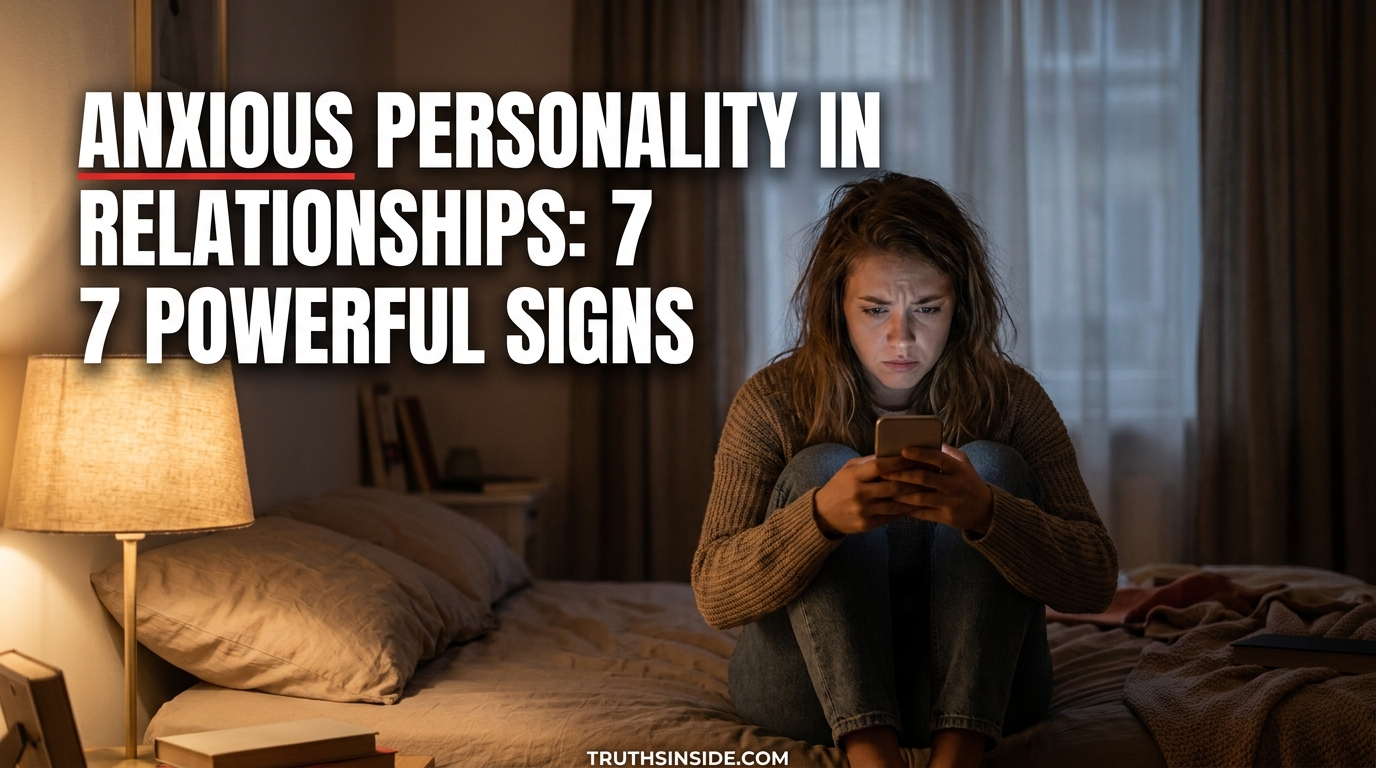
Anxious Personality in Relationships: 7 Powerful Signs
This is where theory meets real life. Here are seven of the most significant ways an anxious personality shows up in romantic relationships — described not as clinical symptoms, but as lived human experiences.
1. You Constantly Seek Reassurance — And It Never Feels Like Enough
One of the most exhausting hallmarks of an anxious personality in relationships is the relentless need for reassurance. You ask your partner if they still love you. You need to hear that everything is okay. You look for evidence in their behavior — their tone of voice, their response time, their facial expression — that the relationship is secure.
And here is the painful paradox: even when reassurance is given, it only soothes the anxiety for a short time before the doubt creeps back in. This is because the reassurance is treating the symptom, not the source. The anxiety lives inside you, not inside the relationship. No amount of external validation can permanently fill an internal wound.
This cycle can be incredibly draining for both partners. The anxious person feels needy and ashamed. The other partner feels pressure and eventually exhaustion. Understanding this pattern is the beginning of breaking it.
2. You Interpret Neutral Behavior as Rejection
A partner takes a few extra hours to respond to a message. They seem quieter than usual over dinner. They cancel plans because they are genuinely tired. To most people, these are unremarkable, everyday occurrences.
To someone with an anxious personality, each of these moments can feel like the beginning of the end. The mind immediately races to worst-case interpretations: They are pulling away. They are losing interest. I did something wrong. This is called negative attribution bias — the tendency to assign negative meaning to neutral or ambiguous information.
Research published in the Journal of Personality and Social Psychology found that people with anxious attachment styles consistently misread neutral partner behavior as threatening, even when no threat exists. This misreading creates conflict and emotional pain that is entirely disconnected from reality — but feels absolutely real to the person experiencing it.

3. You Fear Abandonment Even in Stable Relationships
This is perhaps the deepest and most painful feature of an anxious personality in love. Even when a relationship is objectively stable — even when a partner is kind, consistent, and committed — the fear of abandonment never fully goes away.
It whispers in quiet moments. It wakes you up at 3am. It makes you cling a little too tightly, push a little too hard for commitment, or paradoxically push people away as a self-protective measure before they can leave first.
Fear of abandonment is almost always rooted in early experiences of loss, inconsistency, or emotional unavailability. It is the nervous system replaying an old story in a new relationship. The tragedy is that this fear, left unaddressed, can actually create the very outcome it is trying to prevent — by overwhelming partners and driving them away.
4. You Overanalyze Every Interaction
The anxious mind is a meaning-making machine that never clocks out. A partner says “fine” instead of “great” when you ask how they are doing. They do not use an emoji at the end of a text they would normally use one in. They did not bring up your upcoming plans the way they usually would.
Most people would not register any of these details. An anxious person will notice all of them — and spend considerable mental energy trying to decode what they mean. This hypervigilance is exhausting to live with and makes it extremely difficult to be present and relaxed in a relationship.
The cruel irony is that all of this mental energy being spent on detecting potential problems actually prevents the anxious person from experiencing the genuine joy and safety that their relationship may be offering them right now.
5. You Struggle With Conflict — Even Healthy Conflict
For people with an anxious personality, conflict in a relationship does not feel like a normal part of two humans navigating differences. It feels like a crisis. It feels like evidence that the relationship is broken or doomed.
This can manifest in two opposite directions. Some anxious people become conflict-avoidant — suppressing their own needs and feelings to keep the peace, terrified that expressing displeasure will drive their partner away. Others become conflict-escalating — their anxiety spikes during disagreements and they say or do things they later regret because the emotional intensity overwhelms their ability to regulate.
Either pattern damages the relationship over time. Healthy conflict — where both partners feel safe enough to express needs, disagree, and repair — is actually one of the strongest predictors of relationship longevity. Learning to tolerate conflict without catastrophizing it is one of the most important skills an anxious person can develop.
“Anxiety in love is not weakness. It is an old survival strategy meeting a new relationship — and it takes courage, not perfection, to rewire it.”
6. You Put Your Partner’s Needs Consistently Above Your Own
Anxious individuals are often deeply empathetic, caring, and attentive partners. But there is a shadow side to this that does not get discussed enough: the tendency to completely abandon your own needs in the service of keeping a partner happy and present.
This self-erasure is not genuine selflessness. It is anxiety wearing the costume of generosity. The underlying motivation is not “I want to give” — it is “I am afraid of what happens if I do not.” Over time, this pattern builds resentment, erodes self-worth, and creates a deeply unbalanced relationship dynamic.
Healthy love requires two whole people showing up. When one person consistently disappears into the other, the relationship loses the very thing that made it interesting and alive in the first place.
7. You Attach Deeply and Quickly — Sometimes Too Quickly
Anxious individuals often fall hard and fast. The early stages of a relationship feel intoxicating — finally, the anxiety quiets, because someone is there, someone chose you, someone is close. This can lead to very rapid emotional attachment that far outpaces where the relationship actually is in its development.
This intensity can be beautiful. It can also be dangerous. Attaching too deeply too quickly makes you vulnerable to being deeply hurt by people who were never ready for the level of connection you were offering. It can also put pressure on new relationships that simply need time to develop organically.
Why Anxiety and Love Collide So Powerfully
There is a reason anxiety hits hardest in romantic relationships specifically. Intimate partnership is the arena of life where we are most vulnerable, most exposed, and most dependent on another person’s emotional response to us.
Evolutionary psychology tells us that human beings are wired for pair bonding. Separation from a primary attachment figure triggers the same neurological alarm systems as physical danger. For someone with an anxious personality whose alarm system is already calibrated to be more sensitive than average, love becomes a landscape of constant low-level threat assessment.
This is not drama. This is not immaturity. This is neuroscience. And it means that healing an anxious personality in the context of love requires working with the nervous system — not just the mind.
How to Begin Healing an Anxious Personality in Relationships
Understanding the pattern is powerful. But the real work is in changing it — and that change is absolutely possible. Here is where to begin.
Develop a self-soothing practice that does not rely on your partner.
When anxiety spikes in a relationship, the instinct is to immediately reach for your partner for reassurance. Instead, build a toolkit of internal regulation strategies — deep breathing, journaling, physical movement, calling a trusted friend. This reduces the burden on the relationship and builds genuine self-trust.
Learn to name anxiety as anxiety — not as reality.
When your mind insists that your partner is pulling away, practice saying to yourself: “My anxiety is telling me a story right now. I do not have to believe it without evidence.” This cognitive defusion technique, drawn from Acceptance and Commitment Therapy, creates space between the anxious thought and the behavioral response.
Communicate your anxiety to your partner openly and without shame.
One of the most powerful things an anxious person can do in a relationship is say: “I have an anxious personality and sometimes I need a little extra reassurance. I am working on not relying on you for all of it, but I wanted you to understand this part of me.” This kind of vulnerability builds intimacy and gives your partner context for your behavior that prevents misunderstanding.
Seek therapy — specifically with someone trained in attachment and anxiety.
Cognitive Behavioral Therapy and Emotionally Focused Therapy have both demonstrated strong evidence for helping people with anxious personalities build more secure relationship patterns. This is not a last resort. It is an investment in every relationship you will ever have.
“The goal is not to stop being sensitive. The goal is to stop letting fear write the ending of a love story that has not finished yet.”

You Are Not Too Much. You Are Wired Differently.
Here is what nobody says loudly enough to people with anxious personalities: you are not a burden. You are not broken. You are not too needy, too sensitive, or too emotional for love.
You are a person whose nervous system learned to love in the only way it knew how — by staying vigilant, by working hard, by holding on tight. That strategy made sense once. It kept you safe in an environment where love was unpredictable.
But you are not in that environment anymore. And with the right tools, the right support, and the right partner who understands the depth of what you bring — love does not have to feel like terror. It can feel like home.
Quick Recap: Anxious Personality and Relationships
- An anxious personality is rooted in early attachment experiences and nervous system wiring
- It shows up in relationships as reassurance-seeking, fear of abandonment, overanalyzing, and conflict sensitivity
- The anxiety is internal — no partner can permanently fix it with reassurance alone
- Healing is possible through self-regulation, open communication, and professional support
- You are not too much — you are wired differently, and that can change
CTA Section
💾 Save this article to come back to whenever anxiety starts pulling you into that familiar spiral.
📤 Share it with someone you know who loves deeply but lives in quiet fear — they need to read this today.
➕ Follow Truthsinside.com for more honest, psychology-backed content about love, relationships, and the human mind.
📃 Related article: 15 Subtle Red Flags in a New Relationship Most People Miss
FAQ: Anxious Personality and Relationships
Q1: Is an anxious personality the same as anxious attachment style?
They are closely related but not identical. Anxious attachment style is a specific relational pattern identified in attachment theory that describes how someone seeks closeness and responds to perceived distance from a partner. An anxious personality is broader — it describes a general pattern of heightened worry and emotional sensitivity across many areas of life. Most people with an anxious attachment style do have an anxious personality, but the reverse is not always true.
Q2: Can someone with an anxious personality have a healthy relationship?
Absolutely — and this is important to say clearly. Having an anxious personality does not disqualify you from healthy, loving, lasting relationships. What it does mean is that self-awareness and active effort are required. With the right tools, honest communication, and often professional support, people with anxious personalities build extraordinarily deep and meaningful relationships. The sensitivity that fuels anxiety is also the same sensitivity that fuels profound empathy and love.
Q3: What kind of partner is best for someone with an anxious personality?
Research on attachment styles suggests that a securely attached partner — someone who is emotionally consistent, communicates clearly, and does not use withdrawal as a relationship strategy — tends to be the most stabilizing match for an anxious person. A securely attached partner does not fix the anxiety, but their consistency provides a safe environment in which the anxious person can slowly build more secure patterns of relating.
Q4: How do I stop seeking constant reassurance from my partner?
Start by recognizing the moment the urge to seek reassurance arises and pausing before acting on it. Ask yourself: Is there actual evidence that something is wrong, or is this my anxiety speaking? Practice self-soothing for 15 to 20 minutes before reaching out. Over time, this builds the internal capacity to tolerate uncertainty — which is the true antidote to reassurance-seeking. Therapy, particularly CBT, can accelerate this process significantly.
Q5: Can anxiety actually destroy a relationship?
Unaddressed and unmanaged anxiety can absolutely create serious strain in a relationship over time. The reassurance-seeking cycle, the overanalyzing, the fear-based behaviors — these can exhaust even the most patient and loving partner. However, it is important to note that anxiety itself is not the destroyer. The destroyer is the absence of awareness and the unwillingness to address it. Anxiety that is named, understood, and actively worked on becomes a shared challenge rather than a silent relationship killer.
🎵 Music
Maren Lull is a singer-songwriter who writes from the places most people don’t talk about out loud.
Not the dramatic grief. Not the obvious heartbreak. The quiet kind — the ordinary Tuesday emptiness, the habit of reaching for someone who isn’t there anymore, the particular exhaustion of being strong for so long that the strength itself wears thin.
Her music lives at the intersection of emotional honesty and soft beauty — breathy vocals over gentle piano, slow tempos, lyrics that feel less like songs and more like something you wrote in a private notebook at two in the morning and never showed anyone.
Maren Lull writes for the people who feel everything deeply and say very little about it. For the ones who listen to sad music not because they want to feel worse — but because being understood, even by a song, makes the feeling easier to carry.
📱 Follow Maren Lull:
→ Spotify
→ Apple Music
→ Youtube
→ Audiomack