Red Flags Your Partner Is Emotionally Immature
Living with an emotionally immature partner can feel like being the only adult in a relationship built for two. You explain the same feelings again and again, you tiptoe around their moods, and you apologize for things that were never your fault. Somewhere along the way you start to wonder whether you are asking for too much. You are not. You are asking for basic emotional maturity, and it is a fair thing to need.
Psychology gives us a clear way to see what is happening. John Gottman’s decades of research found that contempt, defensiveness, criticism, and stonewalling are among the strongest predictors of relationship breakdown. These behaviors tend to cluster in people who never learned to handle big emotions. Psychotherapist Lindsay Gibson describes emotionally immature people as reactive, self-focused, and uncomfortable with real emotional closeness.
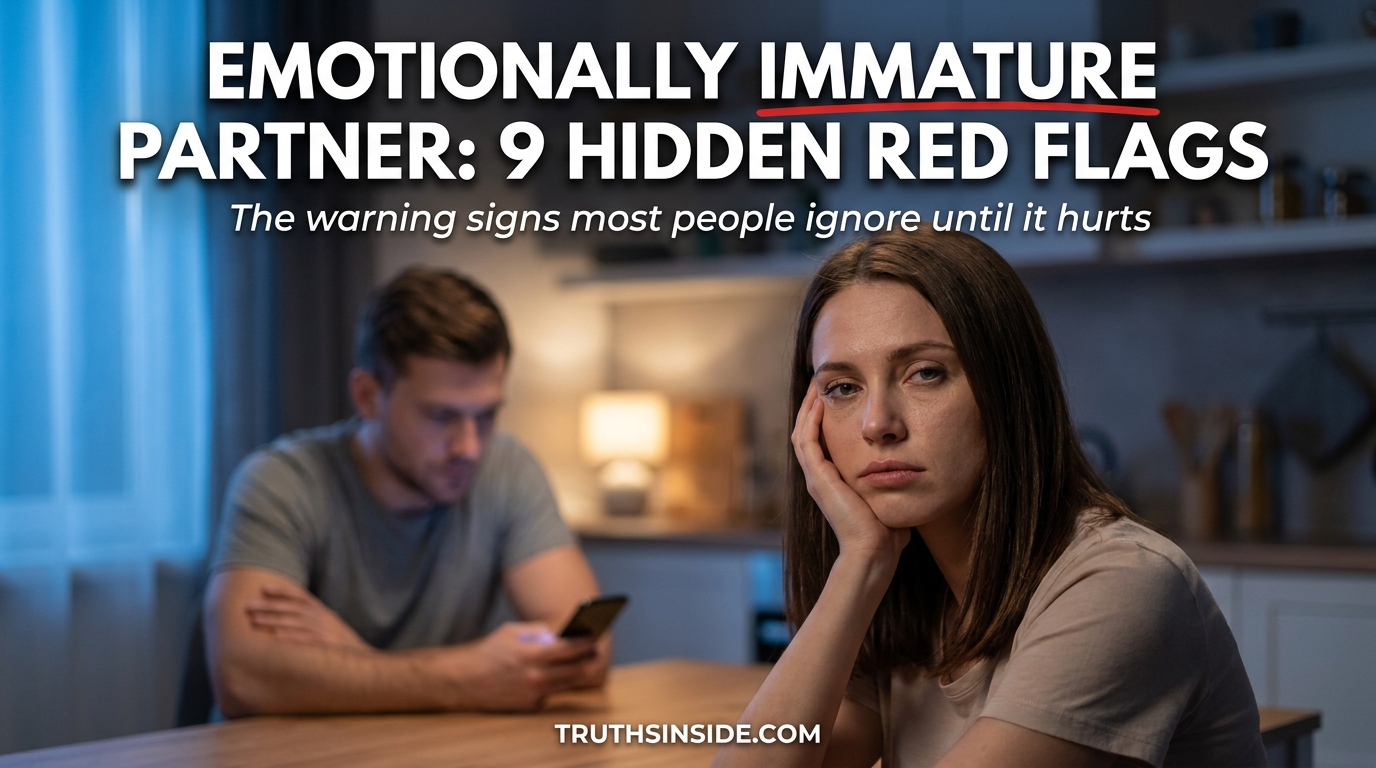
In this guide, you will learn nine hidden red flags, why they appear, and how to tell a bad day from a lasting pattern. You will also find practical steps for responding and honest guidance on when to walk away. Clarity is the first form of self-protection, so let us begin.

What Does Emotionally Immature Really Mean?
Emotional maturity is the ability to notice your feelings, manage them without harming others, and take responsibility for your behavior. It has nothing to do with age, intelligence, or success. A partner can be thirty-five, charming, and financially stable and still handle conflict like a frustrated teenager.
An emotionally immature partner usually struggles in four areas: regulating emotions, taking accountability, showing empathy, and tolerating discomfort. When something goes wrong, they blame, shut down, or explode instead of reflecting. The pattern is not always cruel or dramatic. Often it is quiet, confusing, and easy to excuse, which is exactly why it lasts so long.
Immaturity Is Not the Same as a Bad Day
Everyone reacts badly sometimes. Stress, grief, and exhaustion can make even kind people snappy. The difference lies in repetition and repair. A mature person who loses their temper eventually returns, apologizes, and changes something. An emotionally immature partner repeats the same behavior and treats your hurt as the real problem.
Ask yourself: does this happen once in a while, or almost every time we face conflict? Does my partner come back to repair, or do I always have to? Patterns matter more than moments, so look at the whole picture across months rather than a single ugly night.
How an Emotionally Immature Partner Affects You Over Time
The impact rarely arrives all at once. It builds through small moments: a comment you swallow, a topic you avoid, an apology you give just to end the tension. Slowly, your world shrinks around another person’s comfort, and you may notice yourself becoming quieter, more anxious, and less certain of your own judgment.
Many people describe feeling lonely inside the relationship. You are physically together, but emotionally you are managing everything alone. Living with an emotionally immature partner can also affect sleep, confidence, and friendships, because so much mental energy goes into predicting reactions and preventing conflict.
Recognizing this toll is not about blaming yourself for staying. It is about understanding why you feel so tired. Exhaustion is information, and it deserves to be taken seriously.
📃 Related article: Difficult Family: 7 Proven Ways to Keep the Peace
The 9 Red Flags of an Emotionally Immature Partner
1. They Cannot Take Accountability
Watch what happens when you raise a concern. An emotionally immature partner often deflects with “You’re overreacting,” “I was only joking,” or “Well, you did this too.” The conversation flips until you are defending yourself and the original issue disappears.
Accountability is the foundation of trust, so its absence shakes everything else. Real accountability sounds different. It sounds like “I see how that hurt you, and I am sorry.” If your partner rarely says this without pressure, or apologizes only to end the argument, you are seeing a core sign of emotional immaturity. Without ownership, nothing can change.
2. They Use Silence as Punishment
Going quiet to cool down is healthy when it is announced and temporary. Using silence to punish is different. The silent treatment leaves you anxious, guessing, and desperate to fix things just to restore peace.
Gottman called this behavior stonewalling and found it damages trust because it shuts down connection when it is needed most. If your partner disappears for days after disagreements, refuses to explain, or returns as if nothing happened, they are avoiding discomfort at your expense.
3. Small Problems Trigger Big Reactions
A late reservation becomes a screaming match. A mild comment leads to sulking for hours. Emotionally immature people often lack the internal tools to calm themselves, so minor stress feels like a crisis. The reaction is out of proportion, and everyone around them pays for it.
You may find yourself walking on eggshells, editing your words, and avoiding topics to prevent an outburst. That constant vigilance is not normal partnership. It is a sign that one person is managing the other person’s emotions.
Researcher James Gross, who studies emotion regulation, describes how people differ in their ability to calm and reframe strong feelings. Skills like pausing, reappraising, and self-soothing can be learned, but they must be practiced. Someone who has never practiced them will tend to hand their storms to the nearest person.
4. Everything Becomes About Them
You share a stressful day at work, and within minutes the topic has shifted to their day. You mention feeling sad, and they respond with a long story about how they feel. Empathy requires setting your own needs aside briefly to understand someone else’s, and an emotionally immature partner finds that hard.
Over time, you may realize you have become a listener who is rarely heard. Occasional self-focus is human. A consistent inability to hold space for your feelings is a serious red flag.
“Love is not measured by how well someone speaks when they are happy, but by how they listen when you are hurting.”
5. They Dismiss or Mock Your Feelings
Statements like “You’re too sensitive,” “It’s not a big deal,” or “You always make things dramatic” teach you to distrust your own emotions. Sometimes this is deliberate, and sometimes it is a defense because your feelings make them uncomfortable. Either way, the effect is the same: you learn to stay quiet.
Mockery is even more corrosive. Sarcasm, eye rolls, and teasing about your vulnerabilities are forms of contempt, which Gottman identified as one of the most damaging behaviors in a relationship. A partner who respects you does not make you smaller to feel bigger.
6. They Avoid Serious Conversations
Every relationship needs conversations about money, boundaries, the future, and unmet needs. An emotionally immature partner often dodges them with jokes, changes of subject, or sudden exhaustion. When cornered, they may say, “Why are you making this so serious?”
The avoidance leaves problems unresolved, and unresolved problems grow. You may end up feeling as though you are in a relationship with someone who is unavailable for anything deeper than surface level. Intimacy needs honesty, and honesty needs courage.
7. They Expect You to Manage Their Moods
If you find yourself constantly soothing, cheering up, or working around your partner’s feelings, pay attention. An emotionally immature partner may treat you as their emotional regulator, expecting you to prevent bad moods and fix them quickly when they arrive.
This dynamic can feel like caretaking, and caretaking can feel like love. But love is mutual. Healthy partners support each other while managing their own emotions. If you are the only one doing the emotional labor, you are not in a partnership. You are in a caregiving role.

8. They Struggle With Boundaries and Hearing “No”
A mature partner respects your no, even when they are disappointed. An emotionally immature partner may sulk, guilt-trip, pressure, or punish you for setting limits. You may hear, “If you really loved me, you would.” Your boundaries become negotiations.
Watch for jealousy that grows into control, anger when you spend time with friends, or guilt when you need space. Respect for boundaries is one of the clearest tests of emotional maturity, because it requires accepting that you are a separate person with your own needs.
9. They Repeat Patterns and Never Repair
Perhaps the most important red flag is the absence of change. Your partner may apologize dramatically, then repeat the behavior weeks later. The cycle of blow-up, promise, and repeat wears you down and erodes hope.
Real growth shows up as different behavior over time, not just sweet words. If your emotionally immature partner regularly promises to change but does not build new habits, seek help, or even acknowledge the pattern, the words are working as a bandage rather than a solution.
📃 Related article: Silent Treatment Red Flags: 8 Signs It’s Abuse
Emotionally Mature vs. Emotionally Immature: Side by Side
Comparing behaviors can make the difference clearer. When there is a disagreement, a mature partner asks, “What is going on for you?” while an emotionally immature partner asks, “Why are you attacking me?” When they make a mistake, one says, “That was on me,” and the other says, “You made me do it.”
Under stress, mature people take a break and return. Immature people withdraw, punish, or escalate. When you share a need, mature partners listen and negotiate, while immature partners feel criticized and counterattack. When you succeed, mature partners celebrate with you, and immature partners may sulk or compete.
No one is perfect, and even healthy partners slip. The key question is direction: over time, does your partner move toward understanding, or away from it?
A Quick Self-Check
Ask yourself a few honest questions. Do I edit what I say to avoid a reaction? Do I apologize even when I did nothing wrong? Do I feel relief when my partner is out of the house? Do I dread bringing up needs?
If you answered yes to several, that is not a reason for shame. It is a reason for support, whether from trusted friends, a therapist, or both. Outside perspectives can help you see what is easy to miss when you are inside the pattern.
Why Some People Never Learn Emotional Maturity
Emotional maturity is learned, and many people never had good teachers. Children raised in homes where feelings were ignored, punished, or turned into drama may grow up without healthy tools. They learn to suppress, explode, or avoid, and these strategies follow them into adult love.
None of this excuses harmful behavior. But understanding the origins can help you respond with clarity instead of self-blame. Their pattern is about their history and skills, not about your worth. You did not cause it, and you cannot love it away.
How to Respond to an Emotionally Immature Partner
Start by naming what you see, calmly and specifically. Instead of “You’re so immature,” try “When I bring up a concern and you go quiet for days, I feel shut out. I need us to talk about it within a day.” Specific, behavior-based requests are harder to dismiss.
Next, set clear boundaries and follow through. If shouting ends the conversation, you might say, “I want to work this out, but I will pause until we can both speak calmly.” Then actually pause. Consequences matter more than speeches.
Remember that responding well to an emotionally immature partner does not mean tolerating everything. It means staying clear, calm, and consistent. Notice how your partner responds. Do they listen, reflect, and try something different? Or do they escalate, blame, and punish? Their response tells you far more than any promise. Growth is possible when someone is willing, curious, and consistent.
Can an Emotionally Immature Partner Change?
Yes, but only if they want to. Change requires self-awareness, humility, and often professional support. Therapy, especially approaches such as cognitive behavioral therapy or emotion-focused therapy, can help people build regulation and empathy skills.
You cannot force this process, and you cannot do their work for them. What you can do is offer clarity, encouragement, and a timeline you can live with. If months pass with honest effort, there may be hope. If months pass with excuses, you have your answer.
Look for concrete evidence of effort: booking a therapy appointment, reading about emotional skills, apologizing without excuses, or pausing during conflict instead of exploding. Small, repeated changes matter far more than one grand gesture. Also notice whether your partner respects your pace and boundaries while they work on themselves, or expects instant forgiveness for past hurt.

When It Is Time to Walk Away
Sometimes the healthiest decision is to leave. Consider it seriously if the behavior includes contempt, ongoing humiliation, control, threats, or repeated refusal to change. Also consider it if you have lost your sense of self, your confidence, or your peace.
If you ever feel unsafe, reach out to a trusted friend, a licensed professional, or a local support service right away. Leaving does not make you cruel or impatient. It makes you someone who has decided that love should not require constant self-abandonment.
Frequently Asked Questions
What is the biggest sign of an emotionally immature partner?
The most telling sign is a consistent lack of accountability. When your partner cannot admit fault, apologize sincerely, or change behavior, every other problem stays unsolved.
Is emotional immaturity the same as narcissism?
No. Emotional immaturity is a broad pattern of limited emotional skills. Narcissism is a specific personality pattern, and only a qualified professional can diagnose it. Some behaviors overlap, but many emotionally immature people are not narcissistic.
Can I fix my partner’s emotional immaturity?
No. You can communicate needs and support their growth, but the work belongs to them. Trying to fix someone often leads to burnout and resentment.
How do I know if it is a phase or a pattern?
Look at frequency and repair. A phase usually follows stress and fades with honest effort. A pattern repeats across situations and months, with little real repair.
Should I stay if my partner refuses to change?
Only you can decide, but staying long-term with someone who will not grow often costs your confidence and wellbeing. A licensed therapist can help you weigh your options.
Rebuilding Your Confidence
If you have spent a long time with an emotionally immature partner, your self-trust may be shaky. Start rebuilding it with small steps. Journal what actually happened after difficult conversations, so your memory is not rewritten by blame. Keep up friendships and activities that remind you who you are.
Speak to people who can reflect reality back to you, whether a therapist, a close friend, or a support group. Healing also means relearning that your needs are valid, your feelings are reasonable, and asking for respect is not selfish. That belief is worth protecting, whatever you decide about the relationship.
Final Thoughts
Recognizing an emotionally immature partner is not about labeling someone a villain. It is about honoring your needs for respect, honesty, and emotional safety. Love asks for effort from both people, and you deserve a partner who meets you there.
Healthy love feels steady, not confusing. You should be able to speak honestly, disagree safely, and repair together without fear. Trust your observations, notice the patterns, and act with clarity. Whether that means having a hard conversation, setting a boundary, or leaving, the first step is seeing the truth. You are not too sensitive. You are simply ready for real partnership.
Save this article so you can revisit the red flags whenever doubt creeps in. Share it with someone who needs to know it is not their fault. Follow Truthsinside.com for more honest, research-backed relationship insights every day.
🎵 Music
Maren Lull is a singer-songwriter who writes from the places most people don’t talk about out loud.
Not the dramatic grief. Not the obvious heartbreak. The quiet kind — the ordinary Tuesday emptiness, the habit of reaching for someone who isn’t there anymore, the particular exhaustion of being strong for so long that the strength itself wears thin.
Her music lives at the intersection of emotional honesty and soft beauty — breathy vocals over gentle piano, slow tempos, lyrics that feel less like songs and more like something you wrote in a private notebook at two in the morning and never showed anyone.
Maren Lull writes for the people who feel everything deeply and say very little about it. For the ones who listen to sad music not because they want to feel worse — but because being understood, even by a song, makes the feeling easier to carry.
📱 Follow Maren Lull:
→ Spotify
→ Apple Music
→ Youtube
→ Audiomack