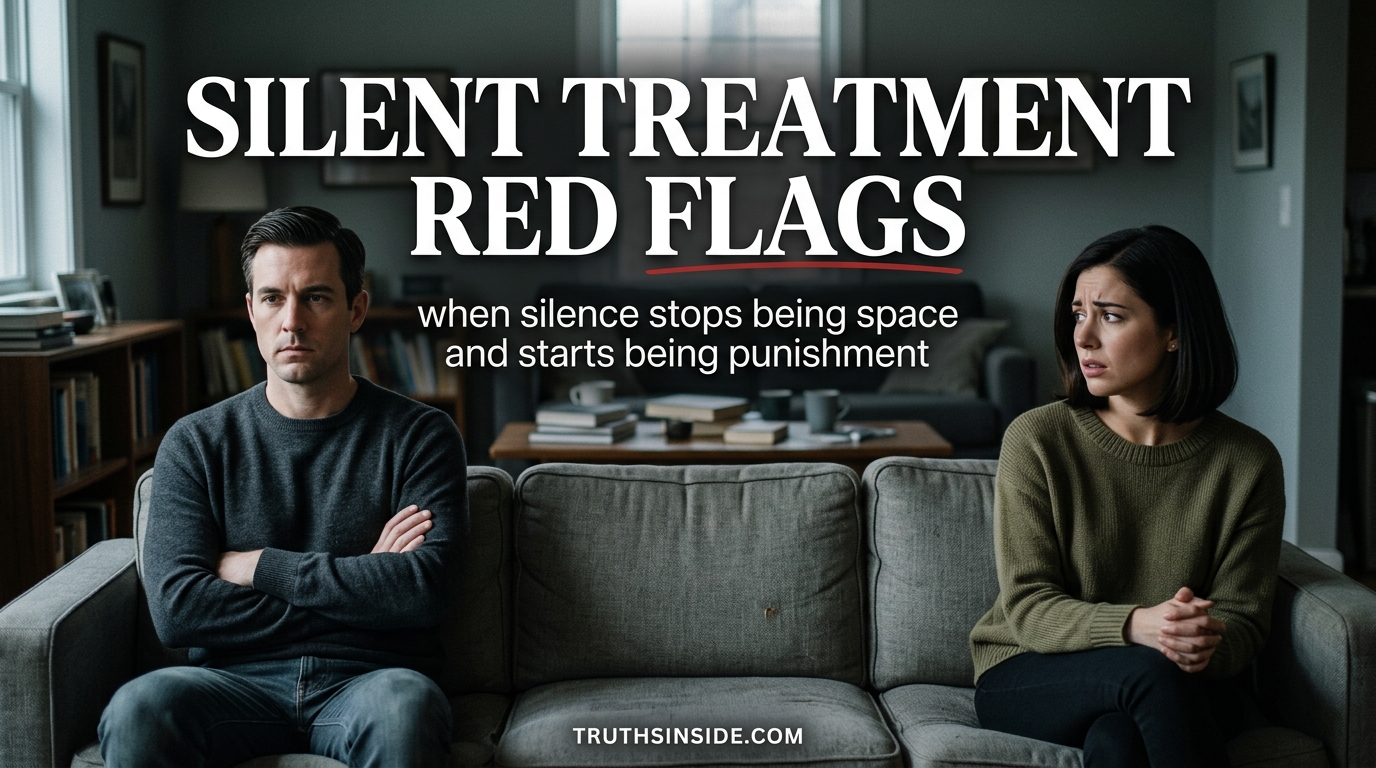
Silent Treatment Red Flags: When Silence Is Used as Punishment
Dr. John Gottman’s research identified “stonewalling” — a partner shutting down and withdrawing from communication entirely — as one of the strongest predictors of relationship failure, alongside contempt and criticism. Not every quiet moment in a relationship is dangerous, but learning to recognize genuine silent treatment red flags is essential, since silence used deliberately as punishment operates very differently from a partner who simply needs space to calm down.
The confusion between healthy space and manipulative silence is exactly what makes this dynamic so damaging. A partner using silence as a weapon often frames it as “just needing time,” making the silent treatment red flags easy to miss or excuse, especially for someone who deeply values keeping the peace. Left unaddressed, this pattern can quietly erode a relationship’s emotional safety over months or years.
This article breaks down what distinguishes healthy emotional space from weaponized silence, the clearest silent treatment red flags to watch for, and what psychology says about why this tactic is so effective — and so harmful.
What Counts as the Silent Treatment, Exactly?
The silent treatment refers to the deliberate withdrawal of communication as a way to express displeasure, exert control, or punish a partner, rather than to genuinely self-regulate during conflict. It differs meaningfully from a healthy pause, where someone steps back briefly to manage strong emotions before continuing a conversation constructively.
Recognizing genuine silent treatment red flags requires paying attention to intent and duration rather than the silence itself. A short pause to cool down is a normal, even healthy, regulation strategy. Silence stretched across days, paired with a clear intent to punish or control, is a fundamentally different — and far more concerning — pattern.
📃 Related article: Secret Life Red Flags: 6 Signs You’re Being Deceived
Red Flag 1: The Silence Has No Clear End Point
One of the most telling silent treatment red flags is silence that continues indefinitely, with no communicated timeline or willingness to reconnect. Healthy space-taking usually comes with some acknowledgment — “I need an hour” or “let’s talk about this tomorrow.” Punishing silence, by contrast, often stretches for days without explanation, leaving the other partner in uncertain limbo.
Research on stonewalling identifies this open-ended quality as a key marker of its harmful version, since indefinite silence functions less like self-regulation and more like a slow-building form of pressure meant to force resolution entirely on one partner’s terms.
“A pause has a purpose. Punishment just waits you out.” — a common distinction made in couples therapy literature on stonewalling
Red Flag 2: It’s Used to Control the Outcome of a Disagreement
When silence consistently appears right after a disagreement doesn’t go a partner’s way, it’s one of the clearer silent treatment red flags pointing toward control rather than genuine emotional overwhelm. The pattern often trains the other partner to avoid raising certain topics altogether, simply to escape the looming threat of being shut out.
Psychologists studying coercive control note that this kind of conditional withdrawal — where connection is only restored once the other partner concedes or apologizes — functions as a powerful behavioral tool, even when never explicitly stated as a demand.
Red Flag 3: Basic Communication Stops Entirely
A significant escalation among silent treatment red flags occurs when even necessary, logistical communication stops — no responses about shared plans, finances, or parenting responsibilities. This goes beyond emotional distance into functional disruption of daily life, using silence to affect practical matters far beyond the original disagreement.

This particular escalation often marks a meaningful shift in severity. Withholding emotional conversation is one thing; withholding basic coordination needed to function as a household is a more deliberate and controlling use of silence as leverage.
Red Flag 4: Physical Withdrawal Accompanies the Silence
Beyond simply not speaking, some of the more intense silent treatment red flags include physical avoidance — leaving the room the moment the other partner enters, sleeping separately without discussion, or refusing eye contact entirely. This combination of verbal and physical withdrawal intensifies the isolating effect significantly.
Attachment research suggests this combined withdrawal can trigger genuine physiological distress in the excluded partner, since humans are wired to interpret social exclusion, even from a partner in the same house, as a real threat to security and belonging.
Red Flag 5: It Happens Repeatedly, Not Occasionally
A single instance of prolonged silence after a serious conflict might reflect a partner genuinely struggling to process difficult emotions. A repeated pattern, however, is one of the more reliable silent treatment red flags distinguishing an isolated coping struggle from an established relational tactic.

Frequency matters because it reveals whether silence is a rare, honest struggle or a default response to any disagreement. A partner who reaches for silence as punishment every time conflict arises is demonstrating a consistent pattern, not an occasional lapse in coping skills.
Red Flag 6: It’s Paired With Denial When Confronted
When directly asked “are you giving me the silent treatment?” and met with dismissive denial — “I’m not doing anything, you’re imagining things” — despite clear ongoing withdrawal, this gaslighting response is among the more damaging silent treatment red flags. It adds confusion and self-doubt on top of the original isolation.
This denial pattern often leaves the excluded partner questioning their own perception of what’s happening, which research on manipulative relationship dynamics identifies as a significant compounding harm beyond the silence itself.
Red Flag 7: Reconnection Requires an Apology, Not a Conversation
A particularly controlling variation among silent treatment red flags is silence that only ends once the excluded partner apologizes — regardless of whether they did anything requiring an apology. This effectively weaponizes reconciliation itself, making resolution contingent on submission rather than mutual understanding.

Healthy conflict resolution typically involves both partners understanding what happened and working toward mutual repair. Silence used this way replaces that process entirely with a simple, unequal demand: apologize, or remain excluded indefinitely.
Red Flag 8: Children or Others Are Drawn Into the Silence
Among the more serious silent treatment red flags is when the withdrawal extends to involving children, family members, or friends — either by speaking through them instead of directly, or by visibly changing behavior toward them as an extension of the punishment. This spreads the emotional impact well beyond the couple itself.
Family systems research consistently warns that children exposed to prolonged parental silent treatment often internalize significant anxiety, even when the conflict itself isn’t directly about them, since they frequently sense the tension without understanding its cause.
📃 Related article: Guilt-Tripping: 8 Toxic Signs of Manipulation
Why the Silent Treatment Feels So Effective — and So Damaging
Silence exploits a deep, evolutionarily rooted fear of social exclusion. Neuroscience research on ostracism shows that being ignored activates similar brain regions to physical pain, which explains why silent treatment red flags can feel so acutely distressing even when no words are exchanged at all.
This effectiveness is precisely what makes the tactic so tempting for a partner inclined to use control rather than direct communication. It requires no confrontation, leaves no explicit statement to be held accountable for, and reliably produces distress and compliance in the excluded partner — a combination that makes it particularly resistant to being named or challenged.
How to Respond to Silent Treatment Red Flags
Responding effectively starts with naming the pattern directly and calmly: “I notice you go quiet for days after we disagree, and I need us to find a healthier way to work through conflict.” This shifts the conversation from confusion to clarity, without necessarily escalating into further conflict.
Setting a clear boundary around acceptable communication — such as agreeing that even a cooling-off period includes some acknowledgment rather than total disappearance — can help distinguish healthy space from the punishing version. If the pattern continues despite direct conversation, couples counseling or individual therapy can help address the underlying dynamic more thoroughly.
Frequently Asked Questions
Is all silence in a relationship a red flag?
No. Brief, communicated pauses to self-regulate during conflict are healthy and normal. The concern arises when silence is prolonged, unexplained, and used specifically to control or punish a partner.
How long is too long for the silent treatment?
There’s no universal cutoff, but silence stretching beyond a day or two with no communication or willingness to reconnect is generally considered a significant warning sign.
Can someone unintentionally use the silent treatment without realizing it?
Yes, particularly people who never learned healthier conflict skills. Intent matters, but the impact on the other partner is real regardless, and addressing the pattern is important either way.
Is the silent treatment considered a form of emotional abuse?
When used repeatedly and deliberately to control or punish a partner, many psychologists classify it as a form of emotional abuse, particularly when combined with denial or escalating isolation.
What should someone do if their partner refuses to acknowledge this pattern?
If direct, calm conversation doesn’t lead to change, seeking guidance from a licensed couples or individual therapist can help address the dynamic and determine appropriate next steps.
If this helped you recognize a pattern in your own relationship, don’t stay silent about it yourself. Save this article to revisit when the pattern resurfaces. Share it with someone who might be experiencing this right now. And Follow Truthsinside.com for more research-backed insight into the relationship patterns that matter most.
🎵 Music
Maren Lull is a singer-songwriter who writes from the places most people don’t talk about out loud.
Not the dramatic grief. Not the obvious heartbreak. The quiet kind — the ordinary Tuesday emptiness, the habit of reaching for someone who isn’t there anymore, the particular exhaustion of being strong for so long that the strength itself wears thin.
Her music lives at the intersection of emotional honesty and soft beauty — breathy vocals over gentle piano, slow tempos, lyrics that feel less like songs and more like something you wrote in a private notebook at two in the morning and never showed anyone.
Maren Lull writes for the people who feel everything deeply and say very little about it. For the ones who listen to sad music not because they want to feel worse — but because being understood, even by a song, makes the feeling easier to carry.
📱 Follow Maren Lull:
→ Spotify
→ Apple Music
→ Youtube
→ Audiomack