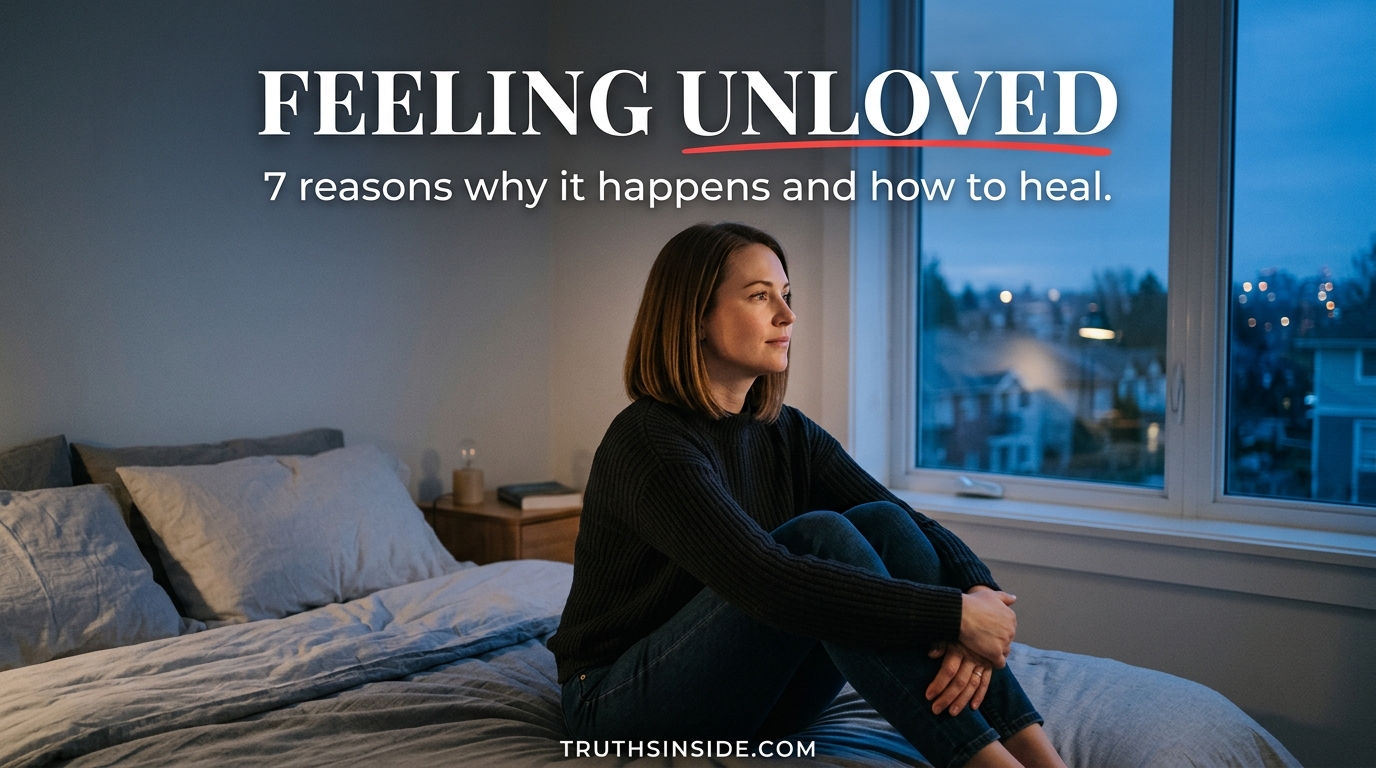
Feeling Unloved: What It Means and What to Do
Nearly a third of adults in committed relationships report feeling emotionally disconnected from their partner at some point, according to survey research on relationship satisfaction cited by the American Psychological Association. Feeling unloved doesn’t always mean a relationship lacks love — it often means a genuine emotional need isn’t being met or communicated clearly, even between two people who care deeply about each other.
This distinction matters more than it might seem. Feeling unloved can occur in relationships with real affection and commitment, in friendships, within families, and even in moments of solitude unrelated to any specific relationship at all. Understanding the psychology behind this feeling is the first step toward addressing it constructively, rather than assuming it always signals the end of a relationship.
This article explores what it actually means to feel unloved, the common psychological roots behind it, and practical, research-backed steps for addressing it — whether the disconnect lives within a relationship or within yourself.
What Does Feeling Unloved Actually Mean?
Feeling unloved describes a persistent sense of being emotionally unseen, unappreciated, or disconnected from meaningful affection, regardless of whether love is objectively present in a relationship. It’s a subjective emotional state, not necessarily an accurate measure of how much someone is actually loved.
Psychologists distinguish this from genuine abandonment or absence of love, noting that feeling unloved often stems from a mismatch between how love is expressed and how it’s received, rather than a true lack of care. Dr. Gary Chapman’s widely referenced framework on love languages illustrates this well — a partner may express deep affection through acts of service while the other partner primarily needs verbal affirmation, leaving both people confused about why connection still feels missing.
“You can be deeply loved and still feel unloved if the love isn’t landing in a language you recognize.” — a concept central to research on love languages and emotional communication
Why Feeling Unloved Happens Even in Healthy Relationships
It’s a common misconception that feeling unloved only occurs in troubled or failing relationships. In reality, even stable, committed partnerships can produce this feeling when communication styles differ, life stress reduces emotional bandwidth, or routines quietly replace intentional connection over time.
Attachment research suggests that people with anxious attachment styles may be more prone to feeling unloved even when a partner is genuinely affectionate, since anxious attachment often comes with heightened sensitivity to perceived emotional distance. This doesn’t mean the feeling isn’t valid — it means the root cause sometimes lies as much in internal patterns as in a partner’s actual behavior.
📃 Related article: Esther Perel on Desire: 7 Truths About Long-Term Love
Root Cause 1: Mismatched Love Languages
One of the most common contributors to feeling unloved is a simple mismatch in how affection is given versus how it’s needed. A partner who shows love through practical support — fixing things, handling logistics, running errands — may leave a partner who needs verbal affirmation or quality time feeling quietly overlooked, despite genuine effort being made.
Addressing this root cause typically starts with open conversation about specific needs, rather than assuming a partner should intuitively know how to make you feel loved. Research on relationship communication consistently shows that named, specific requests are far more effective than hoping a partner eventually figures it out.

Root Cause 2: Emotional Bids Going Unnoticed
Gottman Institute research on “bids for connection” identifies small, everyday attempts to connect — a comment, a joke, a glance — as significant contributors to felt closeness when acknowledged, and to feeling unloved when consistently missed. Over time, a pattern of unanswered bids can create a persistent sense of emotional distance, even without any single dramatic incident.
This pattern often develops gradually and without ill intent. A partner distracted by stress or screens may simply not notice bids being made, while the other partner interprets the repeated lack of response as evidence of diminished care.
Root Cause 3: Unresolved Resentment Blocking Affection
Lingering, unaddressed resentment can quietly numb a partner’s capacity to express or receive affection, even when underlying love remains intact. Feeling unloved in this context often reflects accumulated unresolved conflict rather than an absence of genuine care, since resentment tends to suppress warmth on both sides of a relationship.

Addressing resentment directly, ideally before it accumulates into a persistent undercurrent, tends to restore affectionate expression more effectively than waiting for warmth to simply return on its own without resolving what caused it to fade.
Root Cause 4: Internal Patterns Rooted in Early Attachment
For some people, feeling unloved persists regardless of how consistently affectionate a partner actually is, often rooted in early attachment experiences that shaped a baseline sense of being fundamentally unlovable. This internal pattern can distort perception, making genuine affection feel temporary, conditional, or insufficient no matter how much is actually given.
Attachment-focused therapy research suggests that addressing these deeper patterns, rather than solely adjusting a partner’s behavior, often produces more lasting relief for people whose sense of feeling unloved persists across multiple relationships rather than being specific to one partner.
Root Cause 5: Life Stress Reducing Emotional Availability
External stressors — financial pressure, parenting demands, work burnout — can significantly reduce a partner’s emotional bandwidth, even when their underlying feelings haven’t changed. Feeling unloved during high-stress periods often reflects reduced capacity rather than reduced care, though the emotional experience feels the same either way.
Recognizing this distinction doesn’t mean simply excusing emotional absence indefinitely. It means correctly identifying the cause, which shapes whether the appropriate response is patience during a temporary stressor or a deeper conversation about a more chronic pattern of disconnection.
Step 1: Name the Feeling Specifically
Addressing feeling unloved effectively starts with identifying exactly what’s missing rather than describing the feeling only in vague, global terms. Instead of “you don’t love me,” specificity like “I’ve been missing verbal affirmation lately” gives a partner something concrete and actionable to respond to.
Affective labeling research consistently shows that naming an emotional need precisely, rather than expressing only its emotional fallout, produces more productive conversations and reduces the likelihood of a partner becoming defensive.
Step 2: Communicate Needs Directly, Without Assuming Fault
Feeling unloved often triggers a defensive framing — assuming a partner is failing on purpose. Most disconnection, however, stems from miscommunication or differing needs rather than deliberate neglect. Framing the conversation around a specific need rather than blame tends to produce more constructive outcomes.
“I need more verbal affirmation” invites connection. “You never tell me you love me” often invites defensiveness instead.
Step 3: Examine Whether the Pattern Is Relationship-Specific or Internal

If feeling unloved persists across multiple relationships regardless of how affectionate different partners have been, it’s worth exploring whether the root cause is internal — often connected to early attachment patterns — rather than specific to a current partner’s behavior. This distinction significantly shapes the most effective path toward resolution.
Step 4: Rebuild Small Rituals of Connection
Reintroducing small, consistent gestures — a genuine greeting, a specific compliment, undistracted conversation time — often does more to counteract feeling unloved than occasional grand gestures. Research on relationship satisfaction consistently links small, repeated positive interactions to stronger felt connection over time, more than infrequent large ones.
Step 5: Seek Professional Support When Needed
When feeling unloved persists despite honest communication and consistent effort, couples therapy or individual counseling can help identify patterns that are difficult to see from inside the relationship. A therapist can also help distinguish between a genuinely mismatched relationship and a solvable communication gap.
Seeking support isn’t an admission of failure — research consistently shows couples who address emotional disconnection early, before resentment fully sets in, report significantly better long-term outcomes than those who wait.
📃 Related article: Surviving Romantic Rejection: 8 Steps to Heal Fast
When Feeling Unloved Might Signal a Deeper Relationship Issue
While feeling unloved is often addressable through communication and small behavioral changes, persistent emotional neglect despite repeated, clear communication may indicate a more serious mismatch in relationship needs or values. Recognizing this distinction matters, since not every instance of feeling unloved resolves through better communication alone.
Frequently Asked Questions
Can you feel unloved even when your partner truly loves you?
Yes. This is common when love languages don’t match or when emotional bids consistently go unnoticed, even in relationships with genuine underlying affection.
Is feeling unloved always a sign of a failing relationship?
No. It can appear temporarily during high-stress periods or as a result of miscommunication, and often improves significantly with direct conversation and small consistent changes.
Why do I feel unloved even in relationships where my partner treats me well?
This may reflect internal attachment patterns rather than the relationship itself, particularly if the feeling persists across multiple otherwise healthy relationships.
What’s the best way to bring this feeling up with a partner?
Framing the conversation around a specific, named need rather than blame tends to produce the most productive response, since it invites problem-solving rather than defensiveness.
When should someone consider therapy for feeling unloved?
If the feeling persists despite honest communication and consistent effort, or appears across multiple relationships, a therapist can help identify and address the underlying pattern more effectively.
If this helped you understand what you’ve been feeling, don’t carry it alone. Save this article for the moments this feeling resurfaces. Share it with someone who might need the reminder that this feeling is common and addressable. And Follow Truthsinside.com for more research-backed insight into love, emotions, and connection.
🎵 Music
Maren Lull is a singer-songwriter who writes from the places most people don’t talk about out loud.
Not the dramatic grief. Not the obvious heartbreak. The quiet kind — the ordinary Tuesday emptiness, the habit of reaching for someone who isn’t there anymore, the particular exhaustion of being strong for so long that the strength itself wears thin.
Her music lives at the intersection of emotional honesty and soft beauty — breathy vocals over gentle piano, slow tempos, lyrics that feel less like songs and more like something you wrote in a private notebook at two in the morning and never showed anyone.
Maren Lull writes for the people who feel everything deeply and say very little about it. For the ones who listen to sad music not because they want to feel worse — but because being understood, even by a song, makes the feeling easier to carry.
📱 Follow Maren Lull:
→ Spotify
→ Apple Music
→ Youtube
→ Audiomack