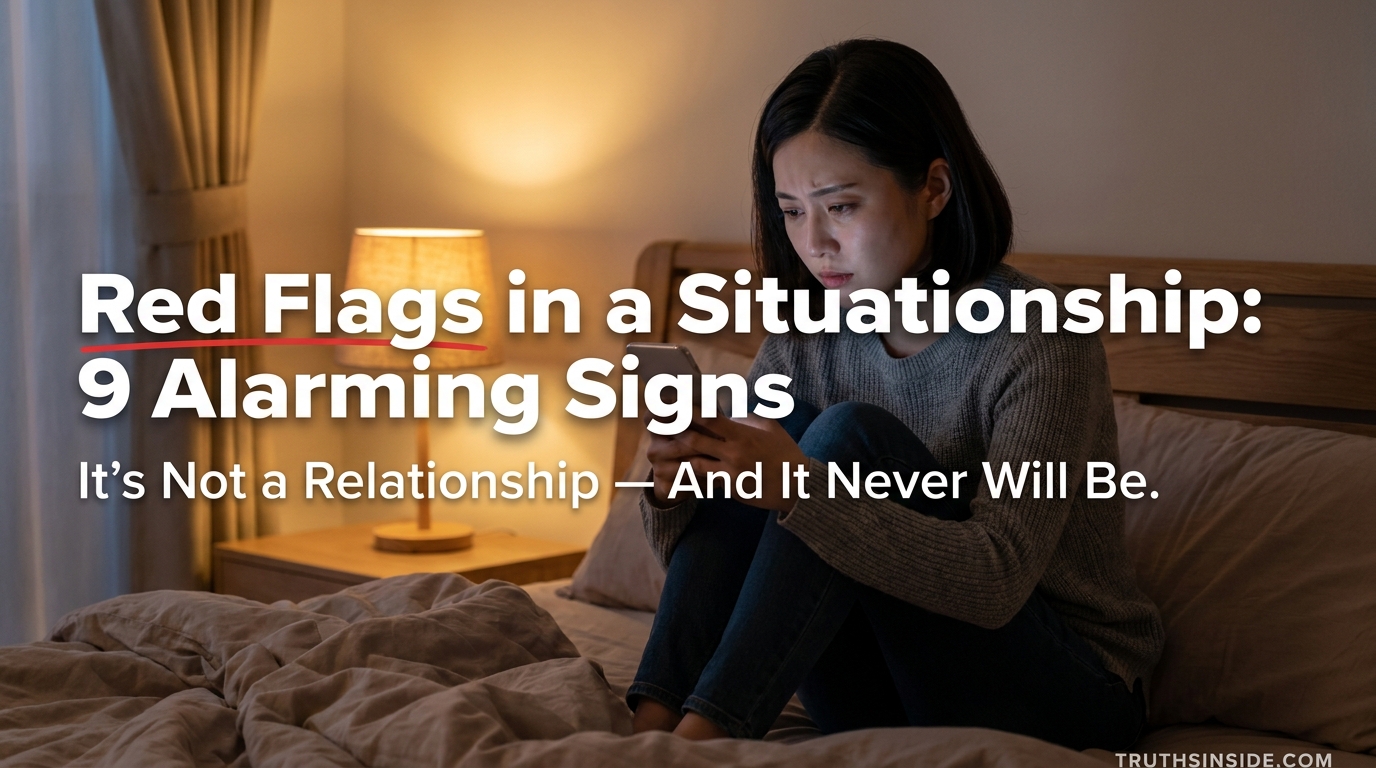
You text each other every day. You spend weekends together. You’ve met some of their friends. From the outside, it looks like a relationship. But when someone asks what you are, neither of you has a clean answer — and that silence, that hesitation, that carefully vague “it’s complicated” is slowly eating you alive. If this feels familiar, you may be deep inside a situationship — and worse, you may be ignoring the red flags in a situationship that are telling you exactly where this is headed.
A 2023 survey conducted by the dating platform Hinge found that over 65% of Gen Z and millennial daters had been in at least one situationship — a romantic arrangement that has the emotional texture of a relationship but none of the commitment, clarity, or security that defines one. And while some people enter these arrangements consciously and contentedly, many others find themselves emotionally invested in something that was never designed to grow into anything real.
The cruelest part of a situationship is not that it lacks a label. It’s that it provides just enough warmth, just enough attention, and just enough intimacy to make leaving feel impossible — while simultaneously providing just enough ambiguity to deny you the security you deserve. This article breaks down nine alarming red flags in a situationship that signal, clearly and honestly, that it is going nowhere — and that it may be time to make a decision about your own future.
What Is a Situationship — And Why Is It So Painful?
Before we dive into the red flags, it’s worth taking a moment to understand why situationships are so emotionally complex — and why so many intelligent, self-aware people find themselves trapped in them.
A situationship is broadly defined as a romantic or sexual relationship that exists without explicit commitment, clear boundaries, or a mutually agreed-upon definition. It often begins organically — two people enjoy each other’s company, feelings develop, intimacy grows — but the conversation about “what are we?” never happens, or happens and is deliberately left unresolved.
The reason situationships are so painful is rooted in psychology. According to research on intermittent reinforcement — a behavioral pattern first identified by psychologist B.F. Skinner — unpredictable rewards create stronger emotional bonds than consistent ones. When someone gives you affection sometimes but not always, when they’re fully present on some days and emotionally absent on others, your brain becomes neurologically hooked on the cycle. You keep returning, hoping for the next reward. This is the same psychological mechanism behind gambling addiction. And it is precisely what keeps millions of people locked inside situationships long after every rational signal has told them to leave.
Understanding this is not about blaming yourself. It’s about recognizing that your attachment to this situationship is not weakness. It is biology. And the first step to breaking the cycle is seeing the red flags clearly.
Red Flag 1: The “What Are We” Conversation Is Always Avoided
If there is one defining red flag in a situationship, this is it. Every time you approach the conversation about labels, commitment, or the future of your connection, something happens. They change the subject. They make a joke. They give you a warm, evasive non-answer that feels reassuring in the moment but says absolutely nothing of substance. Or worse — they make you feel like you’re being unreasonable for even asking.
“Let’s just enjoy what we have.”
“Why do we need to label things?”
“Can’t we just keep it natural?”
These phrases are not reassurances. They are deflections. And they reveal something important: this person knows what they want — which is to maintain access to you without committing to you. A person who genuinely sees a future with you does not run from conversations about that future. They welcome them.
If the “what are we” conversation consistently produces anxiety, avoidance, or emotional manipulation rather than honest dialogue, you are looking at one of the clearest red flags in a situationship that exists.
Related article: 15 Signs She Is Testing You: Why Women Test Men and What to Do
“The person who is right for you will not make you feel crazy for wanting to know where you stand.”

Red Flag 2: You Only Exist in Private
One of the most telling red flags in a situationship is the pattern of private intimacy paired with public invisibility. You spend nights together. You share meals, conversations, and moments that feel deeply personal. But in public — on social media, at social events, or in their broader social circle — you are either invisible or deliberately unnamed.
You’re not introduced as a partner. You might not even be introduced at all. Your photos together never make it onto their social media. When they talk about their weekend, you’re not part of the story they share with others. You exist in the private chapters of their life but are conspicuously absent from the public narrative.
This pattern is not accidental. It is a conscious or semi-conscious strategy to maintain the freedom to present as single — to keep options open — while still enjoying the emotional and physical benefits of your presence. If you matter to someone, they make it known. Not for performance or validation from others, but because pride and joy in a person naturally overflows into their life.
If you’ve been kept a secret for months, ask yourself honestly: what is the most likely reason? The answer, however uncomfortable, is a red flag you cannot afford to ignore.
Red Flag 3: The Connection Is Hot and Cold
One week they are texting you constantly, making plans, showering you with warmth and attention. The next week they are distant, slow to respond, and suddenly very busy with a life that seems to have no room for you. This hot and cold cycle — sometimes called “push-pull” behavior — is one of the most emotionally destabilizing red flags in a situationship.
The push-pull pattern keeps you perpetually off-balance. You never feel fully secure, but you never feel fully rejected either. You’re always in a state of waiting — waiting for the warmth to return, waiting for a sign, waiting to understand what you did wrong during the cold phase. And this waiting keeps you emotionally invested far beyond what the actual situation warrants.
Psychologist and relationship expert Dr. Lisa Firestone notes that this kind of intermittent emotional availability is frequently a sign of an avoidant attachment style combined with a self-serving approach to relationships. The person initiates closeness when they want connection — and retreats when that closeness starts to feel like obligation. What you experience as a “difficult time” they are going through is often simply a rotation of their attention back to you when it suits them.
You deserve consistency. Not perfection — but a baseline of reliable, ongoing care that doesn’t vanish without explanation.
Red Flag 4: Future Plans Never Include You
Pay close attention to how your situationship person talks about the future. When they mention upcoming events — vacations, concerts, holidays, family gatherings — are you in the picture? Or are those plans always described as solo or vague, with no natural invitation for you to be part of them?
Truly interested partners think about the future in terms of “we.” They mention things you could do together down the line. They ask about your plans in a way that suggests they’re considering how those plans might intersect with theirs. They build you into their mental picture of what’s ahead.
In a situationship that’s going nowhere, the future is always singular. Their vacation is “I’m thinking of going to Colorado.” Their holiday plans are “I’ll probably just be with family.” There’s no invitation. No “maybe we could…” No natural inclusion of you in what comes next.
This is not an oversight. It is a boundary — one they haven’t stated out loud but have drawn clearly with their behavior. And it is one of the most honest red flags in a situationship you will ever receive, because the future they’re imagining simply does not have you in it.
Related article: Gaslighting in Relationships: How to Recognize, Name, and Leave It

Red Flag 5: Your Emotional Needs Are Consistently Dismissed
In a healthy relationship — even a new or developing one — both people’s emotional needs are acknowledged and respected. Not always perfectly met, but acknowledged. In a situationship that’s going nowhere, one person’s emotional needs are consistently treated as inconvenient, excessive, or a threat to the arrangement.
When you express that you’re feeling uncertain, they call you “too needy.” When you share that you want more clarity, they accuse you of “pressuring” them. When you show any sign of emotional vulnerability, the warmth they normally offer suddenly cools — as if your feelings are the problem rather than the situation that created them.
This dynamic is a form of emotional manipulation, whether intentional or not. It trains you to suppress your natural, healthy need for emotional security in order to maintain access to someone who was never offering real security in the first place. Over time, you become smaller. More careful. More guarded about what you express.
No one who genuinely cares about you will make you feel like your emotional needs are too much. Your needs are not too much. You are simply in the wrong situation with the wrong person.
Red Flag 6: There’s No Real Effort Outside of Convenience
Ask yourself a direct question: does this person make an effort for you, or do they simply show up when it’s convenient? There is a significant difference between someone who pursues you and someone who accepts you when you’re available and easy to access.
A person who is genuinely invested in you will make plans in advance. They will reach out first sometimes. They will rearrange things occasionally to spend time with you. They will put in the kind of effort that communicates, clearly and consistently, that you are a priority — not an option.
In a situationship going nowhere, the effort is almost always one-sided or circumstantial. They text you at 11 PM when they’re bored. They invite you over when their other plans fall through. They’re enthusiastic about seeing you when it fits neatly into their schedule — and notably absent when it requires any real sacrifice or rearrangement on their part.
Effort is one of the most reliable indicators of genuine investment. When the effort is missing, the investment is missing. And a relationship — of any kind — cannot grow in soil where only one person is planting.
Red Flag 7: You Feel More Anxious Than Secure
This red flag is internal rather than behavioral — but it is just as important as any of the others. How do you generally feel within this situationship? Not on the best days, when everything is warm and easy. But on average, in the quiet moments when you’re honest with yourself?
If the dominant emotional experience of this situationship is anxiety — wondering where you stand, analyzing their texts for hidden meanings, bracing yourself every time the warmth begins to fade — that anxiety is telling you something critical. Security is not a luxury in a romantic connection. It is a basic emotional need. And its consistent absence is a red flag you must take seriously.
Research from the Journal of Social and Personal Relationships confirms that relationship ambiguity — the defining feature of a situationship — is one of the strongest predictors of psychological distress in young adults. The uncertainty itself, independent of any specific negative event, generates chronic low-grade stress that erodes self-esteem, disrupts sleep, and affects overall mental health over time.
Your nervous system knows something your heart is still trying to rationalize. If you feel more anxious than at peace, it is not because you are broken. It is because the situation you are in is not safe enough for your heart.
“You should feel like someone’s first choice — not their favorite backup plan.”
Red Flag 8: Physical Intimacy Without Emotional Intimacy
There is physical closeness — and then there is emotional intimacy. In a healthy relationship, both exist together and reinforce each other. In a situationship that’s heading nowhere, there is often an abundance of one and a conspicuous absence of the other.
If your connection is primarily physical — if the time you spend together tends to revolve around physical intimacy but rarely involves deep conversation, emotional vulnerability, shared experiences, or genuine investment in each other’s inner world — that imbalance is a significant red flag.
Physical intimacy without emotional intimacy creates a false sense of closeness. The body registers connection while the heart remains unseen and unknown. This is one of the reasons situationships can feel so confusing — the physical closeness mimics the feeling of being loved, even when the emotional foundation for real love is entirely absent.
Ask yourself: does this person know what keeps you up at night? Do they know your fears, your dreams, the things that have shaped who you are? Do they ask — and genuinely listen? If the answer is largely no, you are physically close to someone who remains emotionally unknown to you. And that is not a relationship. That is proximity.
Related article: 15 Subtle Red Flags in a New Relationship Most People Miss

Red Flag 9: Your Gut Has Been Telling You the Truth All Along
This final red flag is the one most people try hardest to silence. Your instincts — that quiet, persistent internal voice that has been whispering something is wrong — have likely known the truth about this situationship for longer than you’ve been willing to admit.
The gut feeling that something is off. The sense that you’re giving more than you’re receiving. The nagging awareness that despite all the warmth and chemistry, something essential is missing. These instincts are not anxiety or overthinking. They are your emotional intelligence speaking in its clearest voice.
Research in the field of social cognition suggests that people are remarkably accurate at intuitively detecting relationship ambivalence in their partners — even when the behavioral signs are subtle and the partner provides occasional positive reinforcement. In other words, you already know. You’ve known for a while. The red flags in a situationship that you found in this article didn’t tell you something new. They confirmed something you’ve been carrying quietly for months.
Trusting your gut is not reckless. It is one of the most rational things you can do.
What to Do When You Recognize These Red Flags
Recognizing red flags in a situationship is only the first step. The harder, braver step is deciding what to do with that knowledge. Here is where clarity matters more than comfort.
Have the honest conversation — one final time. Not an ultimatum delivered in anger, but a calm, clear expression of what you need. “I need to know if this is going somewhere, because I can’t continue investing emotionally without that clarity.” Their response will tell you everything.
Set a personal deadline — and honor it. Decide privately how long you are willing to remain in ambiguity. Then keep that commitment to yourself. You are not obligated to wait indefinitely for someone to decide if you are worth choosing.
Redirect your emotional energy inward. The energy you’ve been pouring into analyzing this situationship belongs to you. Redirect it toward your own goals, your own growth, your own relationships with people who show up consistently and clearly.
Seek support. Whether from trusted friends, a therapist, or communities of people who have navigated the same experience, don’t process this alone. You deserve people in your corner who remind you of your worth when the situationship has made you forget it.
Final Thoughts: You Deserve a Love That Is Certain
The most important thing to understand about a situationship that is going nowhere is this: it reflects nothing about your worth. It reflects the limitations, fears, and priorities of the person who refuses to fully commit to you. You are not too much. You are not too emotional. You are not asking for too much by wanting clarity, consistency, and genuine love.
The red flags in a situationship exist not to punish you but to protect you. They are signposts pointing toward a truth you deserve to see clearly. And once you see it, you have the power to make a decision that honors the love you are capable of giving — and the love you absolutely deserve to receive.
You are not someone’s almost. You are someone’s everything — just not this person’s. And somewhere ahead, when you’ve freed yourself from this in-between space, you will find out what it feels like to be chosen fully, consistently, and without hesitation.
That love is real. And it is worth waiting for — just not in a situationship that was never built to hold it.
💾 Save this article — you may need to come back to it on the days when leaving feels impossible.
📤 Share it with a friend who’s been stuck in a situationship and deserves to see the signs clearly.
👉 Follow TruthsInside.com for more honest, psychology-backed content about love, relationships, and the red flags worth paying attention to.
FAQ
Q1: How long is too long to be in a situationship?
There is no universal timeline, but most relationship psychologists suggest that if the question of commitment has not been honestly addressed within three to six months of consistent emotional and physical intimacy, the situationship is unlikely to evolve naturally into a committed relationship. At that point, a direct conversation about intentions becomes not just appropriate but necessary.
Q2: Can a situationship turn into a real relationship?
Yes, it can — but it requires both people to actively choose it. The transition from situationship to relationship is not something that happens passively over time. It requires an honest conversation, a mutual agreement, and visible behavioral change from the person who previously avoided commitment. If only one person is pushing for that change, the transition is unlikely to happen or sustain itself.
Q3: Why do people stay in situationships even when they’re unhappy?
Several psychological factors keep people in situationships: intermittent reinforcement, fear of losing even partial connection, hope that things will naturally progress, low self-worth, and the sunk cost fallacy — the belief that because you’ve already invested so much time and emotion, leaving would make that investment meaningless. Recognizing these patterns is the first step toward making a choice from a place of clarity rather than fear.
Q4: Is it okay to want more from a situationship?
Not only is it okay — it is healthy. Wanting clarity, commitment, and emotional security in a romantic connection is a completely natural and reasonable human need. Anyone who makes you feel “crazy” or “too needy” for wanting these things is revealing their own inability to meet your needs, not a flaw in yours.
Q5: How do I get out of a situationship without getting hurt?
The honest truth is that leaving a situationship will likely involve some degree of pain — because real feelings have been invested. But the pain of leaving is finite. The pain of staying in something that is going nowhere is cumulative and ongoing. The most protective thing you can do is leave with clarity, lean on your support system, give yourself time to grieve what might have been, and resist the urge to return when loneliness makes the familiar feel appealing again.
🎵 Music
Maren Lull is a singer-songwriter who writes from the places most people don’t talk about out loud.
Not the dramatic grief. Not the obvious heartbreak. The quiet kind — the ordinary Tuesday emptiness, the habit of reaching for someone who isn’t there anymore, the particular exhaustion of being strong for so long that the strength itself wears thin.
Her music lives at the intersection of emotional honesty and soft beauty — breathy vocals over gentle piano, slow tempos, lyrics that feel less like songs and more like something you wrote in a private notebook at two in the morning and never showed anyone.
Maren Lull writes for the people who feel everything deeply and say very little about it. For the ones who listen to sad music not because they want to feel worse — but because being understood, even by a song, makes the feeling easier to carry.
📱 Follow Maren Lull:
→ Spotify
→ Apple Music
→ Youtube
→ Audiomack