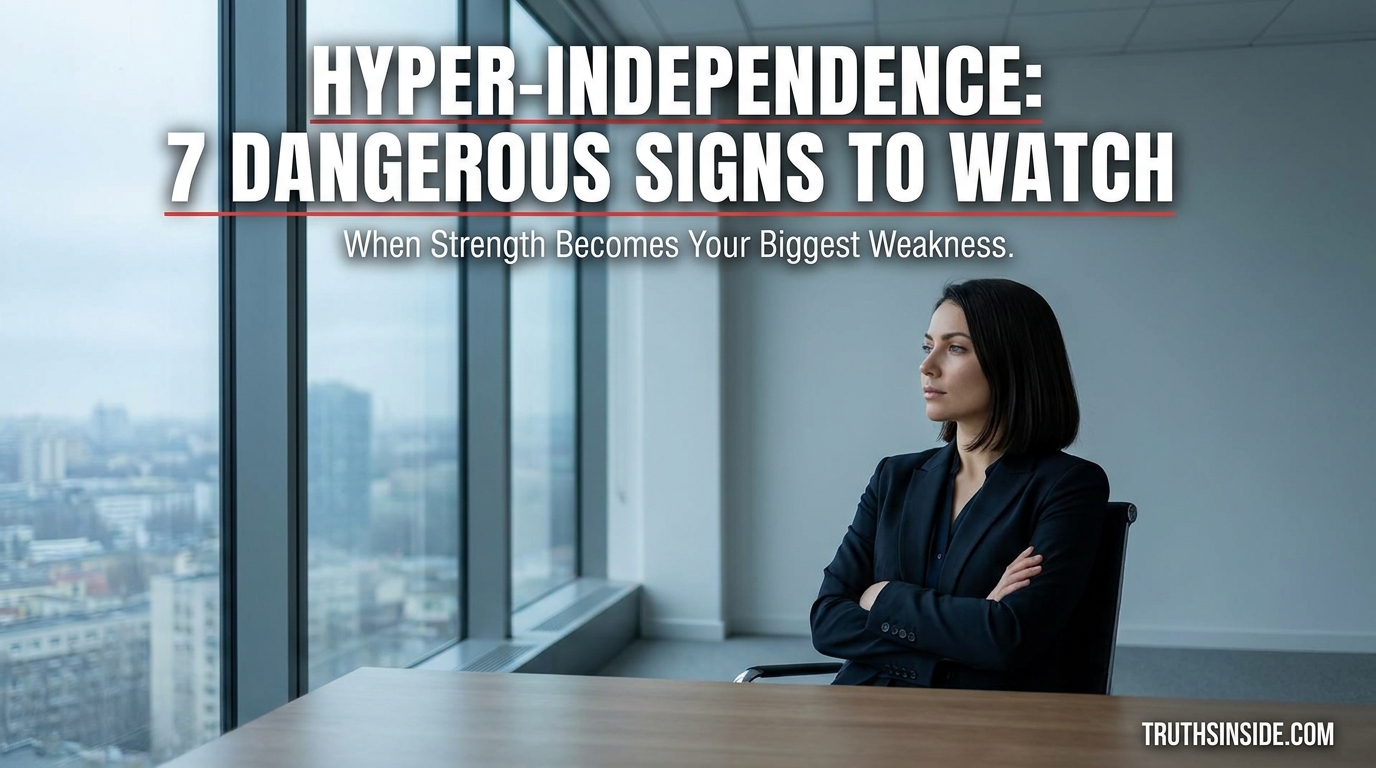
Have you ever been proud of the fact that you never ask for help? That you handle everything on your own, rarely lean on anyone, and keep your struggles neatly tucked away where no one can see them? Most people would call that strength. But psychologists are increasingly calling it something else — hyper-independence. And it may be quietly destroying your relationships from the inside out.
According to research published in the Journal of Counseling Psychology, individuals who exhibit hyper-independent behavioral patterns are significantly more likely to report feelings of emotional loneliness, even when surrounded by people who care about them. The disconnect isn’t about a lack of love in their lives. It’s about an internal barrier that makes receiving that love feel dangerous, uncomfortable, or simply impossible.
Hyper-independence is not the same as healthy self-reliance. It is a psychological pattern — often rooted in trauma, early abandonment, or repeated experiences of disappointment — where a person becomes so committed to not needing others that they inadvertently close the door to genuine connection. If you’ve ever been told you’re “too closed off,” “hard to reach,” or “emotionally unavailable,” this article may explain why — and more importantly, what you can do about it.
What Is Hyper-Independence, Really?
Before we explore the signs, it’s important to understand what hyper-independence actually is — because it is frequently misunderstood, even by the people who experience it.
Hyper-independence is not simply being self-sufficient. Being self-sufficient is a healthy and admirable quality. It means you are capable, resourceful, and able to manage your own life without constantly depending on others for basic functioning. That’s a strength.
Hyper-independence, by contrast, is a compulsive need to handle everything alone — even when help is available, even when the situation genuinely calls for support, and even when accepting that support would lead to a better outcome. It is self-reliance that has crossed a line into self-isolation.
Dr. Joy Harden Bradford, a licensed psychologist and founder of Therapy for Black Girls, describes hyper-independence as “a trauma response that develops when someone has learned — through painful experience — that depending on others leads to disappointment, abandonment, or harm.” In other words, it’s not a personality flaw. It’s a survival strategy that once made sense — but may no longer be serving you.
The challenge is that hyper-independence often looks like success on the outside. The hyper-independent person is frequently high-achieving, self-motivated, and capable of managing enormous amounts of responsibility. They are the ones everyone else leans on. But internally, they are often exhausted, emotionally starved, and deeply disconnected — even in their most intimate relationships.
The Psychology Behind Hyper-Independence
To understand why hyper-independence develops, we need to look at attachment theory — one of the most well-established frameworks in developmental psychology.
Developed by British psychiatrist John Bowlby in the 1950s and later expanded by researchers Mary Ainsworth and Mary Main, attachment theory proposes that the way we bond with our earliest caregivers creates a psychological template — called an attachment style — that shapes how we relate to others throughout our lives.
Children who grow up with consistent, reliable, emotionally available caregivers tend to develop what’s called a secure attachment style. They learn that the world is safe, that people can be trusted, and that asking for help is not weakness but simply part of how humans are meant to function.
Children who grow up with inconsistent, dismissive, or emotionally unavailable caregivers often develop an avoidant attachment style — the psychological soil in which hyper-independence typically takes root. These children learn early that their emotional needs are either unwelcome or unlikely to be met. So they stop expressing those needs. They stop asking. They stop reaching out. And they begin to take fierce pride in needing no one.
This adaptation is brilliant in childhood. It protects a vulnerable child from repeated cycles of disappointment and rejection. But when that child becomes an adult and enters romantic relationships, friendships, or professional environments that require vulnerability and interdependence, the old strategy begins to backfire.
Related article: Signs He Likes You But Is Scared: 18 Behaviors Men Show When Afraid to Commit
“Hyper-independence is not a character trait. It is a wound dressed up as a superpower.”

7 Dangerous Signs Your Hyper-Independence Is Hurting Your Relationships
Sign 1: You Find It Almost Impossible to Ask for Help
This is the most recognizable hallmark of hyper-independence — and also the most socially celebrated, which makes it particularly dangerous. You would rather struggle alone for hours, days, or even weeks than ask someone for assistance. Asking for help feels shameful. It feels like an admission of weakness. It feels like handing someone power over you.
In relationships, this plays out in deeply damaging ways. Your partner offers to help and you refuse — not because you don’t need it, but because accepting it feels like a vulnerability you can’t afford. Over time, your partner stops offering. They feel unnecessary. They feel shut out. And slowly, the emotional distance between you grows into something neither of you can easily cross.
Sign 2: Hyper-Independence Makes You Emotionally Unavailable
Being physically present in a relationship while being emotionally absent is one of the quietest and most painful forms of disconnection. Hyper-independent people are often physically reliable — they show up, they follow through, they keep their word. But emotionally, they maintain a careful distance that keeps even their closest relationships at arm’s length.
You might change the subject when conversations get too personal. You might deflect with humor when emotions run high. You might listen attentively to your partner’s feelings while sharing almost nothing of your own. This pattern — known in psychology as emotional distancing — creates an invisible wall that your partner can feel but often cannot name. They sense something is missing without being able to pinpoint exactly what it is.
Sign 3: Depending on Others Fills You With Anxiety
For most people, leaning on a trusted partner or friend provides comfort. For the hyper-independent person, it triggers anxiety. The moment they begin to rely on someone — even in a small, practical way — an alarm goes off internally. What if this person lets me down? What if they use this against me? What if I become too comfortable needing them and then they leave?
This anxiety is not irrational. It is the echo of past experiences where dependence led to pain. But it functions in the present as an invisible fence that keeps genuine intimacy just out of reach. Psychologists refer to this as “vulnerability aversion” — a deep-seated discomfort with the emotional exposure that real relationships require.
Sign 4: You Struggle to Accept Love, Care, or Kindness
Here’s one that often surprises people: hyper-independent individuals frequently struggle not just with giving vulnerability but with receiving care. When someone does something kind for them — brings them soup when they’re sick, offers a word of encouragement, or simply says “I’m proud of you” — there is an internal discomfort. A deflection. A quick dismissal of the gesture.
“You didn’t have to do that.”
“I’m fine, really.”
“Don’t worry about me.”
These aren’t just polite phrases. For the hyper-independent person, they are reflexive shields against something that paradoxically feels threatening: being cared for. Because being cared for means being seen. And being seen means being vulnerable. And vulnerability, somewhere deep in their history, has always come with a cost.
Related article: What Does It Actually Feel Like to Fall in Love? Science + Real Stories

Sign 5: You Over-Function and Then Resent It
One of the most exhausting paradoxes of hyper-independence is this: the person who insists they don’t need anyone often ends up doing everything for everyone — and then quietly drowning in resentment because no one is doing anything for them.
This over-functioning pattern is common in hyper-independent individuals. They take on more than their share at work, in relationships, and in family dynamics. They manage, organize, fix, and carry — all while refusing to delegate or ask for support. And then, when the inevitable burnout arrives, they feel unseen. Unappreciated. Alone.
The cruel irony is that they created the very dynamic they resent. By refusing to let others contribute, they denied their partner — or their team, or their family — the opportunity to show up for them. And then they suffer in silence over the absence of support they never allowed in the first place.
Sign 6: Hyper-Independence Leaves You Feeling Chronically Lonely
You can be surrounded by people who love you and still feel profoundly alone. This is perhaps the most painful consequence of hyper-independence. The walls built to protect against hurt are so effective that they also block out warmth, connection, and belonging.
Research published in Personality and Social Psychology Bulletin found that individuals with avoidant attachment tendencies — the psychological foundation of hyper-independence — reported higher levels of loneliness even in the context of close relationships. The love is there. The connection is being offered. But the internal wiring prevents it from being fully received.
This loneliness often goes unacknowledged for years. The hyper-independent person is too proud to admit it — and in some cases, too disconnected from their own emotional experience to even identify it. It shows up instead as a vague dissatisfaction, a sense that something is missing, a feeling of emptiness that success, achievement, and busy schedules cannot fill.
Sign 7: The Idea of Truly Letting Someone In Terrifies You
At the core of hyper-independence is fear. Not weakness — fear. The fear of being abandoned. The fear of being betrayed. The fear of needing someone so completely that their loss would be devastating. And so, rather than risk that devastation, the hyper-independent person keeps everyone at a carefully managed distance.
This fear is especially visible in romantic relationships. Just as things begin to deepen — just as the connection starts to feel real and significant — something triggers a retreat. Suddenly you’re busier than usual. Suddenly you need more space. Suddenly the relationship that felt exciting starts to feel threatening. This pattern of pulling back just before real intimacy is possible is one of the clearest and most painful signs of hyper-independence at work.
“The bravest thing a hyper-independent person can do is not to do more alone — it is to finally let someone in.”
How Hyper-Independence Damages Relationships Over Time
The long-term impact of hyper-independence on relationships is significant and, if unaddressed, often fatal to the relationship itself. Partners of hyper-independent individuals frequently report feeling unloved — not because the hyper-independent person doesn’t love them, but because the emotional distance makes it difficult to feel that love in any tangible way.
Over time, the partner begins to stop reaching out. They stop initiating emotional conversations. They stop offering help or care because it’s always refused. They become emotionally self-sufficient out of necessity — not preference. And the relationship slowly becomes two people living parallel lives under the same roof rather than a genuine partnership built on mutual vulnerability and trust.
This dynamic often ends in one of two ways: the partner leaves because they cannot sustain the emotional starvation, or both people remain together in a state of comfortable but hollow coexistence. Neither outcome reflects the depth of love that both people may genuinely feel.
The good news is that hyper-independence is not a life sentence. With awareness, intention, and often the support of a skilled therapist, the patterns that drive it can be identified, understood, and gradually shifted. Healing begins not with a dramatic transformation, but with one small act of vulnerability at a time.
Related article: The 5 Love Languages Explained: Which One Are You?

How to Begin Healing Hyper-Independence
Healing hyper-independence starts with one deceptively simple step: recognizing it. Not as a flaw to be ashamed of, but as a pattern that once protected you and no longer needs to. Here are evidence-based starting points for the journey.
Practice micro-vulnerability. You don’t have to bare your soul overnight. Start small. Tell a trusted person that you had a hard day. Accept help with something minor. Say “thank you” to a compliment without deflecting. Each small act of openness rewires the neural pathways that have long associated vulnerability with danger.
Work with a trauma-informed therapist. Because hyper-independence is often rooted in early relational trauma, professional support — particularly modalities like EMDR, Internal Family Systems (IFS), or Emotionally Focused Therapy — can accelerate healing significantly. A therapist helps you safely revisit the original wounds that made self-reliance feel like survival.
Communicate your patterns to your partner. One of the most powerful things a hyper-independent person can do is name what’s happening to their partner. “I know I pull away sometimes, and it’s not about you. I’m working on it.” This kind of transparency transforms confusion into compassion — and gives your partner a way to support your growth rather than feeling helpless against your walls.
Challenge the belief that needing others equals weakness. Interdependence — the balanced exchange of support, care, and vulnerability between two people — is not weakness. It is the foundation of every healthy human relationship. We are wired for connection. Needing others is not a design flaw. It is the design.
Final Thoughts: Strength Is Not the Same as Invulnerability
Hyper-independence is one of the most misunderstood psychological patterns of our time — largely because our culture so aggressively rewards the appearance of self-sufficiency. We celebrate people who need nothing and give everything. We call them strong. We call them resilient. We hold them up as role models.
But true strength is not the absence of need. True strength is the courage to be honest about your needs — and the willingness to let another person meet them. It is the bravery required to say, “I can’t do this alone,” even when every instinct you have is screaming the opposite.
If you recognize yourself in this article, know this: the walls you built were not mistakes. They were masterpieces of survival. They kept you safe when safety was hard to come by. But you are not that child anymore. You don’t need the same level of protection. And the love waiting on the other side of those walls is worth the risk of letting them down — one brick at a time.
💾 Save this article — it might be exactly what someone close to you needs to understand.
📤 Share it with someone who always says “I’m fine” but never really means it.
👉 Follow TruthsInside.com for more psychology insights, relationship advice, and content that helps you understand yourself and the people you love.
FAQ
Q1: Is hyper-independence always caused by trauma?
Not always, but trauma is one of the most common roots. Hyper-independence can also develop through cultural conditioning, parenting styles that overly praised self-sufficiency, or repeated life experiences where depending on others led to negative outcomes. However, in many cases, a trauma-informed lens is the most helpful framework for understanding and healing it.
Q2: Can a hyper-independent person have a healthy relationship?
Absolutely. Hyper-independence is a pattern, not a permanent identity. With self-awareness, intentional effort, and often therapeutic support, hyper-independent individuals can learn to build emotionally safe, interdependent relationships. Many do, and they often become deeply committed partners once they feel secure enough to open up.
Q3: How do I support a hyper-independent partner without pushing them away?
Patience and consistency are key. Avoid forcing emotional conversations. Instead, create a consistent environment of safety — where your partner gradually learns that vulnerability with you will not lead to judgment or abandonment. Name what you observe gently: “I notice you seem to carry a lot alone. I’m here if you ever want to share.” Then give them space to come to you on their own terms.
Q4: What’s the difference between being independent and being hyper-independent?
Healthy independence means you are capable and self-sufficient while still being able to receive support, ask for help when needed, and maintain genuine emotional intimacy. Hyper-independence means self-reliance has become compulsive — you are unable or unwilling to depend on others even when it would genuinely benefit you or your relationship.
Q5: Can hyper-independence be mistaken for introversion?
Yes, and this is a very common confusion. Introverts recharge alone and may need more solitary time — but they are still emotionally available and capable of deep connection. Hyper-independent individuals may appear introverted, but the core issue is not about energy — it’s about a deep-rooted resistance to emotional dependence and vulnerability, regardless of social preference.
🎵 Music
Maren Lull is a singer-songwriter who writes from the places most people don’t talk about out loud.
Not the dramatic grief. Not the obvious heartbreak. The quiet kind — the ordinary Tuesday emptiness, the habit of reaching for someone who isn’t there anymore, the particular exhaustion of being strong for so long that the strength itself wears thin.
Her music lives at the intersection of emotional honesty and soft beauty — breathy vocals over gentle piano, slow tempos, lyrics that feel less like songs and more like something you wrote in a private notebook at two in the morning and never showed anyone.
Maren Lull writes for the people who feel everything deeply and say very little about it. For the ones who listen to sad music not because they want to feel worse — but because being understood, even by a song, makes the feeling easier to carry.
📱 Follow Maren Lull:
→ Spotify
→ Apple Music
→ Youtube
→ Audiomack