
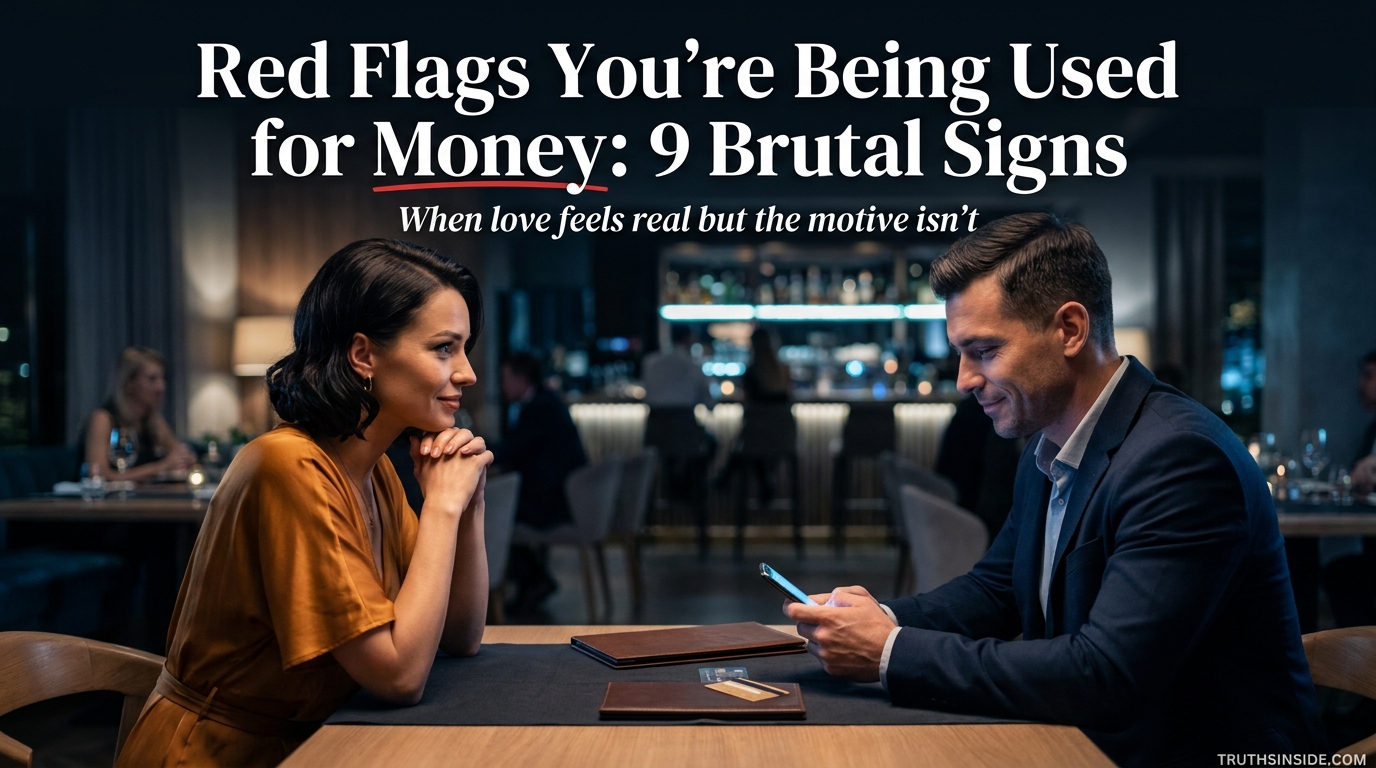
Red Flags You’re Being Used for Money
Red flags you’re being used for money are among the most difficult warning signs to recognize clearly — because financial exploitation in relationships almost never announces itself honestly. It does not arrive with obvious calculation or visible contempt. It arrives wearing the most convincing possible costume: affection, charm, apparent vulnerability, and just enough genuine connection to keep doubt at bay and generosity flowing.
If you have ever felt vaguely unsettled about the financial dynamics in your relationship — if money requests seem timed suspiciously, if warmth appears to correlate with your financial availability, if you find yourself consistently paying while your partner consistently has reasons why they cannot — you deserve clear, honest information rather than the self-doubt that financial exploitation is specifically designed to produce.
Research from the National Domestic Violence Hotline identifies financial abuse as a component of exploitation present in approximately 99% of domestic abuse cases — but financial exploitation occurs across a far broader spectrum than formal abuse, in relationships that otherwise contain genuine affection and no other obvious red flags. Understanding what financial exploitation actually looks like — in its subtle, everyday forms — is the most important protection available.
Financial exploitation in relationships operates through a predictable but not always obvious mechanism. The exploiting partner establishes the financial dynamic gradually — each individual request, each moment of financial need, each absorbed expense seeming reasonable or even loving in isolation. It is the pattern over time — observed honestly and without the softening filter of affection — that reveals what is actually happening. Love is genuinely generous. But genuine generosity flows in both directions, with both people willing to give and both people capable of genuine reciprocity. When generosity consistently flows in one direction, and when the affection and attention that makes generosity feel worth giving correlates suspiciously with financial availability, that pattern deserves honest examination.
The nine red flags in this article are grounded in relationship psychology, financial abuse research, and the documented behavioral patterns of financial exploitation. They are not offered to generate suspicion in healthy relationships — they are offered to provide the clarity that financial exploitation is specifically engineered to prevent.
Red Flag 1: Red Flags You’re Being Used for Money Show Up in How They Respond When You Say No
Red flags you’re being used for money are most honestly revealed not in how someone behaves when you say yes — but in how they respond when you say no. In a genuine relationship, a partner’s warmth, affection, and emotional availability are not contingent on your financial decisions. In a relationship where you are being financially exploited, the response to “no” is one of the clearest available signals of what is actually driving the connection.
When financial exploitation is present, saying no to a money request — or simply not having money available — produces a predictable and revealing response. Coldness replaces warmth. Distance replaces closeness. Irritability, sulking, or emotional withdrawal appears where affection previously existed. This conditional availability — affectionate when money flows, cold or withdrawn when it doesn’t — is the most honest behavioral signal of financial motivation because it reveals what the affection was actually contingent upon.
Pay close attention to the emotional temperature of the relationship immediately following any moment you decline a financial request or express concern about money. The response in that specific moment — not the words, but the behavioral reality — tells you more about the nature of the connection than any declaration of love offered during moments of financial availability. Genuine love is not financially contingent. When yours demonstrably is, that contingency is the red flag.
What to notice: Track the correlation between your financial decisions and their emotional availability. If a clear pattern emerges — warmth tied to yes, withdrawal tied to no — you have important information about what is actually sustaining their investment in the relationship.

Red Flag 2: Financial Crises Arrive With Suspicious Frequency and Timing
Everyone faces genuine financial difficulty at some point — unexpected expenses, temporary income disruption, genuine emergencies that require support. This red flag is not about a partner experiencing financial hardship. It is about a pattern of financial crises that arrives with suspicious frequency, involves escalating amounts, and is consistently timed in ways that correlate with the relationship’s emotional intensity or your demonstrated willingness to help.
Financial exploiters are skilled at manufacturing or dramatically amplifying genuine financial difficulties to activate their partner’s generosity. A real expense becomes a crisis. A manageable problem becomes an emergency. The emotional urgency of the presentation is calibrated to the level of response required — enough distress to produce the desired financial support, not so much that the relationship itself feels threatened.
Notice not just the frequency of financial crises but their pattern over time. Do they escalate as your willingness to help becomes established? Do they arrive with particular timing — immediately after emotional bonding moments, or when you have just received income yourself? Does the crisis reliably resolve when you provide money, only for the next one to arrive within a predictable timeframe? This cyclical, escalating pattern is the behavioral signature of manufactured financial need rather than genuine occasional hardship.
📃 Related article: Dismissive Partner: 8 Alarming Red Flags Never to Ignore
Red Flag 3: They Know Your Financial Situation in Detail — But You Know Little About Theirs
Financial exploiters typically invest significant energy in understanding their partner’s financial situation — income, savings, assets, access to credit, family resources — while maintaining deliberate opacity about their own. This asymmetric financial knowledge serves a specific exploitative function: it allows them to calibrate their requests to the outer edge of what you can provide while preventing you from accurately assessing their actual need or actual resources.
In a genuine relationship, financial transparency develops naturally and mutually over time. Both partners have a reasonable understanding of each other’s financial situation — not necessarily in detail, but broadly and honestly. When one partner consistently deflects questions about their own finances while demonstrating detailed knowledge of yours, the asymmetry is telling.
This deflection takes recognizable forms. Vague answers to direct questions about income or expenses. Irritation or accusations of distrust when financial questions are raised. Constantly shifting explanations for why they cannot pay for things. A general atmosphere in which discussing their finances is uncomfortable while discussing yours is treated as natural and necessary. That directional asymmetry — detailed knowledge flowing one way, opacity maintained the other — serves the exploiting partner’s ability to maximize extraction while minimizing accountability.
“Financial exploitation rarely looks like theft. It looks like love with a price tag — charm and affection calibrated precisely to keep generosity flowing and scrutiny at bay.”
Red Flag 4: The Relationship Progressed Unusually Fast — Alongside Financial Requests
Love bombing — the overwhelming, accelerated intensity of affection, attention, and apparent devotion in the early stages of a relationship — is frequently a feature of financial exploitation rather than simply romantic enthusiasm. When genuine, fast-moving emotional connection is accompanied by early financial requests or needs, the combination is a significant red flag worth examining carefully.
The mechanism is straightforward: deep emotional investment, created rapidly through intense attention and apparent devotion, lowers the psychological defenses that would otherwise produce appropriate caution about financial requests. When you are emotionally flooded by the intensity of a new connection, requests for financial help feel like opportunities to demonstrate the love you genuinely feel — rather than what they may actually be: the exploitation of that emotional investment.
This does not mean that fast-moving romantic connections are always exploitative — genuine chemistry and connection can develop rapidly without financial motivation. The red flag is the combination: accelerated emotional intensity accompanied by financial needs, requests, or dependencies that emerge before the relationship has the established trust that genuine financial support between partners requires. The speed of the emotional investment and the speed of the financial requests arriving together are the signal.
Red Flag 5: They Have a Pattern of Financial Dependency Across Relationships
Context matters in evaluating financial dynamics. A partner who has genuinely struggled financially in one period of their life is different from a partner whose relationship history reveals a consistent pattern of financial dependency on romantic partners. When the financial exploitation pattern predates you — when previous partners, family members, or friends describe similar dynamics — that history is among the most reliable predictors of what is happening in your relationship.
This red flag requires information you may not have easy access to — but often becomes visible through the stories partners tell about their own past, through mutual acquaintances, or through the partner’s own framing of previous relationships. Pay attention to how they describe why previous relationships ended. Pay attention to what previous partners are said to have “failed” to provide. Pay attention to family relationship dynamics involving money.
A person whose relationship history consistently features financial support from partners — and whose account of those relationships frames the financial dimension as the other person’s responsibility or failure — is showing you a pattern that significantly predates your specific relationship. Patterns that predate you are not caused by you. And they are not changed by you, however generously you give.

Red Flag 6: Affection and Attention Increase Noticeably Before Financial Requests
This red flag requires honest, specific observation — because the pattern it describes is subtle enough to rationalize away in the moment but consistent enough to become visible when observed across time. In relationships involving financial exploitation, affection, attention, physical warmth, and apparent emotional investment frequently intensify in the period immediately preceding a financial request.
The dynamic is essentially a transactional priming strategy — increasing the emotional investment of the targeted partner immediately before asking them to demonstrate that investment financially. It exploits the natural human tendency to be more generous toward people we feel closest to — and it specifically manufactures closeness in the moments when generosity is about to be required.
The tell is the timing correlation. Not that affection exists — affection should exist in a genuine relationship — but that its intensity reliably peaks immediately before a financial request arrives. A particularly warm evening followed by a financial crisis the next morning. An unusually attentive weekend followed by a money conversation on Monday. The pattern, once visible, is difficult to unsee. And the specific correlation between emotional warmth and financial request timing is one of the clearest behavioral signals that the warmth is serving a strategic rather than purely genuine function.
📃 Related article: Cycle of Apology and Repeat: 8 Red Flags Sorry Won’t Fix
Red Flag 7: They React to Your Financial Boundaries With Guilt, Anger, or Accusations
How a partner responds to your financial boundaries — your expressed limits on what you are willing or able to provide — is one of the most revealing behavioral tests available in evaluating whether financial exploitation is present. Genuine partners, when told that financial support is not possible or appropriate, respond with understanding, with the recognition that your financial limits are as valid as their financial needs.
Financial exploiters respond to financial boundaries very differently. Guilt production: “I thought you cared about me.” “I would do this for you without a second thought.” “I can’t believe you’re choosing money over our relationship.” Anger: disproportionate emotional reactions to a simple no that communicate that the no is a genuine threat rather than a disappointing but understandable response. Accusations of distrust, selflessness, or insufficient love — framing your financial boundary as evidence of relational inadequacy rather than as a reasonable personal limit.
These responses serve a specific function — they transform your reasonable financial boundary into an emotional liability, making the psychological cost of maintaining the boundary higher than the financial cost of abandoning it. That pressure is not accidental. It is the exploitation mechanism making the most efficient move available when direct financial requests encounter resistance.
Red Flag 8: They Never Reciprocate — And Always Have a Reason
Financial exploitation in relationships is definitionally one-directional — resources flow from the exploited partner toward the exploiting one, consistently and without genuine reciprocity. The exploiting partner always has reasons why reciprocity is not currently possible — reasons that are individually plausible but collectively reveal a pattern of permanent unavailability for financial reciprocity regardless of circumstances.
This red flag is most clearly visible when you observe the relationship across a sustained period of time rather than evaluating individual moments. Yes, there may be a period where their income is genuinely reduced. Yes, there may be expenses that genuinely preclude reciprocity in a specific month. But genuine financial difficulty is temporary and produces genuine remorse about the imbalance, combined with genuine effort to reciprocate when circumstances allow.
Financial exploitation produces a different pattern — the reasons for non-reciprocity are always present, always just-plausible-enough, and always followed by new reasons when previous ones resolve. The imbalance never genuinely closes. The effort to close it never genuinely materializes. And the partner who gives consistently finds that their giving is treated as the natural state of the relationship rather than as a generous accommodation of temporary difficulty.
“In a genuine relationship, financial imbalance produces discomfort in the partner receiving more — and genuine effort to restore balance. In financial exploitation, imbalance is the point — and it produces comfort, not discomfort, in the one benefiting.”
Red Flag 9: Your Financial Situation — Not You — Is the Relationship’s Anchor
This final and most revealing red flag requires the most honest self-examination — because it asks you to imagine something uncomfortable. If your financial situation changed significantly — if your income decreased substantially, if your savings disappeared, if your ability to provide financial support was genuinely removed — would the relationship survive it? Not would they claim it would. Would it actually, demonstrably, continue with the same warmth, attention, and investment?
Financial exploitation is definitionally dependent on the exploited partner’s financial availability. When that availability is removed, the exploiting partner’s motivation for the relationship is removed. This does not always produce immediate departure — some financial exploiters maintain relationships through difficult financial periods in anticipation of recovery. But the emotional investment, attention, and warmth that characterized the relationship during financial abundance consistently does not survive financial difficulty in exploitative dynamics.
You can test this red flag through honest observation of existing patterns. Does their investment in you increase during your financially abundant periods and decrease during leaner ones? Do your financial contributions feel like the foundation the relationship is built on rather than one dimension of a genuinely mutual connection? Does the relationship’s energy feel most vibrant when you are most financially available?
Genuine love survives financial difficulty because its anchor is you — your presence, your character, your particular way of being in the world. When the anchor is your financial availability rather than your person, that distinction reveals itself with painful clarity the moment the financial availability wavers.

Why Financial Exploitation Is So Hard to See Clearly
Understanding why financial exploitation in relationships is so difficult to recognize clearly — even for intelligent, self-aware people — is essential for removing the shame that often accompanies its eventual recognition. Financial exploitation works specifically because it is designed to prevent clear seeing. The warmth is genuine enough to produce doubt. The financial needs are plausible enough to rationalize. The connection is real enough, in its own way, to make the pattern difficult to name without feeling like you are betraying something that mattered.
Confirmation bias further obscures the pattern — when we love someone, we are cognitively motivated to find alternative explanations for their behavior rather than the one that requires us to accept that the connection was not what we believed. Each financial request has an individual explanation that feels adequate. It is only in observing the full pattern — stepping outside the emotional frame of each individual moment and looking at the arc honestly — that the exploitation becomes visible.
Social shame also plays a role. Many people who recognize financial exploitation hesitate to name it — to themselves or to others — because doing so requires acknowledging that they were manipulated. That acknowledgment conflicts with the self-image of someone who would have recognized manipulation sooner. But financial exploiters are skilled specifically at preventing early recognition. Being skillfully manipulated is not evidence of inadequacy. It is evidence of the manipulator’s skill.
📃 Related article: Gaslighting in Relationships: How to Recognize, Name, and Leave It
What to Do When You Recognize These Red Flags
Recognition of financial exploitation red flags does not automatically require immediate, dramatic action. It requires honest assessment of the pattern, honest conversation about what you have observed, and honest evaluation of the response that conversation produces.
Begin by observing the pattern without immediately confronting it — keeping a mental or written record of the correlation between affection and financial requests, between your financial decisions and their emotional availability, between financial crises and relationship intensity. This record provides the clarity that individual moments cannot.
When the pattern is sufficiently clear, a direct conversation about specific, observable behaviors — not accusations of exploitation, but honest observations about the financial dynamic — provides the most useful information available. “I’ve noticed that I consistently pay for things between us, and when I’ve mentioned the imbalance, the conversation hasn’t gone anywhere. I’d like to understand your perspective on how we handle finances together.”
Their response to this conversation — both the words and the subsequent behavior — tells you everything you need to know. Genuine partners engage with this conversation with honesty and genuine accountability. Exploiting partners respond with guilt production, deflection, accusations, or temporary improvement followed by identical patterns. Either response gives you the information you need to make a genuinely informed decision about the relationship.
A Final Word on What You Deserve
You deserve a relationship where your financial resources are not the primary variable determining the quality of your partner’s investment in you. Where warmth is not a priming strategy. Where financial need, when it genuinely exists, is accompanied by genuine remorse about the imbalance and genuine effort to restore it. Where your generosity is received with gratitude rather than treated as an expectation.
Recognizing financial exploitation is not being ungenerous or unromantic. It is exercising the self-respect that genuine love — the real kind, the kind that does not require your bank account to sustain itself — would never ask you to abandon. Real love is financially honest. It is mutually generous. It survives financial difficulty because it was never the financial availability it was holding onto. It was always you.
💾 Save this article. Share it with someone who needs this clarity. Follow Truthsinside.com for relationship red flags and psychology that protects your heart — and your financial wellbeing.
FAQ
Q1: Is it a red flag if my partner earns significantly less than me?
Income disparity alone is not a red flag — genuine relationships across income differences are common and can be deeply healthy. The red flag is the behavioral pattern around the disparity: whether the lower-earning partner shows genuine discomfort about imbalance and genuine effort toward reciprocity within their means, or whether they treat the imbalance as natural and expected without accountability or effort. Genuine financial limitation produces different behavior than deliberate financial exploitation — primarily through the presence or absence of remorse, transparency, and reciprocal effort in non-financial dimensions of the relationship.
Q2: Can someone financially exploit a partner without being fully aware they’re doing it?
Yes — some financial exploitation operates with limited conscious awareness, particularly when the exploiting partner has a history of relationships where financial support was provided without question. They may have normalized the dynamic without fully examining it. However, limited conscious awareness does not reduce the impact on the exploited partner. The behavioral pattern — conditional affection, guilt production at financial limits, consistent non-reciprocity — produces identical harm regardless of the exploiter’s level of conscious intent. The distinction matters for understanding; it does not change what protective action is appropriate.
Q3: How do I bring up financial concerns without seeming materialistic?
Frame the conversation around the pattern rather than individual transactions. “I’ve noticed I consistently cover our expenses and I’d like to talk about how we share financial responsibility going forward” is direct without being accusatory. Avoid generalizations like “you always” — use specific, observable examples. Express what you need clearly: mutual contribution, greater financial transparency, honest conversation about each person’s situation. A partner who responds to this reasonable conversation with guilt production or accusations of materialism is providing you with important information about how they handle financial accountability.
Q4: What if they genuinely love me but also benefit financially from the relationship?
This is a real and complex situation. Genuine love and financial benefit can coexist — the question is which one drives the relationship’s core investment. The honest test is behavioral: does their investment in you remain consistent when your financial availability decreases? Do they demonstrate genuine reciprocity within their actual means? Do they show discomfort about the financial imbalance and genuine motivation to address it? If yes — the financial benefit may be a feature of the relationship rather than its foundation. If the investment consistently tracks your financial availability rather than your presence — you have your answer.
Q5: When does financial imbalance become financial abuse?
Financial imbalance becomes financial abuse when it is accompanied by deliberate control mechanisms — preventing a partner from accessing their own money, creating financial dependency through isolation or sabotage, using financial resources as leverage for behavioral control, or threatening financial harm as a consequence of relational choices. The distinction between exploitation and abuse is often one of degree and deliberateness. Both are serious. Financial abuse specifically involves the use of money as a tool of control and coercion — and is recognized as a distinct form of domestic abuse by mental health and legal professionals.
🎵 Music
Maren Lull is a singer-songwriter who writes from the places most people don’t talk about out loud.
Not the dramatic grief. Not the obvious heartbreak. The quiet kind — the ordinary Tuesday emptiness, the habit of reaching for someone who isn’t there anymore, the particular exhaustion of being strong for so long that the strength itself wears thin.
Her music lives at the intersection of emotional honesty and soft beauty — breathy vocals over gentle piano, slow tempos, lyrics that feel less like songs and more like something you wrote in a private notebook at two in the morning and never showed anyone.
Maren Lull writes for the people who feel everything deeply and say very little about it. For the ones who listen to sad music not because they want to feel worse — but because being understood, even by a song, makes the feeling easier to carry.
📱 Follow Maren Lull:
→ Spotify
→ Apple Music
→ Youtube
→ Audiomack