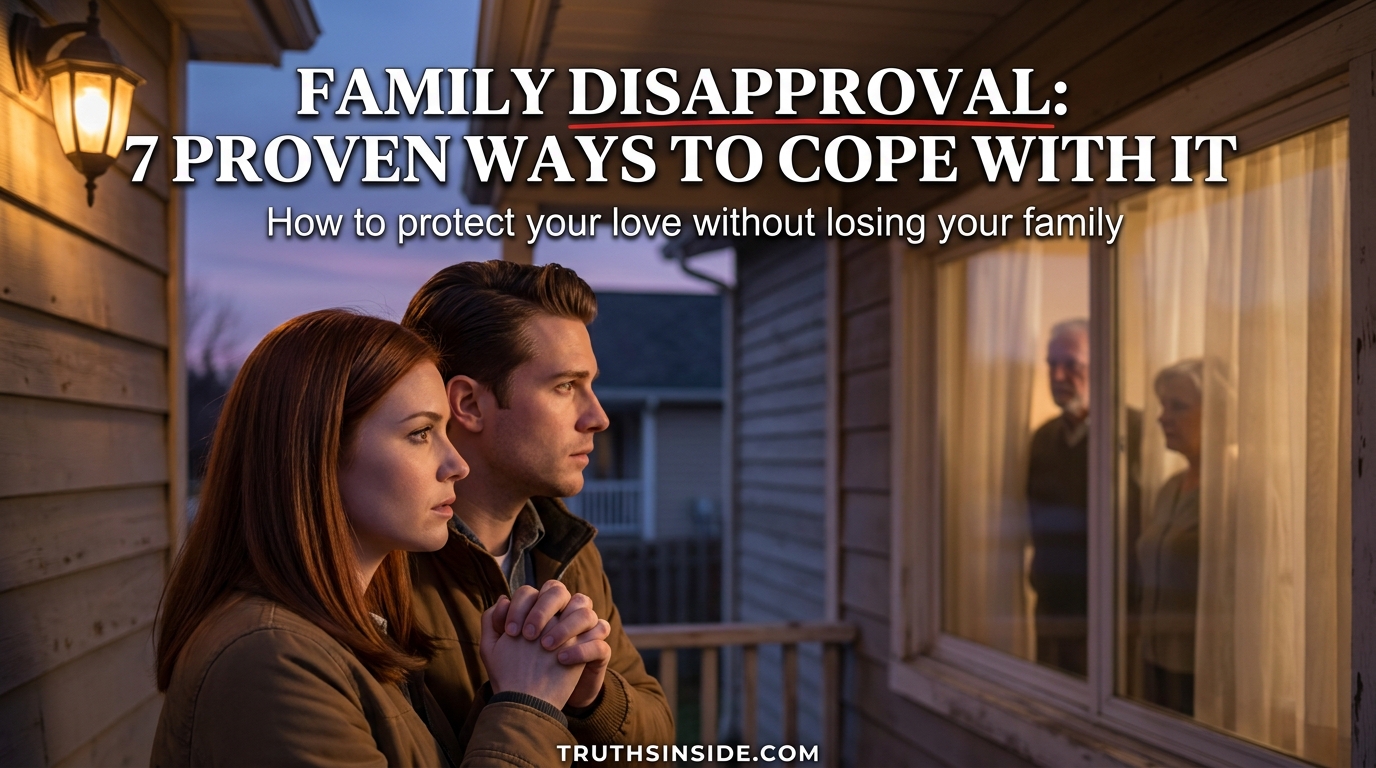
When Family Doesn’t Approve of Your Relationship: What to Do
Family disapproval can turn the happiest chapter of your life into a heavy, lonely one. You finally found someone who makes you feel seen, and yet the people who raised you respond with silence, sarcasm, or open resistance. Every family gathering starts to feel like a trial. You find yourself defending your partner in your head long before you arrive, and you wonder whether loving them means losing everyone else.
Research shows how real this pressure is. Psychologists Justin Lehmiller and Christopher Agnew found that perceived social disapproval from family and friends is linked to lower commitment in romantic relationships over time. A later study by Ronald Sinclair and colleagues revisited the famous “Romeo and Juliet effect” and found little support for the idea that opposition makes love stronger. In most cases, constant opposition simply wears couples down.
The good news is that you are not powerless. How you respond to family disapproval matters more than the disapproval itself. In this guide, you will learn why families resist, how to tell fair concern from unfair control, and seven proven ways to protect your relationship while keeping your heart open to the people who raised you.

Why Family Disapproval Hurts So Deeply
Your family shaped your earliest ideas about love, safety, and belonging. Their opinion matters to you in ways that go far beyond preference. When they reject your partner, it can feel like they are rejecting your judgment, your choices, and even your identity. That is why the pain often feels disproportionate to the actual argument.
It is also confusing because you love both sides. You may not want to choose between them, and you should not have to. Yet the tension pulls you in both directions, leaving you anxious, guilty, and tired. Recognizing that this pain is normal is the first step toward handling it wisely. Many people also feel ashamed of the hurt, thinking they should be tougher, and that shame only makes the isolation worse.
The Belonging Wound
Human beings are wired for group acceptance. Psychologists note that social rejection activates some of the same distress signals as physical pain. When your family withdraws warmth, your nervous system treats it as a threat to your place in the group.
This is why family disapproval can trigger people-pleasing, defensiveness, or sudden doubt about a relationship that was going well. The doubt is not always a sign that something is wrong with your partner. Sometimes it is simply the ancient fear of being cast out. Knowing this can help you pause before making any big decision while the emotions are loud.
What the Research Says About Opposition
The “Romeo and Juliet effect,” proposed in 1972 by Driscoll, Davis, and Lipetz, suggested that parental interference could intensify romantic love. It became a popular belief, but later work found mixed evidence at best. Lehmiller and Agnew’s research on so-called marginalized relationships found that disapproval tends to reduce commitment, especially when couples lack strong support elsewhere.
The takeaway is practical. You cannot rely on opposition to strengthen your bond. You need deliberate strategies, a united front, and outside support. Love does not thrive on pressure alone.
“Love does not need an enemy to grow. It needs safety, respect, and people willing to protect it.”
First, Understand Why Your Family Disapproves
Before you respond, it helps to understand the reasons behind the reaction. Disapproval is rarely random. Behind it usually sits fear, culture, history, or a mix of all three. Understanding does not mean agreeing, but it gives you something to work with instead of something to fight.
Common Reasons Behind Family Disapproval
Some families object because of religion, ethnicity, or cultural background, worrying that traditions will be lost or that daily life will be difficult. Others react to age gaps, differences in education or income, or the fact that your partner has children or a past marriage.
Sometimes the cause is fear. Parents may worry about being left behind, about your safety, or about repeating their own painful mistakes. In other cases, disapproval is tied to control, with a parent who struggles to accept that you are an adult making your own choices. Naming the real reason behind family disapproval helps you choose the right response.
When Their Concerns Deserve a Second Look
It takes courage to ask this question, but it matters: is there something your family sees that you might be missing? Sometimes family disapproval comes from genuine care, especially if they have noticed controlling behavior, disrespect, dishonesty, or signs that you are becoming isolated or unhappy.
Ask yourself honestly: do your friends share the same worry? Do you feel safe, respected, and free to be yourself? If the answer is no, take those concerns seriously and consider speaking with a trusted friend or counselor. If you ever feel unsafe, reach out to a professional or local support service immediately.
If the answer is yes, and the objections are about differences rather than harm, then you are dealing with a different problem, one of values and comfort rather than safety.
Seven Proven Ways to Handle Family Disapproval
There is no perfect script that instantly changes minds. But these seven strategies give you a steady framework for protecting your relationship while keeping the door open for repair.
📃 Related article: Emotionally Immature Partner: 9 Hidden Red Flags
Way 1: Get United With Your Partner First
Your relationship is the team that matters most in this situation. Before facing your relatives, agree with your partner on what you will say, what you will tolerate, and how you will support each other. Discuss how much contact feels comfortable and what you will do if comments become hurtful.
Invite your partner to share how the situation feels for them. They may feel unwelcome, judged, or afraid of coming between you and your family. Listening without defensiveness builds trust. A couple that feels secure with each other can weather far more outside pressure.
Way 2: Stay Calm and Do Not Attack
It is tempting to defend your partner by criticizing your family. Resist that urge. Harsh words are difficult to take back, and they give your relatives a reason to see your partner as the source of conflict.
Instead, stay steady and respectful. Use phrases like, “I understand you have concerns, and I hope you will get to know them.” Calm, repeated messages communicate maturity, and they make it harder for anyone to dismiss you as reckless or rebellious.
Way 3: Listen for the Fear Beneath the Words
When a parent says, “You are making a mistake,” the message underneath might be, “I am scared for you.” When they say, “This is not how we do things,” it might mean, “I am afraid we will lose you.”
Try asking, “What worries you most?” and listen without interrupting. You may not agree with the answer, but understanding it lets you respond to the real concern. Sometimes people soften just because they feel heard. Even when they do not, you gain clarity about what you are actually dealing with.

Way 4: Set Boundaries Around Disrespect
You can understand your family’s fears and still refuse to accept rude or cruel behavior. A boundary might sound like, “I want you in our lives, and I will not stay in conversations where my partner is insulted.” Then follow through by leaving the room or ending the call when the line is crossed.
Boundaries are not punishments. They are the conditions under which a relationship can continue safely. State them once, calmly, and act consistently. Over time, family members often adjust when they realize disrespect has a real cost, and family disapproval tends to lose intensity when it no longer gets a reaction.
“You can honor where you come from without surrendering where you are going.”
Way 5: Give Time and Small, Positive Exposure
Minds rarely change in a single conversation. More often, they shift through repeated, low-pressure contact. Consider short, pleasant meetings: a brief coffee, a shared meal, a walk. Keep the tone light and the length manageable, so no one feels trapped.
Gradually, your family sees your partner as a real person rather than a threat or a stereotype. Small acts of kindness, like remembering birthdays or showing interest in family traditions, can build goodwill without any argument. Patience is not weakness. It is often the fastest path to acceptance.
Way 6: Find a Bridge Person
Every family has someone who is respected and open-minded: a sibling, cousin, aunt, or family friend. Sharing your side with this person can create a quiet ally who speaks up in your favor when you are not in the room.
Choose someone kind and discreet, and avoid recruiting them into a battle. Your goal is to share the truth, not to gather troops. A gentle voice inside the family often carries more weight than any speech you could give yourself.
If no relative is open to this yet, look outside the family. A mentor, a friend from a similar background, or a community group of couples who have faced the same struggle can offer perspective and reassurance. Hearing that others found their way through can make the road feel less lonely and less impossible.
Way 7: Protect Your Relationship and Your Peace
Take care of your own mental and emotional health. Keep friendships strong, maintain routines, and make space for joy that has nothing to do with family conflict. A therapist or counselor can help both of you manage stress, communicate clearly, and make decisions without panic.
Also, make time to celebrate your relationship. Plan dates, share appreciation, and remind each other why you chose one another. Do not let family disapproval become the only story of your love.
It can help to create private rituals that belong only to the two of you: a weekly dinner, a shared hobby, a monthly walk with no phones. These rituals remind you that your relationship is not just a debate topic. It is a living, growing bond with its own joys, humor, and history, and that reminder gives you strength on difficult days.
📃 Related article: Difficult Family: 7 Proven Ways to Keep the Peace
What to Say When Family Disapproval Comes Up
Scripts help when emotions run high. If a parent criticizes your partner, you might say, “I hear that you are worried. I would like you to get to know them before you decide.” If comments turn personal, try, “I am not willing to discuss my partner this way, but I am happy to talk about how you are feeling.”
If you are asked to choose, respond with clarity and kindness: “I love you, and I am also committed to this relationship. I hope we can find a way to make room for both.” Repeat your message calmly, without adding new arguments each time.
What Not to Say
Avoid ultimatums, sarcasm, and comparisons. Statements like, “You will never accept anyone,” or “I will cut you off if you don’t change,” tend to harden positions. Also avoid using your partner as a messenger. Sensitive conversations belong with you.
Finally, resist the urge to prove your family wrong at all costs. The goal is not to win an argument. It is to build a life you can be proud of, and, if possible, keep the relationships that matter.

When Family Disapproval Involves Culture or Religion
Cross-cultural and interfaith couples often face special challenges, because the objection may be tied to deeply held identity and tradition. The pressure can feel enormous, and it can involve extended relatives and community expectations as well as parents.
In these situations, curiosity is a powerful bridge. Learn about your partner’s background, respect traditions where you can, and involve your family in ways that honor their values. Sometimes concrete gestures, such as attending a family ritual or learning a few words of a language, show respect more effectively than words.
Also decide together what matters most. Some traditions can be blended, some can be adapted, and some may require honest negotiation. Clear conversations early on prevent resentment later.
When Family Gives an Ultimatum
Ultimatums are one of the hardest forms of family disapproval. “Leave them or leave us” forces an impossible choice and threatens your sense of belonging. Before reacting, breathe. Ultimatums often come from fear and desperation, and they may soften over time.
Respond calmly, without making counter-threats. You might say, “I am not willing to end my relationship, and I would like to keep you in my life. I hope we can find a path forward.” Then give space. Avoid sudden decisions in the heat of the moment.
If the situation involves control, coercion, or threats to your safety, seek help from trusted people or professionals. No family tradition justifies fear or harm.
What If Family Disapproval Never Changes?
Sometimes, despite your best efforts, the disapproval persists. That can be heartbreaking, but it does not mean you failed. People change at their own pace, and some never change at all. What you can control is your own behavior, your boundaries, and the quality of your relationship.
You may need to adjust expectations. Perhaps you keep contact respectful but limited, or focus on relatives who are supportive. Grief is common in these situations, because you are mourning the family acceptance you hoped for. Let yourself feel it, and lean on your partner and friends for comfort.
Over time, family disapproval often eases, and many families do soften, especially when they see that the relationship is stable, respectful, and happy. Weddings, births, and everyday kindness often open doors that arguments never could.
Frequently Asked Questions
Should I end my relationship if my family disapproves?
Not automatically. Consider whether their concerns point to real problems like disrespect or safety, or whether they reflect differences in values or fear. If your relationship is healthy and you are happy, you have the right to keep choosing it.
How do I stop feeling guilty about family disapproval?
Guilt often shows up when we love people on both sides. Remind yourself that you can care about your family and still make your own decisions. A therapist can help you process the guilt and set boundaries.
Will my family ever accept my partner?
Many do, especially when given time and positive contact. Acceptance is more likely when the couple is united, respectful, and consistent. There are no guarantees, but patience often helps.
Should my partner try to win over my family?
Your partner can be kind and open, but they should not have to earn love through constant performing. Effort from both sides is healthy. One-sided pressure is not.
When should we seek counseling?
Consider counseling if the stress is affecting your relationship, if you argue constantly about family, or if either of you feels anxious, depressed, or stuck. Couples or family therapy can provide a neutral space to communicate.
Final Thoughts
Family disapproval is painful because it touches two of your deepest needs: love and belonging. You do not have to choose one over the other in a hurry, and you do not have to face it alone. With patience, clarity, and mutual support, many couples find a way through.
Remember that your relationship deserves respect, and so do you. Progress may be slow, and some days will feel like steps backward, but consistency is powerful. Stay kind, stay firm, and stay connected to the people who lift you up. Whatever your family decides, you can build a love that is steady, honest, and yours.
Save this article so you can return to these scripts when the tension rises. Share it with someone who is caught between the people they love. Follow Truthsinside.com for more honest, research-backed relationship advice every day.
🎵 Music
Maren Lull is a singer-songwriter who writes from the places most people don’t talk about out loud.
Not the dramatic grief. Not the obvious heartbreak. The quiet kind — the ordinary Tuesday emptiness, the habit of reaching for someone who isn’t there anymore, the particular exhaustion of being strong for so long that the strength itself wears thin.
Her music lives at the intersection of emotional honesty and soft beauty — breathy vocals over gentle piano, slow tempos, lyrics that feel less like songs and more like something you wrote in a private notebook at two in the morning and never showed anyone.
Maren Lull writes for the people who feel everything deeply and say very little about it. For the ones who listen to sad music not because they want to feel worse — but because being understood, even by a song, makes the feeling easier to carry.
📱 Follow Maren Lull:
→ Spotify
→ Apple Music
→ Youtube
→ Audiomack