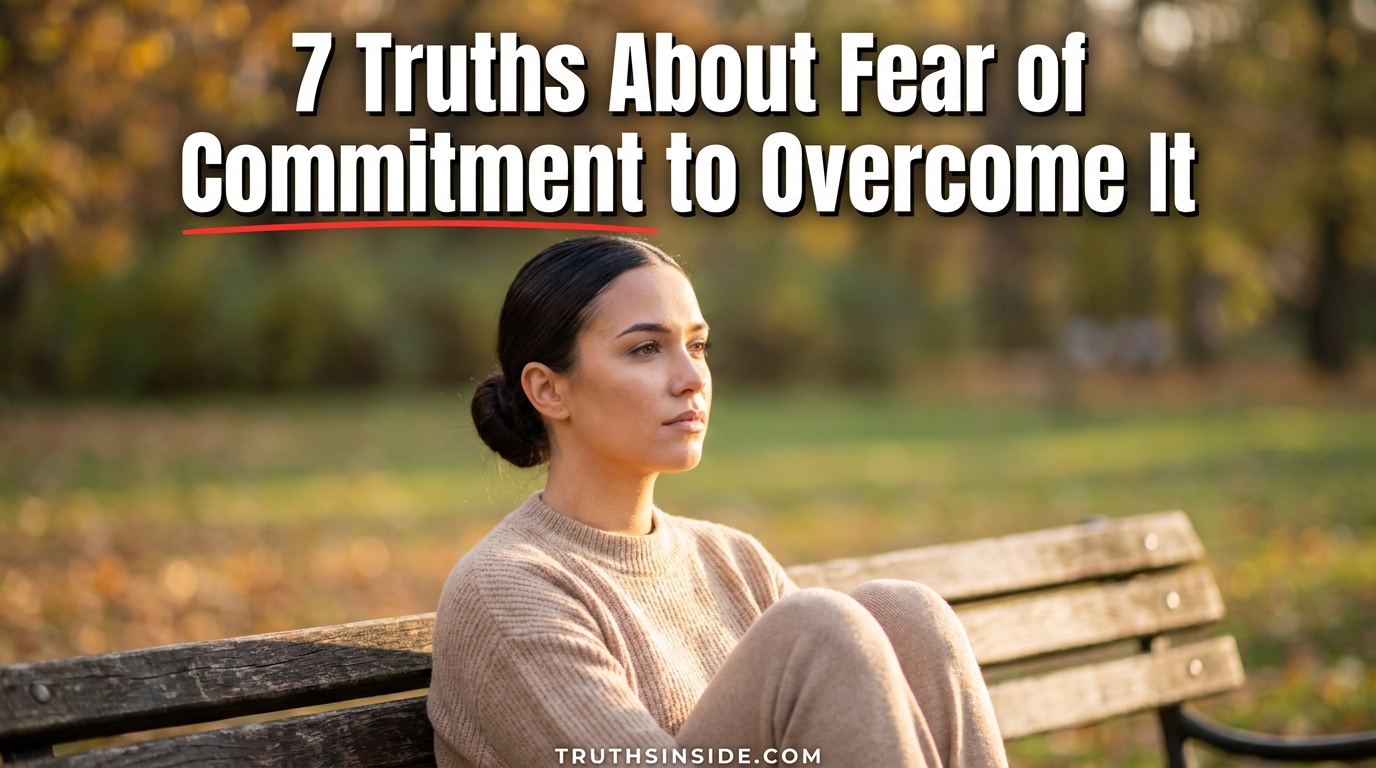
Fear of commitment is one of the most misunderstood emotional struggles in modern relationships — and chances are, it has already touched your life in some way. Maybe you have watched someone you love pull away just when things were getting serious. Maybe you are the one who always finds a reason to leave before it gets too real. According to research published in the Journal of Personality and Social Psychology, nearly 25% of adults report experiencing significant anxiety around long-term romantic commitment. That number is not small. It represents millions of people quietly suffering through a pattern they cannot seem to break — and often, they have no idea why.
What makes fear of commitment so painful is that it rarely looks the way people expect. It does not always show up as someone refusing to say “I love you.” Sometimes it hides behind constant busyness, subtle emotional distancing, or an endless search for a “better option.” The person experiencing it often wants love more than anything — they just cannot seem to let themselves have it. That paradox is heartbreaking, both for the person feeling it and for those who love them.
This article is not here to judge. It is here to help. Whether you are trying to understand yourself, a partner, or simply want to grow emotionally, the insights ahead will give you clarity, science-backed understanding, and real, actionable steps to finally move forward.
What Is Fear of Commitment, Really?
Fear of commitment is not simply about refusing to get married or avoiding labels on a relationship. At its core, it is a deep emotional resistance to becoming fully invested in another person — a fear of being locked in, of losing freedom, of being hurt, or of not being enough. Psychologists often refer to this as gamophobia when it reaches clinical levels, but in everyday life, it tends to exist on a broad spectrum.
Some people with commitment fears are aware of their pattern. They have been told by multiple partners that they “run away” or “never fully show up.” Others have no awareness at all — they genuinely believe they just have not met the right person yet, when in reality they are unconsciously sabotaging every relationship that gets too close to something real.
Dr. Scott Stanley, a relationship researcher at the University of Denver, describes commitment as having two distinct components: dedication — the desire to be with someone — and constraint — the sense of obligation that comes with a serious partnership. For people with commitment fear, the constraint component triggers an almost automatic emotional alarm. Their mind interprets intimacy as a threat, not a gift.
It is important to understand that this is not a character flaw. It is often a deeply ingrained psychological response built from past experiences — sometimes from childhood, sometimes from heartbreak, and sometimes from witnessing the relationships around them fall apart.

The Root Causes of Fear of Commitment
Understanding where fear of commitment comes from is the first and most important step to dismantling it. This fear rarely appears out of nowhere. It has roots — and those roots run deep.
1. Attachment Style Formed in Childhood
One of the most well-documented causes of commitment fear is an insecure attachment style developed in early childhood. According to attachment theory, pioneered by psychologist John Bowlby and later expanded by Mary Ainsworth, children who did not receive consistent emotional attunement from their caregivers often develop either anxious or avoidant attachment patterns. Adults with avoidant attachment tend to suppress emotional needs, value independence to an extreme, and instinctively pull back when a relationship becomes emotionally close. This is commitment fear wearing its earliest mask.
2. Past Relationship Trauma
A devastating breakup, infidelity, or being abandoned by someone you deeply loved can leave invisible scars that rewire how your brain responds to romantic vulnerability. When a person has been badly hurt, the nervous system learns to associate intimacy with danger. Committing to someone again means opening yourself up to that same level of pain — and the subconscious mind will do almost anything to prevent that from happening again.
3. Fear of Losing Identity or Freedom
Some people equate commitment with losing themselves — their independence, their goals, their freedom to change. This is especially common in high-achieving individuals or those who grew up in environments where they were taught that needing others was a form of weakness. They love the idea of a relationship in theory, but in practice, every step toward deeper commitment feels like a door closing on who they are.
4. Witnessing Failed Relationships
Children who grew up watching their parents in an unhappy marriage, going through a bitter divorce, or cycling through toxic relationships often unconsciously absorb the message that love does not last — or that it hurts more than it heals. These early observations become internal blueprints that shape romantic behavior decades later.
5. Perfectionism and the Illusion of a “Better Option”
In the digital age, where dating apps offer an endless scroll of potential partners, perfectionism feeds commitment fear in a uniquely modern way. If someone is never quite satisfied — always wondering if someone better is just one swipe away — it becomes nearly impossible to fully invest in the person in front of them. This is sometimes called the paradox of choice, and it is a very real driver of contemporary commitment avoidance.
“The person with commitment fear does not lack the ability to love. They lack the belief that love is safe enough to stay in.”
Signs You or Your Partner May Have Fear of Commitment
Recognizing the signs is crucial — not to diagnose or shame, but to create awareness so that real change can begin.
You avoid conversations about the future. When your partner mentions moving in together, meeting the family, or even making plans a few months ahead, you feel an unexplainable tightening in your chest and find ways to change the subject.
You find fault when things get serious. Relationships that start beautifully begin to feel suffocating the moment they deepen. Suddenly, small quirks become deal-breakers. Attraction seems to fade not because it has gone — but because closeness has triggered the fear alarm.
You have a pattern of almost-relationships. You connect deeply, things start to grow, and then something in you pulls the emergency brake. You have done this more than once. Maybe more than five times.
You struggle with labels. Even defining the relationship feels threatening. “What are we?” is a question that makes you want to disappear.
You romanticize being alone. You tell yourself and others that you prefer freedom, that you are “not the relationship type,” or that you have not found anyone worth committing to — when the truth is that you have, and you still ran.
You are emotionally unavailable but intensely attracted to those who are. This one is subtle but powerful. People with commitment fear are often drawn to partners who are emotionally open and willing to commit — and then feel overwhelmed when that energy is actually directed at them.

How Fear of Commitment Affects Your Relationships
Fear of commitment does not just affect the person experiencing it — it sends ripple effects through every relationship it touches. Partners of commitment-avoidant individuals often describe feeling confused, unloved, and emotionally exhausted. They may begin to question their own worth, wondering what they are doing wrong, why they can never quite reach the person they love.
Over time, this dynamic creates a painful push-pull cycle. The commitment-avoidant partner withdraws. The other partner, feeling the withdrawal, pursues harder. This pursuit triggers even more withdrawal — until someone eventually breaks, and the relationship ends in exactly the kind of pain the avoidant person was trying to prevent in the first place.
Ironically, the very strategy meant to protect against heartbreak creates it — both for the person running and for those left behind.
It is also worth noting that commitment fear does not disappear on its own. Without awareness and intentional effort, it tends to become more entrenched with age. Every relationship avoided reinforces the belief that closeness is dangerous. Every time someone runs, the pattern becomes more automatic, more comfortable, and harder to break.
How to Overcome Fear of Commitment: Powerful Steps That Actually Work
Here is the part that matters most — because understanding the problem is only halfway there. The real work is in healing.
Step 1: Acknowledge That the Fear Is Real and Valid
Before you can overcome anything, you have to stop pretending it does not exist. Fear of commitment is not weakness. It is a protective response that once made sense — perhaps it kept you emotionally safe during a painful time in your life. Acknowledge it without judgment. Say to yourself: “I have this fear. It is not who I am. And I can work through it.”
Step 2: Identify Your Attachment Style
Take time to genuinely explore your attachment patterns. There are many well-validated online assessments based on attachment theory that can help you identify whether you lean anxious, avoidant, or disorganized in attachment. Understanding your style is not about labeling yourself permanently — it is about shining a light on the unconscious patterns driving your behavior so you can begin to change them.
Step 3: Trace the Origin of the Fear
This is deeper work, and it is powerful. Ask yourself: when did I first learn that love was unsafe? What relationship — romantic, familial, or otherwise — taught me that getting close leads to pain? Journaling, honest reflection, or working with a therapist can help you trace the fear back to its source. When you understand where a belief comes from, it loses some of its invisible power over you.
Step 4: Practice Tolerating Discomfort in Small Steps
Commitment is not all-or-nothing. You do not have to go from emotionally closed to completely vulnerable overnight. Instead, practice taking small, intentional steps toward openness. Share something personal with your partner. Stay in a conversation about the future even when it makes you anxious. Let yourself feel the discomfort without immediately escaping it. Every time you stay present through the fear instead of running from it, you are literally rewiring your brain’s response to intimacy.
Step 5: Communicate Openly With Your Partner
If you are in a relationship and you recognize this pattern in yourself, one of the most courageous and loving things you can do is talk about it — honestly. You do not have to have it all figured out. Simply saying “I have noticed I get scared when things get serious, and I am working on understanding why” is an act of profound emotional bravery. It also gives your partner the context they need to be a supportive presence rather than a confused and hurting one.
Step 6: Consider Professional Therapy
There is no shame in seeking help — there is wisdom in it. A licensed therapist, particularly one who specializes in attachment or emotionally focused therapy (EFT), can help you unpack the deeper layers of your commitment fear in ways that self-help alone often cannot reach. Therapy creates a safe space to explore vulnerability, practice emotional honesty, and gradually build the internal security that makes commitment feel possible rather than terrifying.
Step 7: Redefine What Commitment Means to You
Part of the reason commitment feels so threatening is because of the stories we tell about it. If you believe that committing to someone means losing yourself, giving up freedom, or guaranteeing eventual pain — then of course you will resist it. Challenge those narratives. Commitment, in its healthiest form, is not a cage. It is a chosen partnership between two people who actively decide, every day, to show up for each other. It expands life — it does not diminish it.
“Healing from fear of commitment is not about becoming fearless. It is about choosing love even when the fear is still there.”

When It Is Not Just Fear — Recognizing When to Seek Help Immediately
While fear of commitment is common and workable, there are situations where professional support is not just helpful — it is essential. If your avoidance of commitment is causing you significant distress, if it is rooted in unresolved trauma, if it is pushing you toward harmful coping mechanisms, or if you find yourself repeatedly in relationships that feel emotionally abusive or chaotic — please reach out to a qualified mental health professional.
Commitment fear that goes unaddressed for years can evolve into chronic loneliness, depression, and a painful sense of being fundamentally disconnected from the people around you. You deserve better than that. And the people who love you deserve a version of you that is working toward wholeness — not running from it.
The Role of Self-Worth in Commitment Fear
One of the most overlooked drivers of fear of commitment is low self-worth. Many people do not commit because deep down, they do not believe they are worthy of being loved consistently. They expect to be abandoned or found inadequate — so they leave first. It is an unconscious strategy: if I go before they discover who I really am, I will never have to feel the rejection.
This is why building a genuine, stable relationship with yourself is foundational to overcoming commitment fear. When you know your own worth — not because someone else tells you, but because you have done the work to understand and accept yourself — the idea of another person seeing all of you and still choosing to stay becomes less terrifying. It becomes possible.
A Final Word: You Are Capable of Love That Lasts
Fear of commitment does not make you broken. It makes you human — a human who has been hurt, or who learned early that love comes with conditions or pain. But those lessons, as real as they felt, do not have to be the last word on your story.
The fact that you are reading this, that you are asking these questions and searching for something better, is already evidence that the part of you that wants real love is still very much alive. That part deserves to win.
With awareness, courage, and the right support, fear of commitment can be overcome. Not perfectly, not all at once — but genuinely, meaningfully, and in ways that can transform not just your relationships, but your entire experience of life.
CTA
💾 Save this article so you can come back to it whenever the fear feels loud again.
📤 Share it with someone who might be going through this — you might be the reason they finally understand what has been holding them back.
👣 Follow Truthsinside.com for more honest, research-backed relationship and psychology content that actually helps.
📃 Related article: 15 Signs She Is Testing You: Why Women Test Men and What to Do
FAQ: Fear of Commitment
Q1: Can someone with fear of commitment ever change?
Absolutely. Fear of commitment is a learned emotional pattern, and what was learned can be unlearned. With self-awareness, therapy, and consistent effort, many people with significant commitment fears have gone on to build deeply fulfilling, long-term relationships. Change is not instant — but it is absolutely possible.
Q2: Is fear of commitment the same as not being ready for a relationship?
Not exactly. “Not being ready” often implies a temporary state tied to life circumstances — like finishing school, healing from a recent breakup, or building a career. Fear of commitment, on the other hand, is a persistent emotional pattern that tends to follow a person across different seasons of life and multiple relationships. If the pattern keeps repeating, it is worth looking deeper than “timing.”
Q3: How do I help a partner who has fear of commitment without losing myself?
This is one of the hardest situations to navigate. First, make sure you are communicating your needs clearly — you should not have to indefinitely suppress what you want out of love for someone who is not actively working on their patterns. Encourage your partner to seek support, but also hold firm to your own emotional boundaries. You can be compassionate and still protect your own heart.
Q4: Does fear of commitment always come from childhood?
Not always, though childhood attachment patterns are one of the most common root causes. Commitment fear can also develop from adult experiences — a devastating betrayal, a traumatic relationship, or prolonged periods of emotional isolation. The origin varies from person to person, which is why personalized reflection or therapy is so valuable.
Q5: What is the difference between fear of commitment and simply preferring to be single?
Someone who genuinely prefers the single lifestyle typically feels content and fulfilled in that choice — there is no internal conflict, no pattern of almost-relationships, no persistent longing for something deeper. Fear of commitment, by contrast, often involves a painful tension: wanting love but being unable to let it in. If the idea of being alone long-term fills you with peace, that is a preference. If it fills you with a quiet ache — that is worth exploring.
🎵 Music
Maren Lull is a singer-songwriter who writes from the places most people don’t talk about out loud.
Not the dramatic grief. Not the obvious heartbreak. The quiet kind — the ordinary Tuesday emptiness, the habit of reaching for someone who isn’t there anymore, the particular exhaustion of being strong for so long that the strength itself wears thin.
Her music lives at the intersection of emotional honesty and soft beauty — breathy vocals over gentle piano, slow tempos, lyrics that feel less like songs and more like something you wrote in a private notebook at two in the morning and never showed anyone.
Maren Lull writes for the people who feel everything deeply and say very little about it. For the ones who listen to sad music not because they want to feel worse — but because being understood, even by a song, makes the feeling easier to carry.
📱 Follow Maren Lull:
→ Spotify
→ Apple Music
→ Youtube
→ Audiomack