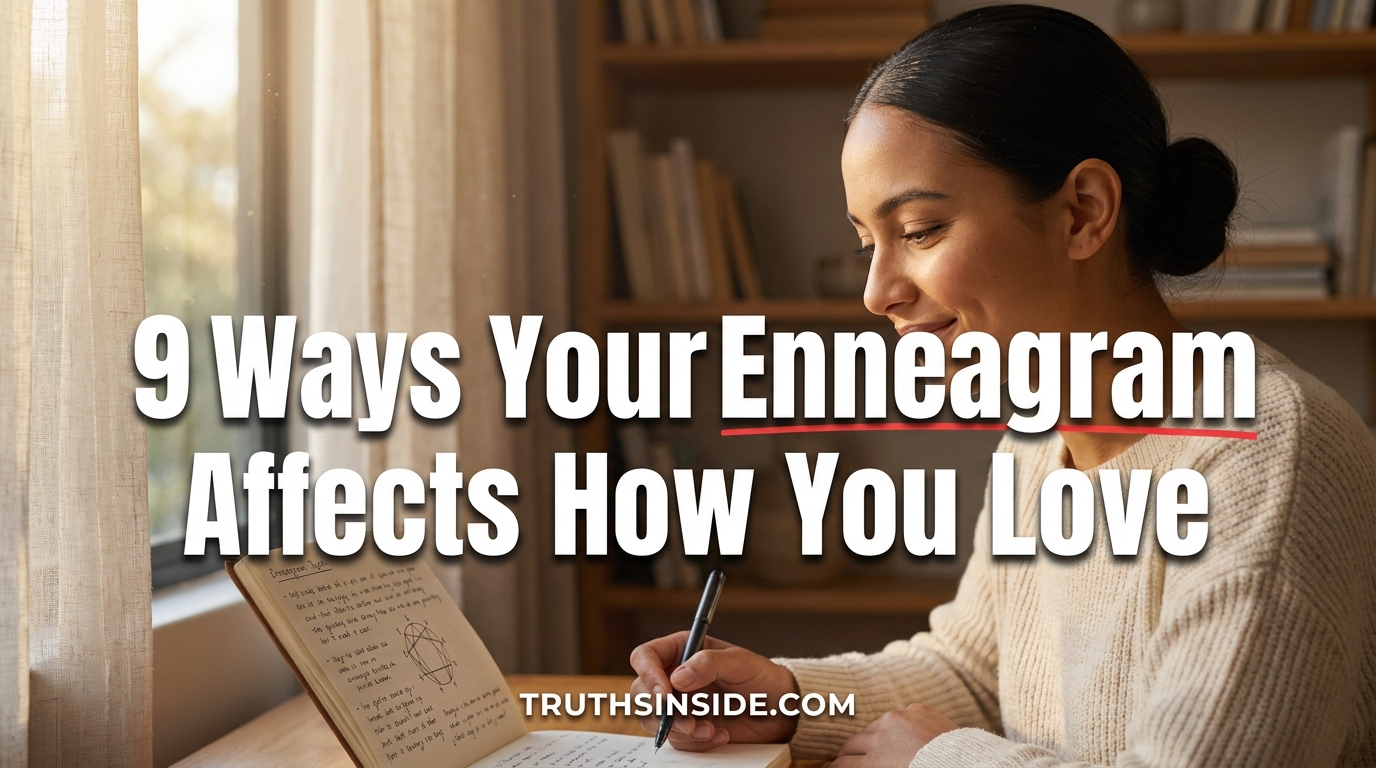
Have you ever wondered why you love the way you do — why you need constant reassurance, or why you pull away when someone gets too close, or why you give everything to a relationship until there is nothing left of yourself? The answer might be written deeper in your personality than you ever realized. Research in personality psychology consistently shows that our core personality patterns directly shape how we behave in romantic relationships — and the Enneagram, one of the most nuanced personality frameworks in modern psychology, offers a uniquely powerful lens for understanding exactly why. A 2021 study published in the Journal of Individual Differences found that Enneagram type significantly predicted relationship satisfaction and conflict patterns across multiple personality categories.
What makes the Enneagram different from other personality systems is that it does not just tell you what you do — it tells you why you do it. It identifies nine distinct core motivations, each rooted in a deep fear and a deep desire that quietly drives almost every decision a person makes, including who they fall for and how they show up in love. It is equal parts illuminating and sometimes uncomfortably accurate.
Whether you are new to the Enneagram or have known your type for years, understanding how your type shows up in love is one of the most valuable things you can do for your relationships. This article walks through all nine types, how each one loves, what each one struggles with, and what real growth looks like in relationships — so you can stop repeating the same patterns and start building something that actually lasts.
What Is the Enneagram and Why Does It Matter in Relationships?
The Enneagram is a personality system that describes nine interconnected character types, each defined by a core motivation — a fundamental fear and a fundamental desire that shapes how a person perceives the world and relates to others. Unlike many personality assessments that focus primarily on behavior, the Enneagram goes beneath behavior to the motivational layer — the emotional engine running underneath everything you say and do.
The nine types are organized around three centers of intelligence: the Body Center (Types 8, 9, and 1), the Heart Center (Types 2, 3, and 4), and the Head Center (Types 5, 6, and 7). These centers indicate where a person primarily processes their experience of the world — through instinct and gut feeling, through emotion and image, or through thinking and mental analysis.
In relationships, this matters enormously. Two people can behave similarly on the surface — both might avoid conflict, for example — but for completely different underlying reasons. A Type 9 avoids conflict to preserve harmony and peace. A Type 5 avoids conflict because emotional confrontation feels deeply draining and threatening to their sense of autonomy. The difference in motivation changes everything: how they respond to reassurance, what they need from a partner, and what patterns are most likely to derail the relationship.
Understanding your Enneagram type is not about putting yourself in a box. It is about understanding the invisible architecture of your emotional life — so that for the first time, you can make conscious choices instead of running on unconscious autopilot in the relationships that matter most to you.

The 9 Enneagram Types and How Each One Loves
Type 1 — The Reformer: Love With High Standards
Type 1s love with deep sincerity, loyalty, and a genuine desire to do things right. In relationships, they are devoted, responsible, and incredibly principled. They want a partnership that is built on shared values, honesty, and mutual growth — and they take the commitment seriously.
However, Type 1s carry an inner critic that never truly goes quiet. This inner critic does not stay in the background — it often extends outward into relationships, manifesting as criticism of a partner’s habits, choices, or ways of doing things. This is rarely malicious. It comes from a deep desire for things to be as good as they can possibly be. But for partners who need to feel accepted as they are, this pattern can feel exhausting and quietly devastating.
The growth path for Type 1 in love is learning to extend to their partner — and to themselves — the same grace and acceptance they wish the world would give more freely. Love does not have to be earned through perfection. It can simply be given.
Greatest strength in love: Loyalty, integrity, and a genuine commitment to growth together.
Biggest challenge: Criticism and the inability to relax into imperfection.
Type 2 — The Helper: Love That Gives Everything
Type 2s are perhaps the most naturally loving of all the Enneagram types — warm, attentive, deeply empathetic, and almost supernaturally attuned to what the people around them need. In relationships, they are incredibly giving partners who make their loved ones feel seen, valued, and deeply cared for.
But the shadow side of Type 2’s love is that it often comes with invisible strings. Because Type 2s so deeply fear being unwanted or unloved, their giving is frequently an unconscious strategy to make themselves indispensable to their partner. When their giving is not reciprocated in the way they hope — and they rarely ask directly for what they need — resentment builds quietly beneath the surface until it can no longer be contained.
The growth path for Type 2 in love is learning that they are worthy of love not because of what they give, but simply because of who they are. Asking for needs to be met is not weakness — it is one of the most loving and honest things they can do in a relationship.
Greatest strength in love: Generosity, emotional warmth, and deep attunement to their partner’s needs.
Biggest challenge: Giving to get, and suppressing their own needs until resentment takes over.
Type 3 — The Achiever: Love Performed or Love Felt?
Type 3s bring ambition, charm, confidence, and magnetic energy into their relationships. They are often exciting, inspiring partners who motivate the people around them and create a relationship that looks impressive from the outside.
The deep challenge for Type 3 in love is authenticity. Because their core fear is being worthless or without value, Type 3s become experts at performing the version of themselves that they believe will be most loved and admired. In relationships, this can mean showing up as the “perfect partner” in terms of appearance and achievement — while the real, unguarded self stays carefully hidden.
True intimacy requires being known — not admired. And for Type 3, learning the difference between the two is the entire journey of love.
Greatest strength in love: Passion, drive, and the ability to make a partner feel like they are with someone truly exceptional.
Biggest challenge: Confusing performance with genuine intimacy and vulnerability.
Type 4 — The Individualist: Love as a Deep, Consuming Experience
Type 4s experience love more intensely than perhaps any other type. They are romantic, deeply emotional, creative, and profoundly attuned to beauty and meaning. When a Type 4 loves you, they love you with their entire soul — and they want that love to feel epic, meaningful, and unlike anything either person has ever experienced before.
The challenge is that Type 4s are also deeply susceptible to melancholy and the feeling that something is always missing. In relationships, this can manifest as idealizing a partner in the early stages and then becoming disappointed when the relationship settles into something more ordinary. They may long for a partner who is unavailable, while taking for granted the love that is right in front of them.
The growth path for Type 4 in love is learning that ordinary moments of real love — consistent, quiet, unglamorous love — are not inferior to the dramatic intensity they crave. They are, in fact, the most profound love of all.
Greatest strength in love: Depth, emotional authenticity, and a capacity for profound intimacy.
Biggest challenge: Idealization, emotional volatility, and longing for what is not there.
“Your Enneagram type does not determine your destiny in love. It reveals the unconscious patterns you must bring into the light to love well.”
Type 5 — The Investigator: Love From a Careful Distance
Type 5s are intellectual, perceptive, and deeply private. In love, they are loyal and genuinely caring — but their way of showing love looks very different from most other types. They show love through presence, through sharing their inner world of ideas, and through the simple act of choosing to let someone in — which for a Type 5, is no small thing.
The core challenge in love for a Type 5 is that intimacy feels inherently depleting. They guard their inner resources — emotional, mental, and energetic — with great vigilance. A partner who needs a lot of togetherness, emotional processing, or verbal affirmation will consistently feel like they are reaching for someone who is always just slightly out of reach.
Growth for Type 5 in love means trusting that sharing yourself does not empty you. Real intimacy — when built with the right person — actually replenishes.
Greatest strength in love: Depth of thought, fierce loyalty, and a rich inner world they will share with very few.
Biggest challenge: Emotional withdrawal, detachment, and difficulty with vulnerability.

Type 6 — The Loyalist: Love Built on Trust and Security
Type 6s are among the most loyal, committed, and trustworthy partners in the entire Enneagram. When a Type 6 loves you, they are in it — fully, seriously, and with a level of dedication that is genuinely rare. They show up, they follow through, and they take the relationship seriously from the very beginning.
The challenge is that Type 6s are driven by anxiety and a deep need for security. In love, this often manifests as persistent worry — about the relationship’s stability, about their partner’s faithfulness, about whether things are truly okay when they seem fine. They may frequently seek reassurance, test their partner’s loyalty in subtle ways, or catastrophize during conflict.
Growth for Type 6 in love is learning to build internal security — to trust not just their partner, but their own ability to handle whatever comes. Love is always a risk. The courage to take that risk without constant reassurance is how Type 6s access their most powerful selves.
Greatest strength in love: Unmatched loyalty, reliability, and a deep desire to build something lasting.
Biggest challenge: Anxiety, over-thinking, and seeking reassurance that can never fully satisfy the underlying fear.
Type 7 — The Enthusiast: Love That Keeps Moving
Type 7s are joyful, adventurous, spontaneous, and endlessly fun to be around. They bring lightness, excitement, and a genuine enthusiasm for life into their relationships — and their partners often feel swept up in a beautiful, expansive energy.
The challenge for Type 7 in love is staying. Not physically — but emotionally. Type 7s run from pain the way others run from fire. When a relationship hits a difficult patch — as all relationships inevitably do — the Type 7’s instinct is to redirect toward something more pleasant, to reframe, to plan something exciting, or to quietly begin looking toward the next new thing.
Real love requires the willingness to sit in the hard moments without escaping them. For Type 7, growth in love means learning that depth — including emotional depth — is not a trap. It is the destination.
Greatest strength in love: Joy, spontaneity, and an ability to make a relationship feel genuinely alive.
Biggest challenge: Avoiding pain, emotional depth, and the harder work of staying present through difficulty.
Type 8 — The Challenger: Love as Fierce Protection
Type 8s love with an intensity and fierceness that is almost overwhelming in the best possible way. They are protective, direct, passionate, and deeply loyal to the people they let into their inner circle. Being loved by a Type 8 means being defended, championed, and chosen with absolute conviction.
The challenge is that Type 8s built their entire identity around strength and self-sufficiency. Vulnerability — the very thing that love requires — feels to a Type 8 like exposure to potential harm. Showing softness, admitting fear, or needing someone can feel like betraying their most essential self. As a result, they may come across as domineering, controlling, or emotionally unavailable in the tender dimensions of love.
Growth for Type 8 in love is discovering that true strength includes the courage to be soft. The most powerful thing a Type 8 can do in a relationship is let themselves be seen without armor.
Greatest strength in love: Fierce protection, passionate loyalty, and a love that never half-heartedly shows up.
Biggest challenge: Vulnerability, control, and difficulty letting a partner truly see behind the strength.
Type 9 — The Peacemaker: Love That Loses Itself
Type 9s are gentle, accepting, warm, and deeply easy to love. They create an atmosphere of peace and non-judgment in relationships that their partners often describe as the most emotionally safe they have ever felt. They are naturally accommodating, deeply empathetic, and almost allergically averse to conflict.
The challenge for Type 9 in love is that they can merge so completely with a partner’s wants, preferences, and world that they lose track of their own. Over time, they may not even know what they want from the relationship — because they have been prioritizing everyone else’s needs for so long that their own have gone underground.
Growth for Type 9 in love means reclaiming their own voice, their own desires, and their own presence in the relationship. A relationship cannot truly thrive when one person has disappeared into it. Both people need to fully show up.
Greatest strength in love: Unconditional acceptance, deep empathy, and a natural ability to create emotional safety.
Biggest challenge: Losing themselves in the relationship and avoiding the conflict necessary for genuine growth.

How to Use Your Enneagram Type to Actually Improve Your Relationship
Knowing your Enneagram type is valuable. Using it is transformative. Here is how to take this knowledge from interesting self-awareness into real relational change.
Share your type with your partner — and actually talk about it. Not as a way to excuse patterns (“I am a Type 5, I just cannot be emotionally available”) but as a way to open honest dialogue about needs, fears, and the kind of love that actually reaches you. The Enneagram becomes a shared language that makes hard conversations easier.
Identify your type’s core fear and how it shows up in conflict. Every type has a specific way their core fear gets activated during relationship stress. When you know what that looks like for you — and for your partner — you can begin to interrupt the automatic response before it does damage.
Focus on your type’s growth direction, not just its stress patterns. Every Enneagram type has a direction of growth — a set of qualities from another type that represent their path toward wholeness. Moving in that direction in your relationship, even in small ways, creates genuine change rather than simply managing the same old patterns.
Use it for compassion, not justification. The most important thing to understand is that the Enneagram is not a permission slip to stay stuck. It is a map toward growth. Use it to understand your partner with more compassion and to hold yourself with more honesty.
“Understanding your Enneagram type in love is not about finding excuses. It is about finding the path back to each other — and to yourself.”
A Final Word: Every Type Is Capable of Deep, Lasting Love
No Enneagram type is better or worse at love. No type is destined for loneliness and no type is guaranteed relational bliss. Every single type — from the fiercely guarded Type 8 to the self-erasing Type 9 — carries within them a profound capacity for love.
The difference between a type’s shadow patterns and their highest expression in love is always the same thing: awareness. The moment you can see the pattern, you are no longer completely controlled by it. And in that space between trigger and reaction, between fear and choice, real love becomes possible.
Your Enneagram type is not your cage. It is your starting point. Where you go from here is entirely up to you.
CTA
💾 Save this article and come back to it every time you want to understand yourself — or your partner — a little more deeply.
📤 Share it with someone whose love patterns you have never quite been able to figure out. This might be the article that finally explains it.
👣 Follow Truthsinside.com for more psychology-driven relationship content that goes beneath the surface and actually changes things.
📃 Related article: Signs He Likes You But Is Scared: 18 Behaviors Men Show When Afraid to Commit
FAQ: Enneagram Type and Love
Q1: How do I find out my Enneagram type?
The most reliable way to identify your Enneagram type is through a combination of reading detailed type descriptions and taking a validated assessment. The Riso-Hudson Enneagram Type Indicator (RHETI) is widely regarded as one of the most accurate paid assessments available. Free versions exist as well, though they vary in accuracy. The key is to read deeply and reflect honestly — not just on your behavior, but on your core motivation and deepest fears.
Q2: Can two people of the same Enneagram type be in a successful relationship?
Absolutely. Same-type relationships can be deeply fulfilling because there is often a natural level of mutual understanding. However, they can also amplify each type’s shadow patterns — two Type 4s may spiral into emotional intensity together, while two Type 9s may struggle to make decisions or address conflict. Awareness is the deciding factor, not type compatibility alone.
Q3: Which Enneagram types are most compatible in romantic relationships?
The Enneagram does not designate specific “compatible” pairings the way some systems do, because compatibility depends far more on each person’s level of self-awareness and emotional health than on their type. That said, some combinations naturally complement each other — such as Type 1 and Type 7, whose energy can balance each other beautifully — while others require more intentional work. No combination is impossible with the right level of growth and commitment.
Q4: Can your Enneagram type change over time?
Your core Enneagram type does not change — it is rooted in your fundamental motivational structure. However, how your type expresses itself absolutely evolves as you grow. A healthy, self-aware Type 2 looks radically different from an unhealthy one. Growth within your type — moving toward your type’s integration direction — is the real journey, and it is one that continues throughout your entire life.
Q5: My partner and I have types that seem incompatible. Should I be worried?
No. Type combinations that seem challenging on paper can produce some of the most rich, growth-oriented, and deeply fulfilling relationships — precisely because each partner stretches the other toward their own growth edge. The question is never really about type compatibility. It is always about whether both people are committed to understanding themselves and each other, and willing to do the work. If the answer is yes, almost any type combination can thrive.
🎵 Music
Maren Lull is a singer-songwriter who writes from the places most people don’t talk about out loud.
Not the dramatic grief. Not the obvious heartbreak. The quiet kind — the ordinary Tuesday emptiness, the habit of reaching for someone who isn’t there anymore, the particular exhaustion of being strong for so long that the strength itself wears thin.
Her music lives at the intersection of emotional honesty and soft beauty — breathy vocals over gentle piano, slow tempos, lyrics that feel less like songs and more like something you wrote in a private notebook at two in the morning and never showed anyone.
Maren Lull writes for the people who feel everything deeply and say very little about it. For the ones who listen to sad music not because they want to feel worse — but because being understood, even by a song, makes the feeling easier to carry.
📱 Follow Maren Lull:
→ Spotify
→ Apple Music
→ Youtube
→ Audiomack