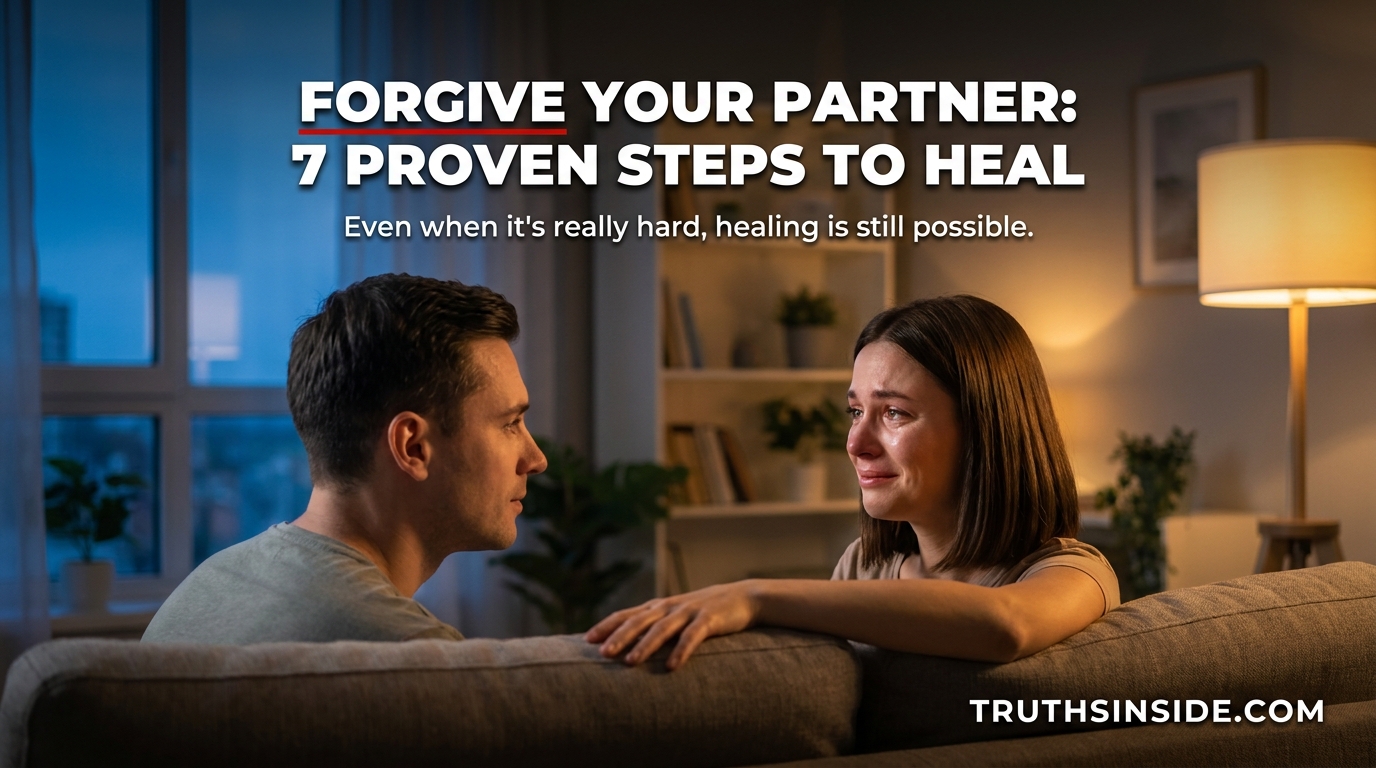
How to Forgive Your Partner (Even When It’s Really Hard)
Trying to forgive your partner can feel like being asked to hold out your hand to the very person who just hurt you. Your mind replays the moment on a loop. Your chest tightens when you see their face. Friends say “just let it go,” but nobody explains how to do that when the pain is still fresh and the trust is still broken. If you are struggling right now, please know this: wanting to forgive your partner and being unable to do it yet are not opposites. They often exist together.
Research gives some reason for hope. Studies by psychologist Frank Fincham and colleagues suggest that forgiveness in marriage is linked with more constructive conflict resolution and greater relationship satisfaction over time. And Everett Worthington, one of the most cited forgiveness researchers, has shown that forgiveness is a learnable process, not a personality trait you either have or lack. You do not need to be a saint. You need a path.
This guide offers that path. You will learn what it truly means to forgive your partner, what forgiveness is not, when it is wise to wait, and seven practical steps to forgive your partner even when it feels impossible. You will also find scripts, a timeline for healing, and clear guidance on situations where forgiveness should never come at the cost of your safety.

What It Really Means to Forgive Your Partner
To forgive your partner means making a conscious choice to release your claim to revenge, punishment, and ongoing resentment, even though they hurt you. It does not mean the hurt was small. It does not mean it was acceptable. It means you decide that the offense will no longer control how you think, feel, and behave.
Worthington distinguishes between two kinds of forgiveness. Decisional forgiveness is a choice to treat the person without hostility and to give up revenge. Emotional forgiveness is the gradual replacement of bitterness, anger, and fear with more neutral or even warm feelings. Decisional forgiveness can happen in a moment. Emotional forgiveness usually takes much longer, and that is completely normal.
Robert Enright, another pioneer in this field, describes forgiveness as a moral response in which you offer compassion to someone who has wronged you, without requiring them to deserve it. He is also clear that forgiveness is not the same as reconciliation. You can forgive your partner and still decide that the relationship must change, or even end.
📃 Related article: Love Yourself First: 7 Powerful Steps to Real Love
What Forgiveness Is Not
Many people resist forgiveness because they misunderstand it. Clearing up these myths can lighten the load right away.
- Forgiveness is not forgetting. You can remember what happened and still choose to release the bitterness.
- Forgiveness is not excusing. Saying “I forgive you” does not mean “what you did was fine.”
- Forgiveness is not instant. It often arrives in layers, with setbacks along the way.
- Forgiveness is not the same as trusting again. Trust is rebuilt through consistent behavior over time.
- Forgiveness is not staying in danger. You never have to forgive your partner in a way that puts you at risk.
- Forgiveness is not a one-time event. You may need to choose it again on hard days.
Keeping these distinctions clear protects you from forcing forgiveness too early, or from refusing it out of fear that it means surrender.
Why It Is So Hard to Forgive Your Partner
Forgiving a stranger is hard enough. When you try to forgive your partner, the stakes feel higher because you gave them your trust, your vulnerability, and often your future. The wound is deeper because the person who hurt you is also the person you turn to for comfort. That contradiction can feel disorienting.
Your brain also works against you. Betrayal and rejection activate stress responses, and the mind tends to replay the injury in an attempt to prevent it from happening again. This rumination feels protective, but it keeps the wound open. Add shame, anger, and fear of being hurt again, and it is no surprise that forgiveness can feel like betraying yourself.
Fear is a big obstacle too. Many people think, “If I forgive, they will think it is okay to do it again.” That is why forgiveness works best with honest conversation, clear boundaries, and visible change.
Forgiveness does not erase the past. It stops the past from owning your future.
When You Should Not Yet Forgive Your Partner
Before you try to forgive your partner, ask whether it is safe and wise to do so right now. Some situations require protection first, and forgiveness can wait.
If you are being abused. Physical violence, threats, coercive control, or ongoing intimidation are not problems to forgive your way out of. Your safety comes first. Talk to a trusted person or an advocate before making any decisions. In the United States, the National Domestic Violence Hotline is 1-800-799-7233, or text START to 88788.
If the harm is still happening. It is difficult to forgive your partner for something that continues. Forgiveness works best when the hurtful behavior has stopped and the person is taking responsibility.
If your partner shows no remorse. You can still release your own anger for your own wellbeing, but you do not have to resume closeness with someone who denies or minimizes the harm.
7 Steps to Forgive Your Partner (Even When It Is Really Hard)
These steps draw on models developed by forgiveness researchers, including Enright and Worthington, and on couples therapy practice. You do not need to complete them in a perfect order. Return to any step as often as you need.
1. Acknowledge the Hurt Honestly
You cannot forgive what you have not named. Write down exactly what happened, how it affected you, and what it cost you. Be specific. “He lied about where he was” is clearer than “He hurt me.” Naming the hurt turns a vague cloud of pain into something you can work with.
Avoid the temptation to minimize. If it hurt you, it matters, and taking it seriously is the first real step if you want to forgive your partner without pretending.
2. Let Yourself Feel the Anger and the Grief
Many people try to rush toward forgiveness to escape painful emotions, but suppressed anger usually returns later in disguise. Let yourself feel angry, sad, scared, or betrayed. Cry if you need to. Write an unsent letter that says everything you cannot say out loud.
Processing your emotions does not mean you are holding a grudge. It means you are clearing the ground so you can forgive your partner from a more honest place.
3. Seek Understanding Without Making Excuses
Once the first wave of emotion settles, try to understand what led to the hurt. Was your partner overwhelmed, afraid, careless, or acting from old wounds? Understanding is not the same as excusing. It simply helps you see them as a flawed human being rather than a villain.
Worthington calls this empathy, and it is a core part of his REACH model for forgiveness. Ask yourself, “What might have been going on for them?” You can hold two truths together: “What they did was wrong” and “They are a person who made a mistake.” That balance makes it far easier to forgive your partner without losing your self-respect.

4. Ask for What You Need
Forgiveness is easier when the person who hurt you takes responsibility. Choose a calm time to talk and describe what you need. This might be a sincere apology, honest answers to your questions, changed behavior, transparency, or time. Use clear words: “I need you to tell me the truth about what happened, and I need to see that it will not happen again.”
John Gottman’s research on repair and on rebuilding trust after betrayal highlights three elements: atoning for the harm, attuning to the other person’s pain, and attaching again through renewed commitment. A partner who listens, owns the mistake, and makes consistent changes makes it much easier to forgive your partner. If they refuse to engage, your path will look different, but you can still work on your own healing.
5. Make the Decision to Forgive
At some point, forgiveness becomes a choice. This is Worthington’s decisional forgiveness: you decide to stop seeking revenge and to stop punishing your partner with coldness, sarcasm, or constant reminders. You might say to yourself, “I choose to forgive my partner, even though I am still hurting.”
This decision does not need to feel warm. It may feel flat or reluctant, and that is acceptable. Feelings often follow the decision over time. If you slip back into resentment, gently renew it.
6. Release Resentment in Small, Daily Ways
Emotional forgiveness grows through practice. When the memory resurfaces, notice it without judgment and breathe slowly. Remind yourself, “I have chosen to forgive, and I am allowed to feel hurt.” Redirect your attention to something grounding, such as a walk, a task, or a conversation.
Worthington’s REACH model offers a helpful sequence: Recall the hurt honestly, Empathize with your partner’s perspective, offer an Altruistic gift of forgiveness (remembering times you were forgiven), Commit publicly or privately to forgive, and Hold on to that forgiveness when doubts return. Practicing these steps repeatedly helps you forgive your partner at a deeper emotional level.
7. Rebuild Trust Gradually
Trust and forgiveness are related but different. You may forgive your partner quickly and still need months to feel safe again. Rebuild trust through small, repeated experiences of reliability: promises kept, honesty during difficult moments, and transparency when it is needed.
Set clear agreements about what will change. Give your partner chances to show you, and notice progress without demanding perfection. If the same harm repeats, you are allowed to reassess. Healthy forgiveness never requires you to ignore a pattern. Trust returns when actions match words over time, and it is perfectly fair to move at your own pace.
What Your Partner Can Do to Help You Forgive
Forgiveness is a two-way street even though you walk your part alone. The biggest helpers are a specific apology without excuses, full responsibility without shifting blame, honest answers to hard questions, patience with triggers, and consistent changed behavior. When a partner does these things, it becomes much easier to forgive, because the wound is being acknowledged instead of denied.
Forgiving After Specific Hurts
Different hurts bring different challenges, but the same principles apply. After infidelity, most therapists suggest that the affair must end, the unfaithful partner must be transparent, and both people need time and often professional support. Many couples need a year or longer to rebuild trust, and some decide not to continue.
After lies or broken promises, ask for clarity about what was hidden and watch for consistent truthfulness over time. After cruel words in anger, an apology plus an agreement to take breaks before conflict escalates can help, unless cruelty is routine, which needs more serious attention. After neglect, honest talks about needs and new routines for connection matter most.
Words That Help: Scripts to Forgive Your Partner
Finding the right words can be the hardest part. Adapt these to your voice.
To name the hurt: “When you did that, I felt betrayed and scared. I need you to understand how deeply it affected me.”
To state what you need: “To move forward, I need honesty, patience with my feelings, and to see changes over time.”
To express a decision: “I am choosing to forgive you, and I will still need time to feel safe again.”
To set a boundary: “I forgive you, and I also need us to agree that this cannot happen again. If it does, I will have to rethink how we move forward.”
Rehearsing these words aloud can make the process feel less overwhelming.
Forgiveness vs. Reconciliation: Two Different Decisions
It helps to separate two choices. Forgiveness is an inner process of releasing resentment. Reconciliation is restoring the relationship. You can do one without the other.
You might forgive your partner and decide to stay, with new agreements and visible change. You might forgive your partner and decide to leave, because the harm was too deep or the pattern keeps repeating. Or you might not be ready for either choice yet. Reconciliation requires both people to participate and to be safe. Forgiveness, in contrast, is something you can do alone, for your own peace.
How Long Does It Take to Forgive Your Partner?
There is no standard timeline. A minor offense may take days or weeks. A serious betrayal can take many months or years. Healing is rarely a straight line, and anniversaries, triggers, or new information can reopen the wound.
Instead of measuring against the calendar, look for signs of progress. You think about the hurt less often. When you do, the intensity is lower. You can talk about it without feeling flooded. You begin to imagine a future again. These small shifts show that you are moving closer to being able to forgive your partner, even if you are not there yet.
📃 Related article: Childhood Affects Relationships: 7 Hidden Wounds
When It Feels Impossible to Forgive Your Partner
Sometimes forgiveness feels out of reach. Shrink the goal: instead of “I must forgive everything,” try “I will stop replaying this tonight.” Separate the person from the act, so you can reject what they did while recognizing their humanity. Journaling and unsent letters help you process anger and see patterns.
Practice self-compassion too. Kristin Neff’s research suggests that treating yourself kindly makes difficult emotions easier to bear. A therapist can help if the hurt connects to older wounds, and partial forgiveness is allowed. It is also acceptable to decide that you will not forgive. If you choose that, aim to release the intensity of your anger for your own wellbeing.
Mistakes to Avoid When You Try to Forgive Your Partner
Forgiving to avoid conflict. Pretending everything is fine only buries the problem.
Bringing it up as a weapon. If you say you forgive your partner, avoid using the past to win later arguments.
Ignoring patterns. Forgiving a single mistake is different from tolerating repeated harm.
Forgetting to forgive yourself. Self-blame can quietly block your ability to forgive your partner.
When to Seek Professional Help
Consider couples therapy or individual counseling if you cannot stop obsessing about the hurt, the same conflict keeps repeating, communication keeps breaking down, or you are dealing with infidelity or another major betrayal. Methods such as Gottman Method Couples Therapy and Emotionally Focused Therapy have research support for helping couples repair.
If your relationship involves violence, threats, or fear, seek help from a domestic violence advocate rather than couples counseling, which can be unsafe in abusive situations. If you feel hopeless or have thoughts of harming yourself, call or text 988 in the United States, or your local emergency number. You deserve support.

Frequently Asked Questions About How to Forgive Your Partner
How do I forgive my partner when I still feel angry?
You do not have to wait for the anger to disappear. Decisional forgiveness can come first, followed by emotional healing. Let yourself feel the anger, process it in healthy ways, and keep choosing to forgive your partner as the feelings gradually soften.
Does forgiving my partner mean I have to stay?
No. Forgiveness and reconciliation are separate. You can forgive your partner and still decide to end the relationship if it is unsafe, if trust cannot be rebuilt, or if the relationship no longer fits your needs.
Can I forgive my partner if they never apologize?
Yes, in the sense of releasing your own resentment, though it is often harder. Without an apology, rebuilding the relationship is unlikely to be healthy. You can work on your healing through therapy, writing, and support while setting boundaries.
What if I forgive my partner and then the anger returns?
That is normal. Forgiveness often comes in waves. When resentment resurfaces, acknowledge it without judgment, remind yourself of your decision, and use calming practices. It does not mean your forgiveness failed.
Is it healthy to forgive your partner for cheating?
It can be, but it depends on the circumstances. Many couples rebuild after infidelity when the affair has ended, the unfaithful partner is transparent and accountable, and both people commit to the work, often with a therapist. If there is ongoing deception, abuse, or no accountability, forgiveness should not require staying.
Final Thoughts
To forgive your partner is not to pretend you were never hurt. It is to decide that the hurt will not decide your future. Be patient, honor your pain, set clear boundaries, and ask for what you need. Whether you stay or go, you can choose to forgive your partner for your own peace. Healing may take time, but it is possible, and you do not have to do it alone.
💾 Save this guide for the days when forgiveness feels far away.
📤 Share it with someone who is carrying a heavy hurt.
➕ Follow Truthsinside.com for more honest relationship and psychology insights every week.
🎵 Music
Maren Lull is a singer-songwriter who writes from the places most people don’t talk about out loud.
Not the dramatic grief. Not the obvious heartbreak. The quiet kind — the ordinary Tuesday emptiness, the habit of reaching for someone who isn’t there anymore, the particular exhaustion of being strong for so long that the strength itself wears thin.
Her music lives at the intersection of emotional honesty and soft beauty — breathy vocals over gentle piano, slow tempos, lyrics that feel less like songs and more like something you wrote in a private notebook at two in the morning and never showed anyone.
Maren Lull writes for the people who feel everything deeply and say very little about it. For the ones who listen to sad music not because they want to feel worse — but because being understood, even by a song, makes the feeling easier to carry.
📱 Follow Maren Lull:
→ Spotify
→ Apple Music
→ Youtube
→ Audiomack