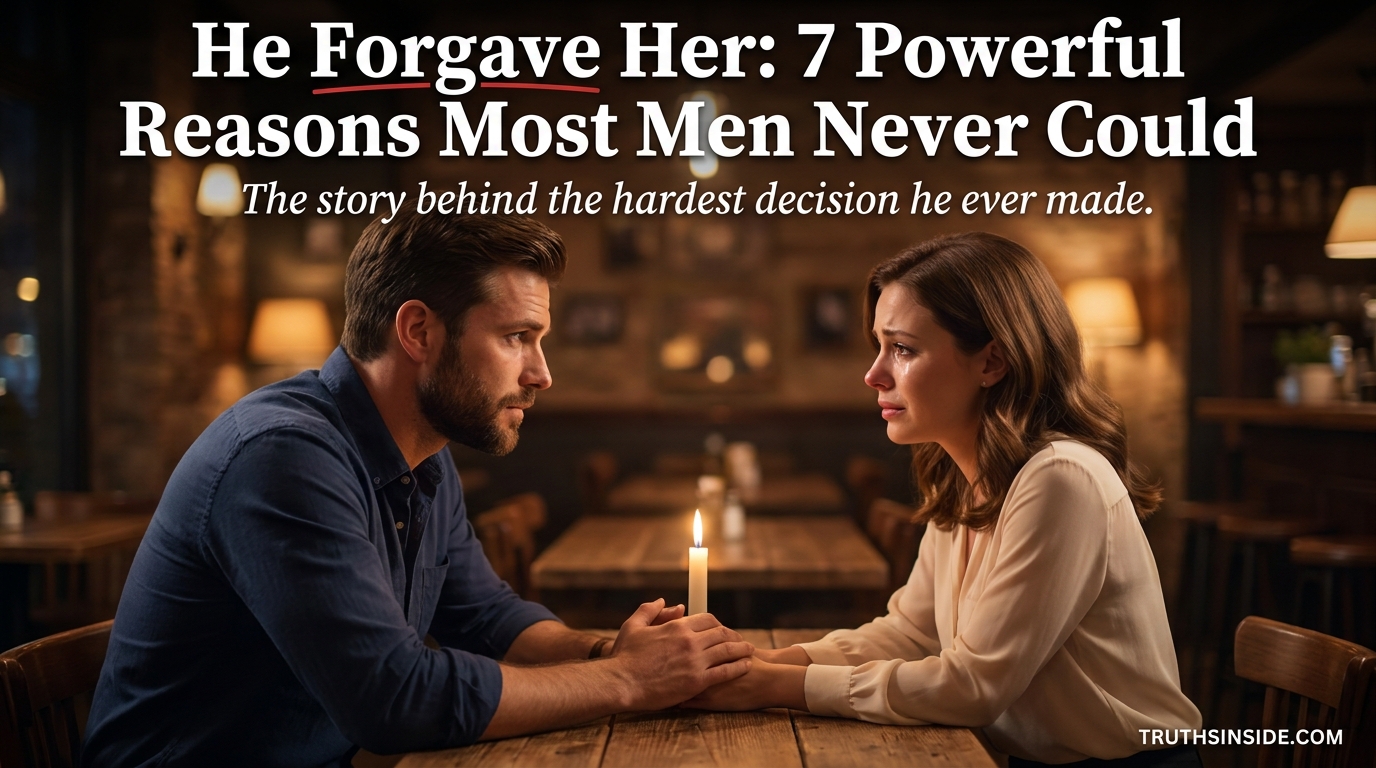
He Forgave Her: 7 Powerful Reasons Most Men Never Could
When Forgiveness Feels Impossible — And Someone Does It Anyway
He forgave her. Those three words — quiet, heavy, and completely unexpected — landed in the middle of a relationship that most people had already written off as over. According to research published by the Journal of Family Psychology, couples who actively practice forgiveness report significantly higher relationship satisfaction and emotional resilience than those who don’t. But knowing that statistic doesn’t make the act any easier. Forgiveness, especially after deep betrayal, goes against every instinct we have. Our pride says run. Our pain says retaliate. Our fear says protect yourself at all costs.
And yet — he didn’t run. He sat across from her, looked her in the eyes, and chose something harder than anger. He chose understanding. He chose to stay. Not naively. Not without weeks of grief and sleepless nights. But deliberately, consciously, and with a kind of emotional courage that most people spend their entire lives avoiding.
This is not a story that tells you forgiveness is always the right choice. Every situation is different. Every relationship carries its own unique weight. But this story will walk you through the seven powerful reasons why one man was able to do what most couldn’t — and why understanding those reasons might change the way you see your own relationships forever.
1. He Understood the Difference Between Forgiveness and Approval
The first reason he forgave her is perhaps the most misunderstood concept in all of emotional healing. He forgave her — but he never once said what she did was okay. This distinction is critical. So many people resist forgiveness because they believe granting it means excusing the behavior, pretending the hurt didn’t happen, or giving the other person a free pass to do it again.
That’s not what forgiveness is. Forgiveness is the internal decision to stop letting someone else’s actions hold your peace hostage. It is not a declaration that the wrong was acceptable. It’s a declaration that you refuse to be imprisoned by it.
He made that distinction early. He had a mentor — a quietly wise older man he’d known since college — who once told him: “Forgiveness is something you do for your own lungs. So you can breathe again.” That line stayed with him. When the betrayal happened, when the confusion and the anger and the grief all crashed in at once, he kept coming back to that idea. Forgiveness would not be about her. It would be about him. That realization was the first crack of light in what had felt like a completely dark room.
2. He Allowed Himself to Actually Feel the Pain First
Here is something most forgiveness conversations skip over entirely: you cannot genuinely forgive someone if you have never genuinely felt what they did to you. He forgave her — but not immediately. Not performatively. Not as a way to rush through the discomfort. He let himself fall apart first.
There were nights he didn’t answer calls. Days he sat in his car in parking lots, not ready to go inside anywhere. Moments where the grief felt almost physical — like something had been pulled out of the center of his chest. He didn’t suppress any of it. He didn’t pretend to be “fine” because being fine felt like the stronger, safer option.
He cried. He journaled. He talked to a therapist for six weeks straight. He processed the pain the way you’re supposed to — by going through it, not around it. And something interesting happened on the other side of all that grief: he found space. Emotional space that hadn’t been there before. Space where understanding could eventually grow. Forgiveness didn’t arrive because he decided to ignore his pain. It arrived because he honored it completely first.
3. He Chose to See Her as a Whole Person, Not Just Her Worst Moment
When someone hurts us deeply, our mind does something almost automatic — it reduces them to that moment. They become the betrayal. They become the lie, the mistake, the wound. It’s a survival mechanism. If we can make them into a villain, walking away feels cleaner and easier.
He forgave her partly because he refused to do that. He had known her for years. He had watched her show up for people she loved in ways that left him genuinely in awe. He had seen her kindness, her humor, her loyalty, her quiet courage during moments that had tested them both. She was not her worst moment — and he knew that.
That doesn’t mean he minimized what happened. He didn’t. But he held both truths at once — that she had hurt him terribly, AND that she was also a full, flawed, deeply human person capable of both love and error. That dual vision is extraordinarily difficult to maintain when you’re in pain. Most people can’t do it. He found a way. And it was that fuller picture of who she was that made forgiveness feel less like surrender and more like wisdom.
“Forgiveness doesn’t mean the pain wasn’t real. It means you’ve decided the pain won’t be permanent.”
4. He Had Done His Own Inner Work
He forgave her — and this reason is one that rarely gets talked about in relationship advice circles. He was able to forgive her partly because he had spent years doing his own emotional and psychological work. He wasn’t a perfect man. He had his own patterns, his own wounds from past relationships, his own moments where he had fallen short as a partner.
He knew what it felt like to be the one who had made a mistake and desperately needed grace. He had been in that position. He had been given grace when he didn’t necessarily deserve it. And that memory — that lived experience of being on the receiving end of someone’s generosity when he was at his worst — created a quiet but powerful empathy inside him.
His personal growth work also gave him the emotional vocabulary to understand what was happening inside himself. He could name his feelings. He could track his own triggers. He knew the difference between a reaction fueled by ego and one fueled by genuine hurt. That self-awareness gave him choices. And having choices meant he didn’t have to be controlled by the loudest emotion in the room.
📃 Related article: Almost Lost Her Over Something Small — 5 Hard Lessons
5. He Believed the Relationship Was Worth Fighting For
He forgave her because he genuinely believed — after deep, honest reflection — that what they had was worth protecting. This is important. Forgiveness in a relationship shouldn’t be automatic or obligatory. It should come from a clear-eyed assessment of what exists between two people and whether it deserves the effort that healing requires.
He looked at their history. Their shared language, the way they had always been able to make each other laugh even in the hardest moments, the countless times they had shown up for one another when the world was difficult. He looked at her willingness to be accountable — genuinely accountable, not defensively so. He saw that she wasn’t asking him to forget. She was asking for a chance to rebuild. And he believed the foundation beneath them was strong enough to hold that process.
This is not a reason that applies to every situation. Some relationships — especially those involving repeated patterns of harm, abuse, or a fundamental lack of mutual respect — should not be rebuilt. He knew that too. But his relationship was not that. His relationship was two imperfect people who loved each other and had hit a wall. He decided the wall was worth climbing over together.
6. He Understood That Holding Onto Resentment Was Hurting Him More
There is a well-known quote — often attributed to various writers and thinkers — that describes holding onto resentment as drinking poison and expecting the other person to suffer. He understood this not just intellectually, but physically. He could feel what the anger was doing to his body.
He wasn’t sleeping well. His focus at work was suffering. He found himself snapping at people who had nothing to do with the situation. The resentment was leaking out everywhere. He was carrying something that was genuinely making him sick — and the person he was carrying it toward wasn’t suffering nearly as much as he was.
He forgave her partly as an act of self-preservation. He recognized that continuing to live inside the wound was costing him his health, his peace, and his presence in his own life. Psychologists call this phenomenon “emotional flooding” — the state in which unresolved anger and grief overwhelm the nervous system and make clear thinking nearly impossible. He had been flooded for weeks. Forgiveness, for him, was the decision to drain the flood. Not for her sake. For his.
7. He Redefined What Strength Actually Looked Like
Perhaps the most powerful reason he forgave her is this: he no longer believed that walking away was the bravest option. Our culture — especially the messaging directed at men — tends to frame emotional exit as strength. “Don’t let people walk over you.” “Know your worth and leave.” “Real strength is protecting your peace by removing toxic people.”
There is truth in all of that. But he had come to understand something more nuanced. Sometimes the bravest, hardest, most emotionally demanding thing a person can do is stay. Not stay out of fear. Not stay out of desperation or low self-worth. But stay with eyes open, with full awareness of the risk, and with the intentional choice to believe in something beyond the worst moment.
He forgave her because he redefined strength as the capacity to hold complexity — to feel hurt AND extend grace, to be disappointed AND maintain hope, to be fully honest about what happened AND still choose love. That is not weakness. That is one of the most difficult emotional feats a human being can perform. He forgave her because he was strong enough — not despite that, but because of it.
“It takes far more courage to rebuild something broken than to simply walk away from the rubble.”
What Happened After He Forgave Her
He forgave her — and the relationship did not instantly transform into something easy or painless. That’s the part the movies skip. After he told her, after that long, honest conversation in the café where they both said things they had never said out loud before, they went home to the same apartment. The same routines. The same reminders.
Rebuilding trust was slow. There were awkward silences. There were nights where old feelings surfaced unexpectedly and they had to talk through them instead of shutting down. They went back to couples therapy — something they had tried briefly early in the relationship but never committed to. This time, they committed.
Three months after he forgave her, he described the relationship as feeling “different, but deeper.” A year later, in a quiet moment that he later told a close friend about, he said it was the best relationship of his life — not despite the hard chapter, but partly because of it. The crack in the foundation had forced them both to look at everything they had been avoiding. The repair made the whole structure stronger.

What You Can Take From This Story
He forgave her — and his story is not a template. It is not a directive. It is not saying that every betrayal deserves forgiveness or that every broken relationship should be rebuilt. Some shouldn’t be. Some are genuinely over. Some things cross lines that cannot or should not be uncrossed.
But what his story offers is something valuable regardless of your specific situation: the understanding that forgiveness is a choice rooted in self-respect, not self-sacrifice. The clearest sign of emotional maturity is not how quickly you can end something — it’s how clearly you can think when everything inside you is screaming.
He thought clearly. He felt deeply. He chose deliberately. And whether his story ends up looking anything like yours, the seven reasons behind his decision are worth sitting with. Because forgiveness — of a partner, of a friend, of a parent, even of yourself — is one of the most quietly revolutionary acts a human being can commit. It doesn’t always save the relationship. But it almost always saves you.
📃 Related article: Signs Your Ex Wants You Back: 10 Signals & What to Do
Final Thought: The Bravest Thing He Ever Did
He forgave her not because forgiveness was easy. Not because the hurt wasn’t real. Not because his pride didn’t resist it every single step of the way. He forgave her because he was brave enough to choose his future over his wound. Because he understood that love — real love — is not an absence of pain. It’s the willingness to move through pain together.
If you’re sitting with something heavy right now — a betrayal, a hurt, a relationship at a crossroads — let his story remind you of one thing: you don’t have to decide everything today. You are allowed to feel it fully first. You are allowed to take your time. But when you’re ready, the most powerful decision you might ever make is waiting for you on the other side of your anger.
And it might just change your life the way it changed his.
💾 Save this article — you might need it again someday.
📤 Share it with someone who’s going through something hard.
➕ Follow Truthsinside.com for more stories that make you think, feel, and grow.
FAQ — Frequently Asked Questions
Q1: Does forgiving someone mean you have to stay in the relationship?
Absolutely not. Forgiveness and reconciliation are two separate things. You can fully forgive someone — release the resentment, wish them well, let go of the anger — and still choose not to continue the relationship. Forgiveness is an internal process. Whether you stay or go is a separate decision entirely, based on what is safe and healthy for you.
Q2: How long does it realistically take to forgive someone after a serious betrayal?
There is no universal timeline. Research in forgiveness psychology suggests that meaningful forgiveness rarely happens in days — it typically unfolds over weeks or months of active emotional processing. Some people work through it in three to six months. Others take years. The key factor is whether you’re actively engaging with the pain rather than suppressing or avoiding it.
Q3: What if the person who hurt me hasn’t truly taken accountability?
Forgiveness does not require an apology. While accountability from the person who wronged you can make the healing process easier, it is not a prerequisite for your own emotional freedom. You can choose to release resentment regardless of whether the other person has shown remorse. Your peace should not be held hostage by someone else’s behavior.
Q4: How do you know if a relationship is worth saving after a betrayal?
Some helpful indicators: Is there genuine accountability without defensiveness? Is there a history of mutual respect and care? Are both people willing to do the difficult work of rebuilding? Is the betrayal part of a repeated pattern, or was it an isolated — though serious — event? These questions don’t give you a definitive answer, but they give you a clearer picture to work from.
Q5: Can a relationship actually become stronger after betrayal?
Research suggests yes — in some cases. Psychologists sometimes refer to this as “post-traumatic growth” in relationships. When both partners engage honestly with what happened, address the underlying issues that contributed to the problem, and commit to rebuilding with greater transparency, some couples report a depth of connection and honesty they did not have before the crisis. It is not guaranteed — but it is genuinely possible.
🎵 Music
Maren Lull is a singer-songwriter who writes from the places most people don’t talk about out loud.
Not the dramatic grief. Not the obvious heartbreak. The quiet kind — the ordinary Tuesday emptiness, the habit of reaching for someone who isn’t there anymore, the particular exhaustion of being strong for so long that the strength itself wears thin.
Her music lives at the intersection of emotional honesty and soft beauty — breathy vocals over gentle piano, slow tempos, lyrics that feel less like songs and more like something you wrote in a private notebook at two in the morning and never showed anyone.
Maren Lull writes for the people who feel everything deeply and say very little about it. For the ones who listen to sad music not because they want to feel worse — but because being understood, even by a song, makes the feeling easier to carry.
📱 Follow Maren Lull:
→ Spotify
→ Apple Music
→ Youtube
→ Audiomack