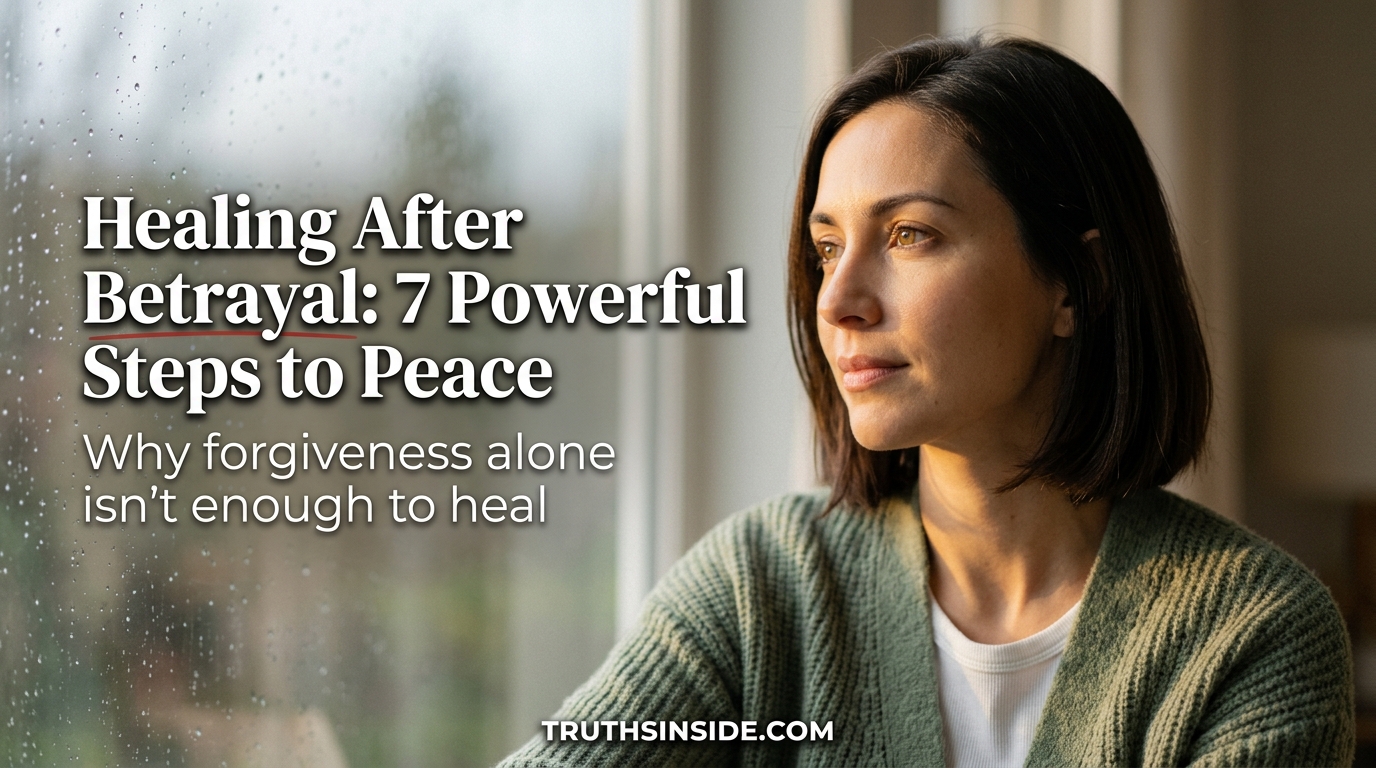
When Forgiveness Isn’t Enough: Healing Fully After Betrayal
Healing after betrayal rarely ends with the words “I forgive you.” Maybe you said them weeks ago and meant them. Then a song, a smell, or a late-night notification dragged you back to the day everything cracked. Nothing is wrong with you. Forgiving someone and healing from what they did are two different jobs.
Science agrees. A 2000 study by Cano and O’Leary in the Journal of Consulting and Clinical Psychology found that humiliating betrayals, including a partner’s infidelity, can precipitate major depressive episodes and symptoms of anxiety. Researchers Kristina Gordon, Donald Baucom, and Douglas Snyder later described recovery from an affair as a journey through three stages: absorbing the impact, searching for meaning, and moving on. Forgiveness researcher Everett Worthington adds another key distinction. Decisional forgiveness is a choice you can make in a single moment. Emotional forgiveness is a gradual change in feeling that cannot be rushed. That gap is exactly why healing after betrayal so often takes far longer than anyone expects.
This guide explains why forgiveness is only one piece of the puzzle, what betrayal does to your mind and body, and seven powerful steps that make healing after betrayal possible even when the pain refuses to fade on schedule. Whether you are staying, leaving, or still deciding, you will find a clear and compassionate path toward peace, self-trust, and a life that feels like yours again. You will also learn to recognize the quiet signs that an old wound is still active, so you can respond with care instead of self-blame.

Why Forgiveness Alone Doesn’t Complete Healing After Betrayal
Forgiveness matters, but it was never designed to carry the entire weight of recovery. When it is treated as the finish line, people feel ashamed the moment the pain returns. Knowing where forgiveness ends and healing after betrayal begins removes that shame and replaces it with a realistic map of what comes next.
Forgiveness Is a Decision, Healing Is a Process
Deciding to forgive can happen in a single afternoon. Healing happens in layers over months, sometimes years. You can choose to release your desire for revenge and still feel your stomach drop when your phone buzzes at an odd hour. That is not hypocrisy or weakness. It is your emotional system catching up to your intentions, and it is a completely normal part of healing after betrayal. Your words and your nervous system simply run on different clocks.
Cheap Forgiveness Leaves the Wound Open
Psychologist Janis Abrahms Spring, author of How Can I Forgive You?, warns against what she calls cheap forgiveness: pardoning someone quickly to avoid conflict, keep the peace, or escape your own discomfort. It skips the honest accounting that real repair requires. Without that accounting, resentment goes underground and leaks out as distance, sarcasm, or constant suspicion. Genuine healing after betrayal asks for truth, accountability, and time, even when the words of forgiveness arrive early.
The Pressure to “Move On” Makes Everything Harder
Friends, relatives, and even faith communities sometimes push people toward fast forgiveness. They usually mean well, but the pressure teaches you to hide what you really feel. Hidden grief does not disappear. It waits. The healthiest version of healing after betrayal makes room for anger, sadness, and confusion without attaching a deadline to any of them, because feelings that are allowed to move eventually do.
Forgiveness Does Not Rebuild Safety
Forgiveness is something you give. Safety is something that has to be earned back through behavior. You can forgive someone completely and still need them to prove, over time, that the harm will not repeat. Mixing the two up leads many people to ignore their own instincts in the name of being generous. Real recovery lets you hold both truths together: I have released my anger, and I still need honesty, consistency, and time before I feel secure again.
📃 Related article: Forgive Yourself: 7 Proven Steps to Heal
What Betrayal Does to Your Mind and Body
Betrayal does not only hurt your feelings. It disrupts your sense of reality. Psychologist Ronnie Janoff-Bulman’s research on shattered assumptions shows that trauma breaks our most basic beliefs: that the world is safe, that people we love are trustworthy, and that we can read situations accurately. When someone close to you deceives you, all three beliefs crack at once. That is why healing after betrayal often feels less like mending a heart and more like rebuilding an entire worldview.
Your body joins in. Attachment researchers, including Susan Johnson, use the term attachment injury for betrayals that happen at a moment when you needed someone most. Your nervous system may respond with hypervigilance, racing thoughts, poor sleep, and sudden waves of panic. These are survival responses, not character flaws. Recognizing them as protection rather than weakness is the first doorway into healing after betrayal, because you cannot treat a reaction you keep judging.
The mind also hunts for explanations. You may replay conversations, search for missed clues, or blame yourself for not seeing the truth sooner. This urge is the brain trying to restore a feeling of control, and it deserves compassion, not criticism.
Betrayal grief is often disenfranchised grief, a term coined by researcher Kenneth Doka for loss that others do not openly acknowledge or support. Because no funeral is held, friends rarely bring casseroles or ask how you are sleeping, and you may feel you must mourn in secret. Giving this grief a name makes it easier to ask for the support you deserve.
“Forgiveness closes the case against them. Healing reopens the door to yourself.”
Signs You Are Still in the Middle of Healing After Betrayal
How do you know forgiveness has not finished the job? Look for patterns rather than single bad days. You may still be deep in healing after betrayal if you notice any of these:
- Intrusive thoughts or replaying the moment you found out
- Checking phones, locations, or social media for proof
- Sudden resentment that seems to come out of nowhere
- Emotional numbness or pulling away from intimacy
- Dread around dates, places, or songs linked to the betrayal
- Difficulty trusting new people who have done nothing wrong
- Comparing yourself to the person who was involved
- Feeling guilty for still hurting
None of these mean you forgave the wrong way. They mean your mind is still processing a real injury. Think of each one as a signal that more care is needed, not as proof that you are broken. The steps below are designed to answer exactly those signals.

The 7 Powerful Steps for Healing After Betrayal
These steps are not a rigid timeline. You will probably circle back to earlier ones, and that is normal. Together they build a foundation for healing after betrayal that does not depend on anyone else’s behavior, which is the only kind of foundation that holds.
Step 1: Name Everything You Lost
Grief is the missing piece in many recovery stories. Beyond the relationship itself, you may be mourning your trust, your shared memories, your future plans, and your image of yourself as someone who would never be fooled. Write a list of every loss, including the invisible ones. Naming them gives your pain edges, and pain with edges is far easier to carry than a shapeless fog. Try finishing the sentences “I miss…” and “I am angry that…” in a notebook each evening for a week. Skipping this step is one of the biggest reasons healing after betrayal stalls.
Step 2: Calm Your Nervous System First
You cannot think your way out of a body that believes it is in danger. Start with the basics: regular sleep, daily movement, steady meals, and slow breathing, such as inhaling for four counts and exhaling for six. Limit late-night scrolling and rumination by giving your worries a fifteen-minute window each day, then closing it on purpose. Even a ten-minute walk outside can ease your stress response enough to think more clearly. A regulated body makes every other part of healing after betrayal more possible.
Step 3: Get the Truth, Then Set an End Point
If you are staying in the relationship, honest answers matter. The research of Gordon, Baucom, and Snyder emphasizes making sense of why it happened, not only what happened. Write your questions down first so you ask from a calm place rather than a panicked one. Ask clear questions, expect truthful replies, and then agree on a point when the interrogation ends. Endless detail gathering feeds anxiety instead of easing it. If the person who hurt you refuses transparency, that refusal is also information, and it belongs in your decision about healing after betrayal.
Step 4: Rebuild Safety With Clear Boundaries
Safety comes before trust. Boundaries might include full transparency about phones and schedules for a season, ending contact with an affair partner, or limiting conversations about the betrayal to agreed times so it does not swallow every evening. Boundaries are not punishment. They are structure, and structure lets your nervous system finally relax. Say each boundary out loud in plain language, then notice whether it is respected over time. Without clear boundaries, healing after betrayal tends to feel like walking across thin ice.
Step 5: Reclaim Your Story and Your Self-Worth
Betrayal often whispers that you were not enough, not attentive enough, or not smart enough to see it coming. That story is almost always false. Another person’s choice to deceive says everything about their decisions and very little about your worth. Each time the old story returns, answer it with one fact: you trusted someone who chose to break that trust. Practice self-compassion, a concept developed by researcher Kristin Neff, by speaking to yourself the way you would speak to a close friend in the same situation. Self-compassion is a cornerstone of healing after betrayal because shame cannot survive kindness for long.
Step 6: Let Trust Return in Small Bets
Trust is not a switch. John Gottman describes it as something built through countless small moments when a person proves reliable even when it would have been easier not to. Make small, measurable bets: a promise kept, a call returned, an honest answer to an uncomfortable question. Notice the evidence you collect and let your trust grow at the pace of that evidence. A simple private log of promises kept and broken gives your gut feelings something solid to lean on. This gradual approach to healing after betrayal protects you from both naive trust and permanent suspicion.
“Trust returns at the speed of evidence, not at the speed of apologies.”
Step 7: Decide What Comes Next With Clear Eyes
Healing after betrayal does not require reconciliation, and it does not forbid it. Once the fog lifts, ask what you actually want. Has the person shown real remorse, consistent change, and transparency? Do you feel safer as time passes, or more anxious? Staying and leaving can both be acts of self-respect when they come from clarity rather than fear. Give yourself permission to take as long as you need to decide. There is no prize for deciding fast, and no penalty for changing your mind when new information arrives.
Healing After Betrayal When You Stay vs. When You Leave
If You Stay: Rebuilding Together
Couples who rebuild successfully usually share three things: a partner who takes full responsibility without excuses, open communication about triggers, and patience from both sides. Gottman’s Atone, Attune, Attach model describes the arc well. The person who caused the harm atones, the couple attunes to each other’s emotional needs, and only then do they rebuild attachment. Staying works when both people treat healing after betrayal as shared work rather than one person’s burden.
If You Leave: Healing Without Reconciliation
Leaving does not mean you failed to heal, and staying does not prove you succeeded. If you walk away, healing after betrayal still involves grief, boundary work, and rebuilding trust in yourself. Closure rarely arrives from the other person, so create it yourself through journaling, therapy, and honest conversations with people who support you. Your story is allowed to have an ending you write.
How to Support Someone Through Healing After Betrayal
If someone you love is going through this, resist the urge to fix, judge, or rush. Listen more than you advise. Avoid phrases like “just forgive them” or “at least you found out.” Offer practical help such as meals, walks, or quiet company. Ask what they need instead of assuming, and keep checking in after the first few weeks, when most support quietly fades. Your steady presence can be one of the most powerful forms of healing after betrayal.
When Professional Support Makes the Difference
Therapy can shorten the road significantly. Approaches such as Emotionally Focused Therapy for couples, trauma-informed individual counseling, and EMDR help many people process betrayal at a depth that willpower alone cannot reach. Even a few sessions can give you language and tools you did not have before. Consider reaching out if intrusive thoughts disrupt your work, sleep, or parenting for several weeks. If you ever feel hopeless or unsafe, call or text 988 in the United States for immediate support. Asking for help is a smart part of healing after betrayal, not a sign of weakness.
Common Mistakes That Stall Healing After Betrayal
Even well-meaning choices can slow recovery. Watch for these common traps:
- Rushing forgiveness to end the discomfort
- Using the betrayal as a weapon in every argument
- Isolating yourself out of shame
- Jumping into a rebound to numb the pain
- Making the person who hurt you your only source of comfort
Each mistake comes from a very human wish to stop hurting faster. Catch yourself gently and return to the steps above. Progress in healing after betrayal is rarely a straight line, and a bad week does not erase a good month.
📃 Related article: Holding Grudges: 7 Toxic Ways It Destroys Love
What Full Healing After Betrayal Really Looks Like
Full healing does not mean forgetting. It means the memory loses its power to run your life. Think of it as the difference between a scar that still aches in cold weather and a wound that is still open. You can recall what happened without your heart racing. You trust your own judgment again. You can love, set boundaries, and be vulnerable without constant fear of the floor dropping out.
Psychologists Richard Tedeschi and Lawrence Calhoun call the positive change that some people experience after trauma post-traumatic growth. Many report deeper self-respect, clearer values, and stronger relationships after a painful struggle. That growth is possible, though it is never required for your pain to matter. Healing after betrayal is complete when you feel free, not when you feel nothing.

Final Thoughts on Healing After Betrayal
Forgiveness may be one chapter, but your recovery is the whole book. Be patient with the version of you who still hurts. Use the seven steps, lean on trusted support, and measure progress by how safe and whole you feel rather than how quickly you move on. Healing after betrayal is slow, honest work. You are not behind. You are doing it. Come back to this guide whenever a trigger catches you off guard, and answer it with patience instead of panic.
Frequently Asked Questions
How Long Does Healing After Betrayal Take?
There is no fixed timeline. Many therapists see meaningful progress within one to two years of consistent effort, though triggers can surface for longer. Your pace depends on the type of betrayal, the support around you, and the honesty of everyone involved.
Can I Forgive Someone and Still Not Trust Them?
Yes. Forgiveness releases resentment, while trust depends on future behavior. You can forgive and still require time, transparency, and proof before trusting again. Healing after betrayal honors both truths at once.
Is Healing After Betrayal Possible Without an Apology?
Yes. An apology can help, but it is not required. Healing can grow from grieving honestly, setting boundaries, building support, and giving your story a new meaning that does not depend on the other person’s remorse.
When Should I Consider Ending the Relationship?
Consider leaving if the betrayal continues, if there is no accountability, or if you feel consistently unsafe or diminished. A therapist can help you sort through the decision with clarity instead of panic.
Save, Share, Follow
Found this helpful? Save this guide on healing after betrayal for the days when old pain resurfaces. Share it with someone who is struggling to move forward after being hurt. And follow Truthsinside.com for more honest relationship advice, psychology insights, and emotional support.
🎵 Music
Maren Lull is a singer-songwriter who writes from the places most people don’t talk about out loud.
Not the dramatic grief. Not the obvious heartbreak. The quiet kind — the ordinary Tuesday emptiness, the habit of reaching for someone who isn’t there anymore, the particular exhaustion of being strong for so long that the strength itself wears thin.
Her music lives at the intersection of emotional honesty and soft beauty — breathy vocals over gentle piano, slow tempos, lyrics that feel less like songs and more like something you wrote in a private notebook at two in the morning and never showed anyone.
Maren Lull writes for the people who feel everything deeply and say very little about it. For the ones who listen to sad music not because they want to feel worse — but because being understood, even by a song, makes the feeling easier to carry.
📱 Follow Maren Lull:
→ Spotify
→ Apple Music
→ Youtube
→ Audiomack