How Low Self-Esteem Sabotages Your Relationships
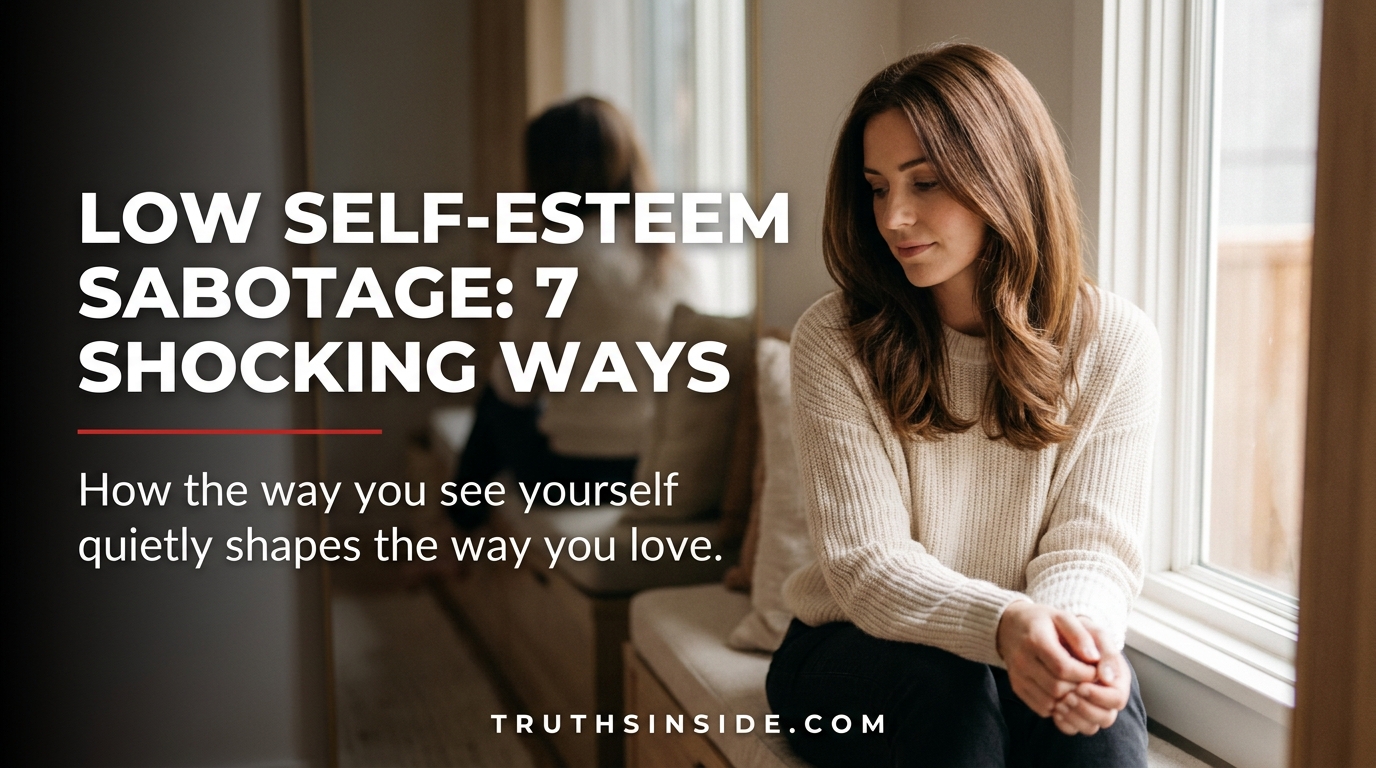
You love them, and still you catch yourself rereading their last message, wondering what you did wrong. Low self-esteem has a way of turning ordinary moments into proof that you are not enough. Long-running research on couples suggests that self-esteem and relationship satisfaction tend to rise and fall together, which means the way you see yourself quietly shapes the way you love.
That link is not about vanity or surface confidence. Studies by psychologist Sandra Murray and her colleagues show that people with low self-esteem often underestimate how much their partners value them. They assume affection is conditional, so they scan for signs of rejection and protect themselves in ways that create the very distance they fear. Low self-esteem does not announce itself. It hides inside jokes, silence, and “I’m fine.”
The good news is that these patterns are learned, which means they can be unlearned. In this guide, you will see exactly how low self-esteem sabotages relationships, where it comes from, what your partner may be experiencing, and the practical steps that rebuild trust in yourself and in love. You do not need to become a different person. You only need to stop treating your worth as something you have to earn.
“Low self-esteem does not end love by itself. It ends love by defending you against a rejection that was never coming.”

What Low Self-Esteem Really Means in Love
Low self-esteem is a persistent, negative evaluation of your own worth. It is not the same as shyness, and it is not the same as feeling insecure after one bad day. People living with it often carry a quiet belief that they are too much, not enough, or simply hard to love, and that belief colors how they interpret everything their partner says and does.
It also does not always look the way people expect. Some people who feel this way appear confident, successful, and endlessly helpful. They are the friend who always shows up, the coworker who never says no, the partner who never asks for anything. Underneath, the same fear runs the show: if they stop performing, the love will disappear.
This matters because low self-esteem in a relationship rarely looks like sadness. More often it looks like irritability, withdrawal, control, perfectionism, or clinginess. Those behaviors are easy to judge and hard to trace back to their root, which is why so many couples argue about the symptom while the real problem stays untouched.
The Science of Low Self-Esteem and Relationship Satisfaction
Psychologists have studied the link between self-view and love for decades. One useful way to think about it is that self-esteem works like an internal gauge of how safe you feel with other people. When the gauge reads high, you can tolerate conflict, ask for what you need, and trust that a bad moment is only a bad moment. When it reads low, even small disagreements feel like threats.
Longitudinal research on couples has found that the influence runs in both directions. People with higher self-esteem tend to grow more satisfied in their relationships over time, and people who feel more satisfied in love tend to see their self-esteem grow. In other words, low self-esteem can drag a relationship down, and a painful relationship can push self-esteem even lower, creating a loop that is hard to escape without awareness.
Research on rejection sensitivity points in the same direction. People who expect rejection are more likely to perceive it in ambiguous situations, and then react with hostility or withdrawal. The partner, who meant nothing negative, feels confused or blamed. Over time the prediction fulfills itself. That is the core mechanism of this article: low self-esteem makes you expect loss, and expecting loss makes you act in ways that cause it.
Attachment Style and Low Self-Esteem
Attachment theory adds another layer. Anxious attachment, marked by a fear of abandonment, frequently travels with a weak sense of self-worth. Avoidant attachment can also hide the same wound behind independence and emotional distance. Neither style is a life sentence.
📃 Related article: Deep Emotional Connection: 9 Beautiful Signs to Know
7 Ways Low Self-Esteem Sabotages Your Relationships
The following seven patterns show up again and again. You may recognize one or two, or all seven.
1. Low Self-Esteem Creates a Constant Need for Reassurance
When you do not fully believe you are lovable, you look for proof outside yourself. You ask “Are you sure you’re not mad?” or “Do you still like me?” more often than you realize. Each answer brings a little relief, but the relief fades fast, because this mindset does not trust good news for long. Your partner becomes responsible for keeping an old wound closed.
Over time, the reassurance loop wears both people down. The partner starts to feel like a full-time comforter who can never say enough, and the person asking feels more ashamed for needing it. That shame deepens the wound, which increases the need for reassurance. Learning to self-soothe, rather than outsourcing every doubt, is one of the most powerful changes you can make.
2. Low Self-Esteem Turns Neutral Moments Into Rejection
A short text reply. A partner who is quiet after work. A canceled dinner because of a deadline. Most people shrug these off. A mind shaped by self-doubt treats them as clues in a case it has already decided: you are losing them.
Psychologists call this negative interpretation bias, and it is exhausting. You may replay conversations at night, searching for the exact moment things changed. Then you bring that fear to your partner as an accusation instead of a feeling: “You’ve been distant.” The partner, who was simply tired, must now defend themselves against something they did not do. Try naming the feeling instead: “I felt worried when you went quiet, and I’m not sure if it’s about us.”
3. Low Self-Esteem Drives People-Pleasing and Self-Erasure
If you believe your needs are a burden, you stop voicing them. You agree to plans you dislike, laugh at jokes that sting, and say “I don’t mind” when you do. It looks like flexibility. It is actually a quiet form of hiding.
The cost is intimacy. A partner cannot truly love someone they never get to meet. Resentment builds in the gap between what you say and what you feel, and eventually leaks out as sudden anger, coldness, or exhaustion. Your partner is blindsided because you never gave them a chance to adjust. That inner voice tells you honesty will cost you the relationship, when in fact the lack of honesty is what slowly drains it.
4. Low Self-Esteem Fuels Jealousy and Relationship Testing
Jealousy is a normal emotion, but self-doubt makes it louder. If you do not believe you are valuable, anyone who seems more attractive, funnier, or more successful becomes a threat. You may check social media, question friendships, or ask loaded questions designed to catch a lie that does not exist.
Some people go further and test their partner: pulling away to see if they chase, starting a fight to see if they stay, or hinting at leaving just to hear “please don’t.” These tests feel like love detectors, but they are really stress tests that no healthy relationship should have to pass.
5. Low Self-Esteem Makes You Push People Away First
This is the most painful pattern, because it looks like the opposite of what you want. If you are convinced the relationship will end, ending it on your own terms can feel safer than waiting to be left. So you withdraw, pick fights over small things, or go silent just as things get close.
Psychologists describe this as a self-fulfilling prophecy. The belief “they will leave” creates behavior that makes leaving more likely. Then the exit confirms the original belief, and the cycle starts again with the next person. Breaking it means tolerating the discomfort of closeness without running from it, which is far easier with support and slow, repeated experiences of safety.
6. Low Self-Esteem Makes You Settle for Less Than You Deserve
When you feel unworthy, red flags can feel like normal weather. Disrespect, inconsistent attention, or emotional unavailability seems like what you are supposed to get. You may even feel grateful for crumbs and anxious about asking for more in case the person walks away.
This is why low self-esteem and unhealthy relationships so often go hand in hand. People who do not believe they deserve better rarely leave poor treatment, and people who treat others poorly often sense who will not push back. If you have ever wondered why you keep ending up with partners who make you feel small, the answer may start with how you already see yourself, not with bad luck.
7. Low Self-Esteem Blocks You From Receiving Love
The last pattern is subtle. Someone with low self-esteem may deflect compliments, dismiss kind gestures, or secretly assume affection is pity or politeness. When a partner says “You’re beautiful” or “I’m proud of you,” it bounces right off.
Giving love is often easy for people who doubt their worth. Receiving it is hard, because accepting it would mean accepting that they might be worth it. Partners often describe this as loving someone through a glass wall: you can see each other, but the warmth never quite gets through. Practicing a simple “thank you” instead of an argument is a small but meaningful way to start letting love in.
“You cannot feel loved by someone while you are busy proving you do not deserve it.”

How Low Self-Esteem Feels From Your Partner’s Side
It is easy to focus on your own pain and forget that your partner is living inside this pattern too. Many partners of people who doubt their worth describe feeling like they are walking on eggshells. They worry that a joke, a late reply, or a night out with friends will trigger a spiral.
Others feel exhausted by the constant reassurance, then guilty for feeling exhausted. A few quietly start to pull away, which is exactly what the person feared, and the cycle tightens.
None of this means you are too much. It means the pattern needs attention from both of you. Sharing the pattern openly, rather than hiding it, often changes the dynamic quickly. Saying “My low self-esteem sometimes makes me read things into silence, and I’m working on it” turns a hidden source of conflict into a shared problem you can face together.
Where Low Self-Esteem Comes From
Low self-esteem rarely appears out of nowhere. For many people it begins in childhood, in homes where approval felt conditional or criticism was frequent. A child who learns that love depends on being good, quiet, or impressive can grow into an adult who believes the same rule applies to every partner.
Painful past relationships can reinforce the belief. Betrayal, repeated criticism, or being left without explanation can teach the mind that love is unsafe and that something about you must be the reason.
Understanding the origin is not about blame. It is about compassion. When you see it as a learned survival strategy rather than a personal flaw, it becomes easier to approach it with curiosity rather than shame.
How to Stop Low Self-Esteem From Sabotaging Your Love Life
Healing is not a single breakthrough. It is a series of small, repeated choices that gradually prove to your mind that you are safe, worthy, and capable of being loved. The following steps are practical places to start.
Step 1: Notice the Story Low Self-Esteem Is Telling
When you feel a sudden wave of anxiety or hurt, pause and ask, “What story am I telling myself right now?” Often it sounds like “They are pulling away” or “I’m too much.” Writing the story down separates what happened from what your mind concluded, and that gap is where choice lives.
Step 2: Learn to Self-Soothe Without Your Partner
Reassurance from a partner is lovely, but it should not be your only tool. Slow breathing, a short walk, journaling, or speaking to yourself the way you would speak to a close friend can calm the spiral before it becomes an argument. Each time you soothe yourself, you teach your mind that you can handle uncertainty.
Step 3: Share Feelings, Not Accusations
Compare “You never text me back” with “I felt anxious when I didn’t hear from you, and I would love a quick check-in.” The first invites defensiveness. The second invites closeness. Speaking from your own feelings is one of the clearest ways to reduce the damage this pattern causes in conversation.
Step 4: Practice One Small Boundary at a Time
Start with something low-risk, like choosing the restaurant or saying “I’d rather not” about a plan. Notice that the relationship survives. Every honest boundary is evidence against the belief that being yourself will cost you love.
Step 5: Build Self-Worth Outside the Relationship
If your entire sense of value rests on one person, every disagreement feels like a threat to your existence. Invest in friendships, hobbies, goals, and routines that belong to you. A fuller life lowers the pressure on your partner and gives self-doubt less room to grow.
Step 6: Choose Consistent, Warm Partners
Insecurity can draw you to people who feel unpredictable, because the highs feel like proof of love. Healing often means learning to trust steady kindness instead of chasing intensity. If calm feels boring at first, that may simply be the feeling of safety you are not used to yet.

When to Seek Professional Help for Low Self-Esteem
Sometimes low self-esteem runs deep enough that self-help is not enough, and that is nothing to be ashamed of. If your thoughts about yourself feel overwhelming, if the same relationship pattern keeps repeating, or if it is affecting your work, sleep, or daily happiness, a licensed therapist can help.
Approaches such as cognitive behavioral therapy and attachment-focused therapy are commonly used to work with the beliefs and patterns described in this article. Couples counseling can also help when both partners want to break the cycle together. If you ever have thoughts of harming yourself, please contact local emergency services or a crisis line right away.
📃 Related article: Love Yourself First? 7 Shocking Truths About Love
Frequently Asked Questions About Low Self-Esteem and Relationships
Can low self-esteem really ruin a relationship?
Low self-esteem does not ruin a relationship on its own, but it can strongly shape the behaviors that do, such as constant reassurance seeking, jealousy, withdrawal, and people-pleasing. The good news is that these behaviors respond well to awareness, honest communication, and support.
How do I know if I have low self-esteem in my relationship?
Common signs include needing frequent reassurance, assuming your partner will leave, struggling to accept compliments, avoiding conflict at all costs, and tolerating treatment you would not accept for a friend. If several of these feel familiar, this pattern may be influencing how you love.
Should I tell my partner about my low self-esteem?
For most couples, yes. Sharing it calmly and without blame helps your partner understand your reactions and reduces the guessing game. You do not need to explain everything at once. A simple, honest sentence is a strong place to start.
Can I build self-esteem while I’m in a relationship?
Absolutely. Many people grow their self-worth within a loving relationship, especially when they also invest in their own friendships, goals, and healing. A supportive partner helps, but the deepest work is the relationship you build with yourself.
How long does it take to overcome low self-esteem?
There is no fixed timeline. Many people notice meaningful shifts within a few months of consistent practice, while deeper patterns can take longer, especially with professional support.
Final Thoughts: Your Worth Was Never Up for Debate
Low self-esteem tells a convincing story, but it is only a story. It is a pattern learned long before this relationship, and it can be changed one honest conversation, one small boundary, and one kind thought at a time. You are not too much, and you are not broken.
If this article helped you see yourself or your relationship more clearly, save it so you can return to it on the hard days, share it with someone who needs to hear they are worthy of love, and follow Truthsinside.com for more honest guidance on relationships and psychology.
🎵 Music
Maren Lull is a singer-songwriter who writes from the places most people don’t talk about out loud.
Not the dramatic grief. Not the obvious heartbreak. The quiet kind — the ordinary Tuesday emptiness, the habit of reaching for someone who isn’t there anymore, the particular exhaustion of being strong for so long that the strength itself wears thin.
Her music lives at the intersection of emotional honesty and soft beauty — breathy vocals over gentle piano, slow tempos, lyrics that feel less like songs and more like something you wrote in a private notebook at two in the morning and never showed anyone.
Maren Lull writes for the people who feel everything deeply and say very little about it. For the ones who listen to sad music not because they want to feel worse — but because being understood, even by a song, makes the feeling easier to carry.
📱 Follow Maren Lull:
→ Spotify
→ Apple Music
→ Youtube
→ Audiomack