The Apology That Saved Our Relationship Wasn’t Even About the Fight
For eleven years, I thought I knew what a real apology sounded like. I thought it meant “I’m sorry” said with your eyes down, or a peace offering left on the counter after a bad night. I was wrong. Researchers at the Gottman Institute have found that 69% of conflict in long-term relationships is never fully resolved — it’s managed, cycled through, revisited in different clothes. My husband and I lived inside that statistic for years without knowing its name. Then, on an ordinary Tuesday, over something as small as a forgotten grocery list, he gave me a real apology that had nothing to do with the groceries at all. That’s the one that saved us.
I want to tell you what happened, because I think a lot of couples are fighting the wrong fight without realizing it. The argument on the surface is rarely the argument underneath. And until someone is willing to dig for the real one, the apologies just keep missing.
It started, as these things do, with something absurd. I’d asked Daniel to pick up milk, eggs, and diapers on his way home. He came back with none of it, phone in hand, distracted by a work call that had run long. I wasn’t even that upset about the milk. I was upset about what the milk represented.
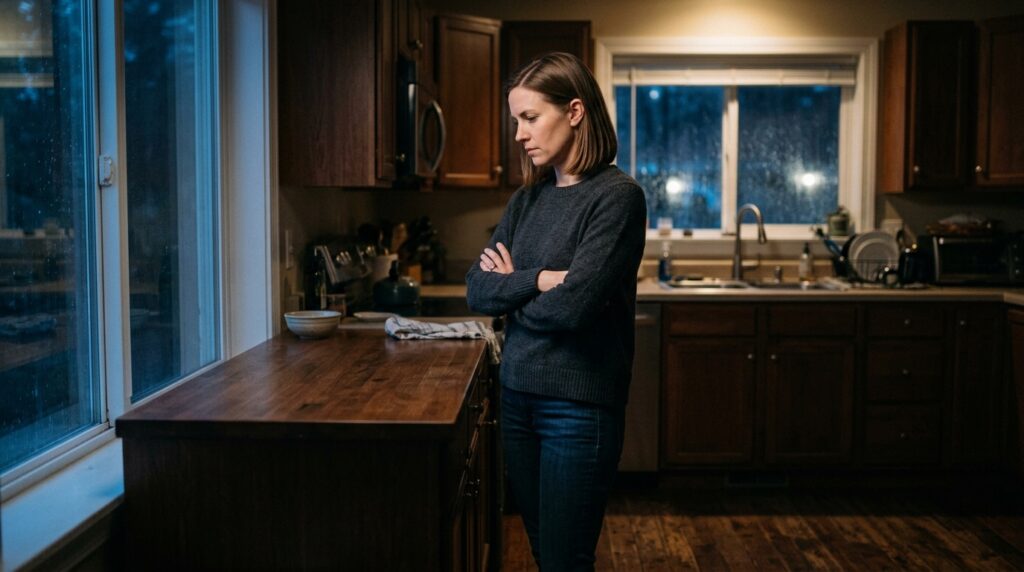
I said something sharp. He said something sharper back. Within minutes we weren’t talking about groceries anymore — we were talking about “you never think about what I’m carrying” and “I work just as hard as you do” and all the old, worn grooves a marriage carves into itself after a while. We’d had some version of this fight maybe forty times before. Different props, same script.
He apologized first, the way he usually did. “I’m sorry I forgot the list. I’ll go back out right now.” It was sincere. It was also, I realized later, completely beside the point. I said “it’s fine” and meant the opposite. We went to bed with three feet of cold mattress between us, which for us was practically a canyon.
Psychologist and researcher Dr. Harriet Lerner has written extensively about what she calls “the dance of anger” — the idea that couples often repeat the same conflict pattern because the apology never touches the actual injury, only the surface behavior. Daniel’s apology was accurate. It was also incomplete. He’d apologized for forgetting eggs. I needed someone to apologize for something he didn’t even know he’d been doing for two years.
The next morning, something shifted. I don’t know if he lay awake thinking about it or if it just surfaced on its own, but he sat down across from me at that same table and said something I wasn’t expecting. Not “I’m sorry about the groceries.” He said, “I think I’ve been treating you like a task manager instead of my wife, and I’m sorry for that.” Seven words that mattered more than the fifty before them: I’ve been treating you like a task manager.
That was the real apology. Not the one about milk.
“The apology that heals isn’t the one that matches the size of the argument. It’s the one that finally names the wound the argument was standing in for.”
I sat there for a second, stunned, because he’d put language to something I’d felt for two years but had never been able to explain without sounding petty. Every request I made — pick up this, remember that, don’t forget the pediatrician appointment — had started to feel less like partnership and more like project management. I wasn’t his wife in those moments. I was his assistant. And the groceries were just the latest line item on a list I’d stopped feeling proud to be part of.
Clinical psychologist Dr. John Gottman’s research identifies something he calls “attunement” — the ongoing, moment-to-moment awareness partners have of each other’s inner emotional world, separate from logistics. When attunement erodes, couples don’t necessarily stop loving each other. They stop seeing each other. Every interaction becomes transactional: who did what, who forgot what, who’s keeping score. A real apology, in Gottman’s framework, has to reach past the transaction and name the disconnection underneath it. Daniel’s apology did that instinctively, without ever having read a page of Gottman in his life.
I want to be clear that this isn’t a story about him being the villain and me the wounded party. I had my own patterns. I’d stopped telling him what I needed and started expecting him to guess, which is its own quiet cruelty. When he guessed wrong — which he often did, because I’d never actually told him — I treated it as proof he didn’t care, instead of proof that I hadn’t spoken clearly. A real apology from me, that same week, sounded like this: “I’m sorry I’ve been expecting you to read my mind and punishing you when you couldn’t.”
Neither of us had said anything like that in years. We’d been fluent in surface apologies — sorry I was late, sorry I snapped, sorry about the mess — while the actual grievances sat untouched underneath, quietly compounding like interest on a debt neither of us was paying down.
Why a Real Apology Is Never About the Fight
Here’s what I’ve come to understand since that Tuesday: almost every recurring argument in a relationship is a decoy. The dishes aren’t about the dishes. The lateness isn’t about the lateness. Underneath almost every repeated fight is an unmet emotional need wearing the costume of a logistical complaint. Attachment researchers describe this as a “protest behavior” — when a person feels emotionally disconnected from their partner, they often express that disconnection through irritability over small, unrelated things, because the real fear underneath (“do you still see me? do I still matter to you?”) feels too vulnerable to say out loud.
A real apology has to be willing to go looking for that fear. It has to ask, “What is this actually about?” instead of settling for the first, easiest explanation. That’s uncomfortable. It requires a kind of humility that “sorry I forgot the milk” doesn’t require, because it means admitting you might have hurt someone in a way you never intended and never noticed — not for one night, but for months or years.
📃 Related article: He Forgave Her: 7 Powerful Reasons Most Men Never Could
What Makes a Real Apology Work
Not every apology qualifies as a real apology, even when it’s well-intentioned. Over the months after that Tuesday, Daniel and I started paying attention to the difference, and a few patterns emerged.
A real apology names the specific hurt, not just the specific behavior. “I’m sorry I forgot” is behavior. “I’m sorry I made you feel like an afterthought” is the hurt. A real apology also resists the urge to immediately explain or defend — no “but I was so stressed at work” tacked onto the end, because that quietly shifts the apology back onto the giver’s experience instead of the receiver’s pain. And a real apology asks a question afterward: “Is that what it’s been like for you?” It leaves room for the other person to say more, rather than treating the apology as a closed transaction.
We started using this with each other almost like a checkpoint. When one of us apologized and it still felt like something was missing, we’d gently ask, “Is that the real apology, or is there something else underneath it?” It sounds clinical written down. In practice it became almost tender — a way of telling each other, I know there might be more here, and I want to find it with you.
“Sorry for what I did is easy. Sorry for who I let you feel like — that’s the real apology, and it’s the only one that actually heals anything.”
How to Give a Real Apology That Rebuilds Trust
If you’re in a relationship where the same fight keeps returning in slightly different outfits, it might be worth asking whether anyone has ever given the real apology underneath it. A few things helped us get there, and I share them not as a formula but as a starting point.
First, slow down before you apologize. The instinct is to apologize fast, to smooth things over and get back to normal. But a fast apology is usually a shallow one. Sit with the conflict for an hour, or a day, and ask yourself honestly what pattern this fits into. Second, listen for the sentence your partner keeps almost saying but not quite finishing — “it just feels like…” — and gently ask them to finish it. That unfinished sentence is usually where the real hurt lives.
Third, when you do apologize, say the specific emotional cost out loud, even if it’s uncomfortable. “I made you feel like a task manager” is harder to say than “sorry about the milk,” but it’s the sentence that actually repairs something.
Fourth, expect it to take more than once. A real apology isn’t a magic phrase that dissolves years of pattern in a single conversation. Daniel and I still catch ourselves slipping into transactional mode sometimes — it’s a groove worn deep, and old grooves don’t disappear just because you’ve found a better path. What’s changed is that now, when we notice it, we have language for it. We can say “I think this is a task-manager moment” and both of us know exactly what that means, without needing to relitigate the whole history behind it.
What Changed After the Real Apology
The groceries got picked up eventually — that part was never really the issue. What changed was smaller and larger than that. Daniel started asking me how I was doing before asking what was on the schedule. I started telling him what I needed instead of testing whether he’d guess it. We stopped keeping score, or at least we started catching ourselves faster when we slipped back into it.
A year later, a friend of mine going through something similar with her own partner asked me how we’d turned things around. I didn’t have a clean answer for her at first. It wasn’t couples therapy, though I’d recommend that to anyone who wants it. It wasn’t a single conversation that fixed everything. It was one real apology that finally named the actual wound, followed by the ongoing, unglamorous work of remembering to look for the real thing every time the surface argument showed up again.

Frequently Asked Questions
What makes an apology a “real apology” instead of a surface-level one?
A real apology names the specific emotional injury behind the behavior, rather than just the behavior itself. It avoids defensiveness, doesn’t demand immediate forgiveness, and leaves room for the other person to share more about how the situation actually felt to them.
Why do couples keep having the same fight even after apologizing?
Because the apology often addresses the surface complaint — being late, forgetting something, a harsh tone — without ever reaching the deeper, unmet emotional need underneath it. Until the real apology happens, the pattern tends to repeat in slightly different forms.
How do I figure out what the “real” issue is beneath a recurring argument?
Pay attention to phrases your partner starts and doesn’t finish, like “it just feels like…” Gently invite them to complete that sentence. It often reveals the actual hurt that the surface argument has been standing in for.
Can a real apology repair years of built-up resentment in one conversation?
Rarely, and it’s important not to expect that. A real apology is usually the beginning of a repair process, not the end of one. It opens the door to a different kind of conversation, but rebuilding trust takes consistent follow-through afterward.
What if my partner isn’t willing to go deeper than a quick “sorry”?
You can model it yourself first, and be specific about what you needed to hear. Some partners aren’t used to this kind of vulnerability and need it demonstrated before they can offer it. If the pattern continues without any movement, a couples therapist can help create a safer space for that deeper conversation.
If this story resonated with you, save it for the next time you’re in the middle of a fight that feels bigger than it should. Share it with someone who might need to hear it. And follow Truthsinside.com for more real stories about the relationships that shape us.
🎵 Music
Maren Lull is a singer-songwriter who writes from the places most people don’t talk about out loud.
Not the dramatic grief. Not the obvious heartbreak. The quiet kind — the ordinary Tuesday emptiness, the habit of reaching for someone who isn’t there anymore, the particular exhaustion of being strong for so long that the strength itself wears thin.
Her music lives at the intersection of emotional honesty and soft beauty — breathy vocals over gentle piano, slow tempos, lyrics that feel less like songs and more like something you wrote in a private notebook at two in the morning and never showed anyone.
Maren Lull writes for the people who feel everything deeply and say very little about it. For the ones who listen to sad music not because they want to feel worse — but because being understood, even by a song, makes the feeling easier to carry.
📱 Follow Maren Lull:
→ Spotify
→ Apple Music
→ Youtube
→ Audiomack