What Respect in a Relationship Really Looks Like
Respect in a relationship is the quiet foundation most of us never think about until it starts to crack. You feel it in small moments: when your partner puts the phone down to listen, when they disagree without making you feel small, when they trust you with a decision. Research by psychologists Jeanne Frei and Phillip Shaver found that people closely link respect to feeling valued, trusted, and admired by a partner, and that it goes hand in hand with how satisfied they feel overall.
If you are wondering whether your relationship has enough of it, you are not being dramatic. Many people struggle to explain why they feel uneasy, lonely, or small beside someone who never raises their voice and never does anything obviously wrong. Often the missing ingredient is respect. Love can survive stress, distance, and boredom for a surprisingly long time, but it struggles to survive the steady feeling of being dismissed.
In this guide, you will learn what respect in a relationship truly means, what the research says about why it matters, and nine clear signs that it is present. You will also see how everyday moments, from money to phones to family, reveal it, what it looks like when it is missing, and practical ways to build more of it, starting today. Read it as a mirror for both partners, not as a weapon for one.
“Love is how you feel about someone. Respect is how you treat them when the feeling gets complicated.”
What Respect in a Relationship Really Means
Respect in a relationship means treating your partner as a whole, equal person whose feelings, boundaries, opinions, and dreams matter as much as your own. It is not a single behavior. It is a steady attitude that shows up in tone, timing, choices, and follow-through. When respect in a relationship is strong, both people feel safe being honest, because they trust they will be heard rather than ridiculed, punished, or managed.
Philosophers and psychologists often describe two kinds of respect. Philosopher Stephen Darwall called one appraisal respect, which grows from admiring someone’s character and qualities. The other is recognition respect, which honors a person’s worth and rights whether or not you agree with them. Healthy couples need both. You can be annoyed by a partner’s choice and still honor their right to make it, and that distinction is the heart of respect in a relationship.
Respect vs. Politeness
Politeness is manners. Respect is meaning. A partner can say please and thank you while still interrupting you, dismissing your worries, or making major decisions without asking. Likewise, a deeply respectful partner may be blunt or a little clumsy with words yet consistently honor your time, your boundaries, and your voice. When you measure respect in a relationship, look beyond polish and ask how you are treated when the stakes are real.
Respect Is Not Fear or Obedience
Some people confuse respect with deference. One partner stays quiet, avoids conflict, and keeps the peace, and the household looks calm from the outside. That is not respect in a relationship. It is often fear or exhaustion. True respect is mutual and flexible. Both people can say no, change their minds, and disagree openly without paying a hidden price. If only one person’s comfort sets the rules, the relationship has a hierarchy, not respect.
📃 Related article: Avoid Being Alone: 7 Shocking Relationship Signs
The Psychology Behind Respect in a Relationship
Gottman and the Cost of Contempt
After watching thousands of couples talk in his research lab, psychologist John Gottman identified contempt, expressed through sarcasm, mockery, eye-rolling, and name-calling, as one of the strongest predictors of relationship breakdown. Contempt is the opposite of respect because it communicates superiority. By contrast, couples who thrived practiced what Gottman called a culture of appreciation, in which they noticed and voiced what they admired in each other. That is why respect in a relationship is not a soft extra. It is protective.
The Five-to-One Ratio
Gottman also found that stable couples tended to keep about five positive interactions for every negative one during conflict. That does not mean you must keep score. It means warmth, humor, and appreciation act as a buffer, so hard conversations feel safe rather than threatening. Respect in a relationship is, in practice, thousands of small positive deposits that make the occasional withdrawal survivable.
Respect Creates Psychological Safety
Researchers who study close relationships emphasize that people thrive when they feel accepted and understood by a partner. Respect creates that safety. When you feel respected, your nervous system relaxes. You can admit mistakes, share fears, and ask for what you need without bracing for attack. This is why respect in a relationship tends to go hand in hand with honesty, affection, and resilience over time.

9 Signs of Respect in a Relationship
No couple shows all of these every day, and respect does not demand perfection. What matters is the overall pattern: how often these behaviors appear, and how quickly your partner repairs things when they slip. Read each sign as a question you can ask about your relationship, and about your own behavior.
Sign 1: They Listen to Understand, Not to Win
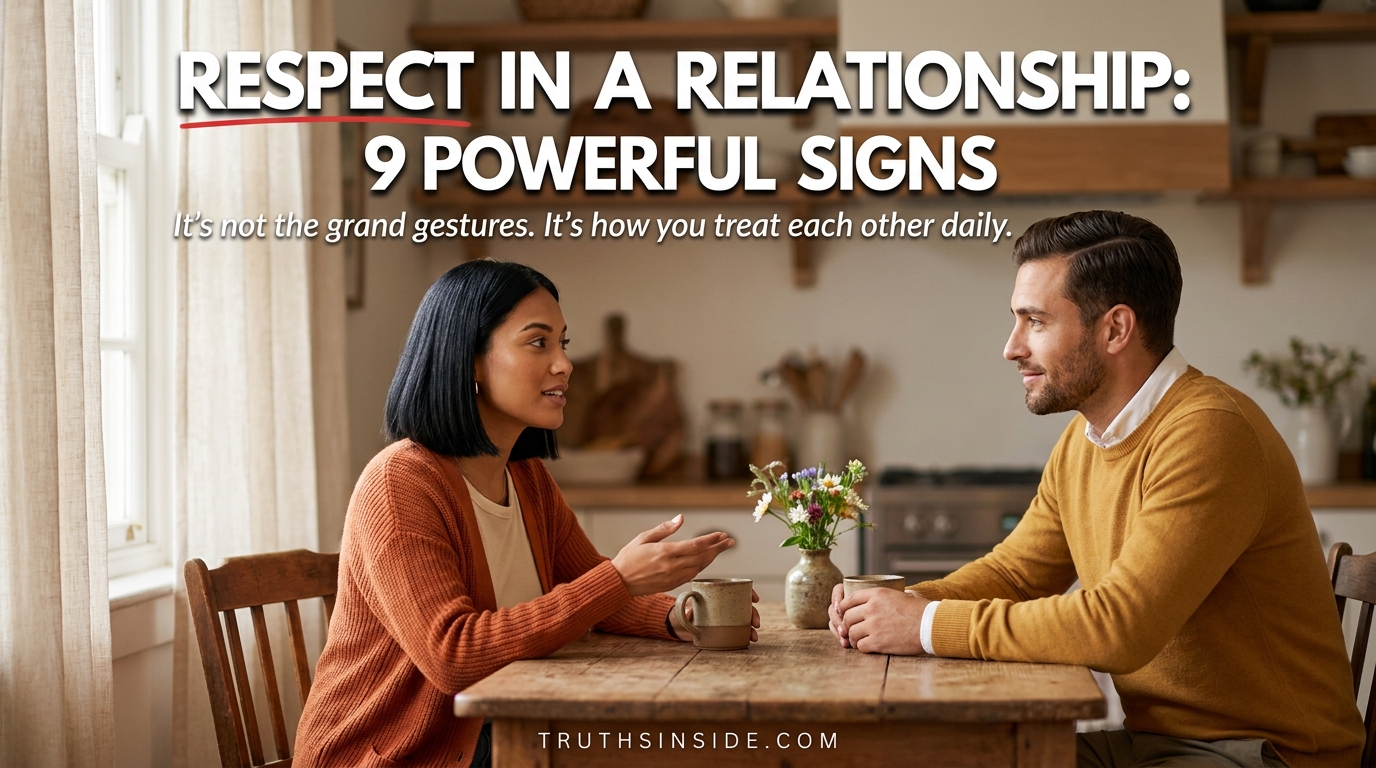
A respectful partner is curious about your inner world. They make eye contact, set distractions aside, and ask follow-up questions. They do not rush to fix, correct, or defend before you have finished. When they disagree, they can say, “Help me understand how you see this.” That small sentence is one of the clearest expressions of respect in a relationship, because it treats your perspective as worth understanding even when it differs from theirs.
Notice how you feel after you share something vulnerable. If you leave conversations feeling heard, even when no solution was found, that is a strong sign. If you often leave feeling lectured, interrupted, or told you are overreacting, your voice may not be receiving the weight it deserves.
Sign 2: They Honor Your Boundaries and Your “No”
Boundaries are where respect becomes visible. A respectful partner accepts your no about plans, privacy, intimacy, money, and time without sulking, guilt-tripping, or bargaining. They do not treat your limits as personal rejection. They ask what you need and adjust. Respect in a relationship means your no is as welcome as your yes, and you never have to justify your right to have limits.
This also applies to privacy. Respectful partners do not demand passwords, track locations, or read messages as a test of loyalty. Trust is given, not extracted. If a boundary is crossed, they listen to how it landed and change their behavior rather than defending their intentions.
Sign 3: They Value Your Opinions and Your Independence
In a respectful relationship, decisions are shared. Your partner asks for your input on things that affect you both, and they take your answer seriously, even when it complicates their plan. They also accept that you are a full person outside the couple. They encourage your friendships, interests, and alone time rather than treating them as threats. Respect in a relationship is the confidence that togetherness does not require you to shrink.
Sign 4: They Disagree Without Contempt
Healthy couples argue. What differs is the style. A respectful partner can say “I’m frustrated” without saying “you’re pathetic.” They attack the problem, not your character. They avoid sarcasm, name-calling, and dredging up old mistakes to win. They may raise their voice in a moment of stress, but they come back to repair. In a respectful argument, you stay on the same team even while you disagree, which is the everyday proof of respect in a relationship.

Sign 5: They Take Accountability and Apologize Well
Everyone hurts their partner sometimes. Respect shows up in what happens next. A respectful partner can say, “I was wrong, and I’m sorry I hurt you,” without adding “but you…” or turning the conversation into an argument about your faults. They ask what would help, and then they follow through. Accountability is not self-punishment. It is the willingness to treat your feelings as real consequences. Respect in a relationship is deeply tied to this ability to repair.
Sign 6: They Respect Your Time, Effort, and Work
Small logistics say a lot. A respectful partner shows up on time or lets you know when they will be late. They do their fair share of household labor without being managed or praised like a hero. They treat your career, your studies, and your caregiving as real work, not as hobbies that rank below theirs. Respect in a relationship is partly about fairness: neither person’s time is treated as endlessly available.
Sign 7: They Speak Well of You, Even When You Are Not There
How a partner talks about you to friends, family, and coworkers is a quiet test. A respectful person does not mock you for laughs, share your private struggles without permission, or compare you unfavorably to others. They defend you when someone criticizes you unfairly, and they correct themselves if they slip. Loyalty in language matters because it shows that respect in a relationship holds even when you cannot see it.
Sign 8: They Support Your Growth and Your Dreams
A respectful partner is genuinely glad when good things happen to you. They celebrate promotions, cheer on risks, and help you through setbacks without competing or making you feel guilty for wanting more. They may disagree with a plan and say so honestly, but they will not belittle your ambitions. Psychologists sometimes call this being a secure base: someone whose presence makes it safer for you to explore, grow, and become who you want to be.
Sign 9: They Keep Their Promises
Reliability is respect in action. When a partner says they will call, pay the bill, show up, or change a habit, and then does it, they tell you that your trust matters. Occasional slips are human. A pattern of broken promises, however, communicates that your needs are optional. In strong couples, small commitments are kept so consistently that big ones feel safe. Over time, that consistency is what makes respect in a relationship feel solid rather than hopeful.
“Respect is not what your partner says on their best day. It is what they do on their most ordinary one.”
Everyday Moments That Reveal Respect in a Relationship
Respect rarely announces itself. It lives in ordinary decisions, and these are the places where it is most often tested.
Money
Respectful couples talk openly about spending, saving, and debt. Neither person hides purchases, controls the accounts, or lectures the other about every expense. Big decisions are made together, and each partner’s contribution, paid or unpaid, is valued. Respect in a relationship means money is a shared conversation, not a source of power.
Household and Care Work
Who notices the empty fridge, the school forms, and the birthdays? Invisible labor often reveals imbalance. Respectful partners notice what needs doing without being asked, share the mental load, and appreciate each other’s effort. They do not keep score as a weapon, but they do not assume one person will quietly absorb everything either.
Phones, Attention, and Technology
Few things feel more dismissive than talking to someone who is scrolling. Researchers have even coined a word for it, phubbing, meaning snubbing a partner in favor of a phone, and studies have linked it to lower relationship satisfaction. Putting the phone down during dinner or a serious talk is a small gesture that says, “You matter more than whatever is on the screen.”
Family, Friends, and Social Life
Respectful partners treat each other’s families and friends with basic courtesy, even when they are not close. They do not force you to choose between them and the people you love. When there is tension, they handle it privately and kindly rather than staging it in public. Respect in a relationship extends to the people who matter to the person you love.
When Respect in a Relationship Is Missing
A lack of respect rarely begins with dramatic cruelty. It often starts with eye-rolling, teasing that stings, ignored boundaries, or decisions made without you, and gradually becomes normal. You may notice that you walk on eggshells, apologize for things that are not your fault, or feel a little smaller each year. Those feelings deserve attention.
If respect in a relationship is inconsistent but your partner is willing to listen, change is often possible through honest conversation and, where helpful, couples therapy. If disrespect includes intimidation, threats, control, or fear, it is no longer a communication problem. In that case, please contact a trusted person or the National Domestic Violence Hotline at 1-800-799-7233, or text START to 88788. Your safety comes first.
📃 Related article: Relationship Built to Last: 9 Proven Healthy Signs
How to Build More Respect in a Relationship
Start With Self-Respect
People tend to accept the treatment they believe they deserve. Building self-respect, by honoring your own needs, keeping promises to yourself, and speaking up kindly but clearly, changes what you tolerate and what you offer. Self-respect is not selfishness. It is the foundation that lets you give respect in a relationship freely instead of resentfully.
Use the Language of Respect
Words shape the climate of a relationship. Try swapping accusations for requests. Instead of “You never listen,” say, “I need ten minutes of your full attention tonight.” Instead of “That’s ridiculous,” try, “Tell me more about why that matters to you.” These small rewrites keep conversations about the issue rather than the person, and they model respect in a relationship even in tense moments.
Build a Culture of Appreciation
Gottman’s research suggests that couples who regularly notice what they admire stay closer. Each day, name one specific thing you appreciate about your partner: “Thank you for handling that call with the landlord. I felt supported.” Specific, sincere appreciation builds a reservoir of goodwill and makes respect in a relationship a daily habit instead of a rare event.
Repair Quickly and Sincerely
When you slip, and you will, repair fast. Acknowledge what you did, name how it affected your partner, and offer a change. A short, honest repair is worth more than a perfect record. Respect in a relationship does not require flawlessness. It requires the willingness to return and make things right.

A Quick Self-Check: How Much Respect in a Relationship Do You Feel?
Answer these honestly, and consider inviting your partner to answer them too.
- Do I feel heard when I share something difficult?
- Can I say no without being punished or guilt-tripped?
- Do we disagree without mocking or name-calling?
- Does my partner apologize in a way that feels sincere?
- Do I trust them to speak well of me when I am not there?
- Am I giving the same respect I hope to receive?
If most of your answers are yes, you have a strong foundation. If several are no, treat that as useful information and a reason for a calm, specific conversation, not as a verdict.
Frequently Asked Questions
What is respect in a relationship?
Respect in a relationship is treating your partner as an equal whose feelings, boundaries, opinions, and dreams matter. It shows up in how you listen, disagree, apologize, and make decisions, and it protects trust and emotional safety over time.
What are signs of a lack of respect in a relationship?
Common signs include contempt, mocking or name-calling, ignored boundaries, dismissed feelings, major decisions made without you, and a partner who speaks badly about you to others. One bad moment is human. A repeated pattern, especially without repair, is a concern.
Can respect in a relationship be rebuilt after it is lost?
Often, yes, if both partners are willing. Rebuilding usually involves honest acknowledgment of harm, consistent changes in behavior, and patience, sometimes with a couples therapist. Trust returns slowly through reliable actions rather than promises. If safety is a concern, put it first.
Is respect more important than love in a relationship?
They work together. Love provides warmth and desire, while respect keeps that warmth safe. Love without respect can feel painful and unstable, and respect without affection can feel distant. Strong relationships tend to have both.
How do I ask my partner for more respect?
Choose a calm moment, describe a specific behavior and its impact, and make a clear request. For example: “When I’m interrupted, I feel dismissed. Could we take turns finishing our thoughts?” Then notice whether they respond with curiosity or defensiveness. Their response is information.
Final Thoughts
Respect in a relationship is not a grand gesture. It is the sum of a thousand small choices: to listen, to pause, to apologize, to keep your word, to honor a boundary. It is what makes love feel safe enough to be honest. Whether you are strengthening a long marriage or a new romance, or noticing what is missing, you can begin today with one respectful action. Small, sincere, consistent steps change the whole climate of a relationship.
Found this helpful? Save this article for the next time you need a gentle reminder, share it with someone who deserves a steadier kind of love, and follow Truthsinside.com for more honest relationship advice every week.
🎵 Music
Maren Lull is a singer-songwriter who writes from the places most people don’t talk about out loud.
Not the dramatic grief. Not the obvious heartbreak. The quiet kind — the ordinary Tuesday emptiness, the habit of reaching for someone who isn’t there anymore, the particular exhaustion of being strong for so long that the strength itself wears thin.
Her music lives at the intersection of emotional honesty and soft beauty — breathy vocals over gentle piano, slow tempos, lyrics that feel less like songs and more like something you wrote in a private notebook at two in the morning and never showed anyone.
Maren Lull writes for the people who feel everything deeply and say very little about it. For the ones who listen to sad music not because they want to feel worse — but because being understood, even by a song, makes the feeling easier to carry.
📱 Follow Maren Lull:
→ Spotify
→ Apple Music
→ Youtube
→ Audiomack