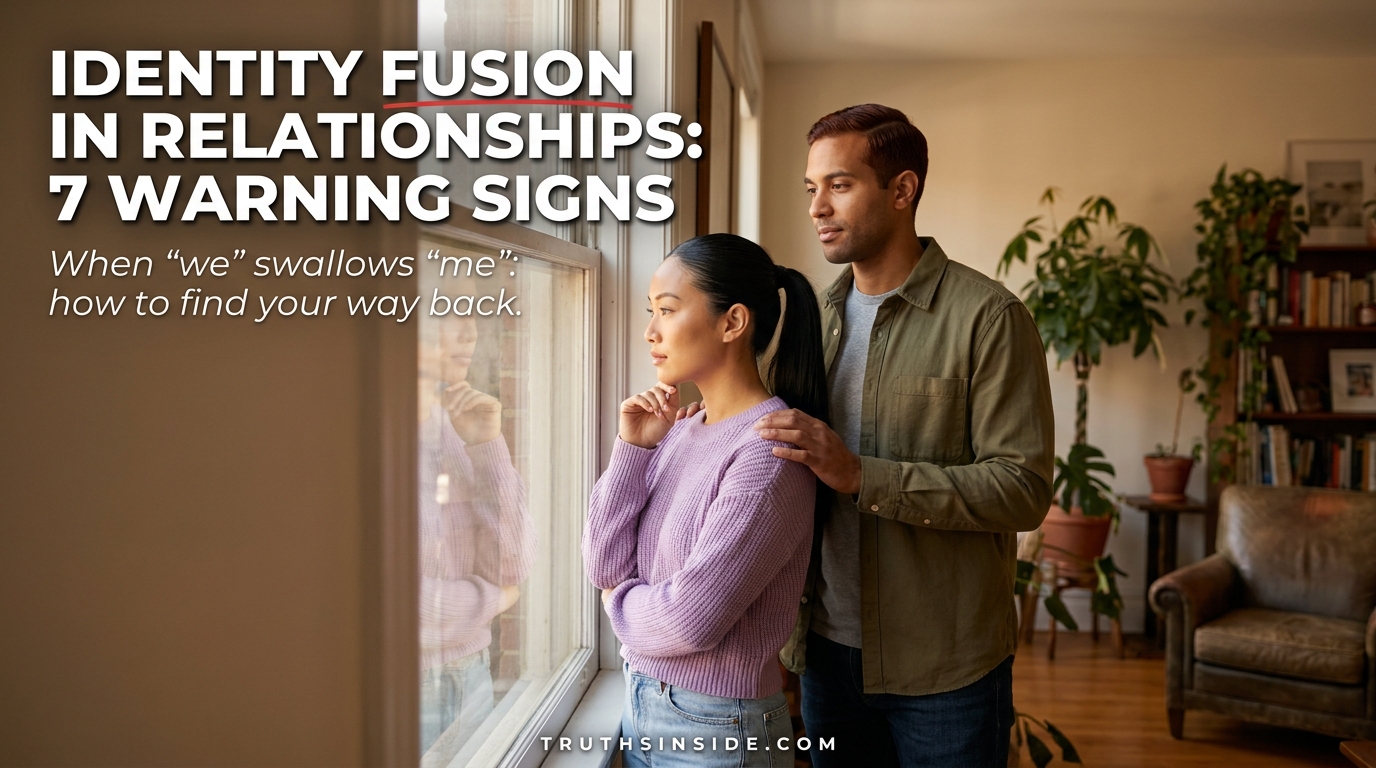
Identity Fusion in Relationships: When You Lose Yourself in Love
Identity fusion in relationships rarely announces itself. It begins with sweet things: shared playlists, shared friends, shared plans, a growing sense that you are two halves of one whole. Then one day you realize you cannot name your favorite movie without checking what they like, or make a Saturday plan without feeling guilty. Research by psychologist Erica Slotter and colleagues found that after a breakup, people’s sense of who they are became less clear, especially when their identity had been tightly woven into the relationship.
If that sounds familiar, you are not weak, needy, or broken. Wanting to merge with someone you love is one of the most natural human instincts. Many of us were taught that real love means giving everything, dissolving into each other, becoming a team so seamless that nobody can see the seams. The trouble is that a self that disappears has nothing left to give, and love built on disappearance eventually leaves both people lonely.
In this guide, you will learn what identity fusion is, where the idea comes from, and what psychology says about why we lose ourselves in love. You will also find seven warning signs, the hidden costs of merging too tightly, and practical steps for reclaiming your own identity without giving up the relationship. Read it as an invitation, not a diagnosis. Closeness is not the enemy. The goal is a bond where both people stay fully themselves.
“The healthiest ‘we’ is made of two people who are still fully ‘me’.”
What Is Identity Fusion in Relationships?
Identity fusion in relationships describes a pattern in which two partners’ identities blend so tightly that one or both lose a clear, independent sense of self. Your preferences, friendships, opinions, and moods become tangled with theirs. You may speak almost entirely in terms of “we,” feel anxious when your views differ, and struggle to answer simple questions about what you want without first considering what they want.
Psychologists use several overlapping terms for this experience. Family therapist Murray Bowen wrote about fusion, the opposite of healthy differentiation of self. Salvador Minuchin described enmeshment, where boundaries between people become blurred. Social psychologist William Swann and colleagues developed identity fusion theory to study a visceral feeling of oneness with a group. Here, identity fusion is a plain-language umbrella for the couple version of the pattern.
Identity Fusion vs. Healthy Closeness
Love naturally brings overlap. When you care deeply for someone, their joys become your joys, and your life expands to include their world. That is not fusion. It is intimacy. The difference is whether the overlap is chosen and flexible, or driven by fear and rigid. In a healthy bond, you can feel very close and still know your own mind. With identity fusion, closeness depends on sameness, and difference feels dangerous.
A simple test is to imagine disagreeing with your partner about something small, like a movie or a weekend plan. If you feel curiosity or mild discomfort, your bond is probably flexible. If you feel panic, guilt, or the urge to agree quickly, identity fusion may be shaping how you relate. The sensation is less “we are different” and more “we are in danger.”
📃 Related article: Proximity Bias: 7 Shocking Reasons We Fall in Love
The Psychology Behind Identity Fusion
Self-Expansion: How Love Changes Who We Are
Psychologists Arthur and Elaine Aron proposed the self-expansion model, which suggests that people are motivated to grow, and that close relationships are one of the best ways to do it. When we love someone, we begin to include their resources, perspectives, and identities in our own sense of self. The Arons even created a simple measure, the Inclusion of Other in the Self scale, which asks people to pick the pair of overlapping circles that best describes their relationship.
Overlap is a normal and beautiful part of love. The risk appears when expansion turns into replacement. Instead of adding your partner’s world to yours, you begin trading yours away. Identity fusion happens when the circles move from overlapping to nearly identical, and the sense of “I” slowly fades.
Differentiation of Self
Murray Bowen’s family systems theory describes two life forces: a drive toward togetherness and a drive toward individuality. Differentiation of self is the ability to hold your own thoughts, values, and emotions while staying emotionally connected to others. Therapist David Schnarch later popularized the idea for couples, arguing that intimacy and desire grow when each person can stay grounded in themselves.
Self-Concept Clarity and the Cost of Merging
Psychologist Jennifer Campbell introduced the idea of self-concept clarity: how clearly, confidently, and consistently you define who you are. Research by Erica Slotter, Wendi Gardner, and Eli Finkel found that after breakups, people’s self-concept clarity often dropped, in part because pieces of their identity had been bound up with the partner. The more of yourself you pour into a relationship, the more of yourself can feel lost if it ends.
Self-determination theory, developed by Edward Deci and Richard Ryan, adds another layer. It describes autonomy, the sense that your choices are your own, as a basic psychological need. Identity fusion in relationships can quietly starve that need, leaving you connected but strangely empty.

7 Signs of Identity Fusion in Relationships
No single sign proves anything, and many of these patterns appear briefly in every new romance. Look for clusters that persist over months, especially when they bring more anxiety than joy. Read each sign with curiosity rather than blame, and remember that fusion often involves two people, not one.
Sign 1: You Say “We” About Everything
Language reveals identity. When almost every sentence starts with “we,” as in “we love sushi,” “we hate crowds,” or “we’re not into that,” you may have stopped distinguishing your own tastes from theirs. Using “we” is natural for couples. The warning sign is when “I” feels risky, as though stating a separate preference might disturb the peace.
Sign 2: Your Friendships and Interests Have Quietly Shrunk
Fusion rarely begins with a rule. It begins with one skipped coffee, one canceled class, one hobby that no longer fits the shared schedule. Slowly your social world narrows to the two of you, or to mutual friends only. Time with your own friends starts to feel guilty or complicated. Identity fusion often looks like a shrinking life that nobody remembers choosing.
Sign 3: You Cannot Say What You Want Without Checking Theirs
Small decisions become surprisingly hard: what to order, what to watch, how to spend a free afternoon. You find yourself answering “I don’t mind” even when you do, because forming a preference feels like creating a possible conflict. Over time, the muscle of wanting weakens, and you may honestly not know what you like anymore.
Sign 4: Their Mood Becomes Your Weather
When someone you love is upset, concern is natural. In identity fusion, though, their emotions flow straight into yours with no buffer. If they are irritable, you feel responsible. If they are down, your whole day collapses. You monitor their face for clues, adjust your behavior in advance, and feel unable to enjoy anything while they are unhappy.
Emotional attunement is a strength. Emotional absorption is not. A healthy partner can say, “I’m sorry you’re hurting, and I’m still okay.” Without that boundary, both people become responsible for managing each other’s feelings, which is exhausting and rarely effective.

Sign 5: Disagreement Feels Like Disaster
In flexible couples, disagreement is information. In identity fusion, it can feel like a crack in the foundation. You may hide your real opinion, give in quickly, or exaggerate agreement to keep the connection intact. Conflicts, when they happen, can feel enormous, because each difference threatens the shared identity.
Sign 6: Time Apart Feels Threatening
A weekend away, a night out with friends, or a solo trip may trigger anxiety, guilt, or a flood of checking messages. You might feel relieved to return, or you might feel you need permission to leave. Some people with identity fusion feel oddly numb or disoriented when alone, as though they do not know what to do with themselves.
Sign 7: You Cannot Imagine Who You Would Be Without Them
Perhaps the clearest sign is the quiet question: who would I be if this ended? If the thought produces not only grief but a sense of dissolving, as though there would be nothing left, identity fusion may have taken root. Research on self-concept clarity suggests that this is exactly where the pain of a breakup can become most disorienting.
Notice that this sign does not mean you love too much. It means your sense of self has been resting on one pillar. The goal is not to love less. It is to build more pillars.
“Love should be a place you return to, not a place where you disappear.”
Why Identity Fusion Happens
Nobody decides to lose themselves. Fusion tends to grow from several ordinary ingredients mixed together over time. Understanding them can replace shame with compassion.
Childhood Patterns and Fear of Conflict
If you grew up in a home where love depended on keeping the peace, pleasing others, or staying small, merging may feel like the safest way to be loved. People who learned that conflict leads to abandonment often become experts at reading and matching others. In adulthood, that skill can quietly turn into the habit of disappearing.
The Soulmate Myth
Cultural stories also play a role. The idea that a partner should complete you, finish your sentences, and share every interest suggests that difference is a sign of failure. When the ideal is sameness, any individuality can feel like betrayal. Identity fusion is often fueled by this quiet belief that true love means no gaps.
Is Identity Fusion Always Unhealthy?
Not necessarily. Culture matters. Psychologists Hazel Markus and Shinobu Kitayama described how some cultures emphasize an interdependent self, where identity is defined largely through relationships, while others emphasize an independent self. Closeness that feels natural and healthy in one culture may look like fusion in another.
The key questions are choice and freedom. Do both of you feel free to disagree, to have separate interests, and to be apart? Does the closeness bring peace or anxiety? Identity fusion becomes a concern when it is driven by fear, when it costs you things you value, or when one partner cannot say no without paying a price. Healthy interdependence feels spacious. Fusion feels tight.
The Hidden Costs of Identity Fusion
The first cost is resentment. When you keep giving up pieces of yourself to keep the peace, anger accumulates quietly, even if you cannot name it. It may show up as irritability, passive aggression, or a sudden urge to escape. Partners often feel confused, because nothing obvious seemed wrong.
The second cost is desire. Therapist Esther Perel argues that passion often needs a bit of space, because you cannot long for someone you have completely merged with. When two people share every thought, mystery fades, and with it much of the spark.
A third cost is fragility. When your self-worth depends on the relationship, any conflict feels existential, and a breakup can feel like losing yourself. Finally, there is the cost to your partner, who may feel burdened by being someone’s entire world. Identity fusion rarely hurts only one person.
How to Reclaim Yourself Without Losing the Relationship
Reclaiming your identity does not require ending the relationship, building walls, or becoming cold. It means rebuilding the parts of yourself that went quiet, at a pace that feels safe. These steps are small on purpose, because small changes are easier to sustain and less likely to trigger panic.
Step 1: Get Curious About Your Own Preferences
Start with tiny choices. Each day, make one decision based purely on what you want: a meal, a song, a route home. Keep a short note of things you like and dislike, without asking how your partner feels about them. Over a few weeks, this rebuilds the habit of noticing your inner voice, which is the foundation of recovering from identity fusion.
Step 2: Reconnect With Your Own Circle and Interests
Reach out to a friend you have drifted from. Return to a hobby you once loved, or try one that is entirely yours. Having a life that does not run through your partner is not disloyalty. It is protection for both of you. More sources of meaning make you less dependent on any single one.
Step 3: Practice Small, Gentle Separations
Begin with short periods apart: an hour at a café, a morning walk, a phone-free afternoon. Notice the anxiety that arises and let it pass without reaching for reassurance. Each time you tolerate the wave, your nervous system learns that separateness is survivable. This is gradual exposure, and it works because it is repeated.
Step 4: Use “I” Statements and Practice a Small No
Say “I would prefer” instead of “we should.” Say “I need a quiet evening” instead of “we’re tired.” Start with low-stakes disagreements and build up. A small no, said kindly, is one of the most powerful tools for undoing identity fusion, because it proves that the relationship can survive difference.
Step 5: Talk With Your Partner
Choose a calm moment and share what you have noticed, without blame. You might say, “I’ve realized I’ve been losing track of my own interests, and I’d like to bring some of them back. It’s not about us. It’s about wanting to feel more whole.” Many partners respond with relief, since they may also feel pressure to be everything. How your partner responds tells you a lot about whether the relationship can make room for two people.
Step 6: Get Support
A therapist, especially one familiar with attachment or family systems approaches, can help you understand where the pattern began and practice new ways of relating. Individual therapy can strengthen your sense of self, and couples therapy can help both of you adjust to a healthier balance.

A Quick Self-Check: How Much Identity Fusion Is in Your Relationship?
Answer these honestly, and be gentle with whatever you find.
- Can I name three things I enjoy that have nothing to do with my partner?
- When we disagree, do I feel curious, or do I feel afraid?
- Do I see my own friends as often as I want to?
- Can I spend a day alone without feeling anxious or guilty?
- Do I know what I want for dinner without checking what they want?
- If this relationship ended, would I still recognize myself?
If most answers are yes, your bond likely has healthy room in it. If several are no, that is not a verdict. It is a map showing where to begin.
When It Is More Than Identity Fusion
Sometimes losing yourself is not a pattern you both drifted into. If your partner pressures you to cut off friends or family, monitors your messages, controls your money, or punishes you for spending time apart, that is not identity fusion. It is coercive control, a form of abuse. You deserve support. In the United States, the National Domestic Violence Hotline offers free, round-the-clock support at 1-800-799-7233, and you can text START to 88788. If you are in immediate danger, call 911.
📃 Related article: Avoid Being Alone: 7 Shocking Relationship Signs
Frequently Asked Questions
What is identity fusion in relationships?
Identity fusion in relationships is a pattern in which partners’ identities blend so tightly that one or both lose a clear, independent sense of self. It often shows up as constant “we” language, shrinking friendships, difficulty knowing your own preferences, and anxiety when you disagree or spend time apart.
Is identity fusion the same as codependency or enmeshment?
They overlap but are not identical. Enmeshment describes blurred boundaries between people, codependency usually involves excessive reliance and self-sacrifice, and identity fusion is a plain-language way to describe a merged sense of self. They often appear together, and the same strategies, such as building autonomy and boundaries, help with all three.
Can identity fusion be healthy?
Brief, intense merging is normal in new love, grief, or crisis, and cultures differ in how much interdependence they value. Identity fusion becomes a concern when it is driven by fear, rigid, or costly to your wellbeing. The healthiest closeness leaves both partners free to disagree and to have separate lives.
Can a relationship survive when one partner reclaims their identity?
Many do, and often become stronger. Some partners feel threatened at first, so go slowly, explain what you are doing, and keep showing warmth. If your partner punishes you for having separate interests or opinions, that is a sign to seek outside support.
Final Thoughts
Identity fusion in relationships often grows out of love, which is why it is so hard to see. You did not fail by merging. You tried, with good intentions, to stay close. Now you can keep the closeness and add something precious: a self you recognize. The strongest couples are not two halves making a whole. They are two whole people choosing each other, again and again, from a place of freedom.
Found this helpful? Save this article for the next time you feel yourself blurring, share it with someone who is quietly losing themselves in love, and follow Truthsinside.com for more science-backed psychology insights every week.
🎵 Music
Maren Lull is a singer-songwriter who writes from the places most people don’t talk about out loud.
Not the dramatic grief. Not the obvious heartbreak. The quiet kind — the ordinary Tuesday emptiness, the habit of reaching for someone who isn’t there anymore, the particular exhaustion of being strong for so long that the strength itself wears thin.
Her music lives at the intersection of emotional honesty and soft beauty — breathy vocals over gentle piano, slow tempos, lyrics that feel less like songs and more like something you wrote in a private notebook at two in the morning and never showed anyone.
Maren Lull writes for the people who feel everything deeply and say very little about it. For the ones who listen to sad music not because they want to feel worse — but because being understood, even by a song, makes the feeling easier to carry.
📱 Follow Maren Lull:
→ Spotify
→ Apple Music
→ Youtube
→ Audiomack